

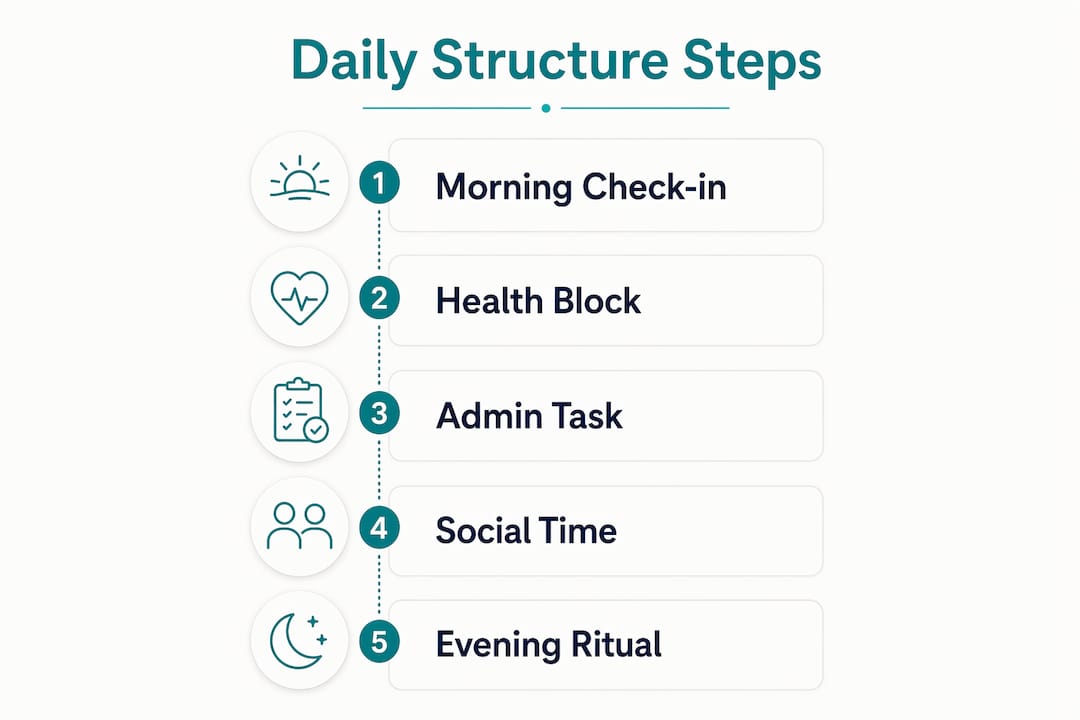
A compact, repeatable daily structure for solo living looks like this: wake and check in, a short health block, one admin task, social or leisure time, then a gentle evening ritual. That sequence, done consistently, reduces decision fatigue, keeps safety habits in place, and gives your day a shape that feels steady rather than empty.
Here is your one-step start: right now, text or call one person and tell them you are starting a daily check-in habit. That single action anchors everything else.
- Wake + 5-minute check-in (5 min): open a window, take your medications, send a quick "good morning" text to your check-in person
- Health block (20–30 min): movement, breakfast, and morning light exposure to set your circadian rhythm
- Admin block (30–45 min): one bill, one phone call, one errand, or a short planning task
- Social or leisure block (60–90 min): a walk, a phone call, a hobby, or a volunteer commitment
- Evening ritual (15–20 min): tidy one surface, prep tomorrow's medications, and wind down with low light
Pro Tip: If the day goes sideways, your minimum viable action is just the check-in text. One message keeps the safety net intact and gives you a place to restart.
Agingsolo offers printable daily checklists and a 45-minute Solo Aging Clarity Session if you want a personalized version of this plan.
Table of Contents
- Two flexible sample schedules you can copy today
- How to do a weekly reset that prevents task pile-up
- How to set home zones and cues so your space does the work
- Simple rituals that create momentum without locking you in
- How to fold safety and emergency planning into your daily routine
- Practical daily habits that sustain your health and energy
- Practical tools and checklists that keep your plan running
- How to recognize when to ask for help and build a support circle
- Key Takeaways
- Why structure is really about dignity, not discipline
- Ready to make your plan personal?
- Useful sources and further reading
- FAQ
Two flexible sample schedules you can copy today
Not every day has the same energy. Here are two templates: one for a productive weekday and one for a slower recovery day.
| Block | Weekday (active) | Slow day (low energy) | Time budget |
|---|---|---|---|
| Wake + check-in | Medications, text check-in person | Medications, brief text | 5–10 min |
| Morning health | Walk or chair exercises, breakfast | Gentle stretching, light breakfast | 20–30 min |
| Admin | Bills, calls, appointments | One small task only | 15–30 min |
| Social/leisure | Outing, hobby, phone call | Reading, podcast, window time | 45–90 min |
| Rest | Optional nap or quiet time | Longer rest block | 30–60 min |
| Evening ritual | Light tidy, med prep, wind-down | Same, shortened | 15 min |
Scaling tips:
- Low mobility day: swap the walk for seated stretching or a 10-minute balance drill near a sturdy chair
- Appointment day: move the admin block to the morning slot and shrink leisure to 30 minutes
- High-energy day: extend the social block and add a second short walk after lunch
- Front-load your most important task in the morning when momentum is easiest to build
How to do a weekly reset that prevents task pile-up
A weekly reset is one dedicated session where you batch the tasks that would otherwise nag at you all week. Pick a consistent day, Sunday afternoon or Monday morning both work well, and treat it as a standing appointment with yourself.
- Laundry (20 min active, 45 min unattended): start a load first so it runs while you do everything else
- Meal prep (30–45 min): cook two or three single-serving portions, freeze one, refrigerate one; keep frozen staples like pre-cut vegetables and canned beans for low-effort nights
- Medications (5 min): fill your weekly pill organizer and confirm you have enough supply for the next two weeks
- Finances (10–15 min): pay any bills due, check your bank balance, and flag anything unusual
- Calendar review (10 min): write upcoming appointments on a wall calendar or whiteboard where you will see them daily
Batching tips:
- Pair errands with a friend when possible; doing chores alongside someone improves follow-through and makes the session feel lighter
- Keep a running grocery list on your refrigerator so the shopping step takes under five minutes to plan
- A visible wall calendar near your front door acts as a passive cue, no app required
How to set home zones and cues so your space does the work
Your home can do a lot of the remembering for you. Dividing it into simple zones creates automatic transitions between activities, which means fewer decisions and less drift.
Five zones, even in a small space:
- Sleep zone: bed area only; no screens, no paperwork, no work materials here
- Food/coffee zone: kitchen counter or table; keep medications and vitamins here so they are impossible to miss
- Admin zone: one chair, one surface, one folder; bills and paperwork live here and nowhere else
- Movement zone: a clear 6-foot path or a single mat near a wall for balance exercises
- Relaxation zone: your favorite chair, good lighting, and whatever you reach for to unwind
Sensory cues make transitions feel natural. Adjustable lighting and background sound have an outsized effect on mood and cognitive function. Try a warm lamp for the evening wind-down, a podcast or playlist tied to your walk, and a scented candle or diffuser to signal the shift from admin to leisure.
Accessibility notes: keep pathways at least 36 inches wide, store frequently used items between hip and shoulder height, and add contrasting tape or paint to step edges.
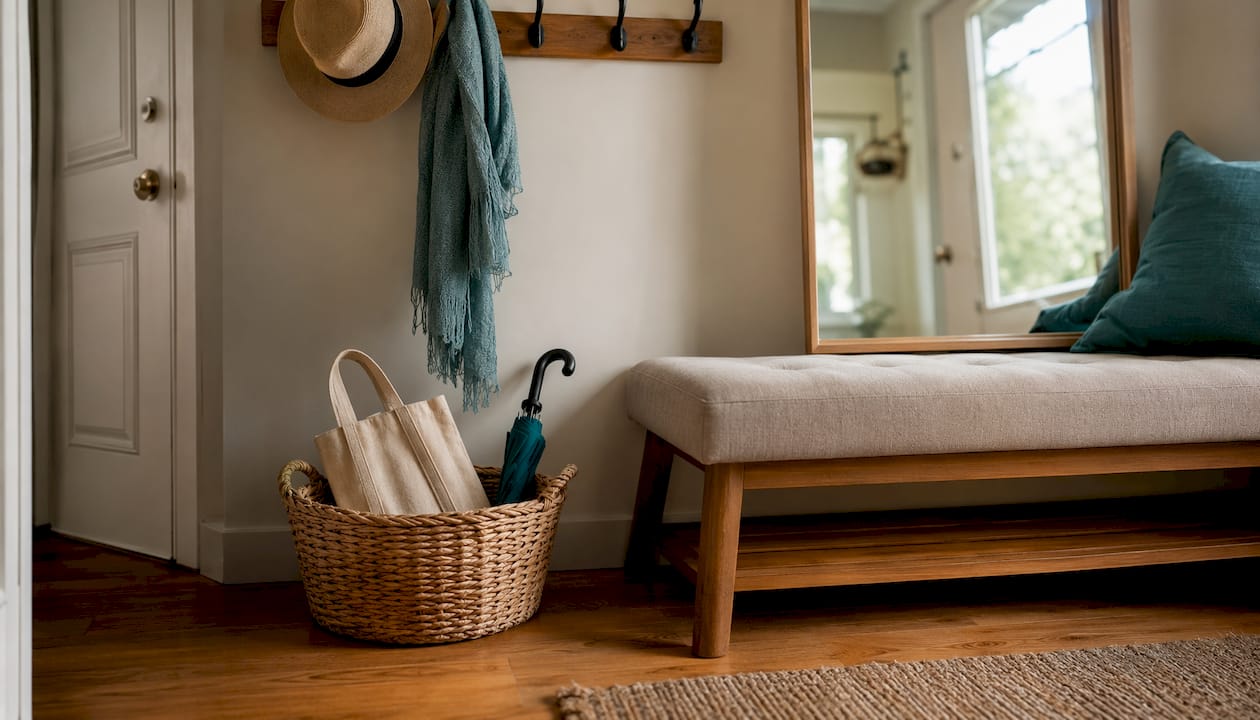
Pro Tip: A single lamp on a timer can serve as both a wake cue and an evening wind-down signal. Set it to turn on at your target wake time and dim at your target wind-down time. Zero willpower required.
Simple rituals that create momentum without locking you in
Rigid hour-by-hour schedules tend to collapse the first time a doctor's appointment or a bad night's sleep disrupts them. Anchor habits and rhythm blocks are more resilient: you attach a behavior to a cue rather than a clock.
Morning rituals (cue: first light or alarm):
- Open a blind or step outside for five minutes of natural light
- Make your coffee or tea the same way, every day; the repetition itself is calming
- Send your check-in text before you sit down
Midday rituals (cue: hunger or a gentle phone alarm):
- Plate your lunch rather than eating from a container; intentional plating signals a real meal and a real break
- Step outside briefly, even just to the porch or a window
Evening rituals (cue: sunset or a lamp timer):
- Tidy one surface, not the whole house
- Set out tomorrow's medications and lay out clothes if that helps
- Lower the lights and switch to a quieter sound environment
Pro Tip: On hard days, your only job is the morning check-in text. That one action keeps the rhythm alive and gives you a thread to pull when you are ready to do more.
How to fold safety and emergency planning into your daily routine
Safety works best when it is woven into habits you already have, not treated as a separate project.
Daily checks:
- Phone charged to at least 50% before bed
- Medications taken and logged (a simple checkmark on a paper chart works)
- Doors locked; stove off before sleep
Weekly checks:
- Confirm your check-in person heard from you every day that week
- Test your medical alert device or personal emergency response button if you have one
- Review the week's medication log for any missed doses
Monthly checks:
- Test smoke and carbon monoxide detectors
- Review your emergency contact list and update any changed numbers
- Check expiration dates on any emergency medications
Your contact plan: Write three names on a card and tape it inside a kitchen cabinet. Name 1: your daily check-in person. Name 2: a backup who knows your routine. Name 3: a local service (your doctor's after-hours line, a neighbor, or a local non-emergency number). If you miss a check-in, Name 2 calls Name 3. Simple, no app required.
For deeper guidance on emergency planning for solo agers, Agingsolo has a dedicated resource that walks through every layer of a safety plan.
Practical daily habits that sustain your health and energy
Keeping nutrition, movement, and medications on track does not require a complicated system.
Meals for one:
- Batch-cook one protein and one grain on reset day; mix and match through the week
- Keep single-serving freezer meals for low-energy days; frozen vegetables, canned fish, and eggs are fast, affordable, and nutritious
- Single-portion batch cooking reduces daily cooking decisions without sacrificing variety
Movement (10–20 minutes is enough):
- Chair squats, wall push-ups, and heel raises require no equipment and reduce fall risk
- A 10-minute walk after lunch supports both digestion and mood
- Balance drills near a sturdy chair, one-leg stands for 10 seconds each side, take under three minutes
Sleep and energy:
- Five minutes of morning sunlight helps set your circadian clock and supports better sleep at night
- A consistent sleep environment, cool, dark, and quiet, makes falling asleep easier without medication
- Protect your medication times by setting a phone alarm labeled with the medication name
For evidence-based movement ideas tailored to older adults, Agingsolo's guide on healthy routines for seniors is a practical next read.
Practical tools and checklists that keep your plan running
| Tool type | Best for | Pros | Cons |
|---|---|---|---|
| Printable daily checklist | Visual, paper-based learners | Free, no tech needed, always visible | Must reprint or rewrite weekly |
| Wall calendar | Appointments and weekly reset | Passive cue, no battery | Limited detail space |
| Pill organizer | Medication tracking | Instant visual confirmation | Requires weekly refill |
| Basic reminder app (Clock, Google Calendar) | Timed alerts | Free, customizable | Requires a smartphone |
5-minute setup for each:
- Printable checklist: download from Agingsolo's toolkit, print two copies, tape one to the refrigerator and keep one at your admin zone
- Wall calendar: hang it at eye level near your front door; write every appointment in the moment you make it
- Pill organizer: fill it on reset day; place it next to your coffee maker so it is impossible to skip
- Reminder app: set three daily alarms (wake, medications, evening wind-down) and label each one clearly
How to recognize when to ask for help and build a support circle
Asking for help is a planning skill, not a sign of decline. The earlier you build your circle, the more options you have.
Red flags that mean it is time to ask:
- Missed check-ins two or more days in a row
- Bills unpaid or repeated confusion about finances
- Noticeable drop in mobility, balance, or strength
- Medications missed more than occasionally
- Meals skipped regularly or significant unintended weight loss
Simple ways to recruit help:
- Ask a neighbor: "I'm setting up a check-in habit. Would you be willing to wave or text if you haven't seen me by noon?"
- Ask a friend: "I'm doing a weekly reset on Sundays. Want to do errands together once a month?"
- Hire for high-risk tasks only: yard work, heavy lifting, and driving in bad weather are worth paying for before a fall happens
A layered support plan:
- Peer buddy: daily or every-other-day check-in, free
- Neighbor network: passive safety net, free
- Paid help: one or two tasks per week where the risk is highest
- Professional backup: your doctor, a care manager, or a local Area Agency on Aging for guidance
Agingsolo's resource on building your support circle walks through each layer in more detail, including how to have the conversation without it feeling awkward.
Key Takeaways
A steady daily structure for solo living comes down to five habits: a morning check-in, a health block, one admin task, social time, and an evening ritual repeated every day.
| Point | Details |
|---|---|
| Start with the check-in | Text one person every morning; this single habit anchors your safety net and your daily rhythm. |
| Pick a weekly reset day | Batch laundry, meal prep, medications, and finances in one 90-minute session to cut daily decision load. |
| Zone your home | Assign five simple zones and use lighting or scent as cues; your environment will do the remembering for you. |
| Use rituals, not rigid schedules | Anchor habits to cues rather than clocks so your routine survives disruptions and low-energy days. |
| Agingsolo resources | Download free printable checklists from Agingsolo's toolkit or book a 45-minute clarity session for a personalized plan. |
Why structure is really about dignity, not discipline
Most advice about routines for people living alone focuses on productivity. That misses the point entirely. When you are aging solo, structure is not about getting more done. It is about staying in charge of your own life.
The quiet that comes with living alone can feel heavy on some days. A simple rhythm, even a loose one, gives that quiet a shape. It tells you where you are in the day. It keeps small safety habits in place without requiring willpower. And it creates the kind of steady, dignified independence that lets you stay in your own home, on your own terms, for as long as possible.
The plan in this article is not meant to fill every hour. It is meant to give you just enough structure to feel grounded, safe, and free. Adapt it. Shrink it on hard days. Expand it when you have energy. The goal is a life that fits you, not a schedule that controls you.
Ready to make your plan personal?
Agingsolo's Solo Aging Clarity Session is a focused 45-minute Zoom call where you work through your specific situation: your daily structure, your safety plan, your support circle, and your next steps. No generic advice. Just a clear, practical plan built around your life.

The free checklist pack at Agingsolo's Soloist's Toolkit includes a printable daily checklist, a weekly reset guide, and an emergency contact template. Download it today and have your plan on paper before the week is out. When you are ready for a personalized session, booking takes under two minutes at agingsolo.today.
Useful sources and further reading
- Agingsolo: Practical Wellness Routines for Solo Adults Over 50 — morning and evening routine examples
- Agingsolo: Health and Emergency Planning — safety checks and emergency contact planning
- Agingsolo: Build Your Support Circle — layered support plan and buddy system
- Agingsolo: Healthy Routines for Seniors — evidence-based movement and activity ideas
- Building Sustainable Healthy Routines While Living Alone — broader context on solo living and accountability
- Morning Routines That Support Mental Wellness When Living Alone — morning check-in and light exposure research
- Introvert Living Alone: The Complete Solo Life Guide — anchor habits, rhythm blocks, and sensory cues
- Divine Transitions for Seniors — practical transition and wellness topics for older adults
This article is general information, not professional medical, legal, or financial advice. Confirm any health, safety, or legal decisions with a qualified professional for your own situation.
FAQ
What is the simplest way to build daily structure when living alone?
Start with one anchor habit: a morning check-in text to a trusted person. That single action creates a safety net and a daily rhythm you can build everything else around.
How long should a daily routine take for an adult over 50 living alone?
The core blocks, check-in, health, admin, social, and evening ritual, add up to roughly 2–3 hours of intentional time. The rest of the day stays flexible.
What should a weekly reset include for solo agers?
A 90-minute weekly reset covers laundry, single-serving meal prep, medication refills, bill review, and a calendar check. Batching these tasks once a week cuts daily decision load significantly.
How do I stay safe living alone without relying on family?
Write a three-name contact card (daily check-in person, backup contact, local service) and tape it inside a kitchen cabinet. Pair that with a daily phone-charging habit and a weekly medication log review.
Where can I get printable checklists for solo aging routines?
Agingsolo offers free downloadable checklists and templates at the Soloist's Toolkit, including a daily checklist, weekly reset guide, and emergency contact template.