

TL;DR:
- A consistent daily routine significantly enhances elder safety by reducing fall risks, supporting cognition, and preventing social isolation. Building habits around movement, medication timing, sleep, and social contact provides practical protection beyond home modifications. Maintaining regular, simple anchors fosters independence and resilience for solo aging individuals.
Most people think elder safety is about grab bars and better lighting. Those things matter. But the role of daily routines in elder safety goes much deeper than any single home modification. Your daily habits shape how steady you are on your feet, how sharp your thinking stays, and whether someone notices if something goes wrong. If you are aging solo, a well-built routine is not just a comfort. It is one of the most practical safety tools you have.
Table of Contents
- Key Takeaways
- How consistent daily routines support physical safety
- Sleep, circadian rhythms, and your brain's safety role
- Social connection as a daily safety practice
- Building a safety-oriented routine that actually sticks
- Common pitfalls that undermine your routine
- My take: routine is the most underrated safety tool
- Build your safety routine with Agingsolo
- FAQ
Key Takeaways
| Point | Details |
|---|---|
| Routines reduce fall risk | Consistent movement, footwear habits, and medication timing work together to prevent falls more effectively than home fixes alone. |
| Sleep patterns protect your brain | Stable circadian rhythms are linked to preserved brain volume and sharper hazard recognition, which matters every single day. |
| Social connection is a safety tool | Scheduled social contact reduces isolation and provides informal monitoring that protects against self-neglect and elder abuse. |
| Anchored routines have the highest payoff | Fixing your wake time, hydration, medication, and movement to set times gives you the most safety benefit per effort. |
| Gradual building beats perfection | Starting with two or three anchors and adding slowly is more sustainable than overhauling your entire day at once. |
How consistent daily routines support physical safety
Let's start with the most urgent number. Over 41,000 adults 65+ died from falls in 2023, and about one in four older adults falls each year. That is not a rare event. It is a leading cause of injury and death in this age group.
Here is what most people miss: the majority of fall risk factors are behavioral, not structural. Yes, a loose rug is dangerous. But so is taking a sedating medication at the wrong time, skipping morning movement, or shuffling to the bathroom in socks.
Exercise routines that actually move the needle
Exercise programs targeting balance and strength reduce falls by 23 to 40 percent. Tai Chi is one of the best-studied options because it trains slow, controlled weight shifting, exactly the skill you need when you misjudge a step. The Otago Exercise Programme is another evidence-backed option you can do at home, designed specifically for older adults living alone. Even 20 minutes of intentional balance and leg-strengthening work three times a week makes a real difference over months.
The key word is scheduled. A workout you plan to do "when you feel like it" rarely happens. One anchored to 9 a.m. on Monday, Wednesday, and Friday does.
Medication timing as a safety routine
Medications like sedatives and blood pressure drugs cause dizziness, sedation, and coordination problems that dramatically increase fall risk in older adults. The danger is not just which medications you take, but when. Taking a sedating medication right before you need to be up and moving is a real hazard.
Pro Tip: Schedule a medication review with your prescriber at least once a year, and ask specifically about fall risk. Bring a full list of everything you take, including over-the-counter drugs and supplements.
Environment checks as a weekly habit
Embedding hazard-removal tasks into a routine schedule is far more sustainable than doing a one-time home sweep. A quick Monday morning walk-through to check lighting, test handrails, and scan for loose rugs takes five minutes and catches things that shift over time. A burned-out bulb above the stairs is only dangerous if you never notice it.
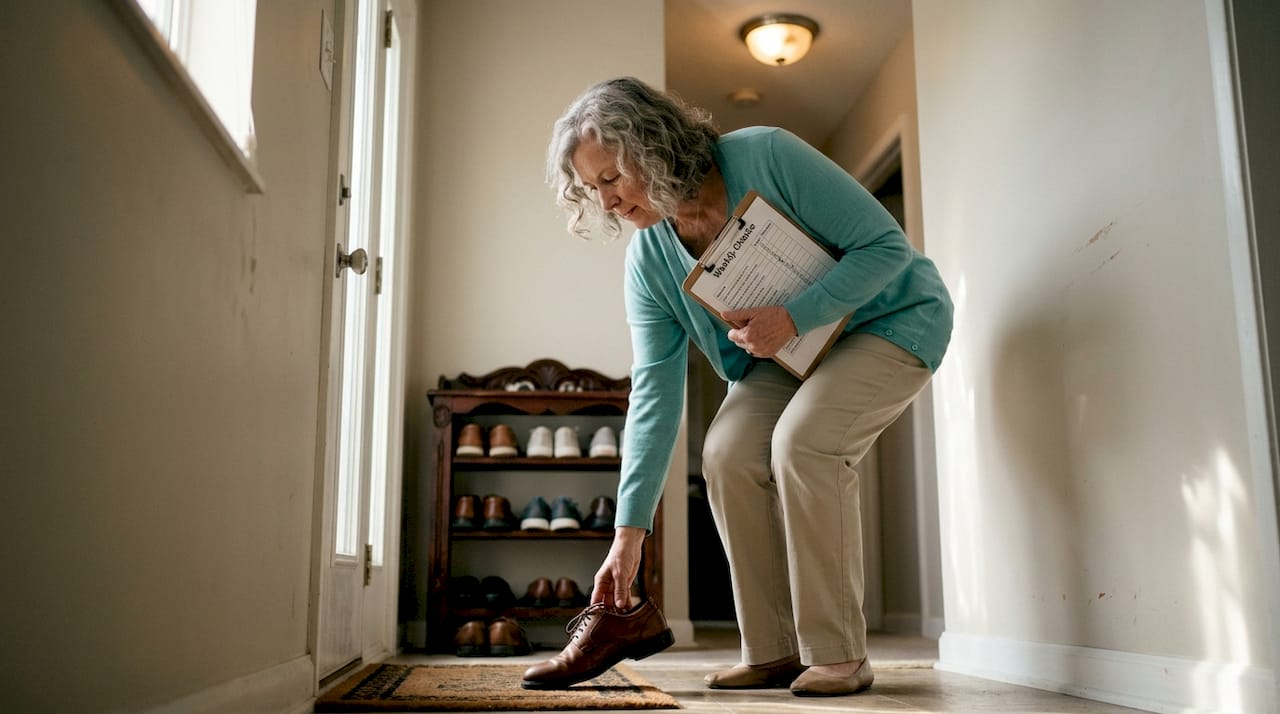
One more detail worth knowing: older adults wearing socks or barefoot at home when they fall are twice as likely to be seriously injured. Wearing supportive footwear inside your home, every day, is a safety practice. Not a preference.
Sleep, circadian rhythms, and your brain's safety role
This is the part most elder safety conversations skip entirely.
A 2026 JAMA Network Open study found that higher amplitude and more regular rest-activity rhythms are associated with lower epigenetic age acceleration. In plain language: people whose daily activity follows a consistent, predictable pattern show biological aging markers that are younger than their chronological age. Your routine is not just keeping you safe today. It may be slowing how fast you age at a cellular level.
Separately, Johns Hopkins research found that weaker, more fragmented circadian rhythms are linked to smaller brain volumes in regions tied to memory and emotional regulation, including the amygdala. That matters for safety because the amygdala helps you recognize and respond to threat. Cognitive sharpness is not just a quality-of-life issue. It is a hazard-recognition tool.
"Routine consistency supports cognition, which is critical for hazard recognition and safer independent living, making routine a safety engineering tool, not just wellness." — Johns Hopkins research insight
Here is what this means practically for you:
| Rhythm factor | What it affects | Safety consequence |
|---|---|---|
| Consistent wake time | Cortisol regulation and alertness | Reduces morning grogginess and coordination lapses |
| Regular daytime movement | Circadian amplitude | Supports deeper, more restorative sleep |
| Fixed sleep window | Sleep quality and brain repair | Preserves cognitive function over time |
| Reduced evening light exposure | Melatonin production | Improves sleep onset and overnight recovery |
Pro Tip: Set a fixed wake time and stick to it seven days a week, even on weekends. It is the single highest-leverage thing you can do to stabilize your circadian rhythm.
Social connection as a daily safety practice
Living alone means there is no built-in witness to your days. Nobody to notice that you seemed off at dinner, that you have not left the house in a week, or that your speech was slurred yesterday. That absence of casual observation is a real safety gap.
Social support is one of the most researched protective factors against both elder abuse and self-neglect. When people have regular, consistent contact with others, there are more eyes and ears around them. Someone notices. Someone asks. That informal monitoring function is something a grab bar simply cannot provide.
For solo agers, building social contact into your daily and weekly routine is not optional. It is part of how you stay safe. Here are some concrete ways to do that:
- Daily check-in call or text. Even a short exchange with one person each morning creates a touchpoint. If you go dark, someone notices that day. Not a week later.
- Weekly in-person activity. A class, a faith community, a walking group, a standing lunch date. Regular face-to-face contact gives others a baseline reading on how you are doing.
- Scheduled video calls. If family or close friends live far away, a standing weekly call at a specific time is more reliable than "we should catch up soon."
- Check-in network. Consider working with a support broker service or structured programs that formalize regular contact when your personal network is thin.
Learning to build your support circle before you need it is one of the smartest things you can do as a solo ager. Do not wait until a crisis to figure out who your people are.
Building a safety-oriented routine that actually sticks
The research is clear: routine anchors combining movement, medication, hydration, and social contact have the highest safety return for solo agers. A multifactorial approach that combines physical exercise, medication review, and home safety checks outperforms any single strategy.
Here is how to build that in practical steps:
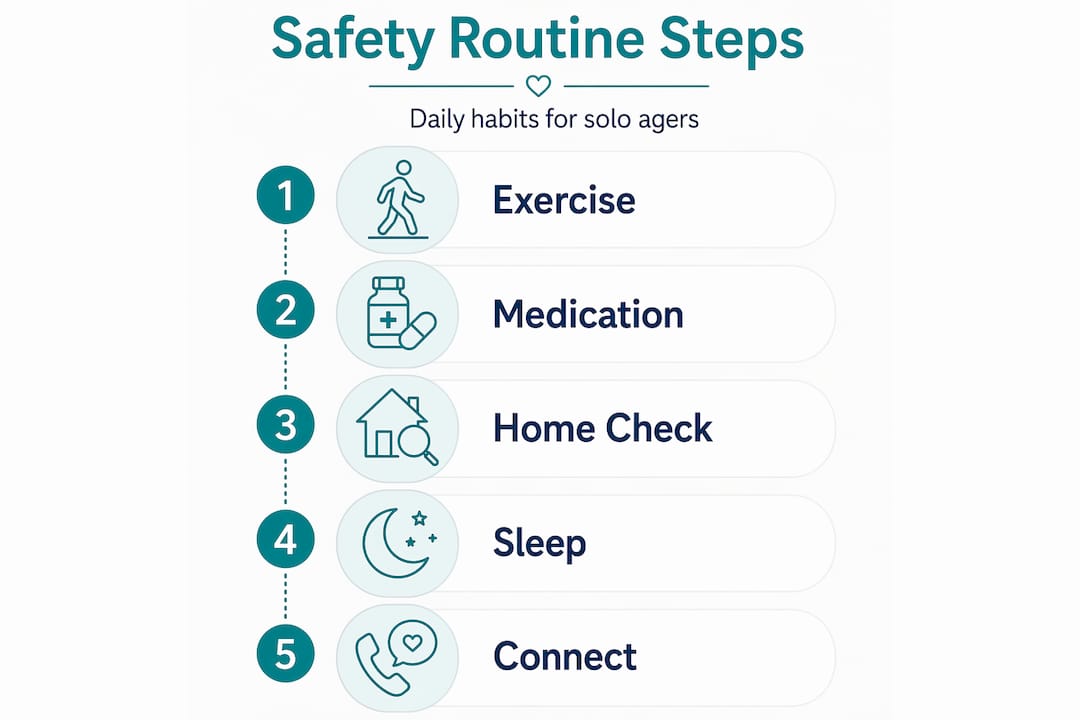
- Fix your wake time. Everything else anchors off this. Pick a consistent time and hold it.
- Morning medication with water. Take medications at the same time every day, paired with a full glass of water to support hydration and alertness.
- Movement before 10 a.m. Even a 15-minute walk or a balance exercise sequence signals your body that the day has started.
- A midday check-in. Text or call one person. This is both social connection and a daily touchpoint.
- An evening home scan. Before you settle in for the night, take two minutes to check that lights are on, pathways are clear, and your phone is charged.
- A consistent sleep window. Aim for the same bedtime and rise time, and wind down with lower light and less screen activity in the hour before sleep.
A sample weekly framework might look like this: balance exercises on Monday, Wednesday, and Friday mornings; a standing social engagement on Tuesday or Thursday; a brief home environment check every Monday; and a monthly medication review reminder on the first of each month.
Pro Tip: Use your phone's alarm or calendar to set recurring reminders for each anchor. You do not need a complicated app. A simple daily alarm labeled "morning meds and water" is enough to keep the habit running without relying on memory.
Common pitfalls that undermine your routine
Even with the best intentions, a few patterns tend to derail elder safety practices for solo agers.
- Focusing only on home modifications. A bathroom grab bar is worth installing. But if you are skipping medication reviews and have no social check-in system, you have addressed one layer of risk while leaving others wide open.
- Ignoring polypharmacy risk. Solo agers often neglect medication review even when they are otherwise doing everything right. Exercise without medication management still leaves a significant fall risk gap.
- Treating social connection as optional. It is not a bonus. It is a safety control, especially when you live alone.
- Trying to overhaul everything at once. A complicated routine you cannot sustain is worse than a simple one you can. Start with two anchors. Add a third when the first two feel automatic.
- Relying on memory alone. Memory gets less reliable with age, especially under stress or illness. Build external reminders into the system from day one.
Pro Tip: Pick the single routine change most likely to reduce your biggest current risk. Live with it for three weeks before adding the next one. Slow and steady builds something real.
My take: routine is the most underrated safety tool
I have talked with a lot of solo agers over the years, and the pattern I keep seeing is this: people invest in the physical stuff, the grab bars, the shower seat, the motion sensor light, and then feel like they have handled safety. They have handled part of it. But the cognitive and social dimensions rarely get the same attention, and those gaps are where real vulnerability builds up quietly.
What I find genuinely compelling about the newer research is that behavioral circadian rhythms are now understood as measurable markers of biological aging. Your daily pattern is not just about how you feel tomorrow. It is writing something into your biology over time.
In my experience, the solo agers who do best are not the ones with the most elaborate safety setups. They are the ones who have built a steady, repeatable daily structure and stuck with it. Not rigidly. Not perfectly. Just consistently enough that their bodies, their brains, and the people around them all know what to expect. That predictability is protective in ways that a grab bar simply is not.
Viewing your routine as an act of independence, something you are building for yourself, changes how you relate to it. It stops feeling like a chore and starts feeling like the real thing. Because it is.
— Mike
Build your safety routine with Agingsolo
If reading this has you thinking about where to start, Agingsolo has the tools to help you move from awareness to a real plan. Whether you are just beginning to think about solo aging safety planning or looking to fill specific gaps in your current routine, the resources at Agingsolo are designed for exactly where you are.

You can explore the aging in place guide for a grounded look at what safe independent living actually requires, or check out the health and emergency planning section to start building the kind of routine that covers all your bases. If social connection is the area you want to strengthen, the 30-day connection plan is a practical place to begin. You do not have to figure this out alone. That is exactly what Agingsolo is here for.
FAQ
What is the role of daily routines in elder safety?
Daily routines protect older adults by structuring movement, medication timing, social contact, and home checks into consistent habits that reduce falls, cognitive lapses, and isolation risk. For solo agers, a stable routine also provides an informal monitoring system through regular contact with others.
How do routines help prevent falls in older adults?
Scheduled exercise targeting balance and strength reduces fall risk by 23 to 40 percent, and pairing that with consistent medication timing and daily footwear habits addresses the most common fall triggers simultaneously.
Why does sleep consistency matter for elder safety?
Stable sleep-wake patterns are linked to preserved brain volume in regions that support hazard recognition and emotional regulation, meaning that protecting your sleep rhythm is a direct form of cognitive safety.
How often should a solo ager review their medications?
At minimum, a full medication review with your prescriber once a year is recommended, with special attention to drugs that cause dizziness or sedation, which are among the leading medication-related fall risks in older adults.
How can social routines protect solo agers from harm?
Regular, scheduled social contact creates a network of informal observers who can notice changes in your health or behavior early. Routine social interaction is one of the most effective protective factors against elder abuse and self-neglect for adults living alone.