

TL;DR:
- Starting with trusted directories simplifies finding a vetted geriatric care manager for solo agers.
- Effective communication and a written care plan are essential for ensuring reliable support when family is unavailable.
Start with the Aging Life Care Association (ALCA) directory and your local Area Agency on Aging. These two sources produce the fastest, most trustworthy referrals when you have no family nearby to help you search. Both vet their members and connect you to professionals with real local knowledge.
The industry term for what you're looking for is a geriatric care manager, sometimes called an Aging Life Care Professional. These are typically licensed nurses or social workers who assess your needs, write a care plan, coordinate providers, and serve as your local advocate when you can't rely on family to fill that role.
Your three fastest starting points:
- ALCA directory — Search by ZIP code, filter by membership level, and reach professionals who follow a formal Code of Ethics and Standards of Practice. This is the most vetted national directory available.
- Eldercare Locator — A free federal service that connects you to your local Area Agency on Aging (AAA). Call 1-800-677-1116 or enter your ZIP online. Free referrals, often same-day.
- Hospital case manager — If you're facing a discharge or a health crisis right now, ask the hospital's social work department for a referral. They know local providers and can move quickly.
One step you can take in the next ten minutes: Go to the ALCA directory, enter your ZIP code, and request a 30-minute consultation with two or three candidates. You don't need to decide anything yet. You just need names.
Table of Contents
- Where can you find a vetted care manager as a solo ager?
- How do you choose and hire a care manager when no one can attend interviews for you?
- What do care managers actually do, and what will it cost you?
- How should solo agers use a care manager day to day?
- Your 30/60/90-day plan for hiring and evaluating a care manager
- Key Takeaways
- Why a written plan and steady communication change everything
- Agingsolo can help you build your care plan before you hire
- Useful sources to start your search right now
- FAQ
Where can you find a vetted care manager as a solo ager?
Not all sources are equal, and the right one depends on your situation. Here's how the main channels compare.
| Source | Vetting & credentials | Typical services | Coverage | Pricing model | Best for |
|---|---|---|---|---|---|
| ALCA directory | ALCA membership, Code of Ethics, RN/MSW/LCSW credentials | Full assessment, care plan, coordination, monitoring | National; in-person local + some remote | Hourly or retainer; private pay | Complex medical needs, ongoing coordination |
| Eldercare Locator / local AAA | State-licensed programs; varies by agency | Referrals, case management, community services | Local/regional | Often free or sliding scale | Limited budget, first referral, community programs |
| Hospital case managers | Hospital-employed social workers | Discharge planning, short-term coordination | Local | Usually covered during hospitalization | Urgent discharge situations |
| Private geriatric care management firms | Firm-level vetting; may hold ALCA membership | Comprehensive, ongoing care management | Local or regional | Hourly or package; private pay | Ongoing, high-touch coordination |
| Online marketplaces | Varies widely; background checks not always standard | Task-based or companion care | National | Hourly; private pay | Light daily living support, not medical coordination |
Scenario-based recommendations:
- Urgent hospital discharge: Start with the hospital case manager today, then use ALCA to find ongoing support before you leave the building.
- Planning ahead: ALCA directory first. Take your time, interview three candidates, and verify credentials.
- Limited budget: Call the Eldercare Locator. Local AAA programs often offer free or low-cost case management and can point you to sliding-scale options.
- Complex medical needs: Prioritize ALCA-member professionals with an RN or MSW background and confirmed local hospital relationships.
AARP's caregiving resources also describe how care managers help identify needs and find community services. Their guidance specifically cautions you to verify credentials before hiring.
How do you choose and hire a care manager when no one can attend interviews for you?
The good news: you can do this entirely by phone or video. Many solo agers find their best care manager through a 30-minute video consultation without anyone else in the room.
Core hiring criteria
Before you schedule a single call, decide what matters most. The non-negotiables are:
- Professional credentials — RN, MSW, LCSW, or a certified Aging Life Care Professional designation
- Local knowledge — they should be able to name specific hospitals, home health agencies, and community programs in your area
Your 12-question interview checklist
Use these during a 30-minute phone or video consultation:
- What are your professional credentials, and are you an ALCA member?
- How long have you worked in this specific geographic area?
- Which hospitals and home health agencies do you work with regularly?
- How will you communicate updates to me, and how often?
- What does your initial assessment include, and how long does it take?
- Do you provide a written care plan? What does it cover?
- What is your fee structure — hourly, retainer, or package?
- Are you available for emergencies outside business hours? How do I reach you?
- Do you carry professional liability insurance?
- Can you provide two recent client references?
- What happens if I need to end the agreement — what is your termination policy?
- Have you worked with solo agers before? How do you handle decisions when there's no family proxy?
Red flags to watch for
- Reluctance to provide a written fee agreement or scope of services
- Vague answers about emergency availability ("I'll do my best" is not a plan)
- No professional liability insurance
- Unable to name specific local providers or hospitals
- Pressure to sign a long-term contract before completing an assessment
- No references, or references who can't be contacted directly
Pro Tip: Ask the candidate to name two local hospitals and one home health agency they've worked with in the past six months, then call one of those organizations to confirm the relationship. A care manager with genuine local ties will welcome this question. One who deflects probably doesn't have the connections they're implying.
A step-by-step long-distance workflow recommends starting with ALCA, asking your primary care physician for referrals, contacting your local AAA, and then verifying local knowledge and credentials before committing.
What do care managers actually do, and what will it cost you?
Geriatric care managers are often licensed nurses or social workers who bring both clinical knowledge and community connections to their work. Think of them as the "quarterback" of your care team, coordinating medical care, daily living support, and long-term planning so nothing falls through the cracks.
Core services
- Comprehensive needs assessment (home visit, medical history review, functional evaluation)
- Written care plan with specific recommendations
- Provider coordination (doctors, therapists, home health aides)
- Regular home visits and safety monitoring
- Medication reconciliation and management oversight
- Discharge planning from hospital or rehab
- Crisis response and emergency coordination
- Advocacy with medical providers and insurers
- Long-term planning support, including housing decisions
How should solo agers use a care manager day to day?
A care manager's greatest value for someone aging alone is serving as your local eyes and ears. Regular home visits catch problems you can't see from a distance — or that you might minimize when you're the one living with them.
AARP describes care managers as trusted liaisons who reduce stress by managing fragmented healthcare and serving as a consistent point of contact. For solo agers, that consistency is the whole point.
A practical checklist for ongoing use
- Schedule regular home visits (monthly at minimum; more often after a health event)
- Ask for medication reconciliation at every visit
- Request a written summary after each visit, even a brief one
- Establish a clear emergency protocol: who does the care manager call first, and what authority do they have to act?
- Share your health and emergency planning documents with your care manager so they can act quickly in a crisis
- Review the written care plan every 90 days and update it after any significant health change
Sample communication template
Ask your care manager to provide:
- Monthly: — A written summary covering health status, any provider contacts made, upcoming appointments, and any concerns
This structure gives you verifiable information and a paper trail, which matters when you're making decisions without family input.
Pro Tip: Delegate limited authority in writing. A signed letter authorizing your care manager to speak with your medical providers and receive health updates removes friction in a crisis. Pair this with a life care plan that documents your preferences so your care manager can advocate accurately on your behalf.
Caregiver burnout is a real risk even for professionals. Understanding how to prevent caregiver burnout helps you recognize when your care manager may need support or when the scope of work needs adjustment.
Your 30/60/90-day plan for hiring and evaluating a care manager
Moving from "I need help" to "I have a care manager I trust" takes about three months if you're steady and intentional about it.
Days 1–30: Search, interview, and hire
- Search the ALCA directory by ZIP code and identify three candidates.
- Contact your local AAA via the Eldercare Locator for additional referrals.
- Ask your primary care physician for a recommendation.
- Schedule 30-minute consultations with at least two candidates.
- Use the 12-question checklist from the section above.
- Call at least one reference for your top candidate.
- Review the written fee agreement and scope of services before signing.
- Confirm emergency availability and contact protocol in writing.
Days 31–60: Onboard and assess
- Complete the initial assessment; receive the written care plan.
- Confirm the communication cadence (weekly brief, monthly report).
- Introduce your care manager to your primary care physician.
- Share your emergency contacts, medical history summary, and any legal documents (healthcare proxy, power of attorney).
- Schedule the first home visit.
- Note any gaps between what was promised and what was delivered.
Days 61–90: Evaluate and decide
- Review the written care plan against actual outcomes.
- Assess communication quality: Were updates timely, clear, and useful?
- Ask yourself: Do I feel more secure and informed than I did 90 days ago?
- Decide whether to continue at the same scope, expand services, or make a change.
Key Takeaways
Finding a care manager with no family nearby is most effective when you start with vetted directories, insist on written plans and a clear communication cadence, and budget for private-pay costs from the beginning.
| Point | Details |
|---|---|
| Start with ALCA and Eldercare Locator | These two sources offer the fastest, most vetted referrals for solo agers searching by ZIP code. |
| Insist on written plans | A written care plan and a formal communication schedule are non-negotiable when no family can monitor care in person. |
| Budget for private pay | Care management is typically out of pocket; initial assessments commonly range from $100–$750 before ongoing fees apply. |
| Verify local relationships | Ask candidates to name specific local hospitals and providers, then follow up to confirm those connections are real. |
| Use the 90-day checkpoint | Evaluate communication quality, outcomes, and responsiveness at 90 days and decide whether to continue, adjust, or change providers. |
| Agingsolo clarity session | A 45-minute Agingsolo clarity session helps you build a shortlist, set expectations, and create a hiring plan tailored to your situation. |
Why a written plan and steady communication change everything
Most people searching for a care manager focus on credentials and cost. Both matter. But the single factor that most often determines whether a care manager actually works for a solo ager is communication structure.
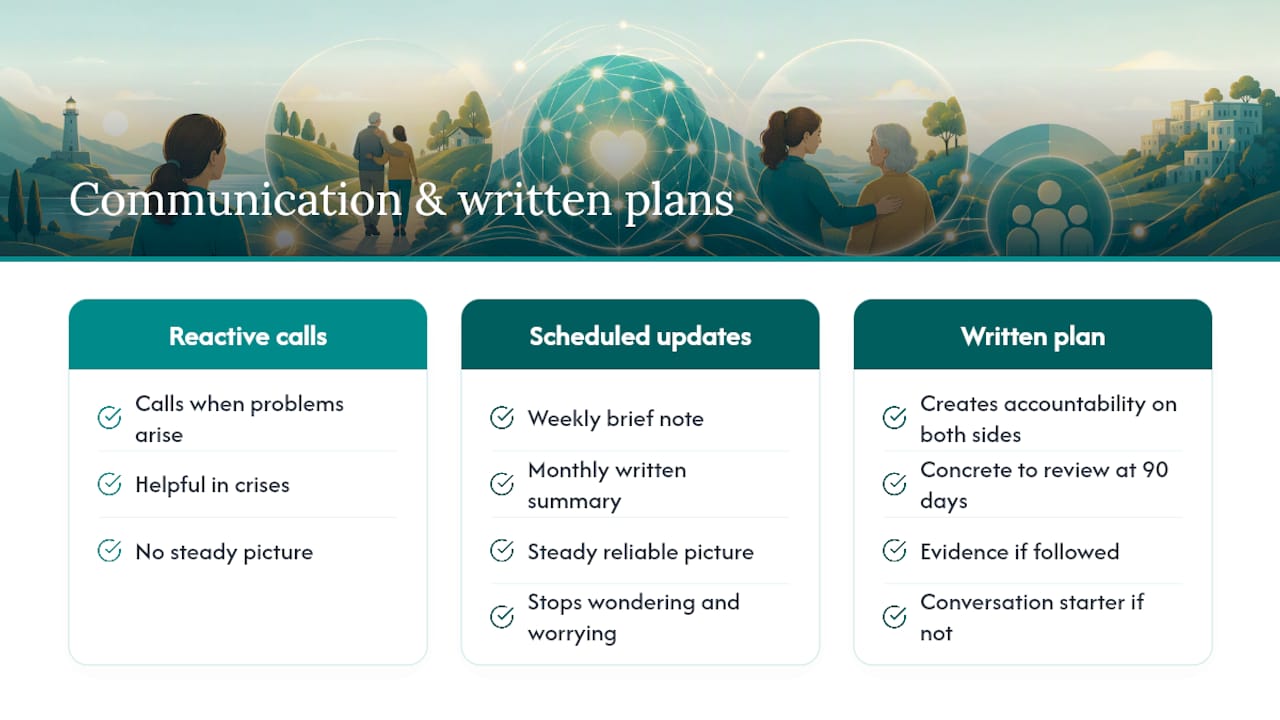
When no family is nearby, you are the decision-maker, the monitor, and the advocate all at once. A care manager who calls when something goes wrong is helpful. One who sends a brief weekly note and a monthly written summary gives you something more valuable: a steady, reliable picture of your own situation. You stop wondering. You stop worrying about what you might be missing. That peace of mind is not a soft benefit. It's the whole point.
Written care plans matter for the same reason. Verbal agreements fade. A written plan creates accountability on both sides and gives you something concrete to review at 90 days. If the plan was followed, you have evidence. If it wasn't, you have a conversation starter.
Choosing a care manager is one of the most practical steps a solo ager can take toward real independence. It's not a sign that you can't manage. It's a sign that you're thinking clearly about what sustainable support actually looks like.
Agingsolo can help you build your care plan before you hire

Hiring a care manager is a significant decision, and going into those first consultations with a clear picture of your own needs puts you in a much stronger position. Agingsolo offers free downloadable checklists, a practical Life Care Plans guide, and a full resource hub at the Compassionate Clearinghouse designed specifically for solo agers.
The paid 45-minute Solo Aging Clarity Session goes further. In a single Zoom call, you'll work through your current situation, identify your most pressing support gaps, and leave with a prioritized action list and recommended next steps. It's the kind of focused, personalized planning that makes your first care manager interview far more productive.
Ready to get clear before you commit? Visit Agingsolo's solo aging resources to explore free tools or book your clarity session.
Useful sources to start your search right now
- Aging Life Care Association Home
- Eldercare Locator
- How Geriatric Care Managers Can Help Family Caregivers
- How to Find a Geriatric Care Manager Long-Distance - ParentCareFromAfar
- Services for Older Adults Living at Home | National Institute on Aging
- Care Coordination & Other Services | Department for Aging ...
- Care Management Services / Professional care management resource
- ALCA Find Expert - Distance
FAQ
How much does a care manager cost?
Care management is typically private pay. Initial assessments often require an upfront fee, with ongoing services billed hourly or through a monthly retainer. Medicare does not routinely cover geriatric care management.
How do you find a reputable care manager?
Start with the ALCA directory, which lists professionals who follow a formal Code of Ethics. Cross-reference with your local Area Agency on Aging via the Eldercare Locator and ask your primary care physician for a referral.
How do I find an independent caregiver without family help?
Use the ALCA directory and Eldercare Locator to generate a shortlist, then conduct 30-minute phone or video consultations using a written checklist. You can complete the entire search and hiring process remotely without family involvement.
How much do caregivers charge per hour?
Hourly rates for geriatric care managers vary significantly by region and the professional's credentials. Rates differ from those of home health aides or companion caregivers, so clarify the professional's role and fee structure in writing before your first meeting.