
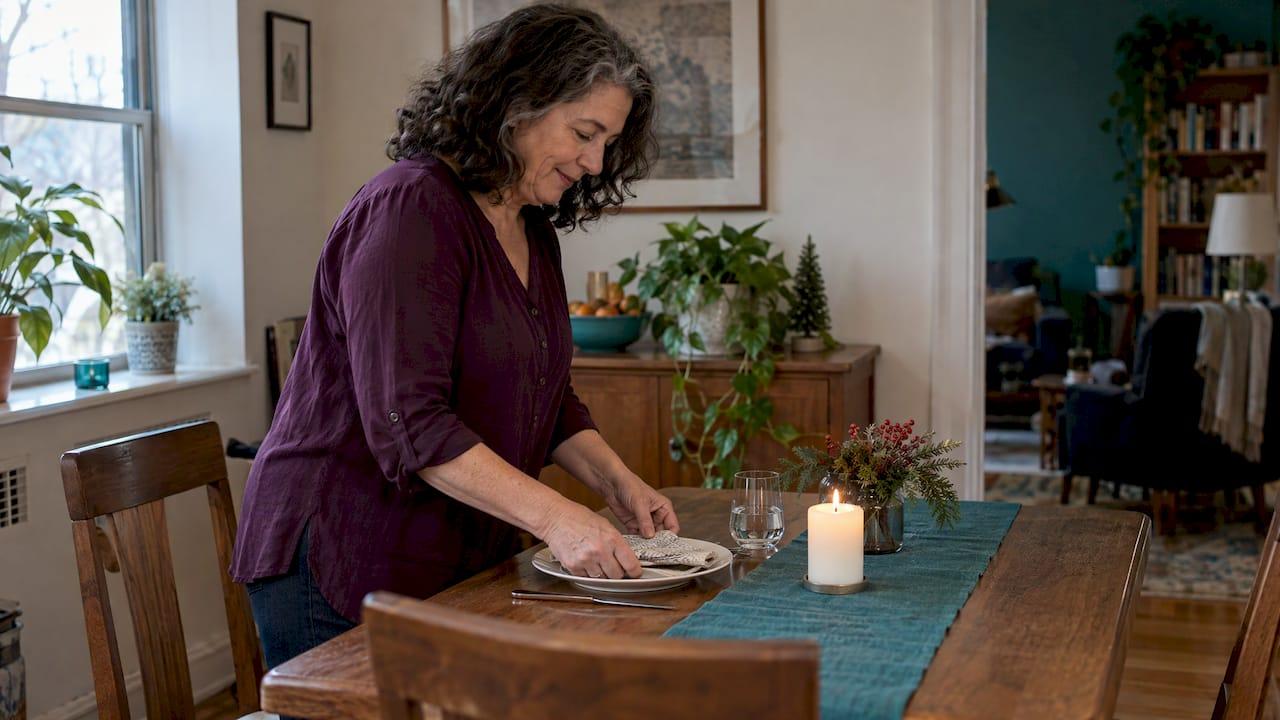
It's the first Thursday in December, and you're standing in your kitchen with a small pot of milk warming on the stove. Nobody asked you to make hot cacao. Nobody's waiting for it. You made it because the season has started and you wanted to mark it. You carry the mug to your favorite chair, put on the music you like, and notice something. The quiet doesn't feel heavy. It feels like yours.
That is what holidays on your own terms can be. You decide what stays from the old days, what goes, and what gets invented this year. Alone doesn't have to mean lonely, and a holiday spent solo can be as warm as any crowded table. Below you'll find ways to build traditions that fit you, bring people in when you want them, and travel if the season calls you somewhere.
TL;DR
- A solo holiday is a choice you get to design, not a gap to fill. Start with what actually feels good to you.
- Keep the family rituals that still fit, change the ones that don't, and let one or two brand-new ones in.
- Small, repeatable rituals (a certain drink, a candle, a phone call) give the season a shape you can look forward to.
- Connection can be on your schedule: a few calls, a small dinner, or a trip with a group and some solo days.
- Writing your own holiday script is a way to enjoy life today, and it grows richer every year.
Table of Contents
- Alone is not the same as lonely
- Start with what you loved, and keep what still fits
- Small rituals that belong only to you
- Bringing people in, on your schedule
- When the holidays call you somewhere else
- Giving the day itself a gentle shape
- Making it a life, not just a season
- Talk it through with someone who gets it
- Our perspective
- FAQ
- Sources
Alone is not the same as lonely
Let's be honest about the hard part first. The holidays can make quiet feel louder. The ads show a long table, a houseful of relatives, a picture-perfect crowd. If your life doesn't look like that, it's easy to feel you're missing something.
Sometimes you are, and that feeling deserves respect. Maybe a spouse died. Maybe the family drifted apart, or you never had children, or your friends have moved. It's fine to feel a pang. It's also fine to feel relief when you realize nobody expects you to cook for twelve.
Both can be true in the same afternoon. Many solo agers describe a season that holds a little ache and a lot of freedom at once. The trick isn't to argue yourself out of the ache. It's to give the freedom something to do.
Psychologist Annie Wright describes this as adult choice: the capacity to decide what to continue, adapt, or create in your own life, including around family traditions. In her words, you can love parts of your family's holiday history and still choose a different way to spend your time. That's a permission slip worth reading twice. You are not abandoning anything by building something new.
If the loneliness side of the season is weighing on you, our piece on common isolation challenges and how to overcome them is a gentle place to go next. For now, let's talk about what a good day can look like.
Start with what you loved, and keep what still fits
Before you invent anything, take a slow look back. Which holiday moments made you feel warm? Not the ones you were supposed to love. The ones you actually did.
Maybe it was the smell of something baking on a Sunday before the big day. Maybe it was the radio playing carols while you wrapped gifts. Maybe it was the walk after dinner, when the street went quiet and the lights came on. Annie Wright suggests reviewing your personal history to see which family rituals felt good and fulfilling, then continuing or modifying those, and brainstorming from the question of what would feel truly delightful.
That last word matters. Delightful isn't dutiful. It isn't what a magazine says a holiday should be. It's the small thing that makes you smile when you picture it.
Some traditions may need to go, and that's normal too. Writing in Psychology Today about rebuilding her holidays after her husband died, Sophia Dembling describes aiming for something between the beautiful impossibility of what was and the plausibly pleasurable. She notes that some traditions have to be let go, while others can be brought back in some new form. I find that honest and freeing. You don't have to recreate the past, and you don't have to erase it.
Here's one doable way to try this. This week, take ten quiet minutes and finish this sentence out loud: The part of the holidays I'd miss most is... Whatever you say, that's your starting point. Everything else is optional.
Small rituals that belong only to you
A tradition doesn't need an audience. It needs to mean something to you and to come around again. That's what turns an ordinary Tuesday in December into a marker you can look forward to.
One writer who lives solo, Amie Harpe, shares the rituals she keeps in a personal essay on holiday solo living. She makes a slow pot of cacao on December 1st. On Christmas she sets the table for one with candles and instrumental music. On Boxing Day she makes three unscheduled phone calls to friends. On January 6th she blows out all the season's candles at once to mark the end. Her guiding ideas are presence over performance and sensory anchors such as particular scents and candlelight.

Notice what's missing from that list: pressure. Nothing there requires a crowd, a budget, or a perfect result. Each one is small enough to actually do.
The sensory part is worth borrowing. Smell and sound carry memory faster than almost anything. A cinnamon candle that only comes out in December, a certain album, a blanket you only use in winter: these become the season's signature, and your body learns to relax when it sees them.
Food is another strong anchor. Reporting for the Cascadia Daily News on how people cultivate traditions when they're solo for the holidays, Annie Todd talks with a woman who makes her mother's snowy yogurt danishes each year. She says the pastry represents a feeling of togetherness and safety. A dish from childhood can sit at your table for one and still bring the whole family to mind.
If cooking for one feels like too much, or too little, a few holiday meal prep tips can help you plan a holiday meal that fits your pace, so more of the day is for savoring and less is for standing at the stove.
Make one of them yours this year
You don't need a full calendar of rituals. Pick one or two:
- A morning ritual. The same mug, the same song, the same window seat, on the day that matters to you.
- A table ritual. Linen napkin, a candle, the good plate. Eat the meal you'd serve a guest, because you are one.
- A closing ritual. Something that says the season is done, so the quiet after doesn't just drift in.
Then do them again next year. Repetition is where the meaning grows. Wright writes that rituals can give us something to count on and look forward to, which is exactly what a solo season can use.
Bringing people in, on your schedule
Choosing your own terms doesn't mean choosing isolation. It means you decide how much company, when, and in what form. Think of it as a dial rather than a switch.
At the low end of the dial are the quiet touches. Harpe's three unscheduled calls to friends are a good model: no big plan, just a voice on the line for a few minutes. If you find calls easy to put off, pick the day in advance and treat them like the ritual they are.
In the middle are small, casual gatherings. After her husband died, Sophia Dembling decorated a little, had people over for Christmas dinner, played the Christmas music he had collected, and bought gifts for her dogs as a new tradition. She also planned to host Thanksgiving the next year and cook a turkey for the first time. Look at how the old and new sit side by side: his music, her new guests, a turkey she'd never made. That's the whole idea in one story.
A gathering doesn't have to be a feast. Consider:
- A dessert-and-coffee evening for two or three neighbors.
- A cookie swap where everyone leaves with a tin.
- A walk to see the lights, followed by soup at your place.
- A potluck of people who also happen to be solo that day.
At the high end of the dial is a regular community. If you'd like a standing circle to share holidays with, not just a one-off invitation, it helps to know what these groups offer. Our overview of the benefits of community groups for adults 50+ and our guide to building a social circle are good places to look at how friendships form later in life.
One gentle reminder: inviting people can feel risky. Someone might say no. That's all right. A no is rarely about you, and a yes can turn into next year's tradition. Ask early, keep it low-key, and say exactly when it ends so everyone feels at ease.
When the holidays call you somewhere else
For some people, the best way to spend the season is to leave it behind for a little while. A trip can be an adventure, a change of scenery, or simply a break from the expectations at home. If that sounds like you, you're in good company.
A first solo trip doesn't have to be a big one. Writing in AFAR, Pat Tompkins suggests that older adults trying solo travel start with a small group tour and add solo days afterward, noting this works especially well for getting used to a large foreign city. The same article offers a lovely observation: making friends gets harder with age, but traveling with like-minded people makes it easy to get acquainted, and some new friends stay in touch after the trip.

That's a quiet kind of holiday magic. You go on your own and come back with a few new names in your phone.
Be honest about what your body enjoys
The most useful advice I've seen is also the simplest: choose a trip that matches the energy you really have. Solo travel writer Janice Waugh, quoted in Travel + Leisure, advises assessing your physical abilities honestly: how far you can walk, ride, or hike, and how you handle stairs and uneven surfaces. She points out that people at 40 or 50 often think they're 10 to 20 years younger than they are, and overestimating can spoil the trip. Pick the cobblestone city only if you'll enjoy the cobblestones. A sunny resort with a good book is a perfectly grand holiday.
Another Travel + Leisure piece by Patricia Doherty suggests that in a big city, you prioritize your attractions and save something for next time. That's good holiday philosophy in general. You don't have to do it all. Leaving something for next year is its own small tradition.
Doherty also recommends booking at least the first night's room so you arrive somewhere pleasant. And for the holidays especially, make restaurant reservations well ahead for popular spots, since the season fills tables quickly.
Come home a little more yourself
Trips often give back more than a rest. Rachel Craft writes in The Points Guy that solo travel builds confidence and new skills and gives you time to reflect and recharge. Many travelers come home feeling steadier and more like themselves.
When you're ready to think through the practical side of a trip, our travel checklist for solo agers covers it in one place, so you can spend your energy on the fun part.
Giving the day itself a gentle shape
The holiday itself, the actual day, is where many people brace. An empty calendar can feel enormous. A loose shape makes it softer.
Try thinking in three parts: something for the morning, something for the afternoon, something for the evening. Not a schedule, just three anchors.
- Morning: a slow start with the ritual you chose. Coffee in the good mug. Music. No news.
- Afternoon: something outside your four walls. A walk, a drive to see the lights, a visit to a friend, a call to someone you love.
- Evening: the meal and the candle. A favorite movie, a book, a long bath. Let it be cozy.
Harpe's approach includes building in recovery days around the holidays, protecting your energy rather than packing the calendar. That's smart for anyone, and especially if the season stirs up big feelings. Leave the day after as open as the day before. A holiday with room around it feels more spacious.
And if a wave of sadness arrives in the middle of it all? Let it. Put the kettle on, call a friend, step outside for ten minutes. You can feel it and still have a good day. Those two things sit together more often than we're told.
If feelings stay heavy for weeks, or you notice it's hard to get through daily life, please talk with your doctor or a licensed counselor. That's a kind thing to do for yourself, not a failure of the holiday.
Making it a life, not just a season
Here's what I've noticed. The people who enjoy the holidays most as solo agers aren't the ones who found the perfect substitute for what they used to have. They're the ones who got curious. What would I like? Who would I like to see? What would make this feel like mine?
That curiosity doesn't turn off on January 7th. The same muscle helps you plan a summer trip, start a weekly dinner with a friend, or try a class you've always wondered about. If you'd like more on living this way year-round, our guide to thriving alone after 50 and the retirement lifestyle guide are written in that spirit.
Talk it through with someone who gets it
Sometimes it helps to think out loud with another person, especially when you want your holidays, your friendships, and your next few years to line up with how you actually want to live. We offer the Solo Aging Clarity Session: a 45-minute Zoom conversation for personalized solo ager planning. It's a one-time $97 session, and you can book it here.

It was shaped by a solo ager's own experience, and it's built for adults over 50 who are living alone or aging without family and want clarity about what comes next. Bring your questions about the life you want, and we'll work through them together.
Our perspective
We started Aging Solo Today because a solo life can be a complete one. That belief shapes how we think about the holidays.
There's a lot of pity aimed at people who spend holidays on their own. We don't share it. We know solo agers who treat December as a season of their own making, with candles they love, friends they choose, and meals they actually want. We also know the quiet can be hard some years. Both are real, and neither makes you less whole.
What we've learned from our own lived experience is that the holiday you build on purpose tends to feel steadier than the one you inherit by default. You get to keep what warms you, let go of what doesn't, and invent what's missing. You can do that alone, but it often goes better with a little company and a little clarity.
That's why we pair warm, practical resources with a one-on-one conversation. Our free guides and articles help you think things through at your own pace. Our Solo Aging Clarity Session is there when you'd like to talk it through with someone who understands solo aging, so your days, your connections and your plans can all point toward the life you want.
Here's to a season that's entirely yours.
Mike Crawford
FAQ
Is it okay to spend the holidays alone?
Yes. Plenty of people choose it, and plenty find it restful and meaningful. Reporting in the Cascadia Daily News describes time alone over the holidays as a chance to make your own traditions, reflect on the year, and settle into familiar comforts. What matters is that it's your choice, with the connection you want built in.
How do I create new holiday traditions when I live alone?
Start by noticing which past rituals felt good, then keep or adapt those. Add one small new ritual tied to your senses, such as a special drink, a candle, or a playlist. Repeat it each year, because repetition is what turns a nice moment into a tradition.
How can I feel connected without a big family gathering?
Turn the dial to what feels right. A few unhurried phone calls, a small dinner with neighbors, or a standing circle of friends can each bring warmth. Inviting people early and keeping the plan simple helps. You can also read our guide to building a social circle.
Should I travel on my own for the holidays or join a group?
It depends on how challenging the destination is and how much backup you'd like. Pat Tompkins recommends starting with a small group and adding solo days afterward, especially in a large foreign city. Match the pace of the trip to what your body enjoys, and book a first night's stay so your arrival is easy.
Sources
- 10 Must-know Tips for Traveling Solo After You Retire, Travel + Leisure
- Solo Travel for Retirees: 14 Mistakes to Avoid, Travel + Leisure
- 5 Tips for Solo Travel as an Older Adult, AFAR
- 7 Mistakes to Avoid on Your First Solo Trip, The Points Guy
- Cultivating Solo Holiday Traditions, Cascadia Daily News
- Holiday Solo Living: My Own Traditions Without Family Drama, Peacefully Proven
- The Psychological Importance of Creating Rituals, Annie Wright
- Building New Traditions After Loss, Psychology Today