

Giving up the keys feels like an all-or-nothing moment. But that framing is one of the biggest misconceptions around driving cessation for solo agers. The living alone driving cessation plan explained in this guide is not about a single dramatic handover. It is about building a steady, intentional transition on your own terms. You control the timeline. You protect your independence. And you avoid the crisis conversations that nobody wants. Here is how to think about it, plan for it, and move through it with confidence.
Table of Contents
- Why starting early matters: the living alone driving cessation plan begins now
- The role of professional driving assessments in safe cessation planning
- Unique daily living challenges for solo agers during driving cessation
- Practical steps to create your living alone driving cessation plan
- Why gradual planning and documentation empower solo agers through driving cessation
- Supportive resources for your driving cessation journey and living alone independence
- Frequently asked questions
Key Takeaways
| Point | Details |
|---|---|
| Start early | Begin driving cessation planning before problems arise to maintain control and dignity. |
| Use professional assessments | Objective driving evaluations provide clear guidance on safe driving and necessary limits. |
| Implement gradual limits | Gradual driving restrictions preserve independence and safety better than abrupt stops. |
| Plan transportation alternatives | Having reliable and varied transportation options prevents isolation and unmet needs. |
| Document your plan | Written agreements and assessments reduce family conflict and empower solo agers. |
Why starting early matters: the living alone driving cessation plan begins now
Most people wait too long to talk about driving. It becomes an emergency conversation instead of a practical one, and that is where things go sideways. For solo agers, the stakes are even higher. There is no partner to pick up the slack, no adult child down the street to step in. So starting early is not just wise. It is essential.
Driving-safety discussions should begin well before problems arise, with gradual restrictions rather than an abrupt removal. That approach preserves dignity and keeps you in the driver's seat of your own planning. Literally and figuratively.
Gradual driving restrictions look different for everyone. Some common examples include:
- No nighttime driving after a certain hour
- No highway driving in heavy traffic
- No driving in bad weather such as rain, fog, or snow
- Limiting distance to a defined radius around home
These limits are not failure. They are smart, evidence-based adjustments that keep you safer while keeping you mobile.
"A written agreement outlining specific restrictions creates a record. It protects relationships, clarifies expectations, and documents your own thoughtful decision-making."
If you involve a third party, like a physician or an occupational therapist, you take family opinion out of the equation. That reduces conflict. It also gives you something that feels fair and grounded in fact. Think of this as part of your broader life care planning as a solo ager. Driving cessation is one piece of a bigger picture, and it fits best when it is planned alongside everything else.
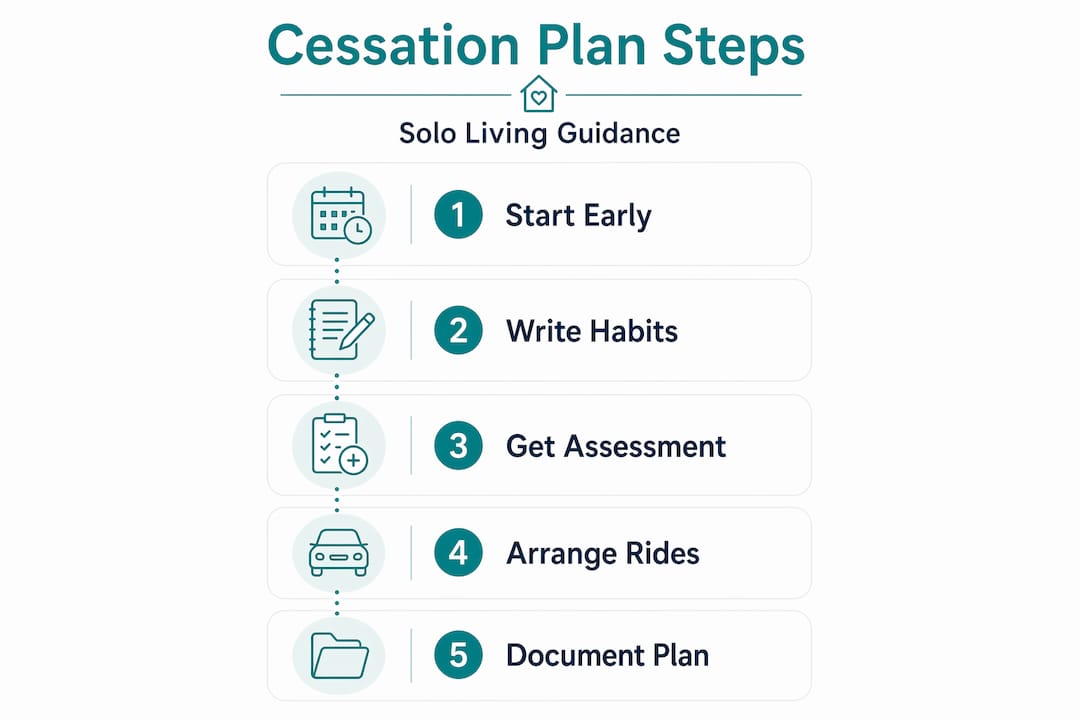
Pro Tip: Write down your current driving habits now. When do you drive? Where? What conditions feel uncomfortable? That self-audit becomes the foundation of your gradual restriction plan.
The role of professional driving assessments in safe cessation planning
Feelings are unreliable guides when it comes to driving ability. You might feel perfectly fine. Or you might be more anxious than you admit. Either way, personal feelings and family pressure are poor substitutes for an objective evaluation.

That is where occupational therapy driver assessments come in. An OT driver assessment includes both off-road clinical tests and an on-road evaluation, leading to documented recommendations that may include restrictions or license cancellation.
Here is what the process typically involves:
- Vision testing to check for changes in acuity, depth perception, and peripheral vision
- Cognitive screening to assess reaction time, attention, and decision-making
- Physical ability evaluation covering strength, coordination, and range of motion
- On-road observation with a qualified occupational therapist in the vehicle with you
The outcome is a written report. That document carries weight with your doctor, your family, and any legal process if it comes to that. It transforms a subjective family argument into a professional recommendation.
"Objective evidence supports informed decisions. Without it, you are left with opinions. With it, you have a plan."
Understanding these assessments also connects to broader solo aging basics. Solo agers benefit from building relationships with healthcare providers who can guide this process, including audiologists, since untreated hearing changes can affect driving safety more than most people realize. Hearing assessments are often overlooked in this context.
One important planning note: arrange transportation alternatives during and after the assessment period. There can be a gap between your assessment date and your next steps, and without a plan, that gap becomes a problem.
Unique daily living challenges for solo agers during driving cessation
Stopping driving affects more than getting to the grocery store. For someone living alone, the ripple effect touches nearly every part of daily life. Unmet daily living needs in older adults increase risks of injury, malnutrition, social isolation, and faster health decline. That is the reality of letting this transition happen without a plan.
The challenges cluster around a few key areas:
- Medical appointments: Missing regular checkups or specialist visits because transportation fell through
- Food and nutrition: Relying on delivery services that may not be available in rural areas, or eating poorly because shopping trips stopped
- Social connection: Losing casual community contact that came naturally from driving, like stopping at the pharmacy or attending a weekly class
- Emergency mobility: Not having a reliable way to get somewhere quickly if something goes wrong
| Daily living need | Risk without planning | Practical solution |
|---|---|---|
| Medical appointments | Delayed care, missed medications | Schedule standing rides or telehealth options |
| Grocery shopping | Poor nutrition, missed medications | Grocery delivery, meal programs, neighbor networks |
| Social activities | Isolation, depression | Community shuttles, faith community carpools |
| Emergency transport | Safety gaps | Pre-arranged contacts, medical alert systems |
Rural solo agers face an extra layer of difficulty here. Public transit may not exist. Ride-share services may be unreliable or unavailable. That means your plan needs to be more creative and built further in advance. This is where living alone safety tips become critical reading, not just comforting reading.
Pro Tip: Contact your local Area Agency on Aging. Most counties have one, and they often know about transportation programs, volunteer driver networks, and home delivery services that never get publicized widely.
Practical steps to create your living alone driving cessation plan
You now have the context. Here is how to actually build the plan. Think of it as five clear moves, done in order, at whatever pace works for you.
-
Schedule a professional driving assessment. Contact an occupational therapist with a driver rehabilitation specialty. Document the results and share them with your primary care physician. This becomes your baseline.
-
Write a gradual restriction agreement. Based on the assessment, put your current limits in writing. Date it. Keep it somewhere accessible. Update it as your situation changes. Gerontologists recommend formal written plans with gradual driving limits to preserve dignity and independence.
-
Research and compare transportation alternatives. Do not wait until you need them to find out whether they work.
| Transportation option | Best for | Limitations |
|---|---|---|
| Ride-share apps | Urban and suburban areas | Tech barrier, variable availability |
| Community transit | Medical trips | Limited schedules, advance booking needed |
| Volunteer driver programs | Rural areas | May require lead time, limited slots |
| Friends or family | Flexible trips | Inconsistent, can feel like a burden |
| Grocery/pharmacy delivery | Errands | Fees, no in-store control |
-
Modify your home for easier mobility. Grab bars, better lighting, rearranged furniture, and a medication delivery service can compensate significantly for reduced mobility. Small changes now prevent larger problems later.
-
Build and formalize your support network. Who checks in on you? Who has a key? Who is your emergency contact? For solo agers, these answers need to be deliberate. Being intentional about staying active and socially connected after driving cessation reduces isolation risk dramatically.
Pro Tip: Create a simple one-page contact list that includes your transportation options, emergency contacts, and the name of your occupational therapist. Keep it on your refrigerator. It is low-tech, but it works.
Why gradual planning and documentation empower solo agers through driving cessation
Here is the uncomfortable truth that most articles skip. The hardest part of driving cessation is not the logistics. It is the emotional weight of feeling like your independence is being taken, not given up on your own terms.
When the process happens in crisis mode, someone else is making the call. A family member, a doctor, a DMV officer. You are reactive. That feels like loss, and it often is.
But when you plan ahead? The dynamic shifts entirely. You are the one choosing terms before driving cessation, and that preserves dignity in a way nothing else can.
For solo agers especially, self-determination is not a luxury. It is a lifeline. There is no partner absorbing the emotional fallout, no built-in family to process the transition with you. This means you need your own documentation, your own agreements, and your own professional relationships to carry you through.
A gradual plan also creates something unexpected: time to build new habits before they become urgent. You learn which bus route covers your medical center. You test a volunteer driver program before you depend on it. You discover that a neighbor is happy to drive you to the pharmacy on Thursdays if you ask.
These small discoveries only happen when there is room to explore them. Crisis-driven cessation leaves no room.
The transition is also an opening. It is a chance to re-examine your living situation, your social connections, and your support structures. Solo agers who approach this thoughtfully, with resources like solo aging well-being guides behind them, often emerge from the transition more connected and more resourced than before. Not less.
Supportive resources for your driving cessation journey and living alone independence
You do not have to figure this out alone. Aging Solo has built a set of practical, focused resources designed specifically for people in your situation: living alone, planning ahead, and wanting to stay independent as long as possible.

Start with the guide on staying active and independent while aging alone. It covers mobility, social connection, and routines that hold up when big changes happen. From there, the life care plans guide will help you place your driving cessation plan inside a bigger framework for your future. And when you are ready to think through safety nets and emergency preparedness, the health and emergency planning section gives you the tools to do that clearly and calmly. These resources are built for solo agers, not general audiences. They meet you where you actually are.
Frequently asked questions
When should I start planning to stop driving if I live alone?
Start well before any driving problems appear. Written agreements early for gradual driving limits give you the most control over the process and protect your relationships.
What does a professional driving assessment involve?
It includes clinical tests of vision, cognition, and physical ability, followed by an on-road evaluation. An OT assessment produces documented recommendations that may include restrictions or cancellation of your license.
How can I maintain independence after stopping driving while living alone?
Plan alternatives before you need them. Assistive devices, home modifications, community transportation, and a strong support network are the building blocks of independence after driving cessation.
What are common warning signs that I should reduce or stop driving?
Watch for getting lost in familiar places, drifting out of your lane, accidentally using the wrong pedal, losing peripheral vision, or physical changes that limit your range of motion. Medical warning signs like these are worth discussing with your doctor immediately.
How can I avoid family conflicts when giving up driving?
Let objective evidence do the talking. Having your doctor or DMV communicate the decision based on a professional assessment removes personal blame from the conversation and keeps relationships intact.