
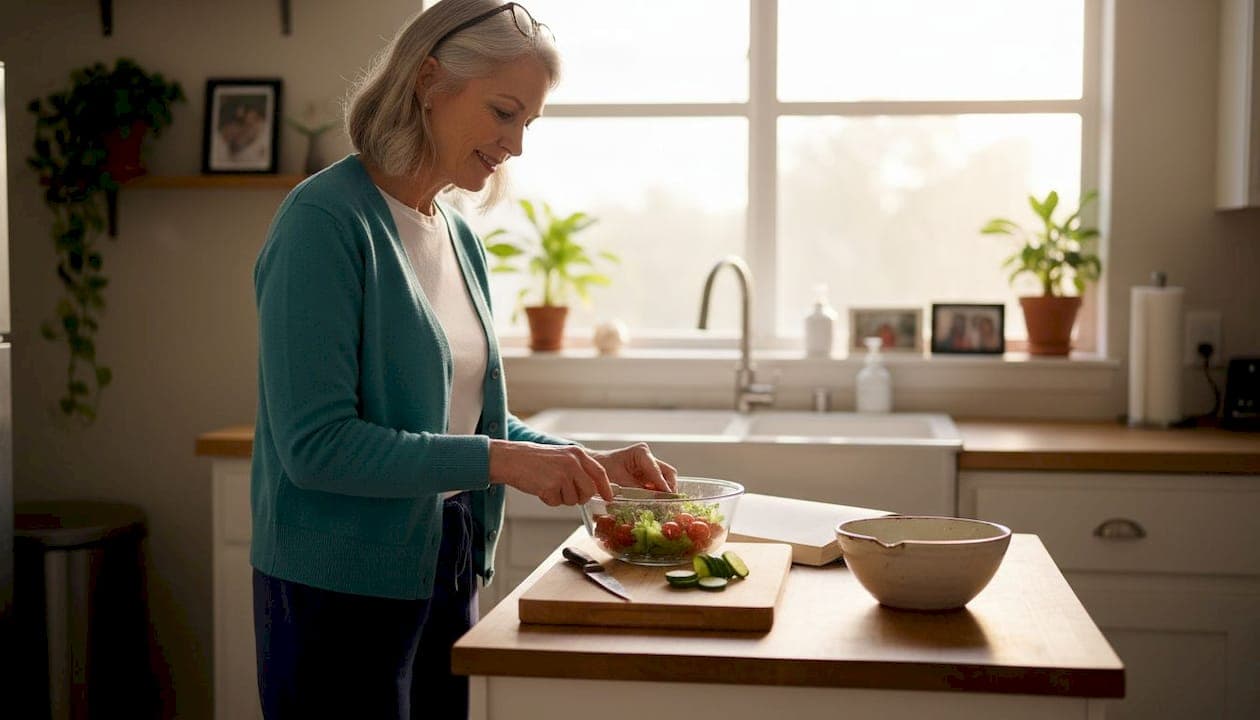
You might be managing your schedule well, staying on top of appointments, and feeling mostly fine. But here's something that catches many independent adults off guard: eating alone is frequently associated with poorer diet quality in community-dwelling older adults, and most people living solo don't realize it's happening to them. Nutrition quietly shifts when there's no one sitting across the table, and those shifts add up over time. This guide walks you through why that happens, what to watch for, and what you can actually do about it.
Table of Contents
- The unique nutrition risks of living alone
- Why is nutrition harder when you live alone?
- Key nutrition benchmarks for solo agers
- Practical solutions for better nutrition when living alone
- Aging Solo's perspective: Why nutrition for solo agers is about more than food
- Find your path to better aging and nutrition
- Frequently asked questions
Key Takeaways
| Point | Details |
|---|---|
| Solo living raises nutrition risk | Living alone increases the likelihood of under-eating and poorer diet quality for older adults. |
| Emotional factors matter | Loneliness and isolation directly reduce appetite and motivation to eat well. |
| Protein and appetite are benchmarks | Monitoring daily protein and appetite loss helps prevent frailty. |
| Social structure is key | Regular shared meals—virtual or in-person—improve dietary quality for solo agers. |
| Practical strategies help | Meal prepping, flavor boosts, and support resources make nutrition easier when living alone. |
The unique nutrition risks of living alone
Living alone after 50 brings real freedom. You set the schedule. You eat what you want, when you want. But that freedom comes with a hidden cost that most solo agers don't see coming.
When there's no one else at the table, solo dining is linked with reduced intake of fruits, vegetables, and protein, and increased risk of weight loss and frailty. That's not a minor finding. It means your independence, the thing you've worked to protect, can quietly be eroded by something as simple as eating alone too often.
Here's a comparison that puts the picture in clearer focus:
| Factor | Older adults living alone | Older adults living with others |
|---|---|---|
| Daily fruit and vegetable intake | Often below recommended levels | Generally closer to guidelines |
| Protein consumption | Frequently insufficient | More consistently adequate |
| Meal variety | Tends to narrow over time | Broader across food groups |
| Risk of unintentional weight loss | Elevated | Lower |
| Frailty risk | Higher | Reduced |
| Motivation to cook | Lower, especially after loss | Usually socially reinforced |
The numbers behind this table matter. Older adults who eat alone are more likely to skip meals, rely on easy but low-nutrition foods, and reduce how much they eat overall. Over time, those patterns lead to muscle loss, weaker immune function, and a real decline in physical resilience.
A systematic review of eating behavior in older adults found that solo dining consistently predicted adverse nutrition outcomes, including reduced caloric intake, lower diet quality scores, and increased risk of frailty and hospitalization.
What makes this especially tricky is that these risks often go unnoticed. You feel fine. Nothing dramatic happens overnight. But frailty and muscle loss are slow processes, and they tend to become visible only after significant damage has been done. Staying on top of staying active and independent matters more when nutrition starts slipping, because the two reinforce each other in ways that are hard to reverse once both have declined.
It's also worth thinking about this in the context of longer-term planning. Understanding your own nutritional risks now is part of smart life care plans for solo agers, not something you address only when a health crisis arrives.
Women over 50, in particular, should pay close attention to minerals like calcium, magnesium, and iron. A useful resource on key minerals for women 40+ can help fill in the gaps that general nutrition advice often misses.
Why is nutrition harder when you live alone?
The challenge isn't just practical. It's emotional, biological, and logistical all at once. And when those three things overlap, eating well becomes genuinely harder.
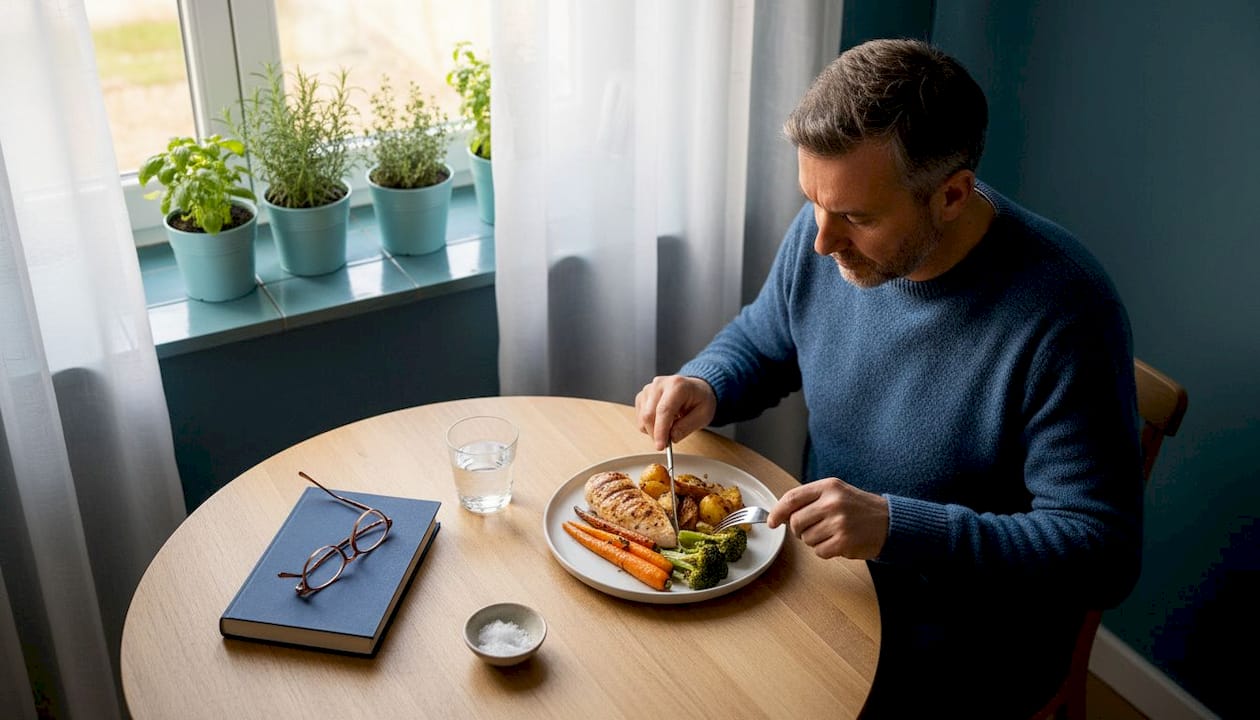
Loneliness plays a bigger role than most people expect. Research shows that loneliness significantly mediates the relationship between living alone and unhealthy dietary patterns. That means loneliness isn't just an emotional state, it actively shapes what you eat and how much you eat. When meals feel pointless or sad, it's harder to cook a real one.
Here are the most common barriers solo agers face:
- Cooking for one feels wasteful. Recipes are built for four servings. Produce goes bad before you finish it. The effort feels disproportionate to the reward.
- Shopping is logistically tricky. Bulk deals don't work for one person. Smaller quantities cost more per unit. Getting to a store can be difficult depending on mobility or transportation.
- Appetite naturally decreases with age. Your hunger signals become quieter over time, so you may simply not feel as driven to eat, even when your body still needs fuel.
- Motivation evaporates without an audience. When no one is joining you for dinner, the incentive to make something interesting drops quickly.
- Food variety narrows without variety in company. People who eat with others tend to try more foods and eat from more food groups, simply because meals become social events.
- Grief and transition affect appetite deeply. If you've recently lost a partner, a friend, or a sense of routine, food often becomes an afterthought.
That last point connects directly to the hidden loneliness checklist that many solo agers benefit from working through. Loneliness doesn't always feel obvious. Sometimes it just looks like not bothering to cook.
Pro Tip: Recognize loneliness as a nutrition factor, not just a feeling. If you notice your meals shrinking or your food choices getting simpler, that's often a sign of social disconnection, not just low appetite. Scheduling social meals, even virtual ones with a friend or family member, can shift both your mood and your intake in meaningful ways.
Key nutrition benchmarks for solo agers
So what should you actually be aiming for? Having a few clear benchmarks makes it easier to notice when things are drifting off course.
Protein is the most important nutrient to track after 50. More than 1 in 3 people over 50 fall short on daily protein needs, and protein is what keeps your muscles strong, your immune system working, and your energy levels steady. This matters enormously for independence.
| Group | Recommended daily protein | In practical terms |
|---|---|---|
| Women 50+ | 1.0 to 1.2 g per kg of body weight | About 5 to 6 ounce-equivalents per day |
| Men 50+ | 1.0 to 1.2 g per kg of body weight | About 6 to 7 ounce-equivalents per day |
| Adults with frailty risk | Up to 1.5 g per kg, per some guidelines | Spread across 3 or more meals daily |
To make this concrete: a 150-pound woman (about 68 kg) would aim for roughly 68 to 82 grams of protein per day. That's roughly three eggs at breakfast, a can of tuna at lunch, and a chicken thigh at dinner. Achievable, but easy to miss when meals shrink.
Beyond protein, appetite loss and shrinking food variety are common warning signs that increase malnutrition and frailty risk. Here are simple self-checks you can do at home:
- Track your weight monthly. Losing more than 5 percent of your body weight in six months without trying is a red flag.
- Notice if your meals are shrinking. Are your plates getting smaller? Are you skipping meals more often?
- Check your energy levels across the week. Feeling persistently tired or weak, especially in your legs or arms, can indicate muscle loss.
- Look at your food variety. Are you eating the same two or three foods most days? Narrowing variety often signals a nutrition gap.
- Pay attention to appetite changes. A persistent lack of interest in food, especially over several weeks, deserves a conversation with your healthcare provider.
If any of these self-checks raise a flag, don't wait. Bring it up at your next appointment. Getting ahead of malnutrition is far easier than recovering from it. For a broader look at what solo aging involves and what proactive planning looks like, Solo Aging 101 is a useful starting point.
Practical solutions for better nutrition when living alone
Here's the reassuring part. Most of these challenges are workable. You don't need a cooking class or a meal delivery subscription to eat better. You need a few practical systems and a little social structure.
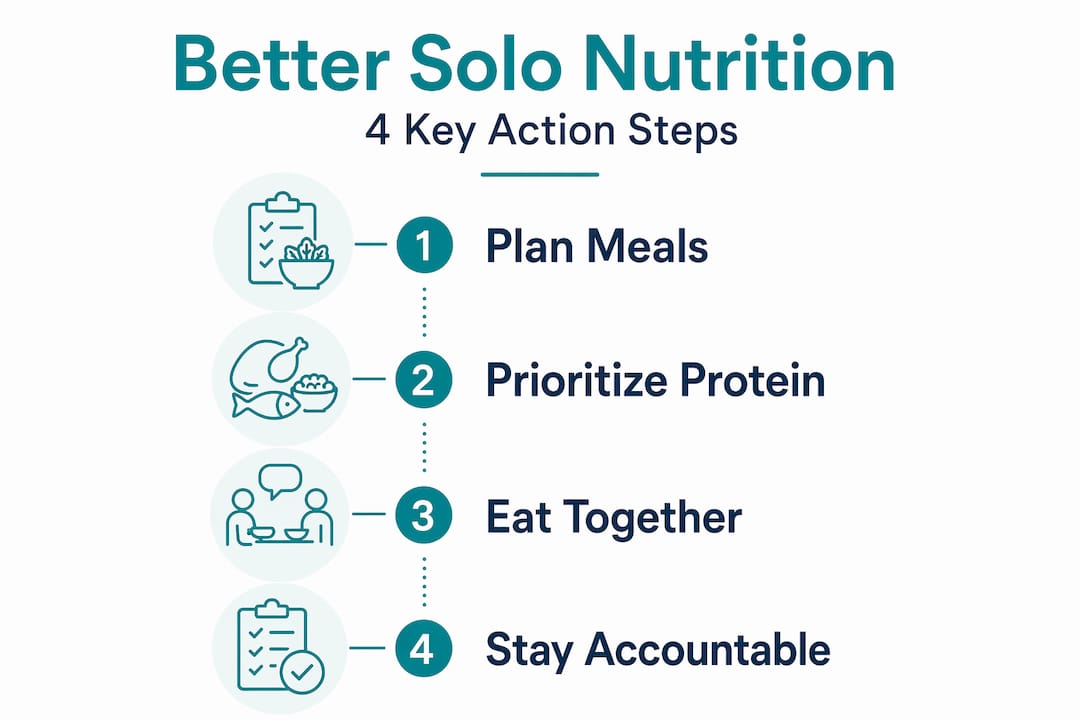
Reducing friction in meal prep is one of the most effective things you can do. Building structure around meals, and finding ways to make eating enjoyable again, are just as important as what's on the plate.
Here are strategies that actually work:
- Batch prep small portions once or twice a week. Cook a pot of grains, a batch of roasted vegetables, or a protein like hard-boiled eggs. Mix and match through the week. Less decision fatigue, less waste.
- Use fresh herbs and new seasonings. As taste sensitivity can shift with age, stronger flavors help make food more appealing. A squeeze of lemon, fresh basil, or smoked paprika can transform a simple meal.
- Freeze single portions immediately after cooking. Instead of eating the same dish four days in a row, freeze half right away. Future you will be grateful.
- Plan one shared meal per week. In person, over video, or even a phone call while you both eat. The social element genuinely changes the experience of eating.
- Try appetite-stimulating techniques. Routine, aromas, and portion prepping can all help bring appetite back when it fades. Start cooking 20 minutes before you're hungry. The smell of food often jumpstarts the appetite signal.
- Keep easy protein boosters on hand. Greek yogurt, nut butters, canned fish, cheese, and protein powder can be added to almost anything with minimal effort.
- Look into community meal programs. Many senior centers, faith communities, and local nonprofits offer group meals or meal delivery services specifically for older adults.
- Explore apps or groups for solo agers. Connecting with others who share your situation, even digitally, can rebuild the social structure that makes eating meaningful again.
Pro Tip: Schedule a shared meal at the same time each week and treat it like a standing appointment. Research shows that the routine itself, not just the company, often leads to better food intake. Having something to look forward to changes your relationship with mealtime.
If you want to build a broader support system that reinforces healthy routines, building your support circle offers practical guidance. And for a full range of tools and resources designed specifically for solo agers, the resource center for solo agers is worth exploring.
Aging Solo's perspective: Why nutrition for solo agers is about more than food
Here's the honest truth: most nutrition advice for older adults is written for people who have someone else around. A caregiver, a spouse, a nearby family member who notices when the fridge is empty or the appetite has slipped. Solo agers don't have that built-in observer.
That's not a complaint. It's an engineering problem.
Think of living alone as an engineering problem, not just a nutrition one. The goal isn't to force yourself to eat better through willpower. It's to design conditions where eating well becomes the path of least resistance.
What does that look like in practice? It means keeping your kitchen stocked differently than someone cooking for a family. It means building social rituals around food, even small ones. It means connecting your meals to purpose, something to look forward to, someone to share it with virtually, or a weekly routine that gives eating a place in your day beyond just fueling your body.
We see this again and again in the solo aging community. The people who eat best aren't necessarily the ones who know the most about nutrition. They're the ones who have found a reason to cook. A weekly video call during dinner. A neighbor who swaps homemade dishes. A cookbook they actually enjoy reading.
Nutrition for solo agers sits at the intersection of food, social connection, and intentional daily design. That's the lens we use at Aging Solo, and it's captured throughout our intentional solo aging philosophy. When you treat your mealtime as part of your broader life structure, not just a health task, things tend to fall into place more naturally.
Find your path to better aging and nutrition
Taking care of your nutrition isn't just about what's on your plate today. It's about protecting your independence, your energy, and your resilience for everything that comes next. Staying proactive now means you're far less likely to face a health crisis down the road that could limit your choices.

Aging Solo offers tools built specifically for people in your situation. Whether you're thinking through long-term planning with our life care planning guide, looking to expand your community through our support circle resource, or just starting to explore what solo aging can look like on your own terms, you'll find practical, grounded guidance waiting for you. Visit Aging Solo to see everything we've put together for your journey.
Frequently asked questions
Why does living alone make it harder to eat well as you age?
Living alone often means more meals alone, which research links to poorer nutrition, reduced appetite, and higher risk of weight loss or frailty. Without the social structure of shared meals, both motivation and food variety tend to decline.
What are the top signs of under-nutrition for solo agers?
Unintentional weight loss, shrinking meal sizes, persistent appetite loss, or feeling weaker can all be warning signs of under-nutrition. Malnutrition can result from loneliness, bereavement, and financial stress, not just poor food choices.
How much protein should older adults living alone aim for each day?
Experts recommend roughly 1 to 1.2 grams of protein per kilogram of body weight daily, which translates to about 5 to 7 ounce-equivalents for most adults over 50. Spreading protein intake across three meals is more effective than eating most of it in one sitting.
What practical strategies help combat appetite loss when living alone?
Eating with others, preparing easy high-protein snacks, and using appetizing flavors or smells to stimulate hunger all help. AARP suggests tactics like preparing portioned meals in advance and using aromas to rebuild appetite signals.
Can virtual shared meals really help with nutrition?
Yes, even regular virtual meals can increase dietary variety and restore the social structure that supports better intake. Mealtime social interventions consistently show improvement in intake quality among solo agers when shared eating is reintroduced, even digitally.