

TL;DR:
- Living alone transportation planning involves creating a personalized, layered mobility system that maintains independence and safety as one ages. It emphasizes combining walking, transit, biking, and rideshare options, tailored to individual needs and neighborhood resources. Early proactive planning, housing choices, and community support networks are essential to ensure reliable, affordable transportation throughout later life.
Living alone transportation planning is the process of building a personalized, flexible mobility system that keeps you independent, safe, and connected as you age in place. Professionals in the field call this approach a "mobility portfolio," a term that captures the idea of combining multiple transportation modes rather than relying on a single option. About 77% of older adults want to remain in their homes as they age, yet nearly 4 million households headed by adults 65 and older lack vehicle access. That gap is exactly why solo living transit options deserve your attention now, not later.
What are the most effective transportation options for adults living alone?
The best transportation for living alone is not one single mode. It is a layered set of options, each suited to a different kind of trip. A successful car-free setup assigns each mode a specific role: walking handles short, flexible trips; transit covers longer corridors; biking fills the mid-range; and rideshare steps in as a backup. Knowing which tool to reach for, and when, is what separates a fragile plan from a steady one.
Here is a breakdown of the most practical options for solo agers:
- Walking is your foundation. It costs nothing, keeps you physically active, and works for any errand within about a mile. Safety factors matter here. Lighting, curb ramps, and visible clothing significantly affect whether older adults feel confident walking regularly. If your neighborhood sidewalks are uneven or poorly lit, that is a planning gap to address now.
- Public buses, paratransit, and community shuttles handle the trips walking cannot. Paratransit, required under the Americans with Disabilities Act, provides door-to-door service for those who qualify. Many counties also run free or low-cost senior shuttles to medical appointments and grocery stores.
- E-bikes expand your range without demanding peak fitness. A standard e-bike can comfortably cover three to eight miles, which puts most neighborhood errands within reach even on days when energy is lower.
- Rideshare apps like Lyft and Uber work well for occasional longer trips, late-night needs, or carrying bulky items. The catch is cost. Relying solely on rideshare is often expensive and unreliable, which is why it belongs in your plan as a backup, not a primary mode.
- Volunteer driver programs, often coordinated through local Area Agencies on Aging or faith communities, provide free or low-cost rides with a personal touch. These programs also reduce social isolation because the driver is often a neighbor or community member.
Pro Tip: Search "[your county name] senior transportation" to find local volunteer driver programs and subsidized transit passes. Many exist but are not widely advertised.
How to build a personalized mobility portfolio for your neighborhood

Understanding transportation needs alone starts with an honest look at where you live and what you need to reach regularly. This is sometimes called a mobility audit, and it is one of the most practical first steps you can take. Mapping essential services within walking, biking, or transit distance helps you identify gaps before they become emergencies.
Follow these steps to build your own mobility portfolio:
- List your essential destinations. Write down every place you visit at least once a month: grocery store, pharmacy, primary care doctor, specialist, bank, and any social or faith community. Note the distance from your home.
- Assess your local environment. Walk or drive each route and ask: Are sidewalks safe and continuous? Is there a bus stop within a quarter mile? Is the route well lit at night? Apps like Google Maps and Walk Score give you a starting point, but your own observation matters more.
- Match each destination to a mode. Grocery store two miles away with a bus stop nearby? That is a transit trip. Pharmacy six blocks away on a flat, well-lit street? That is a walking trip. Medical specialist across town? That is a rideshare or paratransit trip.
- Plan for edge cases. What happens when it rains heavily? What if you need to carry a week's worth of groceries? What if a trip runs late? Planning the return trip separately is a habit that prevents being stranded. Build at least one backup option into every regular trip.
- Use technology to coordinate. One-call/one-click mobility centers are platforms that display multiple transit and rideshare options in one place, reducing the confusion of fragmented services. Many metropolitan areas now offer these through their transit authority websites.
Pro Tip: Print a simple one-page "trip card" for each essential destination. Include the bus route number, the rideshare backup, and a neighbor's phone number. Keep it on your refrigerator.
What challenges do solo agers face in transportation planning?
Planning transport for independent living is not without real obstacles. Knowing what they are ahead of time means you can prepare rather than react.
- Physical and cognitive changes are the most personal challenge. About 63% of adults worry about losing the ability to drive as they age. Reduced night vision, slower reaction times, and joint pain can affect both driving and walking. The solution is not to wait until a crisis forces a change. A driving cessation plan built before you need it gives you control over the transition.
- Fragmented transit services create confusion. Many communities have buses, paratransit, senior shuttles, and volunteer programs that do not communicate with each other. Riders are left to piece together a system that was never designed as one.
- Financial constraints are real. Fixed incomes make frequent rideshare use impractical. The good news is that many transit agencies offer reduced fares for adults 65 and older, and Medicare Advantage plans increasingly cover non-emergency medical transportation.
- Social isolation is the hidden cost of poor transportation planning. When getting somewhere feels too complicated or unsafe, people simply stop going. That withdrawal compounds loneliness and affects physical health over time.
Transportation is not just about getting from point A to point B. For a solo ager, it is the thread that connects you to your doctor, your friends, your grocery store, and your sense of self. Losing that thread quietly is one of the most serious risks of aging alone without a plan.
The most effective response to these challenges is to build your plan in layers. No single solution covers every scenario. A combination of transit knowledge, community relationships, and technology gives you the resilience to adapt when one option falls through.
How does housing location shape your transportation options?
The connection between where you live and how you get around is one of the most underappreciated factors in transportation strategies for singles aging in place. Solo agers benefit most from selecting transit-oriented neighborhoods that put accessible services within reach, rather than trying to retrofit transportation solutions into a car-dependent suburb later.
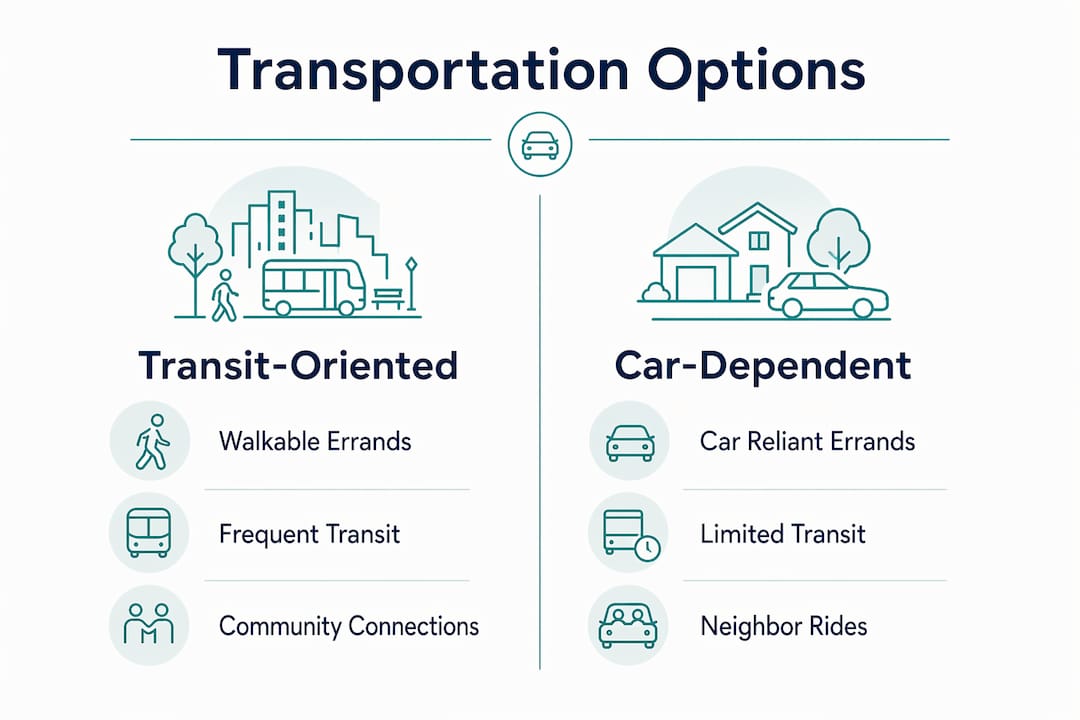
The table below compares two common living situations and their transportation implications:
| Factor | Transit-oriented neighborhood | Car-dependent suburb |
|---|---|---|
| Daily errands | Walkable or one bus ride | Requires a car or rideshare for most trips |
| Medical appointments | Paratransit and bus routes available | Limited options; volunteer drivers often needed |
| Social connection | Community centers and transit hubs nearby | Isolation risk higher without a vehicle |
| Cost over time | Lower transportation spending | Higher rideshare and taxi costs |
| Adaptability as health changes | High; options expand with planning | Low; options narrow as driving ends |
Coordinated multisector approaches that link housing, health services, and transportation produce more sustainable outcomes for solo agers than any single transit improvement alone. Local senior centers and transit stations often serve as anchor hubs, connecting volunteer driver programs, medical transport, and public transit in one place. Universal design features like curb ramps, benches, and well-lit pedestrian paths are not luxuries. They are the infrastructure that makes independent mobility possible.
Frequent transit service on key corridors, ideally every 10 to 15 minutes, gives older adults the confidence to travel without anxiety about long waits. When you are choosing where to live or deciding whether to stay put, transit frequency deserves a spot on your checklist alongside square footage and property taxes.
If you are already in a car-dependent area, the priority is building community connections. A neighbor who can drive you to a medical appointment, a church van that runs on Tuesdays, or a local Area Agency on Aging coordinator who knows every program in the county. These relationships are part of your aging in place plan, not separate from it.
Key takeaways
A sustainable mobility plan for solo agers combines multiple transportation modes, community resources, and intentional housing choices to protect independence long before a crisis forces the issue.
| Point | Details |
|---|---|
| Build a mobility portfolio | Combine walking, transit, biking, and rideshare so no single mode failure leaves you stranded. |
| Start with a mobility audit | Map your essential destinations and match each one to the most reliable available mode. |
| Plan for driving cessation early | Address physical and cognitive changes proactively rather than waiting for a crisis. |
| Use community anchor hubs | Senior centers and transit stations connect volunteer drivers, paratransit, and public transit in one place. |
| Let housing location do the work | Transit-oriented neighborhoods reduce transportation costs and isolation risk as mobility needs change. |
Why I think most people wait too long to plan this
Most solo agers I have spoken with treat transportation as something to figure out when the time comes. That instinct is understandable. Planning for a future where you cannot drive feels like admitting something you are not ready to admit. But the people who handle this transition best are the ones who treated it like any other practical problem, well before it became urgent.
What I have seen repeatedly is that the emotional weight of losing driving independence is much lighter when the alternative is already in place and already familiar. If you have been riding the bus to the farmers market for two years, switching to it for medical appointments does not feel like a loss. It feels like using a tool you already trust.
The other thing worth saying plainly: relying on family members who live far away is not a transportation plan. It is a hope. Solo agers deserve something more solid than hope. A community support network built around real local resources, volunteer programs, and transit options gives you actual choices when your needs change.
One more thing I would push back on: the assumption that car-free living means a smaller life. Done well, a thoughtful mobility portfolio often means a more connected life. You notice your neighborhood differently on foot. You meet people on the bus. You become someone who knows the local transit system, and that knowledge is genuinely empowering.
Start the audit. Make the list. Build the plan while you still have every option available to you.
— Mike
How Agingsolo can help you build your transportation plan
Agingsolo is built specifically for adults who are aging without a built-in support network, and transportation planning is one of the most practical areas where a clear guide makes a real difference.

The Agingsolo resource library includes a dedicated guide on solo aging fundamentals that covers mobility alongside housing, safety, and support circles. If you are just beginning to think through your plan, the Solo Aging 101 guide gives you a clear starting point with checklists and practical steps. For those specifically thinking about what happens when driving ends, Agingsolo's driving cessation planning guide walks you through the transition with calm, step-by-step guidance. You do not have to figure this out alone.
FAQ
What does living alone transportation planning actually mean?
Living alone transportation planning is the process of building a personalized set of mobility options, including walking, transit, biking, and rideshare, so you can reach essential services safely and independently as you age. It is proactive planning rather than crisis response.
When should I start planning my transportation as a solo ager?
Start now, regardless of your current driving ability. 63% of older adults worry about losing the ability to drive, and building alternative options while you still have full mobility makes the eventual transition far less disruptive.
What is a mobility portfolio?
A mobility portfolio is a combination of transportation modes, such as walking, public transit, e-bikes, and rideshare apps, each assigned to the trip types it handles best. Diversifying your transportation modes builds reliability and reduces the stress of depending on any single option.
Are there free or low-cost transportation options for older adults?
Yes. Paratransit services, senior shuttle programs through local Area Agencies on Aging, volunteer driver networks, and reduced-fare transit passes are all available in most communities. Many Medicare Advantage plans also cover non-emergency medical transportation at no additional cost.
How does where I live affect my transportation options?
Your neighborhood's walkability, transit frequency, and proximity to services are the single biggest factors in how well a car-free or reduced-driving plan works. Transit-oriented neighborhoods give solo agers far more flexibility and lower costs as their mobility needs evolve over time.