

For adults with moderate assets, good health, and a decade or more before retirement, long-term care insurance is usually worth serious consideration. For the very wealthy who can self-fund care, or for those with few assets who will likely qualify for Medicaid, it usually is not. The math hinges on how much you have to protect, how healthy you are today, and whether you have family nearby to absorb caregiving hours if you skip coverage.
TL;DR:
- Purchasing LTCI at age 55 to 60 offers better rates and approval chances, especially if you are healthy and have moderate assets to protect.
- Inflation protection is the most significant cost driver for premiums, and skipping it can greatly reduce long-term coverage value.
- Policies are triggered mainly when you need help with two or more activities of daily living or cognitive impairment, with benefit periods typically capped at 2 to 5 years.
- Solo agers without nearby family caregivers should consider LTCI more seriously, as they lack informal support and depend mainly on paid care options.
- Alternatives like hybrid policies, home equity, or health savings accounts may suit some individuals better than traditional full-term policies.
Table of Contents
- Is Long-Term Care Insurance Worth It? The Pros and Cons
- How LTCI Policies Actually Work
- What Does Long-Term Care Insurance Cost?
- Who Should Actually Buy Long-Term Care Insurance?
- Alternatives to Buying Long-Term Care Insurance
- Questions to Ask Before You Buy a Policy
- Aging Solo's Take: Why This Decision Hits Differently When You're On Your Own
- When LTCI Paid Off, and When It Didn't
- How to Estimate Your Own Risk of Needing Long-Term Care
- What I'd Tell a Friend Weighing This Decision
- A Quieter Way to Think This Through
- Sources
- FAQ
Is Long-Term Care Insurance Worth It? The Pros and Cons
The honest answer is that long-term care insurance (LTCI) solves a real problem for a specific group of people, and it's a poor fit for everyone else. Roughly seven out of ten adults over 65 will need some form of long-term care during their lives, and Medicare generally will not pay for it. That gap between "likely to need it" and "not covered by Medicare" is exactly what LTCI is built to fill.
What it protects:
- Your savings, home equity, and retirement accounts from being drained by a multi-year care stay
- Your ability to choose where you receive care, including staying at home longer instead of moving to a facility by default
- Family members from becoming unpaid, exhausted caregivers who put their own careers and health on hold
- Potential tax advantages if the policy is "tax-qualified" under federal rules
What works against you:
- Premiums on traditional policies are not guaranteed and have risen sharply for many existing policyholders over the past two decades
- Coverage is "use-it-or-lose-it" on most standalone plans. Pay for 20 years and never need care, and that money is gone
- Underwriting can deny you outright if you have certain health conditions, or price you out with a much higher premium
- Policies cap benefits by daily amount and total duration, so a severe or long stay can still leave a gap
A private nursing home room now runs a median cost of roughly $129,575 a year in recent national surveys. Compare that to a typical annual premium in the low thousands for a healthy 55-year-old, and the appeal is obvious. The catch is that premium is not locked in for life on most traditional plans, which is the trade-off you're accepting in exchange for lower starting costs.
How LTCI Policies Actually Work
Before comparing quotes, you need to understand what triggers a payout and how policies are structured. Insurers don't pay simply because you're aging. They pay when you meet specific criteria.
- Benefit triggers. Most policies pay out when you need help with two or more Activities of Daily Living (ADLs): bathing, dressing, eating, toileting, transferring, or continence. A diagnosis of cognitive impairment, like Alzheimer's disease, can also trigger benefits even if physical ADLs aren't affected yet.
- Elimination period. This works like a deductible in time rather than dollars. You pay out of pocket for a set number of days, often 30, 60, or 90, before the policy starts paying. A longer elimination period lowers your premium but raises your near-term cash exposure.
- Benefit period. This caps how long the policy pays, commonly two to five years, or with a lifetime option if you want it and can afford it.
- Policy type. Traditional standalone LTCI is the classic model. Hybrid or linked-benefit policies combine LTC coverage with life insurance or an annuity, so unused benefits pass to heirs. Group plans through an employer sometimes offer simplified underwriting.
Underwriting matters more than most buyers expect. Insurers scrutinize health history closely, and applicants can be denied or charged significantly more for preexisting conditions, depending on underwriting criteria. Buying in your 50s or early 60s, while you're still healthy, dramatically improves both your odds of approval and your price.
What Does Long-Term Care Insurance Cost?
Premiums vary widely based on a handful of factors you can actually influence with timing and policy design. Age at purchase is the biggest lever: a policy bought at 55 can cost roughly half what the same coverage costs at 65, because your health risk is lower and the insurer collects premiums longer before any claim.
Other factors that move the price:
- Health at underwriting. A clean bill of health at application locks in better rates than waiting until a chronic condition shows up.
- Daily or monthly benefit amount. Higher payouts mean higher premiums, so this should track your local cost of care, not a generic number.
- Benefit period length. A three-year benefit period costs less than a lifetime one, but it also caps your protection if care runs longer.
- Inflation protection. This is the single biggest cost driver, and skipping it is the single biggest mistake buyers make. Care costs today won't reflect care costs in 20 years, and inflation protection must be selected at purchase. It typically adds a meaningful amount to your annual premium but can substantially increase your effective coverage by the time you actually file a claim.
Pro Tip: If a traditional policy's premium uncertainty worries you, ask specifically about hybrid or linked-benefit products with fixed premiums, you'll pay more upfront, but the price won't move, and unused benefits aren't simply lost. You'll pay more upfront, but the price won't move, and unused benefits aren't simply lost.*
Federal law under the Health Insurance Portability and Accountability Act allows some policies to qualify as "tax-qualified," which can affect the deductibility of premiums and the tax treatment of benefits paid out. Check with a tax professional about your specific situation before assuming a deduction applies.
Who Should Actually Buy Long-Term Care Insurance?
There's a sweet spot, and it's narrower than most people assume. Here's a practical way to think through it:
- You're in the financial middle. If you have enough assets that Medicaid spend-down rules would force you to burn through savings and home equity before qualifying for help, but not so much that you could comfortably self-fund a care bill costing in the six figures annually for several years, LTCI does real work for you.
- You're likely fine without it. If your net worth easily covers several years of high-end care costs, self-insuring often makes more financial sense than paying premiums for decades. On the other end, if your assets are modest enough that Medicaid eligibility is a realistic outcome regardless, insurance premiums may just be money you can't recover.
- Timing beats waiting. The best window to buy is your mid-50s to mid-60s, while you're healthy and premiums are lower. Waiting "until you need it" usually means waiting until you can't get approved, or can only get approved at a punishing price.
- Family capacity matters. If you have adult children or a spouse nearby who could realistically provide hands-on care, that changes your calculation. If you're aging without that built-in backup, the math shifts meaningfully in favor of coverage, because you're not just buying care, you're buying a support system that would otherwise fall on people who don't exist in your life.
None of this is a formula you can run once and forget. Health changes, family situations change, and the insurance market itself has shifted, with more people choosing hybrid products over traditional standalone plans in recent years.
Alternatives to Buying Long-Term Care Insurance
LTCI isn't the only path to covering future care costs, and for some people it isn't the best one.
- Self-funding. Setting aside a dedicated investment account earmarked specifically for care costs gives you full control and no premium risk, but it requires discipline and a large enough asset base to absorb a worst-case scenario without derailing the rest of your retirement.
- Hybrid policies. These pair LTC benefits with life insurance or an annuity so the money isn't lost if you never need care. The trade-off is a much larger upfront premium or lump sum compared to traditional coverage.
- Home equity. A reverse mortgage or a planned home sale can fund care later in life, particularly for homeowners who want to age in place as long as possible and treat the home as a backstop asset.
- Health savings accounts. HSA funds can pay for many qualified long-term care expenses tax-free, making them a useful supplement, though rarely a full replacement for coverage.
- Medicaid and Partnership programs. Many states run Long-Term Care Partnership programs that let you protect a dollar amount of assets equal to your LTCI benefits while still qualifying for Medicaid once benefits run out. It's worth checking whether your state participates before ruling this out.
Questions to Ask Before You Buy a Policy
Shopping for LTCI without a checklist of questions is how people end up with gaps they discover only when they're filing a claim.
- What's the daily or monthly benefit, and does it match local care costs in your area?
- What's the elimination period, and can you cover that gap out of pocket?
- Is inflation protection included, and at what compounding rate?
- Are premiums guaranteed, or can the insurer raise them later?
- What is this carrier's rate-increase history? Consumer regulators recommend checking this directly, since some carriers have raised rates repeatedly over the past two decades while others have held steady.
- What is the carrier's financial-strength rating? A policy is only as good as the company's ability to pay claims decades from now.
Pro Tip: Get quotes from at least three carriers and consider working with an independent broker who sells multiple companies' policies rather than a captive agent tied to one insurer. Consumer advocates consistently recommend comparing multiple quotes before signing anything.
Prepare for underwriting by gathering your medical records in advance and being upfront about your health history. A red flag to watch for: any agent who pressures you to skip the inflation rider to lower the quoted price. That single decision does more to erode long-term value than almost any other policy feature.
Aging Solo's Take: Why This Decision Hits Differently When You're On Your Own
If you're aging without a spouse or adult children nearby, the math around LTCI shifts in a real way. A married couple can informally split caregiving duties or lean on each other during a rough recovery. Solo agers don't have that fallback built in, which makes paid care, whether at home or in a facility, less of a backup plan and more of a primary plan.
This is why we encourage pairing any LTCI decision with a broader Life Care Plan, not treating insurance as a standalone fix. A few moves worth prioritizing now:
- Build a surrogate support network of friends, neighbors, or professionals who can advocate for you if a health crisis hits
- Get honest about your mobility and cognitive risk factors, including family history, before you apply
- Check underwriting timing carefully. Applying while healthy in your 50s or early 60s keeps more doors open
When LTCI Paid Off, and When It Didn't
The clearest financial win shows up when someone buys a policy in their late 50s, stays healthy for another 15 to 20 years, then needs several years of memory care later in life. A policy purchased at 58 with a modest daily benefit and inflation protection can end up paying out multiples of what was ever paid in premiums, especially once you factor in a care stay running into six figures annually at today's median nursing home costs.
The disappointing scenarios usually trace back to one of two mistakes. The first is buying a policy with a short benefit period, say two years, then needing care for five. The policy helps, but it doesn't come close to covering the full stay, and the family still faces a large gap. The second is letting a policy lapse after many years of premium payments because the cost became unaffordable, often after a rate increase. Without a nonforfeiture rider, that policyholder loses the entire value of every premium paid, which is arguably the single most common regret in the LTCI market.
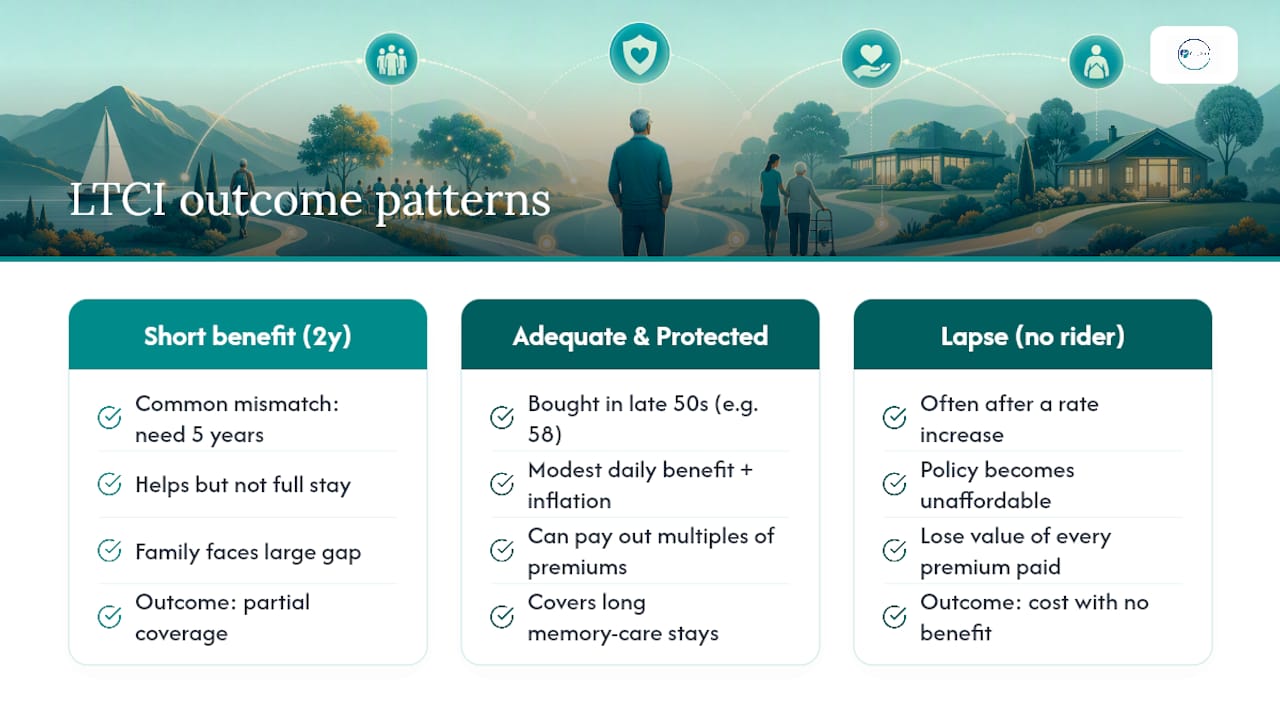
The lesson isn't that insurance is a bad bet. It's that policy design, specifically benefit period length and nonforfeiture protection, matters as much as the decision to buy at all. A cheap policy that lapses is worse than no policy, because it cost money and delivered nothing.
How to Estimate Your Own Risk of Needing Long-Term Care
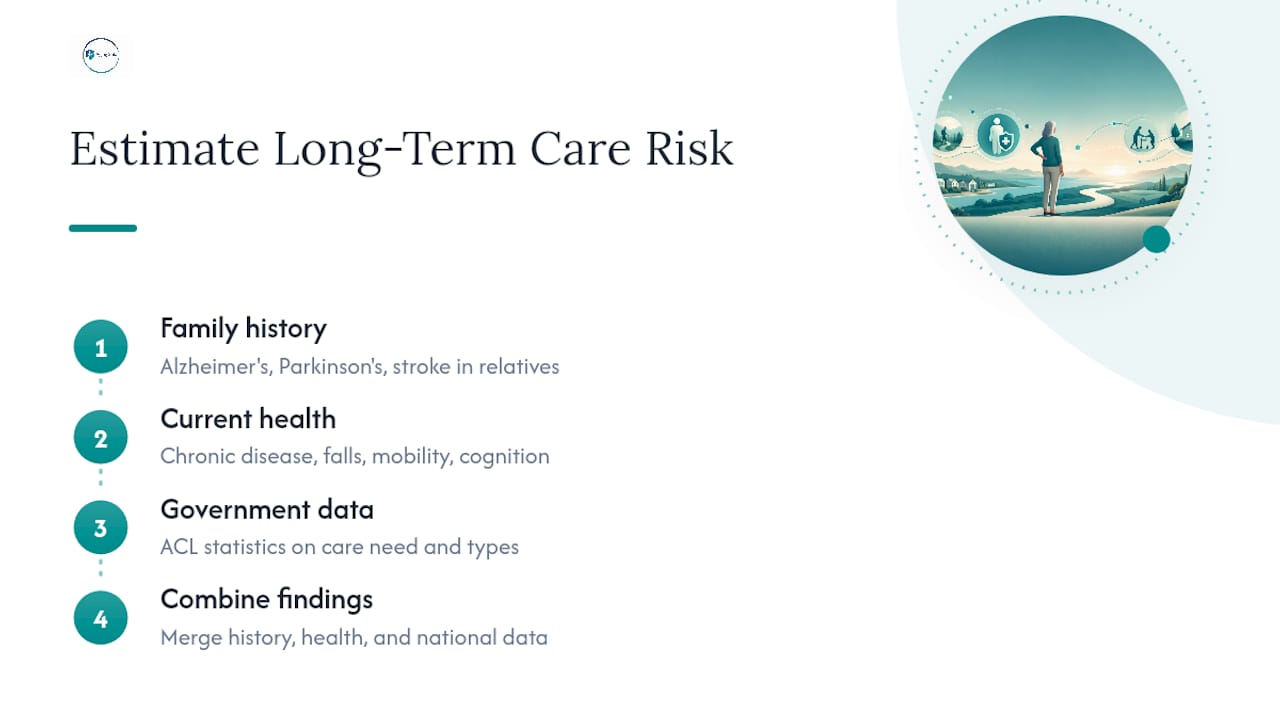
Start with family history, since it's one of the most honest predictors available to you. Conditions like Alzheimer's disease, Parkinson's disease, and stroke run in families, and if a parent or sibling needed years of care, your own odds climb accordingly.
Next, look at your current health realistically. Chronic conditions like diabetes, obesity, or cardiovascular disease increase both the likelihood you'll need care and the difficulty of getting approved for coverage later, which is another argument for buying while you're still insurable. Mobility issues, early cognitive changes, or a recent fall are all signals worth taking seriously rather than dismissing as normal aging.
Government resources can help you translate that risk into concrete numbers. The Administration for Community Living publishes data on how much care people typically need and what forms that care takes, which is a useful way to size your planning against national patterns rather than guessing. Combine that with your own family history and current health picture, and you get a far more grounded answer than a generic actuarial table could give you.
What I'd Tell a Friend Weighing This Decision
I think about the solo agers who call themselves lucky because "nothing's happened yet," as though the absence of a crisis is proof they don't need a plan. It isn't. It just means the plan hasn't been tested.
Here's what stands out to me after working through this material: the people who regret buying LTCI almost never regret the decision to buy. They regret buying the wrong policy, usually one with a benefit period too short or no inflation protection, sold by an agent who wanted to close the deal at the lowest quoted price. The people who regret not buying are almost always the ones who waited until a health scare made the decision for them, and by then the door had already closed.
If you take one thing from this: the cost of indecision compounds just as much as the cost of a premium does. Every year you wait to even investigate LTCI is a year closer to an underwriting answer you don't want to hear. You don't have to buy anything today. But you do owe yourself an honest look at where you actually stand, while you still have every option on the table.
— Mike
A Quieter Way to Think This Through
You don't have to sort this out alone, and you don't have to sort it out by staring at insurance brochures on a Sunday afternoon wondering if you're missing something. Some of the best clarity comes not from buying a policy right away, but from mapping out what your actual life and care preferences look like first, then figuring out what tools, insurance included, fit that picture.

Agingsolo built the Life Care Plan framework for exactly this moment: the point where you know something needs deciding but aren't sure where insurance fits into the bigger picture of aging on your own terms. Our 45 minute Solo Aging Clarity Session walks through your specific situation, your health picture, your support network, and your financial comfort zone, so you leave with a real a sense of direction instead of a stack of quotes you don't know how to compare. If you're ready to think this through with someone rather than a spreadsheet, visit our Elder Planning guide and book a session when you're ready.
This article is general information, not a substitute for advice from a qualified financial advisor. Consult a qualified financial professional about your own circumstances before acting on anything here.
Sources
- What is the lifetime risk of needing/receiving long-term services and supports? — ASPE (HHS)
- What you need to know about long-term care insurance — NAIC
- Medicare
- Congress
FAQ
What is the biggest drawback of long-term care insurance?
The biggest drawback is that traditional policy premiums aren't guaranteed and have risen sharply for many policyholders over the past two decades, sometimes forcing people to drop coverage they've paid into for years.
What does Suze Orman say about long-term care insurance?
Suze Orman has generally advised people to buy long-term care insurance while they're healthy and in their 50s or early 60s, arguing that waiting until you need it usually means you can no longer qualify or afford it.
What does Dave Ramsey say about long-term care insurance?
Dave Ramsey typically recommends buying long-term care insurance around age 60, viewing it as a tool for people with moderate assets who want to protect savings, rather than something the very wealthy or the asset poor generally need.
Why do people decide not to buy long-term care insurance?
Many people skip it because of premium uncertainty, the use-it-or-lose-it structure of traditional policies, or a belief that they'll qualify for Medicaid or can self-fund care with existing assets.
Is long-term care insurance worth it if I'm single with no children nearby?
For solo agers without family caregiving backup, long-term care insurance often carries more practical value, since paid care becomes the primary safety net rather than a supplement to informal family support.