

TL;DR:
- A pearl of wisdom is a short, memorable piece of advice that can be sincere, ironic, or affectionate. It draws on the age-old metaphor of pearls representing rare value and wisdom, often used to encapsulate life lessons. The phrase's tone depends on context, and its plural form usually refers to collections of advice or sayings.
A pearl of wisdom is a short, pithy saying or piece of advice that is meant to sound wise, though it is just as often delivered with a wink. Example (sincere): "My grandmother's pearl of wisdom was simple: never go to bed angry." Example (ironic): "Thanks for that pearl of wisdom — I had no idea I should drink more water."
Merriam-Webster documents the phrase in its plural form, "pearls of wisdom," as the more common usage in everyday American English.
Table of Contents
- Where the phrase comes from and its biblical echoes
- What are the best synonyms for "pearls of wisdom"?
- Examples of the phrase in sentences and notable quotes
- How to use "pearls of wisdom" correctly in speech and writing
- Key Takeaways
- Why short sayings still matter
- Useful sources
- FAQ
Where the phrase comes from and its biblical echoes
The idiom has been in circulation since at least the early twentieth century, appearing in journalistic and literary writing to describe remarks that a speaker delivers with great gravity, sometimes more gravity than the remark deserves. The Free Dictionary's idioms entry documents this early usage and notes the phrase can be applied both affectionately and sarcastically.
The metaphor itself is older than the idiom. Pearls have represented rare, concentrated value across cultures for centuries. In Western literature, wisdom is routinely compared to precious things: gold, silver, and gems. Proverbs 4:7 frames wisdom as the highest acquisition, and that gem-as-wisdom tradition runs through religious and secular writing alike. Andy Wannemacher's writing on wisdom literature draws this line directly from Proverbs-style texts to the modern self-help habit of packaging advice as short, categorized "nuggets."
A clarifying note: The phrase "pearls of wisdom" does not appear as a direct scriptural quotation. It is an idiom that echoes biblical wisdom literature. The resonance is cultural and metaphorical, not a citation.
What are the best synonyms for "pearls of wisdom"?
Several alternatives exist, each with a slightly different register.
- Nuggets of wisdom — slightly more casual, popular in self-help and motivational writing. The "nugget" metaphor (gold, not pearl) carries the same idea of compact, concentrated value.
Register guide: Use sage advice in professional or formal writing. Use nuggets of wisdom in casual or self-help contexts. Use pearls of wisdom when you want the phrase to carry warmth, irony, or a little literary flair.
Examples of the phrase in sentences and notable quotes
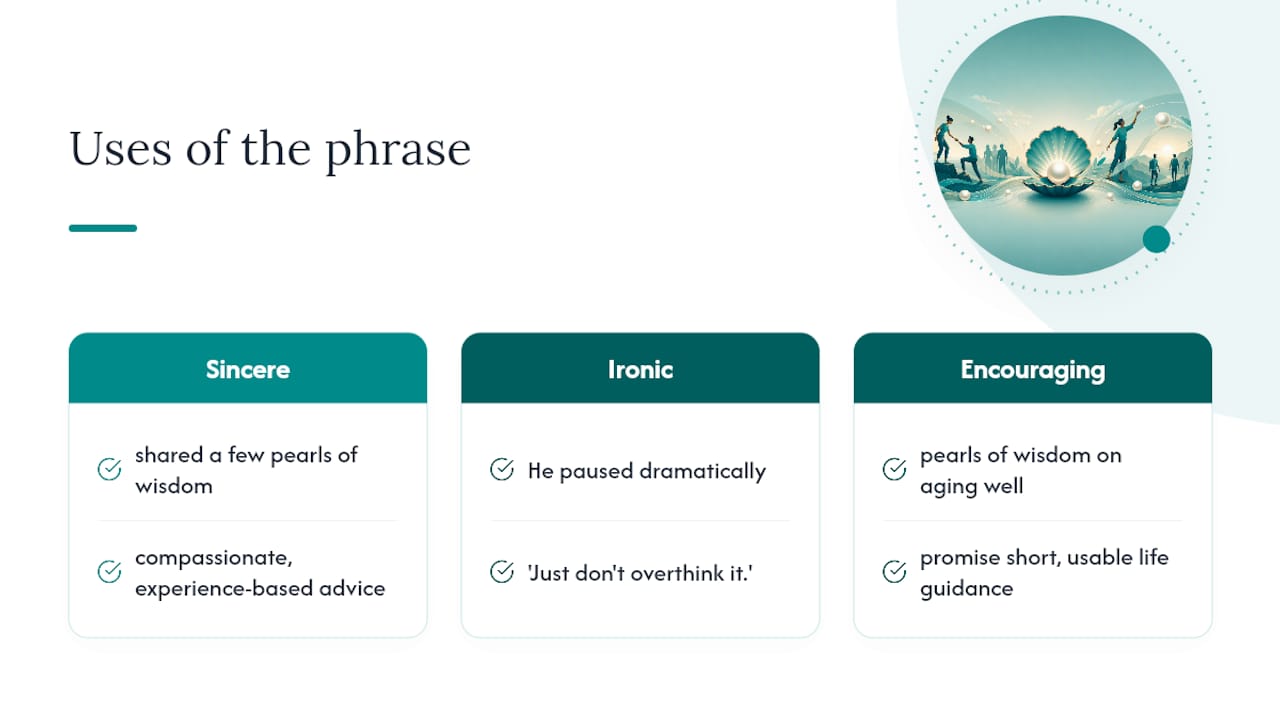
Sincere use: "Before she retired, my manager shared a few pearls of wisdom that I still carry with me."
Ironic use: "He paused dramatically and delivered his pearl of wisdom: 'Just don't overthink it.'"
Encouraging use: "If you're looking for pearls of wisdom on aging well at home, the best ones tend to be the simplest."
Barbara Bush titled her collection of short reflections Pearls of Wisdom, using the phrase to signal compassionate, experience-based advice gathered over a lifetime. It's a good example of how the phrase frames lived insight rather than abstract theory.
The self-help shelf is full of similar titles. Pearls of Wisdom: 30 Inspirational Ideas to Live Your Best Life is one of many that use the phrase to promise short, usable life guidance, which tells you something about how readers respond to the metaphor. It feels approachable, not preachy.
How to use "pearls of wisdom" correctly in speech and writing
Do:
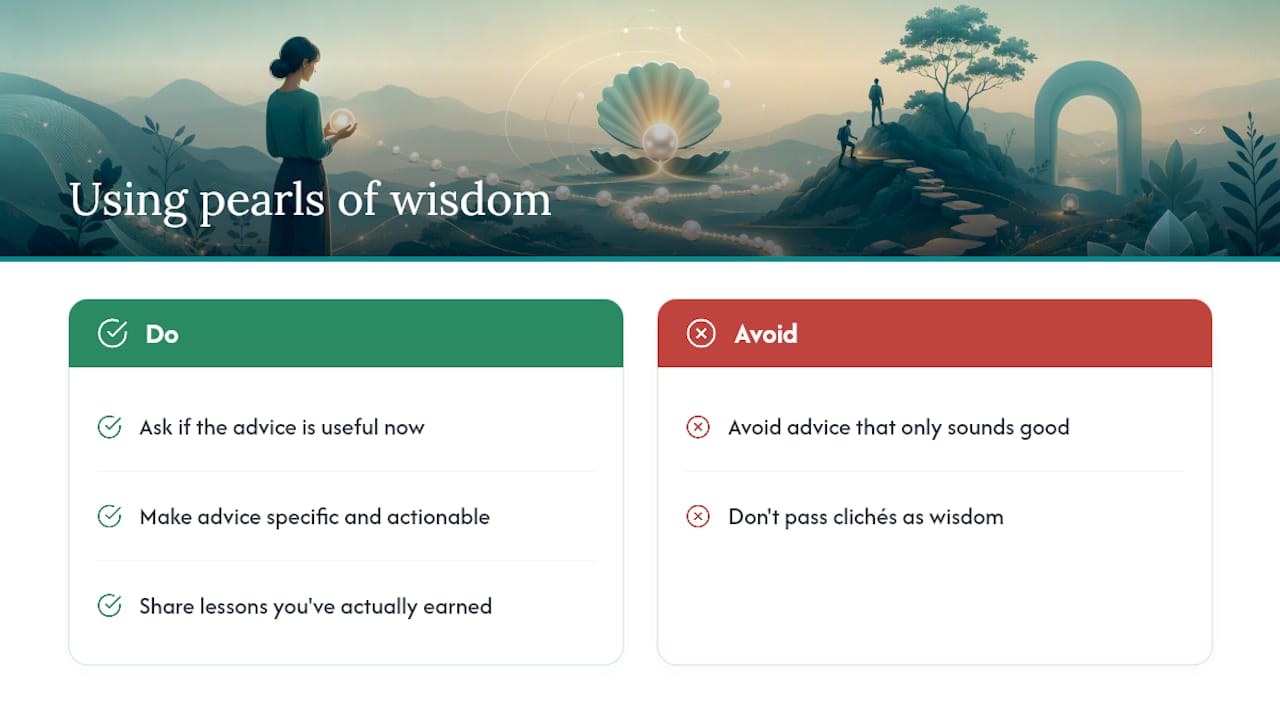
- Use it sincerely when crediting advice from someone with real experience. "My doctor offered a pearl of wisdom I didn't expect."
- Use it ironically when the context is clearly light and the relationship is warm enough to carry the joke.
- Pair it with practical self-care habits or life-lesson content where short, memorable guidance is the point.
- Use the plural ("pearls") when referring to a collection of advice. The singular ("a pearl") works for one specific insight.
Don't:
- Use it sarcastically when the advice-giver is genuinely trying to help and might be hurt by the dismissal.
- Overuse it. Once or twice in a piece of writing is plenty; more than that and it starts to feel like a verbal tic.
- Drop it into formal professional writing without checking the tone. In a performance review or a legal document, it reads as flippant.
Quick rewrite example: Before: "Here are some pearls of wisdom for your retirement." Better (formal): "Here is some practical guidance for your retirement." Better (warm/personal): "A few things I've learned that might help as you step into this next chapter."
For readers thinking about how short pieces of advice translate into real routines, Agingsolo's guide on healthy routines for seniors is worth a look. And if you're navigating the mental-health side of applying advice to daily life, The Pursuit Counseling blog offers thoughtful, grounded perspectives.
Key Takeaways
A pearl of wisdom is a short, pithy piece of advice that can be sincere, affectionate, or ironic depending entirely on tone and context.
| Point | Details |
|---|---|
| Core definition | A short, memorable piece of advice, sincere or ironic depending on tone. |
| Tone is everything | The same phrase can be a compliment or gentle mockery; context decides which. |
| Origin | Early 20th-century idiom rooted in the older gem-as-wisdom metaphor from wisdom literature. |
| Best synonyms | "Words of wisdom," "nuggets of wisdom," and "sage advice" cover most registers. |
| Usage tip | Use the plural for collections of advice; reserve sarcasm for relationships that can hold it. |
Why short sayings still matter
There's something worth sitting with here. Short sayings persist not because they're profound on their own, but because they compress something a person spent years learning into a form someone else can carry. That's the real function of a pearl of wisdom: it's a memory aid for a truth that took time to earn.
What I find interesting is how often people dismiss aphorisms as clichés, then quietly live by them anyway. "Don't borrow trouble." "One thing at a time." These aren't revelations. They're reminders. And reminders, delivered at the right moment, can shift a whole day.
Pro Tip: Before you pass along a piece of advice as a pearl of wisdom, ask whether it's actually useful to the person in front of you right now, or whether it's just something that sounds good. The best ones are specific enough to act on.
If you're a solo ager thinking about how to build a life that holds up, Agingsolo's aging in place guide is full of exactly that kind of practical, grounded guidance.
Useful sources
- PEARL OF WISDOM definition | Cambridge English Dictionary
- PEARLS OF WISDOM definition in American English
- PEARL OF WISDOM Definition & Meaning
- pearl of wisdom - Wiktionary, the free dictionary
- Pearls of Wisdom - Idioms by The Free Dictionary
- Nuggets of Wisdom for Success - Andy Wannemacher
- Pearls of Wisdom by Barbara Bush (Hachette Book Group)
- Pearls of Wisdom: 30 Inspirational Ideas to Live your Best ... (Amazon)
FAQ
What does "pearls of wisdom" mean?
It means a short, memorable piece of advice or insight. The phrase can be sincere (genuinely crediting wise guidance) or ironic (gently mocking advice that is obvious or unhelpful), depending on tone and context.
Is "pearls of wisdom" from the Bible?
The phrase itself is not a biblical quotation. It is an idiom that echoes the gem-as-wisdom metaphor found in wisdom literature like Proverbs, where wisdom is framed as the most valuable thing a person can acquire.
What is another way to say "pearls of wisdom"?
Common alternatives include "words of wisdom," "nuggets of wisdom," "sage advice," and "life lessons." "Words of wisdom" is the most neutral substitute; "nuggets of wisdom" is more casual and popular in self-help writing.
Can "pearls of wisdom" be sarcastic?
Yes. Cambridge Dictionary, Collins, and Wiktionary all note the phrase is frequently used ironically or sarcastically, often to suggest that a remark was obvious, unhelpful, or less insightful than the speaker believed.