

TL;DR:
- Early planning of senior living transitions is essential for solo agers to maintain control, secure ideal options, and avoid rushed decisions. Starting 12 to 24 months prior allows sufficient research, legal preparation, and community visits, reducing emotional and logistical stress. Building a support network and completing legal documents early ensures a smoother move and better adaptation post-transition.
Early planning of senior living transitions is defined as the deliberate process of researching, evaluating, and securing appropriate housing and care options 12 to 24 months before an intended move. For solo agers — adults growing older without a spouse, partner, or nearby adult children — this window is not a luxury. It is the difference between choosing your future and having it chosen for you. Agingsolo exists to help you stay in the driver's seat. The guides, checklists, and tools here are built specifically for people who are doing this largely on their own, and this article walks you through every stage of the process.
When should you start planning senior living transitions?
The ideal planning window is 12 to 24 months before a move. That timeline gives you room to tour communities without pressure, get on waitlists at preferred facilities, and make financial arrangements without scrambling. When you wait until a health event forces the decision, your options shrink fast.
For solo agers, the stakes are even higher. Delaying planning accelerates social isolation as informal support networks — neighbors, friends, local acquaintances — gradually disappear through relocation, illness, or death. Once that network thins out, the emotional and logistical weight of a transition falls entirely on you. Starting early means you still have people around to help you think it through.
If you are living with a progressive condition such as Parkinson's disease or early-stage dementia, the timeline tightens. Planning should begin 12 to 18 months before a move to secure preferred care levels before your needs escalate. Waiting for a clear "trigger event" like a fall or hospitalization is the most common mistake people make, and it consistently limits options.
- Start researching communities at the 18 to 24 month mark
- Schedule initial tours at the 12 to 18 month mark
- Finalize your choice and secure your spot at the 6 to 12 month mark
- Complete legal and financial preparations in the 3 to 6 months before moving
Pro Tip: Set a calendar reminder right now for six months from today. That is your first checkpoint to review your current living situation honestly and ask whether it still serves your needs.
How to assess your care needs and preferences effectively
A needs assessment is the foundation of any good senior living plan. The industry standard framework covers two categories: Activities of Daily Living (ADLs) and Instrumental ADLs. ADLs include bathing, dressing, eating, and mobility. Instrumental ADLs cover tasks like managing finances, handling medications, cooking, and using transportation. Formal needs assessments covering both categories produce more successful transitions by reducing care mismatches from the start.
Beyond physical function, your assessment should include your social and cognitive needs. Do you thrive with daily social interaction, or do you prefer quieter routines? Are you managing any memory concerns? Do you have a doctor, therapist, or specialist you want to stay close to? These questions shape which senior living options will actually fit your life, not just your medical chart.
Here is a practical sequence to follow:
- Write down every task you handle independently today and note any that have become harder in the past year.
- Ask your primary care physician for a functional assessment. Many will complete one during a standard annual visit.
- List your personal values and non-negotiables: outdoor access, pet-friendly policies, proximity to a specific city or neighborhood, religious community, cultural environment.
- Identify your support network. As a solo ager, this may include close friends, a chosen family member, a professional fiduciary, or a geriatric care manager.
- Review and update your legal documents: durable power of attorney, healthcare proxy, advance directive, and will.
Pro Tip: A life care plan is one of the most practical tools a solo ager can create. It maps your current health, anticipated needs, and financial resources into a single living document that guides every housing decision going forward.
Legal and administrative preparations, including power of attorney updates and medical record transfers, typically take 3 to 6 months to complete. Starting this process before you think you need it is the move that prevents last-minute chaos.
What are the main senior living options to compare?
Senior living is not a single category. It is a spectrum of care levels, and understanding where you fall on that spectrum determines which options are realistic for you.
| Living Type | Care Level | Best For |
|---|---|---|
| Independent living | Minimal to none | Active adults who want community without care services |
| Assisted living | Moderate daily support | Adults needing help with ADLs but not full nursing care |
| Memory care | Specialized cognitive support | Adults with Alzheimer's disease or other dementias |
| Skilled nursing facility | 24-hour medical care | Adults recovering from surgery or managing complex medical needs |
Independent living for seniors offers social programming, maintenance-free living, and community without the clinical feel of a care facility. It is often the right first step for solo agers in their 60s and 70s who are healthy but want a built-in social structure. Assisted living adds personal care services, medication management, and staff support. Memory care units provide a secured environment with programming designed for cognitive decline.
When touring communities, go more than once. Touring multiple times and bringing a trusted friend or advisor improves decision quality. Visit at different times of day. Eat a meal there. Watch how staff interact with residents. Ask specific questions:
- What is the staff-to-resident ratio on evenings and weekends?
- How does the community handle a resident whose care needs increase?
- What is the process if a resident needs to move to a higher level of care?
- Are there additional fees for services beyond the base rate?
The last question matters more than most people realize. Many communities charge separately for medication management, laundry, transportation, and incontinence care. Get the full fee schedule in writing before you commit.
How to plan and execute the transition step by step
A smooth transition does not happen by accident. It happens because someone mapped out the tasks, assigned responsibility, and worked the timeline. As a solo ager, that someone is you, which is why a written plan matters so much.
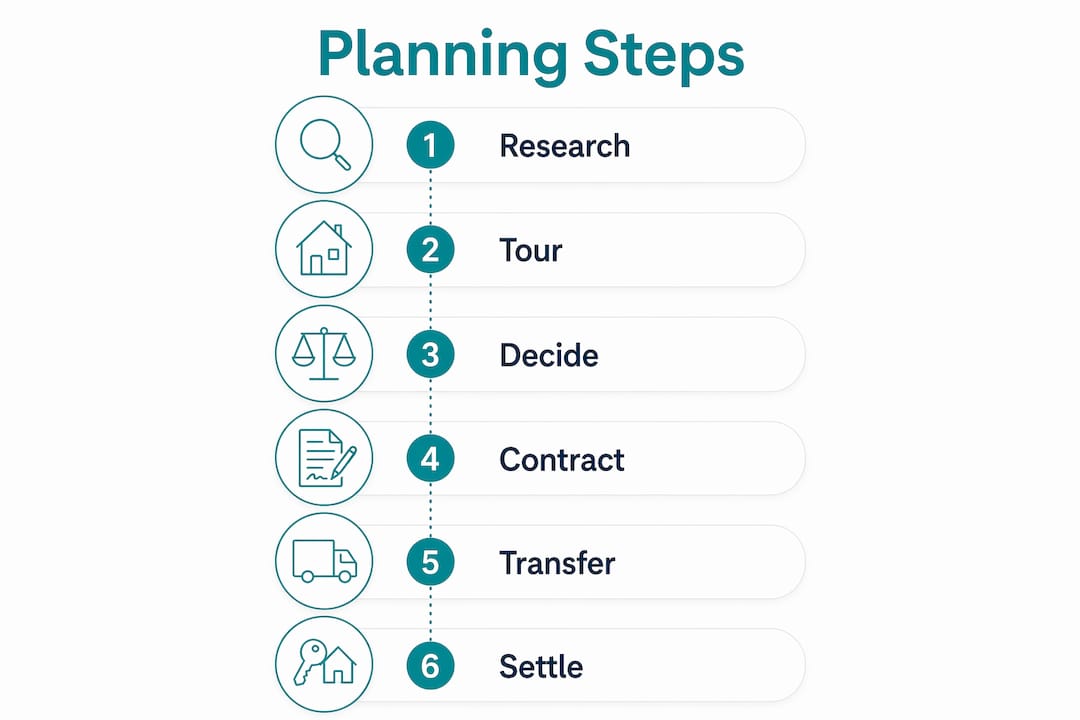
18 to 24 months out: Research communities online using resources like A Place for Mom, Caring.com, and state licensing databases. Create a shortlist of five to eight options. Begin your needs assessment and schedule a conversation with a geriatric care manager if you want professional guidance.

12 to 18 months out: Tour your shortlist. Narrow to two or three top choices. Get on waitlists at your preferred communities, since popular facilities in desirable areas often have waiting periods of six months to over a year. Review your finances with a fee-only financial advisor who specializes in elder care.
6 to 12 months out: Confirm your community choice and sign contracts. Begin downsizing. Senior move managers, certified through the National Association of Senior Move Managers (NASMM), specialize in exactly this process and can coordinate packing, donations, estate sales, and logistics. Update all legal documents and notify your healthcare providers of the upcoming move.
3 to 6 months out: Transfer medical records. Confirm medication management protocols with your new community. Arrange transportation for move day. Notify your bank, insurance providers, Medicare or Medicaid, and the Social Security Administration of your new address.
Pro Tip: Create a single binder or digital folder labeled "Transition File." Put every signed contract, legal document, medical record, and contact list in one place. On move day, that binder goes with you, not in the moving truck.
The 3 to 6 month window for legal and administrative tasks is not padding. It reflects how long these processes actually take when you factor in attorney scheduling, notarization, and record request processing times.
Common challenges during transitions and how to overcome them
Even a well-planned move comes with a real adjustment period. Adjustment after moving typically lasts 3 to 6 months and may include grief, resistance, or unhappiness that does not necessarily mean you chose the wrong community. This is a normal response to a significant life change, not a signal to reverse course immediately.
The first 90 days post-move carry the highest risk for emotional distress, unintended weight loss, and medication errors. Scheduled check-ins during this period are not optional. If you are a solo ager, build this support structure before you move, not after.
Practical strategies that help:
- Schedule one social activity per day for the first two weeks, even if it feels forced
- Keep a familiar object or piece of furniture from your previous home in a visible spot
- Maintain contact with your existing social network through phone, video calls, or visits
- Ask the community's social director to introduce you to two or three residents with similar interests
- Track your mood and appetite in a simple daily journal for the first month
Family dynamics can complicate transitions even when family members are not primary caregivers. Adult children or close friends may second-guess your choice, project their own fears onto the situation, or offer conflicting opinions. Your plan, your needs assessment, and your documented preferences are your anchor in those conversations.
"Solo agers face unique challenges, including limited immediate family support for transition logistics and emotional adjustment, needing tailored planning supports." — Aging Solo
If you notice persistent depression, significant weight loss, or withdrawal from all social contact after the 90-day mark, contact your physician. These are warning signs that warrant professional attention, not just more time.
Key takeaways
Planning senior living transitions early gives solo agers the control, options, and time needed to make decisions that reflect their values rather than their circumstances.
| Point | Details |
|---|---|
| Start 12 to 24 months out | This window allows thorough research, waitlist placement, and financial preparation without pressure. |
| Complete a formal needs assessment | Covering ADLs and Instrumental ADLs reduces care mismatches and clarifies which living type fits your situation. |
| Legal prep takes 3 to 6 months | Update power of attorney, healthcare proxy, and medical records well before your move date. |
| Tour communities more than once | Multiple visits at different times reveal daily life, staff quality, and hidden costs. |
| Plan for the adjustment period | The first 90 days carry the highest emotional and medical risk. Build check-in support before you move. |
Why I think waiting is the most expensive mistake solo agers make
I have spent years talking with solo agers who delayed planning because it felt premature. They were healthy, active, and not ready to think about "that." Then something shifted. A health event, a fall, a diagnosis. Suddenly the timeline compressed from two years to two weeks, and the choices that had been available evaporated.
What strikes me most is not the logistical cost of waiting. It is the emotional cost. When you plan early, you get to visit communities on a Tuesday afternoon with no pressure, have a good meal, and leave thinking, "Actually, that wasn't bad at all." When you plan in crisis, you are signing contracts in a hospital hallway while managing fear and grief at the same time.
For solo agers specifically, the absence of immediate family support makes early planning less optional and more urgent. You are building the support structure yourself. That takes time. Geriatric care managers, trusted advisors, legal professionals, and chosen family members do not appear overnight. They are relationships you cultivate when you are not yet in need of them.
The cultural stigma around senior living is real, but it is also outdated. Modern independent living and assisted living communities look nothing like the institutions people imagine. Many offer fitness centers, art studios, farm-to-table dining, and robust social calendars. The residents who seem most content are almost always the ones who chose to be there, on their own terms, before they had to be.
Start the conversation with yourself first. Then with one trusted person. Then with a community. That sequence takes the weight out of it.
— Mike
Start your senior living plan with Agingsolo
If you are a solo ager thinking about your next chapter, Agingsolo has the tools to help you move forward with clarity and confidence.

The solo aging resource hub at Agingsolo covers needs assessments, legal preparation, community evaluation, and support network building. All of it is written specifically for people who are doing this without a built-in family safety net. You will also find guides on staying safe and independent as you age, whether that means staying in your current home longer or making a planned move to a community that fits your life. The earlier you start exploring, the more options you have. Agingsolo is here to help you use that time well.
FAQ
When is the best time to start planning a senior living transition?
The best time to start is 12 to 24 months before an intended move, which allows thorough community research, waitlist placement, and financial preparation. For those with progressive conditions, starting 12 to 18 months out is strongly recommended.
What is the difference between assisted living and independent living?
Independent living offers community and convenience with minimal care services, while assisted living provides daily support with ADLs like bathing, dressing, and medication management. Your needs assessment determines which level fits your current and anticipated situation.
How long does the adjustment period last after moving to senior living?
Adjustment typically lasts 3 to 6 months and may include grief or resistance that does not indicate a wrong fit. The first 90 days carry the highest risk for emotional distress and medication errors, making scheduled check-ins during this period critical.
What legal documents does a solo ager need before transitioning to senior living?
At minimum, you need a durable power of attorney, healthcare proxy, advance directive, and an updated will. These documents typically take 3 to 6 months to complete properly, so starting early prevents last-minute complications.
How do solo agers build a support network for a senior living transition?
Solo agers can work with geriatric care managers, professional fiduciaries, elder law attorneys, and chosen family members to fill the roles that immediate family typically handles. Building these relationships before a transition is needed gives you a reliable, tested support circle when it matters most.