

TL;DR:
- Planning ahead involves taking deliberate steps to ensure safety, independence, and comfort as you age alone. Using practical tools like the 60/30/10+15 budgeting model and quarterly reviews helps solo agers stay prepared and responsive to changing circumstances. Starting early and keeping plans simple, measurable, and regularly updated increases the likelihood of maintaining independence and making informed decisions.
Planning ahead is defined as taking deliberate, practical steps today to protect your safety, independence, and comfort as you age alone. For adults 50+ living without a spouse, partner, or nearby family, proactive planning is not optional. It is the foundation of a life lived on your own terms. Agingsolo exists to help solo agers build that foundation using real tools, honest frameworks, and research-backed strategies. This guide covers the budgeting models, goal-setting methods, and review cycles that give you the best chance of staying independent for as long as possible.
What practical tools and frameworks help adults 50+ plan ahead effectively?
Strategic planning, the formal term for what most people call planning ahead, gives you a repeatable structure for making decisions before a crisis forces them. For solo agers, that structure is especially valuable because there is no built-in backup person to step in when things go sideways.
The 60/30/10+15 budgeting framework
One of the most useful financial tools for solo agers is the 60/30/10+15 budgeting rule. It works like this: 60% of your income covers essentials like housing, food, and utilities; 15% goes toward retirement savings; 10% funds near-term goals or emergencies; and you keep a minimum of $1,000 in liquid cash at all times. This model is practical because it forces you to treat savings as a fixed expense, not an afterthought.
Five-year planning with quarterly checkpoints
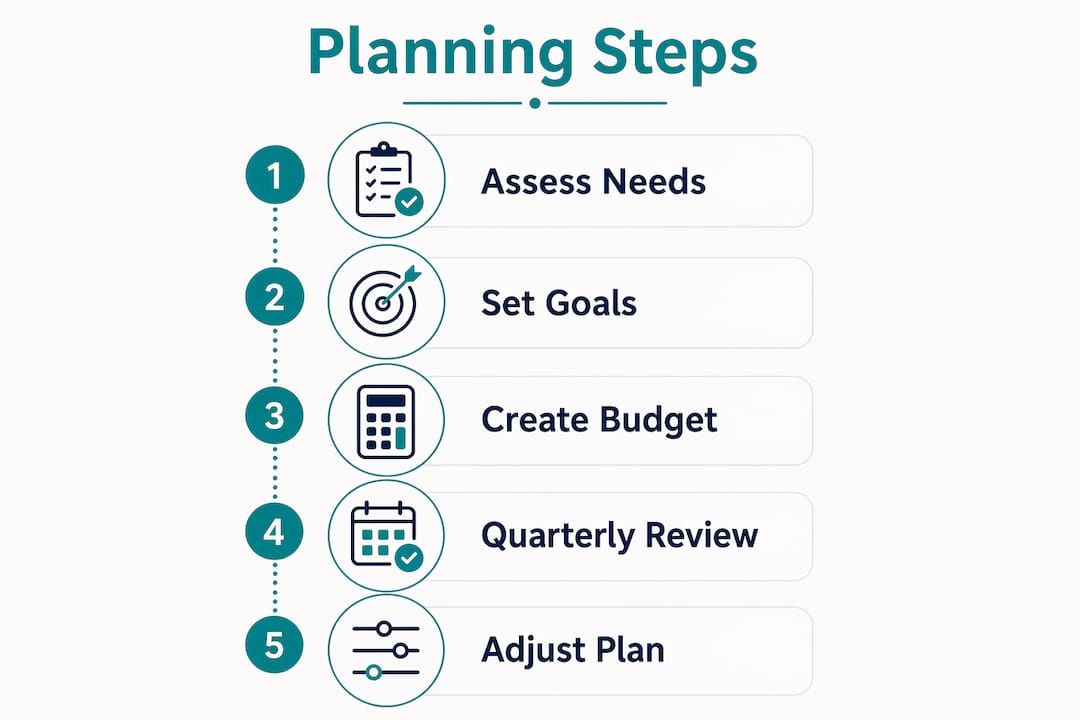
A five-year plan gives your future a shape. Quarterly reviews and milestone check-ins keep that shape flexible and aligned with what is actually happening in your life. Without scheduled reviews, even a solid plan becomes stale within six months.
Pro Tip: Set a recurring calendar reminder every three months to review your plan. Treat it like a doctor's appointment. It is that important.
The table below summarizes the core tools and what each one does for you.
| Tool or framework | Purpose |
|---|---|
| 60/30/10+15 budget model | Allocates income across essentials, retirement, emergencies, and cash reserves |
| Five-year life plan | Provides a long-range roadmap for housing, health, and financial goals |
| Quarterly plan review | Keeps your plan current and responsive to real-life changes |
| Emergency fund (3–6 months) | Covers unexpected costs without derailing long-term savings |
| A/B/Z contingency framework | Builds backup paths for housing, health, and support decisions |
Research from ClearPoint Strategy shows that focused plans with 5–6 objectives are far more effective than sprawling lists of goals. Fewer objectives means more energy for each one. That is a principle worth taking seriously when you are managing your future on your own.
How to create a personalized plan for aging alone
Many adults over 50 living alone underestimate the value of tying health, finances, and social plans into one coherent strategy. A plan that only covers money but ignores housing or support networks will leave real gaps. Your personal plan needs to address all three areas together.
Here is a step-by-step process to build yours:
- Assess your current situation. Write down your health status, monthly income and expenses, living arrangement, and the names of people you trust. Be honest. This is your baseline.
- Set measurable goals. "Stay safe at home" is not a goal. "Install grab bars in the bathroom by March and schedule a home safety assessment by June" is. Concrete targets are trackable.
- Map your support network. Identify at least three people who can help in different ways: a neighbor for daily check-ins, a friend for medical appointments, and a professional advocate or attorney for legal decisions.
- Build contingency paths. The A/B/Z framework gives you an ideal path (Plan A), a solid alternative (Plan B), and a fallback if everything changes (Plan Z). For solo agers, this might mean Plan A is aging in place, Plan B is a senior living community, and Plan Z is a life care plan with professional support.
- Write it down and share it. A plan that lives only in your head cannot help anyone else act on your behalf. Put it in writing and give a copy to at least one trusted person.
- Schedule your first review. Set a date three months from today to revisit every item. Update what has changed. Add what you missed.
Pro Tip: Agingsolo's life care plan guide walks you through building a personalized document that covers health decisions, housing preferences, and emergency contacts in one place.
Integrating community resources into your plan is not a sign of weakness. It is smart strategy. Local Area Agencies on Aging, AARP, and community senior centers all offer services that can fill gaps your personal network cannot.

What are common mistakes in planning ahead and how do you avoid them?
The most common planning mistake is confusing activity with progress. Writing a to-do list feels productive. But confusing tasks with outcomes is one of the leading causes of plan failure. A task says "research Medicare supplement plans." An outcome says "enroll in a Medicare supplement plan that covers my top three specialists by October 1."
Here are the mistakes solo agers make most often, and how to sidestep each one:
- Setting too many goals at once. More than six objectives splits your focus and leads to burnout. Pick the most urgent three and build from there.
- Skipping scheduled reviews. A plan without a review date is just a wish list. Without quarterly check-ins, plans drift out of alignment with real life within months.
- Planning only for the best case. If your plan only works when everything goes right, it is not a plan. Build in at least one backup path for housing, health, and finances.
- Keeping the plan private. If no one else knows your preferences and wishes, they cannot act on them when you need help most.
- Treating the plan as finished. A repeatable planning framework increases your chance of success by 2.5 times compared to a static document. Planning is a cycle, not a one-time event.
"Plans are tools to provide direction and flexibility, requiring regular check-ins to adjust to life's uncertainties rather than rigid adherence." FranklinCovey
Pro Tip: After each quarterly review, write one sentence describing what changed and why. Over time, this creates a record of your decision-making that is genuinely useful if you ever need to explain your choices to a doctor, attorney, or family member.
How do financial preparedness and emergency savings impact solo agers?
Financial security is the backbone of independence. Without it, every other part of your plan becomes fragile. The numbers here are sobering: 60% of Americans feel uncomfortable with their emergency savings levels. That means most people are one unexpected expense away from real stress. For solo agers, that stress lands entirely on one person.
Fidelity recommends keeping 3–6 months of expenses in an accessible emergency fund, plus a minimum of $1,000 in liquid cash for immediate needs. That two-layer approach covers both short-term surprises and longer disruptions like a health event or home repair.
Here is how to think about the two layers:
- Immediate reserve ($1,000 minimum in cash or checking). This covers urgent, unexpected costs without touching savings or going into debt.
- Emergency fund (3–6 months of expenses in a savings account). This covers a job loss, a medical event, or a major home repair without derailing your long-term retirement savings.
The financial safety checklist from Agingsolo is a practical starting point for auditing both layers. It walks you through what you have, what you need, and what to do next.
Long-term planning for success also means budgeting with intention. The 60/30/10+15 model works because it treats every category as non-negotiable. When retirement savings and emergency reserves are fixed line items, they do not get crowded out by daily spending. That discipline is what separates people who feel financially secure from the 60% who do not.
Key takeaways
Solo agers who plan ahead with clear goals, regular reviews, and layered financial reserves are far more likely to maintain independence and safety as they age alone.
| Point | Details |
|---|---|
| Start with a clear baseline | Assess your health, finances, and support network before setting any goals. |
| Limit goals to 5–6 objectives | Focused plans with fewer objectives are more effective and easier to maintain. |
| Build a two-layer financial reserve | Keep $1,000 in liquid cash plus 3–6 months of expenses in a savings account. |
| Review your plan every quarter | Scheduled check-ins prevent plans from drifting out of alignment with real life. |
| Use the A/B/Z framework | Build backup paths for housing, health, and support so you are ready for the unexpected. |
Why I think most people wait too long to start
I have seen this pattern more times than I can count. Someone in their late 50s or early 60s knows they should have a plan. They feel the pull of it. But the plan never quite gets started because it feels too big, too final, or too much like admitting something they are not ready to admit.
Here is what I have learned: the people who start early do not have more certainty. They just have more options. Planning earlier genuinely creates more choices about where you live, who supports you, and how your money works for you. Waiting does not make the decisions go away. It just makes them harder.
The other thing I want to say plainly is this: a plan does not have to be perfect to be useful. A one-page document with your emergency contacts, your financial accounts, your housing preferences, and your health wishes is infinitely more useful than a polished binder that never gets finished. Start small. Write down three things today. Build from there.
The mental relief that comes from having even a rough plan in place is real. It is not just peace of mind in the abstract. It is the concrete feeling of knowing that if something happens tomorrow, there is a path forward. That feeling is worth more than any single financial product or service I have ever seen.
— Mike
How Agingsolo helps you build your plan
If you are ready to move from thinking about your future to actually building a plan for it, Agingsolo has the tools to help you get there.
The Aging in Place guide covers home safety, support options, and the practical steps for staying independent in your own home. The Life Care Plans guide helps you build a personalized document that covers health decisions, housing preferences, and emergency contacts. Both resources are written specifically for solo agers, with no jargon and no assumptions about who is in your corner. You can also explore the full resource clearinghouse for guides, checklists, and tools organized by topic. Whatever stage of planning you are in, there is a practical next step waiting for you.
FAQ
What does planning ahead mean for adults 50+ living alone?
Planning ahead means making deliberate decisions now about your health, finances, housing, and support network so you are not forced into reactive choices later. For solo agers, it includes building emergency savings, identifying trusted contacts, and documenting your preferences in writing.
How many goals should my personal plan include?
Research from ClearPoint Strategy shows that 5–6 focused objectives produce the best outcomes. More than six goals splits your attention and reduces follow-through.
How much money should I have in an emergency fund?
Fidelity recommends saving 3–6 months of living expenses in an accessible account, plus a minimum of $1,000 in liquid cash for immediate needs. Solo agers with no backup income source should aim for the higher end of that range.
How often should I review and update my plan?
Quarterly reviews are the standard recommendation for keeping a plan current and realistic. An annual review is the minimum. Life changes faster than most plans account for, and a review cycle keeps yours from becoming outdated.
What is the A/B/Z framework and why does it matter for solo agers?
The A/B/Z framework means building three paths: your preferred plan (A), a solid alternative (B), and a fallback if circumstances change significantly (Z). For solo agers, this contingency approach is a recognized best practice because it builds resilience into your plan from the start.