

TL;DR:
- Retirement planning for solo agers emphasizes building a financial safety net with layered accounts and healthcare strategies. Saving 15% annually and sequencing withdrawals tax-efficiently help secure a durable retirement. Addressing health and housing plans alongside finances reduces risks unique to living alone without support.
Retirement planning is the process of strategically preparing your finances to support a secure, independent life throughout your retirement years. For solo agers, adults over 50 without a spouse, partner, or nearby adult children, that process carries extra weight. You are building a safety net without a co-pilot. The good news is that tools like Social Security benefits, 401(k)s, Roth IRAs, and Health Savings Accounts (HSAs) give you real options. Fidelity recommends saving 15% annually of pre-tax income as a baseline. Knowing where to start makes all the difference.
How much should you save for retirement?
The savings rate is the single most powerful variable in your retirement outcome. Fidelity's research shows that saving 15% annually from age 25 through 67 positions most people to generate about 45% of their retirement income from personal savings. Social Security and other income sources cover the rest.
That 15% figure assumes you retire at 67, the full Social Security benefit age for most people born after 1960. Retiring earlier changes the math significantly. Here is how the picture shifts depending on your target retirement age:
- Retire at 67. Save 15% of pre-tax income annually. This is the baseline most financial planners use.
- Retire at 62. You need a higher savings rate, often 20% or more, because your portfolio must last longer and Social Security benefits will be reduced if claimed early.
- Retire at 70. A lower savings rate may work because delayed Social Security claiming increases your monthly benefit, and your portfolio has more time to grow.
- Starting late (age 50+). Catch-up contributions and aggressive savings in your final working years can still meaningfully improve your outcome. Every additional dollar saved now reduces the gap.
The practical question is: how large does your portfolio need to be? A common rule of thumb is to multiply your expected annual spending by 25. If you plan to spend $50,000 per year in retirement, you need roughly $1,250,000 saved. That figure assumes a 4% annual withdrawal rate, which many financial planners treat as a sustainable long-term draw.
Pro Tip: If you are starting or increasing your savings rate after 50, do not wait for a "perfect" number. Increasing your savings by even 2–3 percentage points today compresses the gap faster than you might expect.

What are the best retirement accounts for solo agers?
The best retirement accounts are not chosen one at a time. They are layered in a specific sequence to capture every available tax advantage. For solo agers, this layering matters even more because you do not have a spouse's income or benefits to fall back on.
The priority sequence for contributions
Start with your employer's 401(k) or 403(b) plan, but only up to the amount needed to capture the full employer match. That match is an immediate 50–100% return on your contribution. After capturing the match, shift to a Roth IRA or Traditional IRA depending on your current tax bracket. Then return to your 401(k) to maximize contributions. Finally, fund an HSA if you have a qualifying high-deductible health plan.
Catch-up contributions after 50
The IRS allows larger contributions once you turn 50. 2026 contribution limits include $23,500 for a 401(k) with a $7,500 catch-up for adults 50 and older, and $7,000 for an IRA with a $1,000 catch-up. That means you can contribute up to $31,000 to a 401(k) and $8,000 to an IRA in 2026. These limits are not trivial. Maxing both accounts adds nearly $39,000 per year to your retirement savings.
Comparing account types for 2026
| Account | Tax treatment | 2026 limit (50+) | Key benefit |
|---|---|---|---|
| 401(k) / 403(b) | Pre-tax contributions, taxable withdrawals | $31,000 | Employer match, high limit |
| Traditional IRA | Pre-tax contributions, taxable withdrawals | $8,000 | Tax deduction now |
| Roth IRA | After-tax contributions, tax-free withdrawals | $8,000 | Tax-free growth and income |
| HSA | Triple tax advantage | $4,300 individual / $8,550 family | Medical cost coverage |
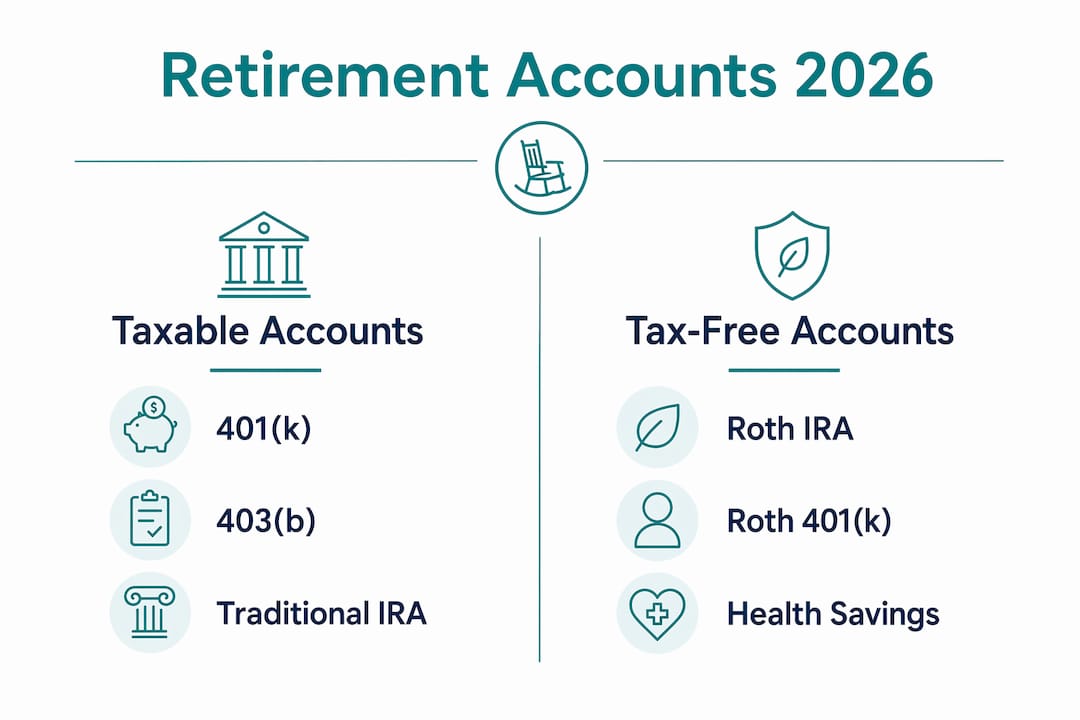
The Roth IRA and Traditional IRA differ in one critical way. A Roth IRA uses after-tax dollars now and grows tax-free. A Traditional IRA reduces your taxable income today but creates a tax bill at withdrawal. Holding both gives you flexibility to draw from whichever account creates the lower tax burden in any given year.
Pro Tip: Professional advisor coordination can add about 3% in net annual returns through better portfolio management and tax planning. For solo agers managing complex accounts without family support, that guidance pays for itself.
Why health care costs belong in your retirement plan
Health care cost inflation consistently outpaces general inflation. That gap compounds over a 20 or 30-year retirement. Fidelity's guidance is direct: health care must be integrated as a primary financial component of your retirement plan, not treated as an afterthought.
For solo agers, this is not optional. Without a spouse or adult child nearby, you carry the full weight of medical decisions and costs alone. A single health event can derail a plan that looks solid on paper.
Here is what a health-aware retirement plan includes:
- An HSA funded to its annual maximum. The HSA offers a triple tax advantage: contributions are pre-tax, growth is tax-free, and qualified medical withdrawals are tax-free. No other account does all three.
- A realistic health care cost estimate. Build a specific dollar figure into your retirement budget for premiums, out-of-pocket costs, dental, vision, and long-term care.
- A life care plan. This document outlines your medical wishes, names a health care proxy, and gives trusted people the authority to act on your behalf if you cannot.
- Telehealth access. Managing routine care remotely reduces both cost and logistical burden, especially if mobility becomes a concern later.
- A plan for housing transitions. Planning senior living transitions early gives you options instead of forcing rushed decisions during a health crisis.
The absence of a built-in caregiver is the defining financial risk for solo agers. Naming proxies and building a financial safety checklist are not just emotional preparations. They are financial ones.
How do you optimize retirement income as a solo ager?
Retirement income optimization means treating Social Security, personal savings, and any guaranteed income sources as one connected system. BlackRock's research shows that combining annuities with growth assets can increase annual spending ability by 29% and reduce downside risk by 33%. That is a significant improvement over a traditional stock-and-bond portfolio alone.
Social Security claiming strategy
Claiming Social Security at 62 reduces your monthly benefit permanently. Waiting until 70 increases it substantially. The break-even point for most people is around age 80. If you are in good health and have other income to draw from in your early 60s, delaying Social Security is one of the highest-return decisions available to you.
Tax-smart withdrawal sequencing
The order in which you draw down accounts determines how much of your savings you keep. The recommended sequence is to spend taxable accounts first, then tax-deferred accounts like Traditional IRAs and 401(k)s, and preserve Roth accounts for last. This approach minimizes your lifetime tax bill and leaves the most tax-efficient assets to grow the longest.
| Strategy | Benefit | Best used when |
|---|---|---|
| Taxable accounts first | Avoids unnecessary tax-deferred growth | Early retirement years |
| Tax-deferred accounts second | Manages RMD exposure | Mid-retirement |
| Roth accounts last | Tax-free income, no RMDs | Late retirement or inheritance |
| Roth conversions at 62–73 | Reduces future RMD burden | Low-income years before RMDs begin |
Strategic Roth conversions between ages 62 and 73 are particularly valuable. Converting portions of a Traditional IRA to a Roth during lower-income years reduces the size of future Required Minimum Distributions (RMDs) and lowers your overall tax liability over time.
Pro Tip: Maintain a cash or bond buffer covering 1–3 years of living expenses. This prevents you from selling investments during a market downturn, which is one of the most damaging things that can happen in early retirement.
Key takeaways
Solo agers who layer retirement accounts, integrate health care costs, and sequence withdrawals tax-efficiently build the most durable financial independence available to them.
| Point | Details |
|---|---|
| Save 15% annually | Fidelity's baseline targets 45% of retirement income from personal savings by age 67. |
| Layer accounts by priority | Capture employer match first, then fund Roth IRA, then maximize 401(k), then HSA. |
| Build health care into the budget | HSAs and life care plans protect solo agers from medical financial shocks. |
| Delay Social Security when possible | Waiting until 70 maximizes monthly benefits and reduces portfolio withdrawal pressure. |
| Sequence withdrawals tax-efficiently | Draw taxable accounts first, tax-deferred second, and Roth accounts last. |
What I have learned about planning alone
Retirement planning for solo agers is not just a financial exercise. It is a declaration of intent. You are saying: I will not leave my future to chance or to whoever happens to be nearby.
What I have seen, again and again, is that the people who struggle most in later life are not those with the smallest savings. They are the ones who never built a plan that connected their money to their health, their housing, and their daily life. A 401(k) balance does not tell you where you will live at 80 or who will make decisions if you cannot. A real plan does.
The financial piece matters enormously. But for solo agers, the non-financial pieces carry equal weight. Who is your health care proxy? Do you have a life care plan? Have you thought through what happens if you need to move? These are not morbid questions. They are the questions that keep you in control.
My honest advice is this: start with the money, because it gives you options. Then build outward. Add the health plan, the housing plan, the support circle. Adjust every year. The plan you build at 55 will look different at 65, and that is exactly right. Flexibility is not a weakness in a retirement plan. It is the whole point.
— Mike
Start your solo aging plan with Agingsolo
Agingsolo is built specifically for adults who are planning their future without a built-in support system. Whether you are just starting to think about retirement finances or you are ready to fill in the gaps around health care, housing, and daily safety, the guides and checklists here are designed for your situation.
Explore the solo ager's planning guide to understand why starting earlier creates more options and less stress. If you are ready to think beyond finances, the aging alone resource covers everything from safety and independence to building the support circle that replaces what others take for granted. Your plan does not have to be perfect. It just has to be yours.
FAQ
How much should I save for retirement each year?
Save at least 15% of pre-tax income annually if you plan to retire at 67. Retiring earlier requires a higher savings rate to compensate for a longer retirement period and reduced Social Security benefits.
What is the best retirement account for someone over 50?
No single account is best. The most effective approach layers a 401(k) up to the employer match, a Roth IRA for tax-free growth, and an HSA for medical costs. 2026 catch-up limits allow adults 50 and older to contribute up to $31,000 to a 401(k) and $8,000 to an IRA.
Should I hire a retirement planner as a solo ager?
Yes. Professional financial advisor coordination can add about 3% in net annual returns through better tax planning and portfolio management. For solo agers without family financial support, that guidance is especially valuable.
When should I claim Social Security?
Claiming at 62 permanently reduces your benefit. Waiting until 70 maximizes it. If you are in good health and have other income sources, delaying Social Security is one of the highest-return decisions available in retirement income planning.
What is the right order to withdraw retirement savings?
Spend taxable accounts first, then tax-deferred accounts like Traditional IRAs, and preserve Roth accounts for last. This sequence minimizes lifetime taxes and keeps your most tax-efficient assets growing the longest.