

Cohousing reduces social loneliness and creates a steady layer of daily mutual support for childless solo agers — but it is not a substitute for formal medical care, legal advocacy, or financial planning. A 2026 Frontiers study found that cohousing residents report less social loneliness and greater perceived social support even after controlling for income and education. That is meaningful. Still, the role of co-housing in childless aging is best understood as one piece of a larger, intentional plan.
Before you explore communities, put these three anchors in place:
- Health-care proxy: name someone who can make medical decisions if you cannot
- Durable power of attorney: designate a trusted person to manage finances
- Geriatric care manager contact: identify a professional who can coordinate care if your needs increase
Pro Tip: Write these three names on a single index card and keep it with your passport. That card is the beginning of your solo-aging safety net.
Table of Contents
- What cohousing is and how it differs from other senior housing
- Evidence-based benefits of cohousing for solo agers
- What cohousing cannot reliably provide
- How cohousing fits into your proactive solo-aging plan
- How to find, evaluate, or start cohousing in the U.S.
- Alternatives and hybrid approaches worth considering
- Key Takeaways
- Cohousing is a tool, not a rescue plan
- Agingsolo can help you build that plan
- Useful sources
- FAQ
What cohousing is and how it differs from other senior housing
Cohousing is a self-managed residential model where adults live in private units clustered around shared common spaces — a kitchen, garden, workshop, or lounge — and operate under mutual-support norms. Residents own or rent their own homes. The community governs itself, usually through consensus or a co-op or HOA structure.
That is very different from what most people picture when they hear "senior housing":
- Assisted living: operator-run, licensed, with onsite staff providing personal care
- Continuing care retirement communities (CCRCs): tiered campuses offering independent living through skilled nursing, typically requiring a large entrance fee
- Memory care or skilled nursing: licensed medical facilities with 24-hour clinical oversight
- Cohousing: resident-governed, low shared services, no onsite medical staff by default
Cohousing can contract in paid aides or home-health workers, but it remains a residential housing option rather than a licensed care facility. That distinction matters when you are planning for what happens if your health needs grow.
Evidence-based benefits of cohousing for solo agers
The main health contribution of cohousing works through psychosocial pathways. The built environment creates daily opportunities for reciprocity — a shared meal, a neighbor who notices you did not pick up your mail, a ride to a medical appointment — and those small moments compound over time.
"Senior cohousing stands out as an innovative and promising alternative for aging in community, offering a balanced combination of housing and social interaction that fosters mutual support among residents." — International Journal of Integrated Care scoping review
Documented outcomes from peer-reviewed research include greater perceived social support, more social engagement, and improved self-rated wellbeing. Practical daily advantages include shared meals and neighbor check-ins, task-sharing for rides and groceries, and a local network that can extend independence well beyond what living alone typically allows.
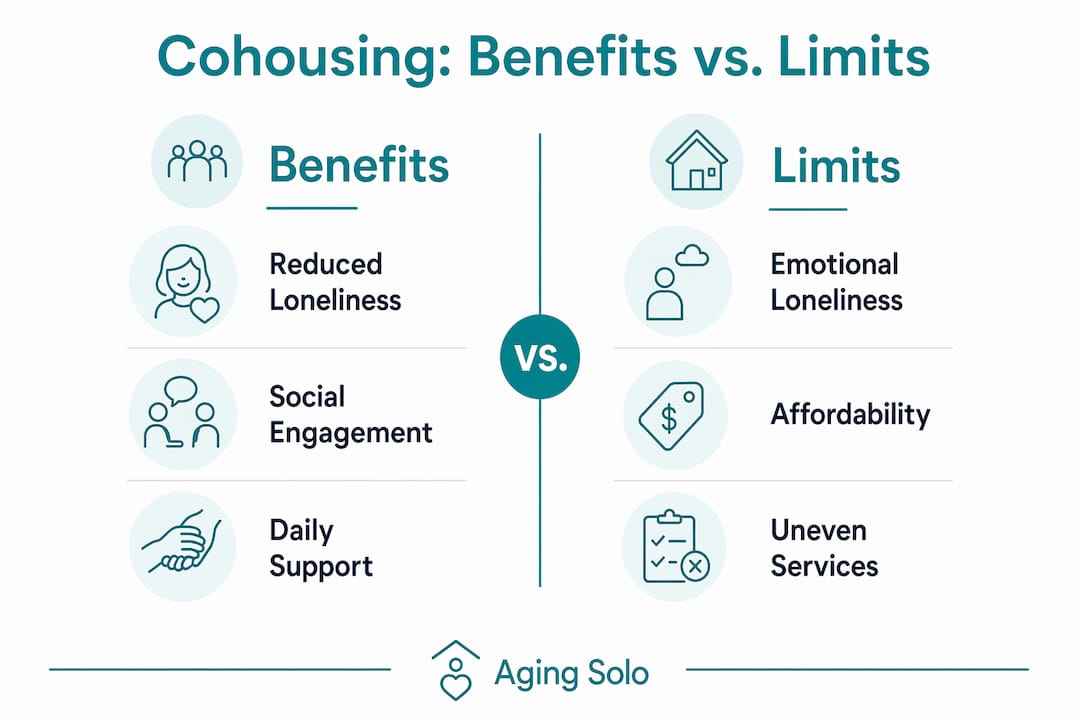
One important nuance: cohousing reduces social loneliness reliably, but emotional loneliness — the kind that follows the loss of a partner or close friend — can persist even in a warm community. Cohousing gives you neighbors, not a replacement for deep personal bonds.
| Benefit | What the evidence shows |
|---|---|
| Social loneliness | Reduced, even after adjusting for income and education |
| Perceived social support | Greater among cohousing residents vs. solo dwellers |
| Daily instrumental help | Shared errands, meals, and check-ins documented across studies |
| Emotional loneliness | Persists after partner loss; not fully resolved by community |
| Lifestyle markers | Healthier patterns reported, but largely explained by socioeconomic selection |
Pro Tip: If you are evaluating a community, ask current residents directly: "What do you actually do for each other day to day?" Their answers will tell you more than any brochure.
What cohousing cannot reliably provide
Cohousing is not a care delivery model. Research consistently notes that it cannot substitute for specialized medical care or 24-hour support for people with high needs. Neighbors act as informal intermediaries — they can notice a problem and alert a family member or social service — but they do not replace a health-care proxy, a paid aide, or a clinical team.
The main risks for childless solo agers fall into four categories:
- Medical gaps: No onsite clinical staff; if your needs increase, you will need to layer in paid services or transition to a higher-care setting.
- Governance burden: Consensus-based decision-making is slow. Committees, shared tasks, and meal coordination require real time and energy — often underestimated by prospective residents.
- Social exclusion: Interpersonal conflict happens in close communities. Residents sometimes limit personal-care tasks for privacy or liability reasons, a pattern researchers call "boundary work."
- Availability and cost: Cohousing options are limited in many U.S. markets. Zoning hurdles, financing complexity, and waitlists are common, and projects often take several years to organize.
Affordability is also uneven. Many existing communities skew toward higher-income, higher-education residents, which means the psychosocial benefits you read about may partly reflect who can afford to join.
Pro Tip: Before joining any community, ask for the governance documents and attend at least two community meetings as a guest. Watch how disagreements are handled.
How cohousing fits into your proactive solo-aging plan
Cohousing works best as one layer inside a broader plan, not as the plan itself. Geriatric experts consistently advise that solo agers need legal and financial safeguards in place before relying on any community model.
Legal and financial anchors to secure first:
- Durable power of attorney and health-care proxy (name someone younger and nearby when possible)
- Advance directive or living will
- A documented emergency plan with contacts, medications, and provider information
- Review of long-term care insurance or self-funding alternatives
Health supports to layer in:
- Identify a geriatric care manager before you need one
- Confirm your primary care provider is accessible from the community's location
- Plan explicitly for what happens if your care needs exceed what neighbors can offer
Financial planning for cohousing specifically:
| Cost category | What to plan for |
|---|---|
| Entrance fee or equity buy-in | Varies widely; some communities require significant upfront capital |
| Monthly dues | Covers shared utilities, maintenance, and common-space costs |
| Contingency fund | Reserve for repairs, accessibility modifications, or care transitions |
| In-home care budget | Estimate costs for paid aides if needs increase |
A life care plan that maps your housing, health, and financial decisions together is the most practical way to hold all of this at once.
How to find, evaluate, or start cohousing in the U.S.
Where to search:
- The Cohousing Association of the United States (CohoUS) maintains a national directory
- Local housing nonprofits and community land trusts sometimes sponsor or support cohousing projects
- Agingsolo's housing options guide covers the full spectrum of models
Evaluation checklist:
- Cost and financing model (co-op shares, HOA dues, rental, or shared equity)
- Governance style (consensus, co-op board, HOA)
- Level of shared services and care access
- Accessibility features (single-story units, grab bars, wide doorways)
- Proximity to your primary care provider and specialists
- Waitlist length and realistic move-in timeline
- Community culture: age range, shared values, activity level
"Cohousing is your average 55 and older community, where you're living independently — but the members share a foundation of what's important to us in our senior years, and here, it's mutual support." — Resident quoted in The Guardian, July 2025
If you want to start a project, expect a realistic timeline of 2–5 years or more. Key steps include forming a legal entity (co-op or HOA), securing seed capital, completing a zoning review, and recruiting aligned members. Upfront cost categories typically include legal fees, architectural design, land or building acquisition, and financing costs.
Pro Tip: The early planning advantage is real: solo agers who start researching cohousing five or more years before they need it have far more options than those who wait for a health event to prompt the search.
Alternatives and hybrid approaches worth considering
Cohousing is not the only path to community living for elderly adults. Several models can work alongside it or instead of it:
- Shared housing: two or more unrelated adults share a home, splitting costs and daily tasks; lower barrier to entry than cohousing
- Village programs: neighborhood-based networks where members pay dues and receive volunteer or low-cost services; no relocation required
- Accessory dwelling units (ADUs): a smaller unit on a property shared with a trusted person; useful when you want proximity without full community governance
- Naturally occurring retirement communities (NORCs): existing neighborhoods where older adults have aged in place together; some receive formal service coordination
- CCRCs: higher cost and governance complexity, but offer a continuum from independent living to skilled nursing in one location — a strong fit for solo agers who want to avoid multiple moves
- Hybrid cohousing with paid care: live in a cohousing community and contract in-home aides, concierge medical services, or a geriatric care manager as needs grow
When medical needs are high, financial resources are limited, or you prefer less governance work, one of these alternatives may serve you better than traditional cohousing. Proactive wellness habits also extend the window during which any of these lighter-touch models remain viable.
Key Takeaways
Cohousing reduces social loneliness and strengthens daily mutual support for childless solo agers, but it must be paired with formal legal, financial, and medical planning to be safe and sustainable.
| Point | Details |
|---|---|
| Cohousing reduces social loneliness | Research shows less social loneliness and greater perceived support, even after adjusting for income. |
| Emotional loneliness can persist | Community living does not fully resolve grief or loss of close relationships. |
| Legal and financial anchors come first | Secure power of attorney, health-care proxy, and advance directives before committing to any community. |
| Governance requires real time | Consensus processes and committee work are ongoing; underestimating this is the most common mistake. |
| Agingsolo supports your full plan | Free checklists, planning guides, and a Solo Aging Clarity Session help you map housing, legal, and care decisions together. |
Cohousing is a tool, not a rescue plan
Most articles about cohousing read like a sales pitch. The community is warm, the neighbors are wonderful, and the loneliness problem is solved. That framing does a disservice to solo agers who are making real, consequential housing decisions.
The research is genuinely encouraging. Daily reciprocity, shared meals, and a neighbor who notices when something is off — these things protect cognitive and emotional health in ways that matter. But the same studies that document those benefits also document the limits: governance fatigue, boundary work, and the hard reality that cohousing cannot step in when clinical care is needed.
What I find most useful is treating cohousing the way you would treat any good tool: it does specific things well, and it requires the right conditions to work. Those conditions are legal documents, a named health-care proxy, a geriatric care manager you have already spoken with, and a financial plan that accounts for rising care needs. With those in place, cohousing becomes a genuine asset. Without them, it is a warm place to live that leaves you exposed when it matters most.
The solo agers who thrive in cohousing are not the ones who moved in hoping the community would take care of everything. They are the ones who arrived already prepared.
Agingsolo can help you build that plan
Planning for cohousing means planning for your whole future, not just your next address. Agingsolo offers free downloadable checklists and planning guides covering emergency contacts, legal documents, housing evaluation, and care coordination — the exact steps this article describes.
If you want personalized guidance, the Solo Aging Clarity Session is a 45-minute Zoom call with Mike that produces a concrete next-step roadmap: which documents to prioritize, which housing models fit your situation, and which local resources to contact first. No generic advice. No long-term commitment. Just a clear plan you can act on.
Start with the aging in place guide for a full overview, or go straight to the free checklists and resources to download what you need today.
Useful sources
The claims in this article draw on peer-reviewed research and authoritative practitioner guides. Here is where to go deeper:
- Frontiers in Public Health (2026): "Active Reciprocity" study — supports the psychosocial benefits and socioeconomic selection findings
- PMC6801586: Senior Co-Housing in the Netherlands — benefits, limitations, governance burdens, and boundary work
- Cambridge Core: Cohousing and intermediaries in later life transitions — intermediary roles and the limits of neighbor-provided support
- AARP: Planning for Retirement Without Kids — legal, financial, and housing steps for childless adults
- Aging in Place, Aging in Community Through Cohousing (PPI) — practical community advantages and development timelines
- International Journal of Integrated Care scoping review — broad synthesis of senior cohousing evidence
- Agingsolo: Health and emergency planning — practical templates for the emergency brief described in this article
- Agingsolo: Solo aging explained — foundational context for solo agers new to proactive planning
FAQ
What does cohousing actually do for childless solo agers?
Cohousing reduces social loneliness and provides daily mutual support through shared meals, neighbor check-ins, and task-sharing. It does not replace formal medical care or legal advocacy, so it works best as part of a broader solo-aging plan.
Is cohousing affordable for most solo agers on a fixed income?
Costs vary widely. Some communities use shared-equity or co-op models that are more accessible; others require significant entrance fees or monthly dues. Many existing U.S. communities skew toward higher-income residents, so evaluating the specific financing model of any community you consider is important.
How long does it take to join or start a cohousing community?
Joining an existing community can take months to years depending on waitlists. Starting a new project typically takes 2–5 years or more, given zoning reviews, legal formation, and recruitment timelines.
What legal documents should I have before moving into cohousing?
At minimum: a durable power of attorney, a health-care proxy, and an advance directive. AARP recommends naming someone younger and nearby when possible, since cohousing neighbors are not a legal substitute for these roles.
How does Agingsolo help with cohousing planning?
Agingsolo provides free checklists, planning guides, and a 45-minute Solo Aging Clarity Session that helps you map housing, legal, and care decisions together — giving you a concrete next-step plan tailored to your situation.