

TL;DR:
- Living alone after 50 emphasizes the importance of regular social contact to prevent cognitive decline. Consistent daily habits, especially in sleep, exercise, nutrition, and social engagement, support brain health over time. Addressing sensory health and making small, steady lifestyle changes can maintain mental sharpness effectively.
Living alone after 50 can feel freeing. It can also feel like the quiet gets heavier than expected some days. If you want to stay mentally sharp living solo, that quiet matters more than most people realize. Cognitive health does not maintain itself on autopilot. It responds, steadily and measurably, to the choices you make every single day. The good news is that none of those choices have to be dramatic. Small, intentional habits done consistently are what actually move the needle. This guide walks you through what works, what the research says, and how to build it into a life you actually enjoy.
Table of Contents
- Key takeaways
- Stay mentally sharp living solo: why it starts with social connection
- Six daily habits that protect your brain
- Practical ways to engage your brain and your social life
- Physical health and sensory care for a sharper mind
- My honest take on what actually works
- How Agingsolo supports your mental wellness plan
- FAQ
Key takeaways
| Point | Details |
|---|---|
| Isolation hurts more than loneliness | Objective social isolation predicts cognitive decline more directly than the feeling of loneliness alone. |
| Daily habits compound over time | Consistent small choices around sleep, food, movement, and connection shape how your brain ages. |
| Face-to-face contact still leads | In-person social interaction supports executive function and orientation better than online-only engagement. |
| Combine physical and mental exercise | Pairing cognitive training with physical activity produces stronger brain benefits than either alone. |
| Sensory health is brain health | Managing hearing and vision loss reduces cognitive load and helps prevent social withdrawal. |
Stay mentally sharp living solo: why it starts with social connection
Most people think loneliness is the problem. Researchers have found something more specific. Social isolation and loneliness are not the same thing, and the distinction matters enormously for your brain.
Loneliness is subjective. It is the feeling of being disconnected, even when people are around. Social isolation is objective. It means you genuinely have limited contact with others. You can feel lonely in a crowded room, or feel content living alone with regular contact with friends. The critical finding is that only about 6% of social isolation's effect on cognitive decline is explained by feelings of loneliness. The other 94% is driven by the isolation itself.
That means fixing how you feel is not enough. You need actual, regular contact with other people built into your life.
"Effective cognitive decline prevention requires addressing structural social disconnection, not just the emotional feeling of loneliness." Researchers studying social isolation and brain health consistently reach this conclusion.
Adults living solo are at elevated risk simply by circumstance. There is no built-in daily check-in, no shared meals, no one to notice a shift in your thinking. Knowing this is not a reason to worry. It is a reason to plan. And new-onset loneliness has been shown to trigger an immediate acceleration in cognitive decline across memory, name recall, and orientation. The trajectory changes fast once isolation sets in.
The practical takeaway here is simple: getting regular, real contact with other people is one of the most direct ways to protect your brain. Not as a feel-good bonus. As a structural requirement.
- Schedule it like a medical appointment. Do not wait until you feel like connecting. Make contact a standing commitment.
- Prioritize in-person when possible. Digital connection counts for something, but in-person contact carries more cognitive weight.
- Start with building your support circle. Even two or three consistent contacts can change your cognitive trajectory.
Six daily habits that protect your brain
The AARP Staying Sharp program identifies six pillars that research consistently links to better brain health: eating right, staying socially engaged, managing stress, keeping your brain engaged, exercising regularly, and getting restorative sleep. What makes these pillars powerful is not any single one in isolation. It is the combination, practiced steadily over time.
Dr. Brent A. Bauer of Mayo Clinic puts it plainly: there is no magic food or quick fix. It is the cumulative effect of consistent daily lifestyle choices that shapes how your brain ages. That framing should feel reassuring. You do not need a dramatic overhaul. You need steady repetition of the right basics.
Here is how each pillar translates into a solo lifestyle:
| Pillar | Solo-friendly habit |
|---|---|
| Eating right | Prepare one Mediterranean-style meal per day with fish, olive oil, and greens |
| Social engagement | Schedule two in-person contacts per week, minimum |
| Stress management | Practice 10 minutes of mindfulness or breathing exercises each morning |
| Brain engagement | Spend 20 minutes daily on a new skill, puzzle, or language app |
| Exercise | Walk 30 minutes most days, or follow a simple home strength routine |
| Restorative sleep | Keep a consistent bedtime and eliminate screens 60 minutes before sleep |
The keyword in all of this is consistent. A walk you take three times a week for months is worth far more than a week-long burst of intensive activity.
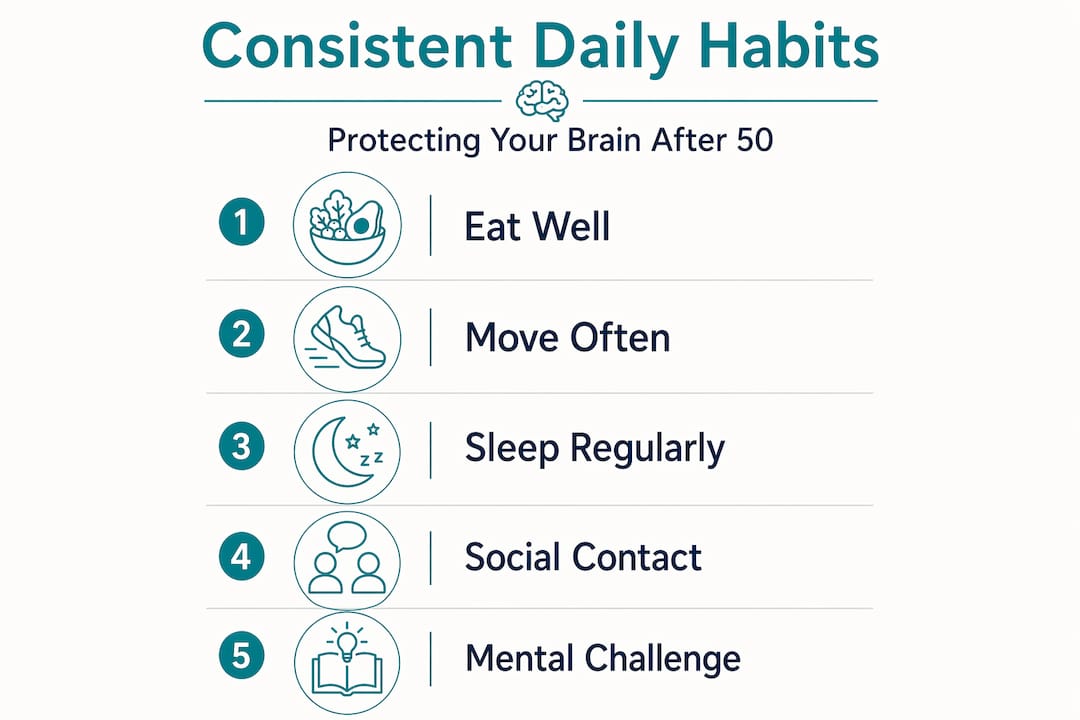
Pro Tip: If six changes feel like too much, start with just two: fix your sleep schedule and add one weekly in-person social commitment. These two alone have the highest individual payoff for brain health.
Practical ways to engage your brain and your social life
Knowing you need social contact and cognitive stimulation is one thing. Finding ways to make it happen when you live alone is another. The options are more accessible than most people expect.
In-person engagement with other people consistently outperforms online-only connection for older adults' cognitive performance across orientation, memory, and executive function over a nine-year window. That does not mean digital tools have no value. It means they work better as a supplement, not a substitute.
Here are practical ways to build genuine social and mental engagement into your week:
- Take a class in person. Community colleges, libraries, and parks and recreation departments all offer low-cost options. The combination of learning something new and being around people hits two pillars at once.
- Volunteer regularly. Even two hours a week in a consistent role gives you a schedule, a social group, and a sense of purpose. All three matter for your brain.
- Join a recurring group activity. A book club, walking group, or weekly card game builds the kind of repeated, familiar social contact that is most cognitively protective.
- Schedule a standing check-in. A weekly call or coffee with the same person is more valuable than sporadic contact with many people.
For purely cognitive training, the most effective strategies pair mental challenge with physical movement. Combining cognitive training with physical exercise produces synergistic benefits for working memory, executive function, attention, and mood. In practice, that might look like taking a brisk walk while listening to a language learning audio lesson, or doing balance exercises while practicing memorization.
- Try crossword puzzles, Sudoku, or strategy games for 15 to 20 minutes daily.
- Learn to play a musical instrument. Even beginner-level practice activates multiple brain regions simultaneously.
- Take a different route on your walk each day to engage spatial reasoning.
- Read books in a genre you do not normally choose. The unfamiliar vocabulary and reasoning demands more from your brain.
Pro Tip: Physical exercise bolsters the effects of cognitive training. A 20-minute walk before a mentally challenging activity is not a warm-up. It is part of the cognitive workout itself.
Physical health and sensory care for a sharper mind
Your brain and your body are running the same system. What drains one drains the other. The habits that support your physical health are not separate from cognitive care. They are the same thing, approached from two directions.

Lifestyle factors including physical activity, sleep quality, blood pressure management, sensory health, and social connection all influence how the brain ages. Addressing just one is better than nothing. Addressing several together is significantly more powerful.
Here is a practical snapshot of where solo adults over 50 get the most return:
| Area | Why it matters | Simple starting point |
|---|---|---|
| Aerobic exercise | Increases blood flow to the brain, supports new cell growth | 30-minute walk, 5 days per week |
| Strength training | Preserves muscle and supports mood and metabolic health | Two sessions per week with bodyweight or light weights |
| Sleep quality | Brain clears metabolic waste during deep sleep | Consistent bedtime, cool room, dark environment |
| Hearing health | Untreated hearing loss increases cognitive load and social withdrawal | Annual hearing check starting at age 60 |
| Vision health | Visual impairment reduces stimulation and contributes to isolation | Regular eye exams, address corrections promptly |
The sensory piece is often overlooked. Research shows that hearing loss can trigger cognitive compensation strategies where the brain works harder to process information, sometimes improving immediate memory encoding in the short term. But over time, untreated hearing loss increases the mental effort required for basic social interaction, which leads to withdrawal. Less social contact means more isolation, which loops back to cognitive decline.
Getting your hearing and vision checked regularly is not just about sensory comfort. It is about keeping your brain from working harder than it needs to just to get through the day. Treating those issues reduces cognitive load and keeps you engaged with the world around you. That engagement is protective.
For a practical guide on staying active and independent while aging alone, Agingsolo has resources built specifically for this.
My honest take on what actually works
I have spent years working with adults navigating solo aging, and one thing has become very clear to me. People consistently overestimate the value of big, one-time changes and underestimate the power of small, boring, repeated habits.
Everybody wants the program, the protocol, or the supplement that will do the heavy lifting. What I have seen actually work is far less exciting. It is the person who walks every morning regardless of how motivated they feel. The one who shows up to the same community group every Thursday, not because it is thrilling, but because it is theirs. Those people consistently hold on to their sharpness longer.
What I have also learned is that addressing loneliness as a feeling is not enough on its own. If the structure of your life leaves you going days without speaking to anyone, focusing on your mood will not fix the cognitive risk. You need to change the structure. That often means making a few deliberate, sometimes uncomfortable decisions about how you spend your time and who you spend it with. It is worth it.
The other thing I want you to hear is this: asking for help building that structure is not a failure. It is exactly the right move. Solo aging with a real plan looks very different from solo aging without one. Start small, stay steady, and let the habits compound.
— Mike
How Agingsolo supports your mental wellness plan
At Agingsolo, the focus has always been on practical, honest support for adults growing older on their own. Staying mentally sharp is not just about brain games or supplements. It is about having a thoughtful plan for your daily life, your social connections, and your long-term wellbeing.
If you are ready to move from general awareness to a real structure, start with the life care planning guide built for solo agers. It walks you through creating a practical framework for independence, decision-making, and support. You can also explore solo aging essentials for a clear starting point that covers the key areas most solo agers need to think through. Every tool on the site is designed for people who are building a genuinely good life on their own terms. You deserve that kind of support.
FAQ
What is the difference between loneliness and social isolation?
Loneliness is the subjective feeling of being disconnected, while social isolation means you objectively have little regular contact with others. Research shows that only about 6% of isolation's effect on cognitive decline is explained by feelings of loneliness, meaning the structural lack of contact drives the risk independently.
How much social contact do you need to protect your brain?
There is no single number, but research on in-person engagement and cognitive trajectory suggests that regular, recurring contact with consistent people matters more than the total quantity. Aim for at least two meaningful in-person interactions per week as a reasonable starting point.
Can exercise really help you think more clearly?
Yes. Combining physical and cognitive exercise produces synergistic benefits for memory, attention, and executive function. A brisk walk before mentally demanding tasks amplifies the cognitive benefit of both activities.
Should I get my hearing checked if I want to stay mentally sharp?
Hearing health directly affects how hard your brain has to work in social settings. Untreated hearing loss can lead to social withdrawal, which increases isolation and cognitive risk. Annual checks starting at age 60 are a practical and often overlooked part of a cognitive health routine.
What is the single most effective habit for cognitive health when living alone?
There is no single best habit, but consistent small lifestyle choices across sleep, movement, nutrition, and social contact compound significantly over time. If you can only change one thing, prioritize regular in-person social contact, since the research on isolation's direct cognitive impact is among the most consistent in the field.