
TL;DR:
- Technology provides continuous safety monitoring for solo agers living independently at home. It includes passive sensors, wearable alerts, and AI systems to improve safety and preserve dignity. Early adoption and personalized choices increase the effectiveness of these solutions.
Technology is the most reliable safety net available to solo agers living independently at home. The role of technology in solo aging safety covers everything from wearable fall detectors to passive home sensors that quietly watch over your daily routines without requiring you to do a thing. For adults 50 and older who live without a nearby spouse, partner, or adult children, these tools fill a real gap. They provide the kind of steady, around-the-clock awareness that no single person or phone call can replicate. Agingsolo has tracked these developments closely, and the evidence is clear: the right technology, chosen thoughtfully, makes independent living both safer and more dignified.
What types of technology support safety and independence for solo agers?
Assistive technology for seniors covers a wide range of tools, and knowing the categories helps you choose what actually fits your life. Each type serves a different purpose, and most work best when combined.
- Wearable alert devices. Smartwatches and medical alert pendants detect falls and send emergency signals automatically. A mobile medical alert smartwatch can detect a fall and contact emergency services without you pressing a single button.
- Passive home sensors. Motion sensors, door contacts, and occupancy detectors track your daily patterns. Wellness monitoring add-ons start as low as $5 per month, with professional 24/7 monitoring available for an additional $5 monthly. That price point puts real-time safety within reach for most budgets.
- Smart home systems. Automated lighting, smart locks, and thermostat controls reduce fall risks and support daily routines. Voice-activated controls let you manage your environment without moving across the room.
- Medication management tools. Automatic pill dispensers and reminder apps reduce missed or doubled doses. This matters because medication errors are a leading cause of preventable hospital visits for older adults.
- Communication tools. Video calling platforms and voice assistants like Amazon Alexa keep you connected to family, friends, and care coordinators. Regular check-ins through these tools provide both social connection and informal safety monitoring.
- AI-powered home monitoring. Systems like Sensi.AI use audio and behavioral pattern analysis to detect changes in health or routine without cameras, preserving your privacy while providing continuous oversight.
Pro Tip: Choose at least one passive monitoring tool that works without any action on your part. On a bad day, you may not be able to press a button or answer a call. Passive sensors work even then.
Devices that use local data processing keep your information off public cloud servers. Local storage options like microSD cards and dedicated home hubs reduce both monthly fees and privacy exposure. That combination of affordability and privacy is worth prioritizing from the start.
How effective and reliable are current technology solutions?
The performance of digital tools for aging alone has improved significantly in recent years. The evidence now supports real confidence in these systems, not just cautious optimism.
Advanced edge-computing fall detection systems achieve over 90% accuracy while processing data locally, meaning your video feed never leaves your home. Millimeter-wave radar systems exceed 0.90 accuracy and F1 scores, detecting falls without any camera at all. That level of precision is meaningful when a fall on a Tuesday evening could otherwise go unnoticed for hours.
Newer vision-based frameworks push performance even further. Integrated real-time safety systems using YOLOv8 detect multiple risks including falls with 93% mean average precision, running at 30–45 frames per second on accessible hardware. These systems require no wearable device, which removes one of the biggest barriers to consistent use.
| Technology type | Accuracy or reliability | Privacy approach |
|---|---|---|
| Millimeter-wave radar fall detection | Over 90% accuracy | No camera; local processing |
| Vision-based AI frameworks (YOLOv8) | 93% mean average precision | Local hardware; no cloud upload |
| Passive motion and door sensors | Pattern-based; flags anomalies | Data stays within home network |
| Wearable medical alert devices | Dependent on user wearing device | Varies by provider |
The table above shows one honest limitation: wearables only work when worn. Many solo agers remove devices at night or during bathing, exactly when falls are most common. Passive systems close that gap.
"Successful tech adoption requires balancing user peace of mind with privacy and dignity, not just hardware selection. Families often overlook the psychological impact of monitoring and user acceptance."
Smart home technologies improve safety, independence, and quality of life for older adults, but impact varies. A systematic review confirms the evidence is promising yet uneven, which means personalized selection matters more than picking the most popular device.
What challenges do solo agers face when adopting safety technology?
Adoption barriers are real, and ignoring them leads to expensive devices sitting in a drawer. The most common obstacles fall into three categories: comfort with technology, privacy concerns, and cost.
- Digital literacy. Many adults 50 and older did not grow up with touchscreens or app-based interfaces. A device that requires frequent software updates or a complex setup process will be abandoned quickly.
- Privacy and dignity. Feeling watched inside your own home creates genuine discomfort. Person-centered technology approaches strengthen personal agency rather than reducing you to a subject of surveillance. The goal is safety on your terms, not monitoring for someone else's peace of mind.
- Cost and subscriptions. Monthly fees add up. A device that costs $80 upfront but requires a $30 monthly monitoring subscription costs over $400 in the first year. Choosing local storage options reduces that ongoing expense significantly.
- One-size-fits-all products. Most consumer devices are designed for average users. Solo agers have specific needs, specific home layouts, and specific health considerations that generic products rarely address well.
Pro Tip: Before buying any device, ask the seller two questions: "Can this work without a monthly subscription?" and "Can I try it for 30 days and return it?" Both answers tell you a lot about whether the product is built for your needs or for recurring revenue.
Families often focus solely on devices and ignore the user's sense of being watched, which directly impacts adoption and effectiveness. The most technically advanced system fails if you refuse to use it. Comfort and trust in the technology matter as much as its specifications.
Introducing technology early while you are still healthy increases your comfort and ability to use devices effectively in an emergency. Learning a system during a calm period is far easier than figuring it out during a health crisis.
How to select and integrate technology into a solo aging safety plan
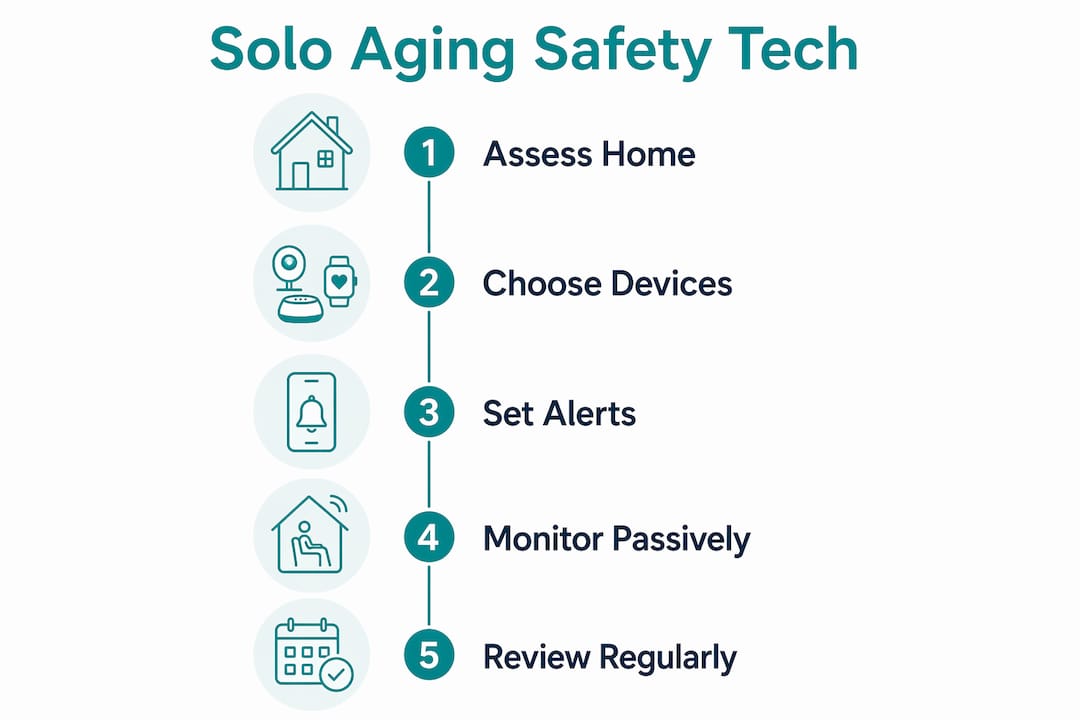
A safety plan built around technology works best when it starts with your actual risks, not with the newest gadget on the market. Here is a practical sequence for building one.
- Assess your specific risk factors. Falls, medication management, and emergency communication are the three most common concerns for solo agers. Identify which applies most urgently to your situation right now.
- Match technology to your abilities and preferences. If you dislike wearing anything on your wrist, a wearable alert device is not your best first choice. A passive motion sensor system or a voice-activated assistant may serve you better.
- Combine passive monitoring with active human support. Medical alert devices alone do not guarantee safety. Combining technology with scheduled caregiver visits or regular check-in calls covers the gaps that automated systems cannot fill.
- Plan for setup and troubleshooting support. Every device eventually needs a reset, a software update, or a battery replacement. Identify one person in your life who can help with these tasks before you need them.
- Schedule a professional home safety assessment. An occupational therapist or certified aging-in-place specialist can identify hazards and recommend specific technology solutions matched to your home layout and health history.
- Review and update your plan annually. Your needs at 62 differ from your needs at 74. A plan that worked well three years ago may have gaps today.
The aging in place guide from Agingsolo walks through this process in detail, including how to evaluate your home for fall risks and which technology categories address each one. The goal is a layered approach: one tool for falls, one for medication, one for communication, and a human backup for everything else.
Key takeaways
Technology for solo aging safety works best when it is layered, personalized, and introduced early rather than chosen in a crisis.
| Point | Details |
|---|---|
| Passive monitoring fills critical gaps | Sensors and AI systems work even when you cannot press a button or answer a call. |
| Fall detection accuracy is high | Edge-computing and radar systems now exceed 90% accuracy while keeping data local. |
| Cost can be managed | Passive monitoring starts at $5 per month; local storage removes recurring subscription fees. |
| Early adoption increases effectiveness | Learning technology while healthy makes it far more useful during an actual emergency. |
| Human support remains necessary | Technology works best when combined with scheduled visits or regular check-in calls. |
What I've learned about technology and solo aging safety
The conversation about assistive technology for seniors tends to focus on the device. Which one detects falls best? Which one has the clearest video? Those are reasonable questions, but they miss the harder one: will you actually use it?
I have seen solo agers invest in well-reviewed systems that ended up unused within six months. The reason is almost never the technology itself. It is the feeling the technology created. A camera in the living room that a family member insisted on. A wearable that felt like a constant reminder of vulnerability. A monitoring app that sent alerts to three relatives without the person's full understanding of what was being shared.
The most effective approach I have observed is one where the solo ager drives the decision. You choose what gets monitored. You decide who receives alerts. You set the boundaries. That sense of control is not a luxury. It is what determines whether the technology stays on and stays useful.
The other thing I would push back on is the idea that technology is a substitute for human connection. It is not. A motion sensor can tell your daughter that you moved through the kitchen at 7:00 AM. It cannot tell her that you are lonely, or that you skipped breakfast, or that something feels off. Technology handles the measurable. People handle the rest. The best solo aging safety plan uses both, deliberately and in proportion.
Start with one tool. Learn it well. Add the next one when the first feels natural. That pace works better than building a full system overnight and feeling overwhelmed by all of it.
— Mike
Agingsolo's resources for safer independent living
Agingsolo has built a library of practical guides specifically for adults who are aging without a built-in support network. These are not generic senior-living articles. They are written for people who are making real decisions about safety, independence, and what happens when they need help.
The technology for aging solo section covers specific tools, how to evaluate them, and how to fit them into a broader safety plan. If you are ready to think through the bigger picture, the aging alone guide covers everything from emergency planning to building a support network from scratch. Both are free, practical, and written with solo agers in mind. Start with whichever feels most urgent right now.
FAQ
What is the role of technology in solo aging safety?
Technology for solo aging safety provides continuous monitoring, fall detection, medication reminders, and emergency communication for older adults living alone. It fills the gap left by the absence of a nearby caregiver or family member.
What is the most effective safety device for elderly living alone?
No single device covers every risk. The most effective approach combines a passive monitoring system with a wearable alert device and scheduled human check-ins, since each covers gaps the others cannot.
How much does remote monitoring for seniors cost?
Passive wellness monitoring starts at $5 per month for basic sensor alerts. Professional 24/7 monitoring adds approximately $5 more monthly. Choosing devices with local data storage removes recurring fees entirely.
When should a solo ager start using safety technology?
The best time to introduce assistive technology is while you are still healthy and not in a crisis. Early adoption gives you time to learn the system and build comfort before you actually need it in an emergency.
Do smart home solutions for seniors protect privacy?
Many current systems use local data processing, meaning your information never leaves your home network. Millimeter-wave radar fall detectors and AI audio monitors like Sensi.AI operate without cameras, offering strong privacy protection alongside reliable monitoring.