

TL;DR:
- Making your home fully accessible on one level is key to long-term independence for solo agers.
- Planning early, including assessments and budget preparation, helps you adapt or relocate on your own terms.
The fastest way to protect your long-term independence is simple: make sure you can sleep, bathe, cook, and do laundry on one level without using stairs. For most solo agers, the transition to single-floor living comes down to three realistic paths.
- Move to a true single-level home where all daily essentials are already on the main floor.
- Remodel your current home to create a main-level primary suite with a full bathroom.
- Adapt in place with targeted changes that reduce stair use while you plan a longer-term move or remodel.
Your first three steps, regardless of which path you choose: schedule an occupational therapist (OT) home assessment, contact your local Area Agency on Aging for free guidance, and consider booking an Agingsolo 45-minute clarity session to build a personalized action plan.
Table of Contents
- Which path fits your situation: move, remodel, or adapt?
- How to build a realistic step-by-step plan
- What safety upgrades should you prioritize first?
- How to downsize without burning out
- How can you pay for a move or home modifications?
- Who should you involve, and what should you ask them?
- What do typical timelines and costs look like?
- What should you do on move day and in the first 30 days?
- Key Takeaways
- The part most planning guides skip
- Agingsolo can help you build your personal plan
- Useful resources for your next steps
- FAQ
Which path fits your situation: move, remodel, or adapt?
Each option has real trade-offs. Knowing them upfront saves time and money.
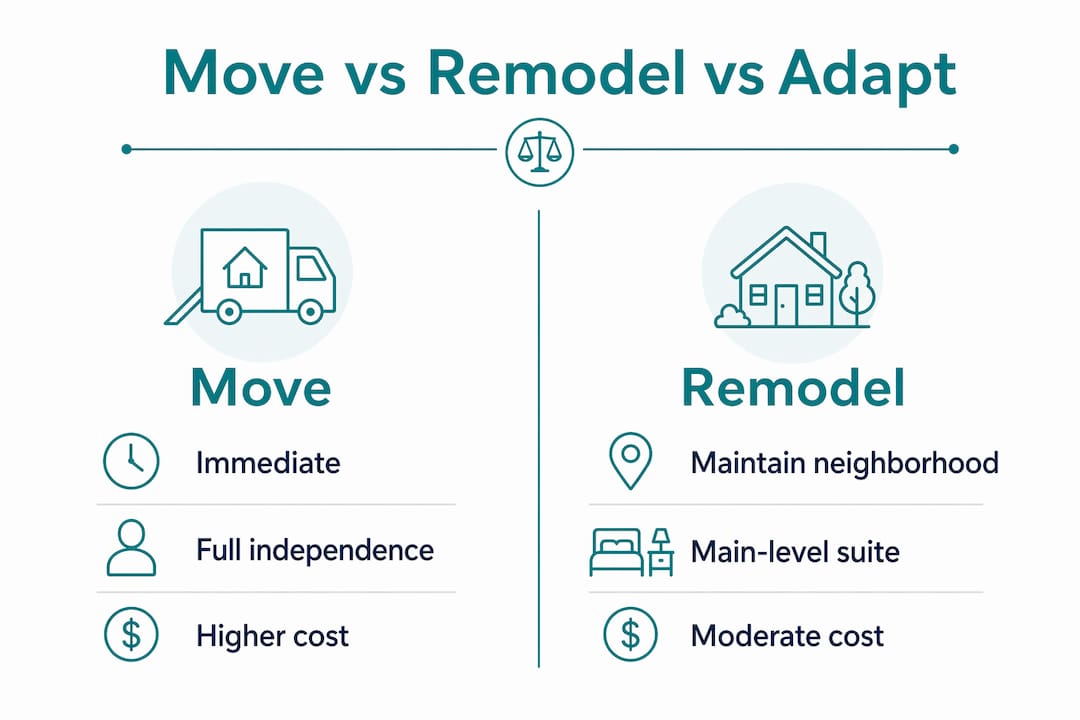
Moving to a single-level home gives you true one-floor independence from day one. Single-level homes consolidate plumbing, HVAC, and electrical systems on one floor, which simplifies maintenance and can reduce energy costs over time. The downside: transaction friction runs 6–8% of your sale price plus buyer closing costs, and the process typically takes 9–18 months from decision to move-in. Emotionally, leaving a long-time home is real work.

Remodeling to create a main-level suite keeps your neighborhood and roots intact. A purpose-built curbless shower and step-free entry can be designed exactly to your needs. Costs can vary widely depending on scope, and construction disruption is real. Structural limits in some homes make a full conversion impractical.
Adapting in place costs the least upfront and buys you planning time. Stair lifts, grab bars, and rearranged sleeping spaces can reduce risk quickly. These are partial solutions, though. A stair lift is a bridge, not a destination.
Three questions to pick your path: How urgent is your mobility risk right now? What's your equity and budget flexibility? How important is staying in your current neighborhood?
How to build a realistic step-by-step plan
Planning early in your mid-50s to mid-60s preserves options and prevents rushed, costly decisions after a health event. Here's a practical sequence.
- Assessment (Month 1–2). Book an OT home-safety assessment. Walk through your home asking: Can I sleep, bathe, cook, and do laundry on the main level today? What would need to change? Get a medical check-in with your primary care provider to understand any mobility trends.
- Prioritize and budget (Month 2–3). Rank must-haves versus nice-to-haves. Get two contractor quotes for retrofit work. Calculate your net proceeds from a potential sale after transaction costs.
- Information gathering (Month 3–6). Research single-level inventory in your target area. Talk to a HUD-approved housing counselor. Contact your Area Agency on Aging about local modification grants.
- Decision and financing (Month 6–9). Choose your path. Secure financing if needed. Finalize your team: OT, contractor, real estate agent, or all three.
- Execution (Month 9–18). Begin remodel work or list your home. Run your downsizing plan in parallel. Set 30/60/90-day milestones so nothing stalls.
What safety upgrades should you prioritize first?
Most indoor falls among older adults happen on level surfaces and in bathrooms, not just on stairs. Eliminating stairs is one part of the picture; bathroom safety is the other.
Do these first (urgent):
- Confirm a main-level full bathroom with a curbless or low-threshold shower.
- Create a step-free entry to your home.
- Clear nighttime pathways between bedroom and bathroom with night-lights.
Near-term (within 3–6 months):
- Install grab bars in the shower and near the toilet.
- Replace slippery bathroom flooring with non-slip surfaces.
- Widen doorways to at least 32 inches if mobility aids are a future possibility.
- Address raised thresholds between rooms.
Longer-term (6–18 months):
- Move laundry to the main level. This removes one of the most frequent stair trips in any home.
- Evaluate exterior ramp options for the main entry.
- Plan any structural additions only after comparing full costs.
Pro Tip: A wellness checklist reviewed with your OT can catch hazards you've stopped noticing — the threshold you step over every day without thinking, the lamp cord across the hallway. Fresh eyes matter.
How to downsize without burning out
Downsizing is as much emotional as logistical. The belongings in a long-time home carry real weight. Working in short, focused sessions keeps the process from becoming paralyzing.
- Work one room at a time. Start with the room you care about least — a guest room, a storage closet. Build momentum before you tackle spaces with more meaning.
- Use four piles every session: keep, sell, donate, trash. No fifth pile. No "maybe" box. Decisions made in the moment stick better than ones deferred.
- Keep sessions to 45–90 minutes. Set a concrete goal for each one: clear two shelving units, choose five items to donate. Stop when the time is up.
- Create a small keepsake box for memory items that don't fit your new space but can't be released yet. Give yourself a deadline to revisit it.
- Bring in an objective helper. A paid professional organizer or a trusted friend who isn't emotionally attached to your things can move the process forward when you stall.
Document valuables before selling or donating. Schedule pickup dates for donations and estate sale items so they leave your home on a fixed timeline, not "eventually."
How can you pay for a move or home modifications?
Funding a transition takes more planning than most people expect. Budget for total transition costs beyond the purchase price: decluttering help, accessibility retrofits, furniture adjustments, and transaction friction all reduce your net proceeds.
Common funding paths in the U.S.:
- Home equity via a home equity line of credit or cash-out refinance for retrofit work.
- Sale proceeds from your current home, after accounting for 6–8% in selling costs.
- FHA 203(k) rehabilitation loans for buyers purchasing a home that needs accessibility modifications.
- VA home modification benefits if you have qualifying military service.
- Local grants and low-interest loans through your Area Agency on Aging or state housing finance agency.
A HUD-approved housing counselor can review your options at no cost. Check your financial safety checklist before committing to any loan. Note that Medicare generally does not cover home modification costs.
This article is general information, not financial or legal advice. Confirm current program eligibility with a qualified professional for your specific situation.
Who should you involve, and what should you ask them?
| Role | Top questions to ask |
|---|---|
| Occupational therapist (OT) | "Can I sleep, bathe, cook, and do laundry on the main level safely?" |
| Contractor (universal design) | "Can you create a curbless shower and step-free entry within my budget?" |
| Real estate agent | "Show me true single-level homes — not split-levels or plans that still require stairs." |
| Geriatric care manager | "What health changes should I plan for in the next 5–10 years?" |
| HUD housing counselor | "What loan or grant programs am I eligible for in my county?" |
Watch for red flags: a contractor with no accessible-design examples, an agent who can't walk through a daily-living scenario with you, or any professional who dismisses bathroom access as a minor detail.
What do typical timelines and costs look like?
| Scope | Typical timeline | Estimated cost range |
|---|---|---|
| Grab bars, lighting, non-slip flooring | 1–6 weeks | — |
| Bathroom conversion, laundry relocation | 1–6 months | $10,000–$80,000 |
| Full main-level suite addition | 3–9+ months | $40,000–$80,000+ |
| Move to a single-level home | 6–18 months (best case: 6–9) | Varies by market |
Targeted safety upgrades like grab bars and curbless showers typically run $10,000–$20,000 for a focused bathroom retrofit. A full suite addition can reach $40,000–$80,000 depending on your home's structure. Emergency-driven moves often exceed 24 months from decision to settled, which is why starting early matters so much.
What should you do on move day and in the first 30 days?
Move day essentials:
- Set up the bedroom and full bathroom before anything else.
- Place night-lights along the path between them immediately.
- Keep a "day-of" bag with medications, phone charger, insurance cards, and emergency contacts.
- Set up your medical alert device or phone before the movers leave.
First 30 days:
- Walk every path at night to check lighting.
- Test all door thresholds for trip hazards.
- Install grab bars if not already in place.
- Program your doctor, pharmacy, and two emergency contacts into your phone.
- Schedule an OT follow-up assessment to catch anything you missed.
Set a 30/60/90-day checklist for remaining retrofit tasks so nothing drifts. Solo agers benefit from staying active and connected after a move, so plan your first social outing or neighborhood walk within the first two weeks.
Key Takeaways
True single-floor independence requires bedroom, full bath, kitchen, and laundry all usable on one level — and the best time to plan that is before a health event forces the decision.
| Point | Details |
|---|---|
| Verify daily essentials on one level | Confirm bedroom, full bath, kitchen, and laundry are all accessible without stairs. |
| Start planning in your mid-50s to mid-60s | Early planning preserves options and avoids rushed, costly moves after a health event. |
| Prioritize bathroom safety first | Most indoor falls happen in bathrooms; grab bars and curbless showers deliver the highest impact per dollar. |
| Budget for total transition costs | Transaction friction, retrofits, and moving help reduce net proceeds more than most people expect. |
| Agingsolo clarity session | A 45-minute Zoom session builds a personalized 30/60/90-day action plan tailored to your home and health. |
The part most planning guides skip
There's a quiet assumption in most downsizing advice: that you have someone to help you sort through it. A partner to say "keep that" or "let it go." A child to drive the donation boxes. For solo agers, that support isn't automatic, and the emotional weight of this transition lands differently when you're carrying it alone.
What I've seen, again and again, is that the people who do this well aren't the ones who feel ready. They're the ones who started before they felt ready. They booked the OT assessment when mobility was still fine. They sorted one closet on a Tuesday afternoon with no particular urgency. They gave themselves permission to treat the plan as a map, not a mandate, something to adjust as they went rather than execute perfectly.
The housing options available to you are genuinely good right now. The market for single-level homes is strong. Modification programs exist. The window to plan on your own terms is open. The only thing that closes it is waiting.
Agingsolo can help you build your personal plan
Planning a move or home modification alone, without a built-in support system, is a different challenge than the generic guides assume. Agingsolo's 45-minute Zoom clarity session is built specifically for that situation.

In a single session, you get a quick triage of your current home and living setup, a 30/60/90-day action list prioritized to your budget and health, and referrals to vetted OTs or contractors when you need them. No generic advice. No homework you can't act on alone. Just a clear, specific next step for your situation.
If you're ready to move from thinking about this to actually planning it, book a clarity session or explore Agingsolo's independence planning resources to get started at your own pace.
Useful resources for your next steps
- Area Agency on Aging (Eldercare Locator) — Find local services, modification grants, and housing counselors by ZIP code. Free and government-run.
- HUD-Approved Housing Counselors — Free loan and housing advice, including FHA 203(k) guidance and reverse mortgage counseling.
- VA Benefits — Home modification and adaptation grants for eligible veterans.
- Agingsolo: Aging in Place Guide — Safety checklists and step-by-step independence planning for solo agers.
- Agingsolo: Solo Living After 50 — Practical guidance on maintaining routines, social connections, and daily independence after a move.
- Agingsolo: Growing Old Alone — Emotional and community support resources for solo agers navigating major life transitions.
FAQ
What makes a home truly single-level for a solo ager?
A true single-level home has the bedroom, full bathroom, kitchen, and laundry all accessible on the main floor without stairs. A home can appear to be one level but still require stair use if the laundry or full bath is upstairs.
When is the best time to start planning this transition?
Starting in your mid-50s to mid-60s gives you the most options and the least pressure. Waiting until a health event forces the decision typically results in a rushed, more expensive move.
A focused bathroom retrofit with grab bars, a curbless shower, and non-slip flooring typically runs $10,000–$20,000. A full main-level suite addition can reach $40,000–$80,000 depending on your home's structure.
Does Medicare cover home modification costs?
Medicare generally does not cover home modification costs. Funding options include home equity, VA benefits for eligible veterans, and local grants through your Area Agency on Aging.
How long does it take to move to a single-level home?
A proactive move typically takes 9–18 months from decision to settled. Best-case timelines run 6–9 months; emergency-driven moves often exceed 24 months.