

TL;DR:
- A structured, theme-based life review helps solo agers find emotional clarity and produce practical safety plans. It involves reflecting on key life chapters and creating legacy artifacts and actionable documents for preparedness. The process can be self-guided using templates and prompts, but safety should be prioritized if emotional risks arise.
A senior life review process is a structured, theme-based reflection where you examine your life's key chapters, extract meaning from them, and turn that meaning into something real: a legacy artifact and at least one concrete planning action, like an updated emergency contact list or a brief life-care note. It is not journaling for its own sake. Done well, it produces both emotional clarity and practical preparedness, which matters especially if you are aging without a built-in support network. Organizations like the National Institute on Aging (NIA) and AARP recognize life review as a meaningful tool for older adults. Agingsolo builds on that foundation with templates and checklists designed specifically for solo agers.
Table of Contents
- Why a life review matters when you are aging alone
- How to conduct a life review as a solo older adult
- Sample prompts and low-cost tools you can use right now
- When a life review becomes emotionally risky
- How to turn your reflections into a real aging-alone plan
- Practical legacy artifacts you can create and preserve
- 10-step checklist to start and finish your life review
- Key Takeaways
- A perspective on life reviews for people aging alone
- Agingsolo has the tools to help you get started
- Trusted sources and further reading
- FAQ
Why a life review matters when you are aging alone
For solo agers, the stakes of reflection are higher than most people realize. Without a spouse or nearby adult child who knows your history, your preferences, and your wishes, that knowledge can simply disappear. A life review gives it a place to live.
The emotional benefits are real. Reviewing your life with intention helps you move from what gerontologists call "despair" toward "ego integrity," the sense that your life has made sense and mattered. Research published in Behavioral Sciences found that life review and reminiscence therapy significantly improved both quality of life and life satisfaction among older adults, with effects on life satisfaction remaining statistically significant even 12 weeks after the intervention ended.
The practical benefits are just as concrete:
- Clearer emergency preferences documented in writing, not just in your head
- Documented life roles (caregiver, professional, community member) that help chosen contacts understand who you are
- A legacy artifact, such as a photo album or a short letter, that you can share with your trusted circle
- A starting point for updating legal documents, beneficiary designations, and health notes
NIA and AARP both offer mental-health and aging resources that can complement what you discover during a review.
How to conduct a life review as a solo older adult
The process works best when organized by theme rather than strict chronology. Theme-based life review connects events to meaning instead of simply reciting a timeline, which is why practitioners consistently recommend it over a purely linear approach. A full review typically unfolds over several sessions; program lengths range from a few weeks to several months depending on depth.
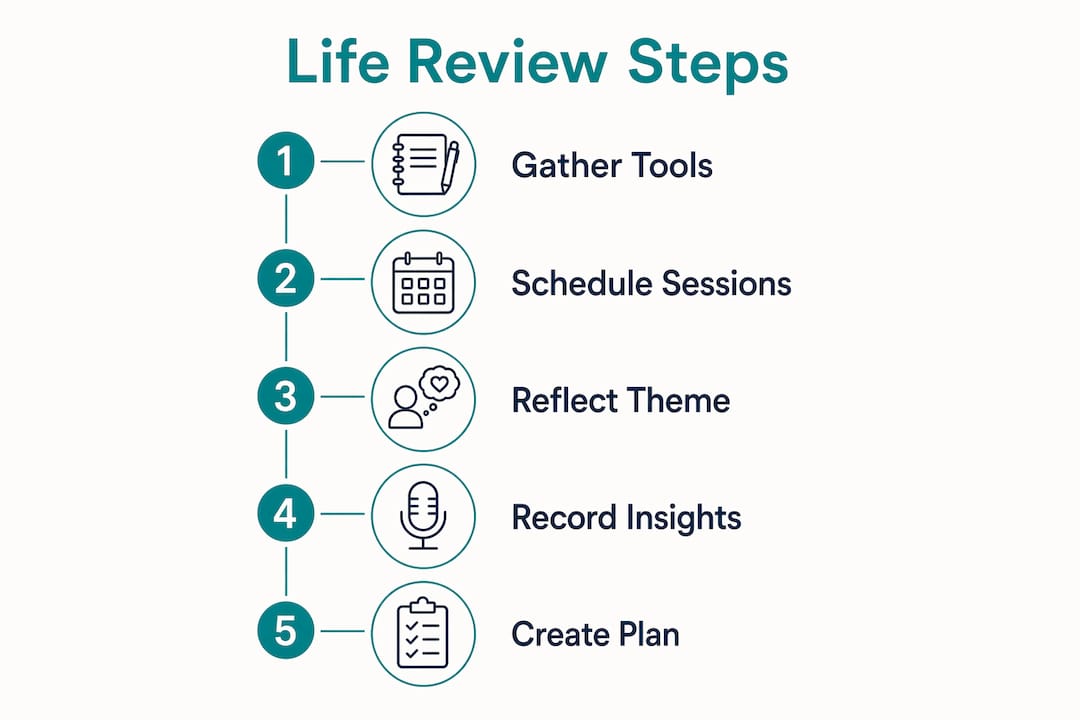
Here is a simple six-step process you can follow on your own:
- Prepare your space and materials (15–30 minutes). Gather photos, documents, and any mementos. Choose a quiet, comfortable spot.
- Choose your themes (15 minutes). Pick three to five areas: family relationships, work and roles, turning points, values, and health.
- Gather artifacts by theme (30–60 minutes). Sort photos, letters, or objects into theme piles or folders.
- Reflect and record (60 minutes per theme). Write, speak, or draw your responses to prompts for each theme.
- Produce one legacy artifact (60–90 minutes). A short letter, a captioned photo set, or a recorded story.
- Extract practical actions (30 minutes). From your reflections, pull at least one planning item: a contact to add, a document to update, a preference to write down.
Materials checklist:
| Item | Purpose |
|---|---|
| Notebook or voice memo app | Capture reflections in real time |
| Photo folder (print or digital) | Organize visual memories by theme |
| Prompt list (see Section 4) | Keep reflection focused |
| Trusted contact sheet | Record names and roles as they surface |
| Folder or binder | Store outputs in one place |
Pro Tip: Limit each session to 60–90 minutes. Emotional fatigue is real, and shorter, spaced sessions tend to produce more honest reflection than one long marathon.
Sample prompts and low-cost tools you can use right now
You do not need a therapist or an expensive program to get started. A voice memo app, a print journal, or a simple photo folder is enough.
Prompts by theme:
- Family: Who taught you the most about love or loyalty? What family tradition do you want someone to remember?
- Work and roles: What work made you feel most alive? What role are you most proud of?
- Turning points: What moment changed the direction of your life? What did you learn from your hardest year?
- Values: What do you believe now that you did not believe at 30? What would you tell a younger version of yourself?
Two quick exercises:
- Five-minute recorded life story (5–10 minutes). Use your phone's voice memo app. Hit record and speak freely about one chapter of your life. No editing. Label the file with the date and theme.
- One-page timeline (20–30 minutes). Draw a simple horizontal line. Mark five to eight turning points with a word or phrase. Note how you felt at each one.
For privacy and durability, save audio files as MP3s and written notes as PDFs. Back up everything to a cloud folder or an external drive, and store the access instructions with your other important documents. Agingsolo's technology tools for solo agers covers simple, low-cost backup options in more detail.
When a life review becomes emotionally risky
There is an important difference between casual reminiscing and a structured life review. Reminiscing is light and social; it aims at mood and connection. A structured life review goes deeper, intentionally examining negative events and unresolved conflicts to create meaning, which can sometimes be emotionally challenging.
Gerontology researchers note that life review can become pathological when unresolved regrets resurface without structured reframing or support. Watch for these warning signs:
- Persistent rumination that does not ease between sessions
- Noticeable changes in sleep or appetite lasting more than a week
- Inability to carry out daily tasks
- Thoughts of self-harm or suicide
"Life review therapy delivered in the home setting can be effective for older adults and may be provided by advanced practice psychiatric nurses, offering a clinically supported path when self-guided work feels too heavy." — PMC: Life Review Psychotherapy
If any warning signs appear, pause the review and reach out. Your primary care provider is a good first call. A licensed therapist with geriatric experience, a geriatric mental-health specialist, or a crisis line (dial 988 in the US) are all appropriate next steps. The support resources for older adults guide on Agingsolo can help you locate providers near you.
This article is general information, not professional medical or mental-health advice. Please consult a qualified provider for your own situation.
How to turn your reflections into a real aging-alone plan
Reflection without action is just memory. The goal here is to convert what surfaces during your review into a one-page plan you can actually use.

One-page plan template:
| Field | What to capture |
|---|---|
| Emergency contacts | Name, relationship, phone for 2–3 trusted people |
| Health notes | Conditions, medications, allergies, primary care provider |
| Legal pointers | Location of advance directive, will, power of attorney |
| Housing preference | Stated preference for aging in place or transition |
| Prioritized tasks | Top 3 actions to complete in the next 30 days |
Legal and medical items to extract from your review:
- Note whether your advance directive reflects your current wishes
- Update your medication list and confirm your primary care provider's contact
- Add a trusted contact to your financial accounts if you have not already
- Check beneficiary designations on any accounts or policies
For storage, keep a printed copy of your one-page plan in a labeled folder at home and a digital copy in a secure cloud folder. Share access instructions with one trusted person, your support circle buddy, not the documents themselves unless you choose to. Agingsolo's life care plan guide walks through each field in detail.
Practical legacy artifacts you can create and preserve
A legacy artifact does not need to be elaborate. The point is that it exists and that someone you trust can find it.
- Photo album with captions: Print 10–20 photos, add a handwritten or typed caption to each, and store in an acid-free sleeve.
- Short memoir letter: One to two pages addressed to a specific person or your future self. Keep it honest and specific.
- Audio or video story: Record yourself telling one story per theme. Label each file clearly (e.g., "2026-06 Family-Turning-Point").
- Simple documented timeline: A printed one-pager with key life events, dates, and a sentence about each.
Save durable formats: PDF for written work, MP3 for audio, MP4 for video. Store one copy at home and one in the cloud. Give a trusted contact the location and access method, not necessarily the content itself.
Pro Tip: If your artifact contains sensitive content (estrangements, health details, financial notes), write a brief cover note explaining who should read it and when. Store that note with your other important documents.
10-step checklist to start and finish your life review
- Choose your three to five themes (15 minutes)
- Gather photos and mementos by theme (30–60 minutes)
- Complete the five-minute recorded life story exercise (10 minutes)
- Work through prompts for Theme 1, writing or speaking your answers (60 minutes)
- Repeat for each remaining theme, one session per theme (60 minutes each)
- Draft your one-page timeline (20–30 minutes)
- Produce one legacy artifact: letter, album, or recording (60–90 minutes)
- Complete your one-page aging-alone plan using the template above (30 minutes)
- Update at least one legal or medical document based on your review (30–60 minutes)
- Back up all files and store access instructions with a trusted contact (15 minutes)
Key Takeaways
A senior life review process works best when it is theme-based, paced across multiple sessions, and designed to produce both a legacy artifact and at least one concrete safety or planning action.
| Point | Details |
|---|---|
| Theme-based structure | Organizing by roles and turning points creates meaning more effectively than a strict timeline. |
| Pacing matters | Limit sessions to 60–90 minutes; full integration often takes weeks to months. |
| Emotional safety | Stop and seek professional help if rumination, sleep changes, or daily-task difficulty persists. |
| Legacy plus planning | Every review should produce one artifact and one updated planning item (contact, document, or preference). |
| Agingsolo resources | Agingsolo's Soloist's Toolkit offers templates and checklists to turn your review into a concrete solo-ager plan. |
A perspective on life reviews for people aging alone
Most articles about life review treat it as a therapeutic exercise, something you do with a counselor to feel better. That framing misses half the point for solo agers.
When you are aging without a built-in support network, the practical output of a life review is just as important as the emotional one. Nobody else is going to know your medical preferences, your chosen contacts, or what you want done with your belongings unless you write it down. A life review gives you a structured reason to do exactly that.
The theme-based approach works especially well for solo agers because it surfaces the relationships and roles that matter most, and those are precisely the people and priorities that belong on your trusted contact list and in your life-care plan. You are not just making peace with your past. You are building the foundation of your safety net.
Solo work is absolutely fine for most people, especially with a good prompt list and a clear structure. If the process stirs up grief or unresolved conflict that does not ease after a few days, that is a signal to bring in a facilitator or a therapist, not a reason to stop altogether.
Agingsolo has the tools to help you get started

Agingsolo is built for exactly this moment: when you are ready to move from reflection to a real plan, and you need practical tools rather than generic advice. The Soloist's Toolkit includes life-review prompts, a one-page plan template, a legacy-artifact worksheet, and a safety checklist, all designed for people aging without traditional supports. The aging alone guide is a good place to start if you want a broader picture of what solo-ager planning looks like in practice. Download a template, work through one theme this week, and build from there.
Trusted sources and further reading
Core research sources used in this article:
- MDPI Behavioral Sciences (meta-analysis): Covers the effectiveness of life review and reminiscence therapy on quality of life and life satisfaction across 32 randomized controlled trials.
- NSUWorks (Nova Southeastern University): Practice-focused guidance on theme-based life review, duration, and facilitation methods. Best for understanding the how-to.
- PMC / NCBI (National Library of Medicine): Clinical study on home-based life review psychotherapy for depressed older adults. Best for clinical and mental-health concerns.
- Wiley (Psychogeriatrics): Research on pathological rumination risk during life review. Best for understanding emotional safety and when to seek help.
- SailorHealth: Plain-language explanation of how structured life review differs from casual reminiscing.
- OpenStax (Lifespan Development): Summary of studies linking legacy artifacts to improved emotional well-being and death preparedness.
- New York Times (Well section): Accessible overview of life review therapy and how it is used in practice.
For clinical mental-health concerns that arise during a review, the National Institute on Aging (NIA) and your primary care provider are the most appropriate first contacts. For practical planning steps, AARP and Agingsolo both offer accessible checklists and guides.
FAQ
What is a senior life review process in simple terms?
It is a structured, theme-based reflection where you examine key chapters of your life to find meaning and produce at least one legacy artifact and one concrete planning action, such as an updated emergency contact list.
How long does a life review take to complete?
A single session typically runs 60–90 minutes; a full review across multiple themes often takes several weeks to a few months, depending on depth and pacing.
Can I do a life review on my own, or do I need a therapist?
Self-guided review works well for most people with a clear prompt list and a structured process. If persistent sadness, rumination, or daily-task difficulty appears, a licensed therapist or geriatric mental-health specialist is the right next step.
What is the difference between a life review and reminiscing?
Reminiscing is light and social, aimed at mood and connection. A structured life review intentionally examines negative events and unresolved conflicts to create meaning, which makes it more effective and occasionally more emotionally demanding.
Where can I find templates to start my life review?
Agingsolo's Soloist's Toolkit includes life-review prompts, a one-page plan template, and a legacy-artifact worksheet designed specifically for solo agers.