
TL;DR:
- Planning for aging without children requires early legal, financial, and support system arrangements to retain control and prevent reliance on default family roles. Building those structures beforehand offers protection, clarity, and peace of mind, especially given the high costs and legal risks involved. Initiating this planning in your 50s ensures you maintain autonomy and adequately prepare for future needs.
Many people assume that aging without children is actually simpler. No family dynamics to manage, no one to burden with your care. But the opposite is true, and understanding why childless aging requires earlier planning could be the most important shift you make in your 50s. Without a spouse, partner, or adult children ready to step in, every role in your future care, legal decisions, and financial protection has to be deliberately filled by someone else. Nobody defaults into place. You have to build that structure yourself, and the earlier you start, the more control you keep.
Table of Contents
- Key takeaways
- Why childless aging requires earlier financial and legal planning
- Choosing your fiduciaries and estate plan
- Financial strategies for childless seniors
- Building your support network
- My honest take on planning alone
- Start your plan with Agingsolo
- FAQ
Key takeaways
| Point | Details |
|---|---|
| Start legal planning now | Without children as default representatives, you must explicitly assign healthcare proxies and financial agents before a crisis. |
| Fund long-term care early | Over 50% of adults over 65 will need paid care, making early savings a non-negotiable priority. |
| Choose fiduciaries intentionally | Professional fiduciaries offer stable, reliable alternatives when personal contacts cannot commit long-term. |
| Build a support circle | A deliberate social network reduces isolation risk and creates the informal support that family typically provides. |
| Act before a crisis | Delaying planning risks losing autonomy in selecting care representatives when it matters most. |
Why childless aging requires earlier financial and legal planning
Here is the reality most people do not say out loud: the entire American system of aging support is built around the assumption that family will handle things. Hospitals ask for a next of kin. Courts appoint guardians when no one steps forward. Estates default to relatives you may barely know. For childless adults, that default system does not work in your favor.
The numbers make this clear. Roughly half of adults over 65 will need paid long-term care services at some point. That care does not come free, and it does not organize itself. Without an adult child to manage appointments, coordinate with facilities, or oversee a home aide, you are paying for all of it, and someone still needs to make the calls.
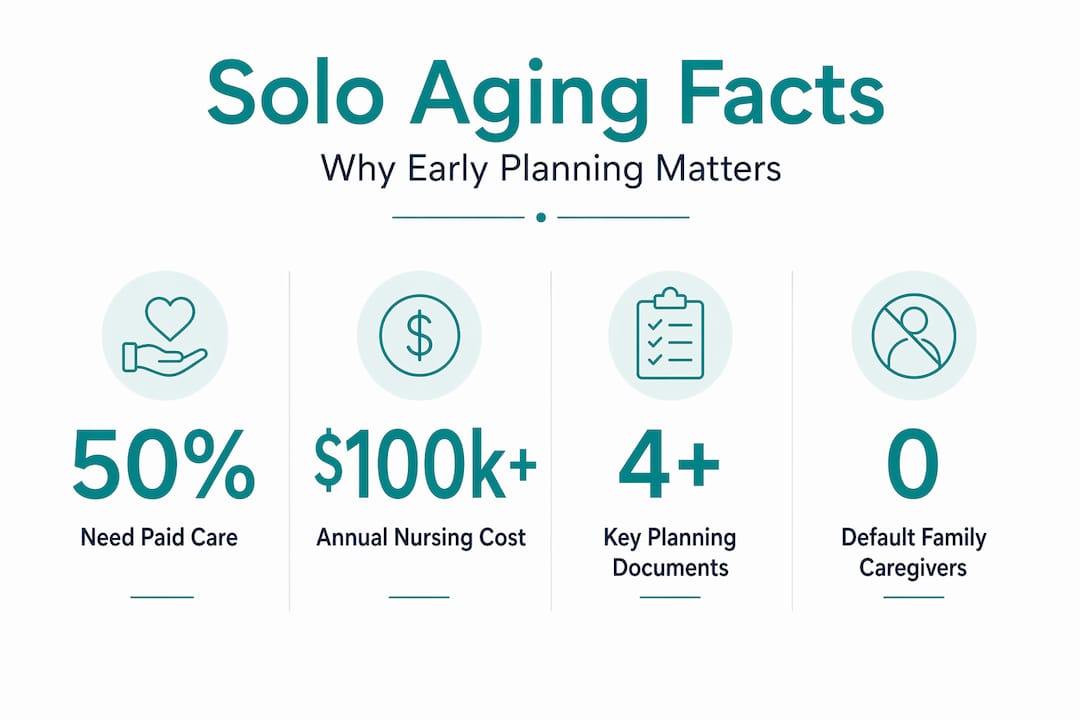
The legal exposure is just as serious. Despite the stakes, 57% of U.S. adults lack a basic will or trust. For childless adults, that gap is not just inconvenient. It is genuinely dangerous. Without a durable power of attorney or a designated healthcare proxy, a court can appoint a guardian for you. That guardian may be a stranger. They may make decisions completely out of step with your values, your wishes, and your life.
The documents you need in place include:
- Durable power of attorney: Assigns someone to manage finances if you become incapacitated
- Healthcare proxy or medical power of attorney: Designates who makes medical decisions on your behalf
- Living will or advance directive: Records your specific wishes for end-of-life care
- Will or revocable living trust: Directs where your assets go and who manages your estate
- HIPAA authorization: Allows trusted contacts to receive your medical information
Managing aging without offspring means these documents are not optional extras. They are your entire safety infrastructure. Many estate planning systems are built around traditional families, which leaves childless individuals structurally vulnerable without explicit legal arrangements. Starting this at 50, rather than 70, gives you time to think clearly, choose well, and update as your life changes.
Choosing your fiduciaries and estate plan
One of the harder truths of planning for aging without children is that you have to ask people to take on serious responsibilities. Your executor. Your healthcare agent. Your power of attorney. These roles require real commitment, and the people you choose need to understand what they are agreeing to.
A close friend might seem like the obvious choice. But informal friend proxies often lack the legal preparation or emotional capacity for long-term fiduciary roles. They may move, become ill themselves, or simply feel overwhelmed. That is not a character flaw. It is just reality.
Pro Tip: Consider naming a professional fiduciary as a backup, even if your first choice is a trusted friend. This gives your plan real staying power without putting everything on one person.
Here is what intentional fiduciary planning looks like for childless adults:
- Choose a primary and backup representative for every role, not just one person per job
- Talk openly with your chosen proxies about your wishes, your values, and the practical details they would need to know
- Explore professional fiduciaries licensed through your state, particularly for financial management; professional fiduciaries provide continuity and accountability
- Plan for pets and charitable giving if those matter to you; these need explicit documents too
- Avoid intestacy at all costs; without a will, assets pass to distant relatives by state law, often people who did not know you well and do not reflect your wishes
The legal and financial basics of early estate planning for childless adults are not complicated once you know what to ask for. The challenge is sitting down to do it before a crisis forces the issue.
Financial strategies for childless seniors
Money is where early planning pays off most concretely. And for solo agers, the financial picture has a few specific wrinkles that generic retirement advice misses.

The most urgent is long-term care funding. Median nursing home costs now exceed $100,000 per year. Even home-based care runs tens of thousands annually. Without an unpaid family caregiver absorbing some of that cost, your financial plan needs a dedicated reserve for this reality.
One practical framework is the SEAL Reserve concept: funds specifically protected for emergencies, aging, and long-term care before any discretionary spending begins. Think of it as the floor of your financial plan, not the ceiling. Everything else, travel, hobbies, gifts, comes after this reserve is secured.
Here are four financial moves worth prioritizing before you turn 65:
- Open or maximize a Health Savings Account (HSA) if you are eligible; it grows tax-free and can be used specifically for qualified medical and long-term care expenses
- Explore Roth conversions during low-income years; early retirement Roth conversions between ages 50 and 65 can save between $90,000 and $270,000 in lifetime federal taxes
- Research long-term care insurance while you are still in your 50s, when premiums are lower and health conditions are less likely to trigger denials
- Set up automatic savings buckets designated specifically for care costs, so the money is there when you need it and not mixed in with general spending
A quick comparison of two common approaches:
| Approach | Best for | Key risk |
|---|---|---|
| Front-loaded spending (travel, experiences early) | Those with clear health constraints | Depletes reserves needed for later care costs |
| Balanced SEAL Reserve model | Most solo agers | Requires discipline to protect care funds from discretionary use |
The importance of early retirement planning cannot be overstated here. Single childless women who interrupt careers to care for aging parents often face compounded financial vulnerability later. Planning your own finances autonomously, well before you face health challenges, puts you in a very different position.
Building your support network
No amount of money or paperwork replaces the experience of having someone who knows you, checks in on you, and can step up when things get hard. That is the part of planning for aging without children that feels the most personal.
Social isolation is a significant risk for solo agers, and it does not always arrive as loneliness. Sometimes it creeps in as fewer people knowing your routines, or no one noticing when something is wrong. Building your support circle before you need it is one of the most protective things you can do.
The "circle of care" model is a useful way to think about this. Your circle has layers:
- Inner circle: Two or three trusted people who know your wishes, have your documents, and can act fast in an emergency
- Middle layer: Friends, neighbors, or community members who check in regularly and provide social connection
- Outer layer: Professional supports like doctors, care managers, a financial advisor, and potentially a geriatric care manager as you age
Technology can strengthen every layer. Simple tools like medication reminders, telehealth check-ins, and wearable fall monitors extend your independence without requiring constant human supervision.
Your housing choices matter here too. Aging in place is possible and often preferred. But it works best when your home is set up thoughtfully and when your community connections are solid. Agingsolo has a detailed aging in place guide specifically for solo agers who want to stay home safely and independently.
For building wider social ties, community groups designed for adults 50 and older provide both connection and practical support. The benefits of aging solo community groups go well beyond friendship; they create a web of people who notice, who help, and who care.
My honest take on planning alone
I have seen what happens when childless adults delay this work. Not theoretical scenarios. Real situations where someone in their late 70s ends up in a hospital, unable to communicate their wishes, with no documents in place and no one legally authorized to speak for them. A court steps in. A stranger makes the call.
The most striking thing is not that people did not care about planning. Most did. They just assumed they had more time, or that it felt too heavy to deal with. What I have learned is that early legal planning is not about expecting the worst. It is about protecting the future you actually want.
Traditional planning models fail childless individuals not because they are poorly designed in general, but because they assume a built-in support system exists. When it does not, you have to build one deliberately. The good news is that people who do this work early almost always feel a deep sense of relief afterward. Not dread. Relief. Because they know someone is named. They know the documents are signed. They know their wishes will be honored.
You do not need everything figured out. You just need to start while you still have full choice in who and what you choose.
— Mike
Start your plan with Agingsolo
Planning for aging without children does not have to feel overwhelming. Agingsolo was built specifically for people in your position: adults who are thinking clearly about their future and want practical, honest tools to get prepared.
Whether you are just beginning to think through your legal documents, exploring how to build a support circle, or figuring out how to stay independent at home, Agingsolo has guides written specifically for solo agers. The resources are calm, non-clinical, and grounded in what actually matters for people aging without a traditional family support system. You can also explore Agingsolo's life care planning tools to map out your care preferences and support needs in one organized place. The best time to start is now, while your options are open and the choices are yours.
FAQ
Why does childless aging require planning earlier than usual?
Without children to serve as default caregivers or legal representatives, childless adults must explicitly designate every role in their care and estate plan. Waiting until a health crisis leaves those decisions to courts or strangers.
What documents does a childless person need for aging?
At minimum, you need a durable power of attorney, a healthcare proxy, a living will, and a will or trust. These documents replace the informal safety net that family typically provides.
How much should I save for long-term care without family support?
Nursing home costs now exceed $100,000 per year on average, so building a dedicated care reserve in your 50s is a strong starting point alongside long-term care insurance.
Who can serve as my healthcare proxy if I have no children?
A trusted friend, sibling, niece or nephew, or a licensed professional fiduciary can all serve in this role. The key is choosing someone willing to commit and legally documenting their authority.
What happens to my estate if I die without a will and no children?
Your assets will be distributed under your state's intestacy laws, which typically pass property to distant relatives regardless of your actual wishes. A will or trust prevents this completely.