

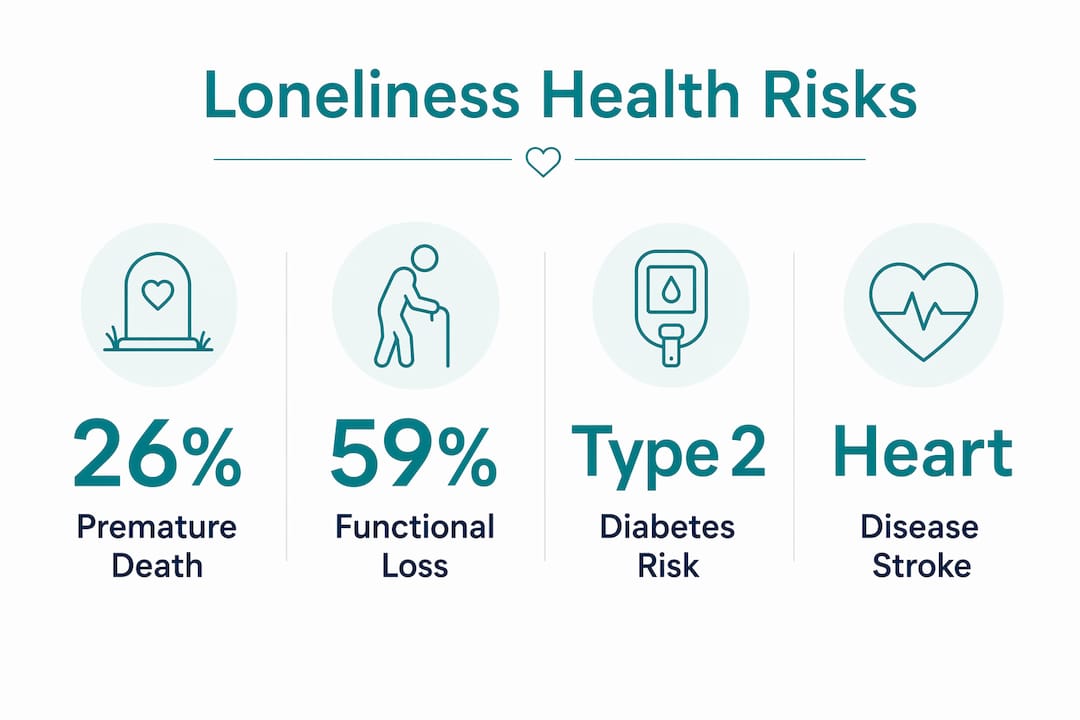
Loneliness does real, measurable damage to your body. The U.S. Surgeon General's Advisory found that loneliness raises your risk of premature death by 26%, while social isolation pushes that figure to 29%. To put that in perspective, the health impact is comparable to smoking 15 cigarettes every single day. This isn't about feeling sad. It's about what happens inside your body when connection is missing.
The physical health risks of loneliness include:
- Heart disease: Poor social connection raises your risk by 29%
- Stroke: Risk increases by 32%
- Type 2 diabetes: Loneliness is linked to a higher likelihood of diabetes
- Depression and anxiety: People who are lonely have a higher likelihood of developing depression
- Premature death: The WHO estimates loneliness contributes to over 871,000 deaths annually worldwide
These are well-documented risks with significant health impacts.
Why loneliness harms physical health differently than social isolation

Loneliness and social isolation are related, but they aren't the same thing. Knowing the difference matters because they affect your body through different pathways.
Loneliness is subjective. It's the feeling of being disconnected, even when people are around. You can be in a room full of family and still feel profoundly alone.

Social isolation is objective. It means you genuinely lack regular contact with other people. No calls, no visits, no meaningful interaction.
Here's what makes this complicated: you can experience one without the other.
- A person living alone may feel content and connected through regular phone calls and community involvement
- Someone surrounded by people at work may feel deeply lonely if those relationships feel hollow
- Social isolation harms physical health even when a person doesn't feel lonely at all
Research suggests isolation tends to connect more strongly with fatal diseases, while loneliness links more to chronic mental and metabolic conditions. Both carry real risk. Both deserve attention.
Who is most at risk for loneliness?
Loneliness doesn't affect everyone equally. Certain life circumstances and personal factors make some people far more vulnerable to its health effects.
Individual risk factors:
- Living alone, especially after a major life change like divorce or bereavement
- Chronic illness or disability that limits mobility and social participation
- Hearing or vision loss, which creates barriers to easy conversation
- Mental health conditions like depression or anxiety, which can shrink social worlds
- Low income or limited access to transportation
Life transitions that increase risk:
- Retirement, which removes a built-in daily social structure
- Loss of a spouse or close friend
- Moving to a new community later in life
Group and community factors:
- Inadequate neighborhood infrastructure or public spaces
- Lack of access to community programs
- Digital exclusion among older adults who aren't comfortable with technology
If you're a solo ager navigating isolation, many of these factors can stack on top of each other, compounding the risk.
How loneliness affects your body: specific health impacts
The physical health risks of loneliness are broad and well-documented. Here's what the research shows across specific conditions.
Heart disease and stroke carry the strongest evidence. A synthesis of 16 independent longitudinal studies found that poor social relationships were associated with a 29% increased risk of heart disease and a 32% increased risk of stroke.
Diabetes is another clear link. People who report loneliness are significantly more likely to develop Type 2 diabetes, partly because loneliness disrupts sleep, raises cortisol, and promotes inflammation, all of which impair insulin regulation.
Cognitive decline follows a similar pattern. Chronic loneliness and social isolation can increase dementia risk in older adults.
Immune function also suffers. Loneliness increases susceptibility to viruses and respiratory illness, likely through its effects on inflammation and immune regulation.
The numbers are striking. The CDC confirms that social isolation and loneliness increase risk for heart disease, stroke, Type 2 diabetes, depression, anxiety, dementia, and earlier death. These aren't separate problems. They're connected through the same biological pathways.
The biology behind why isolation makes you sick
Your body treats loneliness as a threat. That's the core of why it causes physical harm.
When you feel isolated, your brain activates the same stress-response systems it uses for physical danger. Cortisol rises. Your immune system shifts into a defensive, inflammatory state. Over time, that chronic inflammation damages blood vessels, disrupts metabolism, and accelerates cellular aging.
Key biological mechanisms include:
- Elevated cortisol: Persistent stress hormone release strains the cardiovascular system and suppresses immune function
- Chronic inflammation: Loneliness triggers inflammatory responses comparable in magnitude to physical inactivity, and inflammation underlies heart disease, diabetes, cancer, and Alzheimer's disease
- Immune dysregulation: Lonely people show altered immune cell activity, making them more vulnerable to infection
- Neuroendocrine disruption: Social bonding normally regulates systems involving oxytocin; without connection, those systems lose their stabilizing effect
The stress-to-heart-disease pathway is particularly well-established. Chronic stress raises blood pressure, increases arterial inflammation, and promotes clot formation, all direct contributors to heart attack and stroke.
Why social connection is a genuine biological need
Social connection isn't a luxury. Research by Dr. Julianne Holt-Lunstad at Brigham Young University demonstrates that social connection meets the Bradford Hill criteria for causality in disease risk, meaning the evidence is strong enough to conclude that connection directly affects mortality, not just correlates with it.
Strong social bonds protect your health in measurable ways:
- Reduce inflammation and lower cardiovascular risk markers like blood pressure
- Support healthy immune function and reduce infection susceptibility
- Buffer against cognitive decline and dementia
- Reduce depression and anxiety
- Extend lifespan
Building and maintaining meaningful social connections isn't just good for your mood. It's one of the most powerful things you can do for your long-term physical health.
What recent research adds to the picture
The science has grown sharper in recent years. A few findings stand out.
Childhood social isolation carries consequences that stretch into adulthood. Research from the Dunedin Study found that children who experienced social isolation showed higher rates of obesity, elevated blood pressure, and abnormal blood glucose levels as adults. The damage accumulates quietly over decades.
The distinction between loneliness and isolation also matters clinically. Social isolation connects more strongly with fatal outcomes, while loneliness tends to drive chronic metabolic and mental health conditions. Addressing only one may leave the other unexamined.
The WHO's 2025 Commission on Social Connection confirmed that 1 in 6 people worldwide is affected by loneliness, and that the health and economic costs are staggering. The World Health Assembly adopted its first-ever resolution on social connection in May 2025, signaling that governments now treat this as a public health priority.
How loneliness compounds over time
Loneliness doesn't stay still. Left unaddressed, it tends to deepen and spread into other areas of health.
The pattern often looks like this: isolation reduces physical activity, which worsens cardiovascular health. Poor sleep follows, which raises inflammation. Inflammation worsens mood, which makes social engagement feel harder. That withdrawal deepens isolation further.
Older adults who reported loneliness in one longitudinal study showed a 59% increased risk of functional loss, including difficulty with basic daily activities like bathing and mobility. Motor function also declined faster among those with higher loneliness scores at baseline.
The trajectory matters. Catching and addressing loneliness early interrupts this cycle before it compounds.
How loneliness disrupts your sleep
Poor sleep is one of loneliness's most direct physical effects, and it creates a feedback loop that's hard to break.
Lonely people tend to sleep more lightly and wake more often during the night. The brain, perceiving social threat, stays in a state of low-level alertness even during sleep. That fragmented rest raises cortisol, increases inflammation, and impairs the body's overnight repair processes.
Over time, chronic sleep disruption contributes to weight gain, insulin resistance, high blood pressure, and weakened immune response. All of these are also independent risk factors for the same diseases loneliness promotes directly. Sleep is where the biological pathways converge.
How widespread is loneliness in the United States?
The scale of this problem is larger than most people realize.
About one in two adults in America reported experiencing loneliness even before the COVID-19 pandemic, according to the U.S. Surgeon General's Advisory. The pandemic deepened that isolation for millions more.
Globally, the WHO estimates loneliness contributes to over 871,000 deaths every year. That's roughly 100 deaths every hour, a figure that puts the health burden in stark terms.
The hidden loneliness checklist from Agingsolo can help you recognize signs you might be more isolated than you realize, because loneliness often builds gradually and quietly.
How loneliness affects different age groups
Loneliness doesn't peak in old age the way many people assume. It follows a more complex pattern across the lifespan.
Young adults (18–25) report some of the highest rates of loneliness, often tied to major transitions like leaving home, starting college, or entering the workforce without an established social network.
Middle-aged adults face loneliness driven by caregiving demands, career pressure, and the gradual loss of friendships that don't survive busy schedules.
Older adults experience loneliness through bereavement, retirement, reduced mobility, and the shrinking of social networks over time. The health consequences tend to be most severe in this group because they compound with existing health vulnerabilities.
Solo agers face particular risk. Without a spouse or nearby adult children, the social safety net that many people take for granted simply isn't there. Aging alone requires intentional planning to stay connected and protected.
If you're thinking about how to build a stronger plan for your health and social life as you age, Agingsolo's elder planning guide is a practical place to start.
Key Takeaways
Loneliness harms physical health through measurable biological pathways, raising your risk of heart disease, stroke, dementia, and premature death by margins comparable to smoking daily.
| Point | Details |
|---|---|
| Premature death risk | Loneliness raises premature death risk by 26%; social isolation raises it by 29%. |
| Heart and stroke risk | Poor social connection is linked to a 29% higher risk of heart disease and 32% higher risk of stroke. |
| Biological mechanism | Loneliness triggers chronic inflammation and elevated cortisol, damaging cardiovascular and immune systems. |
| Sleep disruption | Lonely people sleep more lightly, raising inflammation and worsening long-term physical health. |
| Dementia risk | Chronic loneliness and isolation can increase dementia risk in older adults. |
FAQ
How does loneliness increase the risk of heart disease?
Loneliness activates chronic stress responses that raise cortisol and inflammation, both of which damage blood vessels and raise blood pressure. Research links poor social connection to a 29% increased risk of heart disease.
Is social isolation the same as loneliness?
No. Loneliness is a subjective feeling of disconnection; social isolation is an objective lack of social contact. Both harm health, but through somewhat different pathways, with isolation more strongly linked to fatal diseases.
Can loneliness affect younger adults, not just older people?
Yes. Young adults aged 18–25 report some of the highest loneliness rates, often tied to life transitions. The health consequences tend to be most severe in older adults because they compound with existing health conditions.
Does social connection actually improve physical health outcomes?
Strong evidence shows that social connection reduces inflammation, lowers blood pressure, supports immune function, and reduces dementia risk. Dr. Julianne Holt-Lunstad's research meets the Bradford Hill criteria for causality, meaning connection directly affects mortality.
How many deaths does loneliness cause each year?
The WHO estimates that loneliness contributes to over 871,000 deaths annually worldwide, roughly 100 deaths every hour, based on its 2025 Commission on Social Connection report.