
TL;DR:
- Solo aging involves growing older without nearby support, making early planning essential to preserve independence. It requires proactive decisions on financial safety, legal documents, housing, and coordinated support to avoid crises and maintain control. Starting now ensures options remain open and your future self retains agency and dignity.
Solo aging is defined as growing older without a spouse, partner, or nearby adult children who can step in during a health crisis, financial emergency, or housing transition. This is precisely why solo agers plan earlier than most. Without a built-in support system, every gap in your plan becomes a gap you face alone. AARP identifies long-term care as one of the most overlooked planning areas for solo agers, and the Wharton Pension Research Council confirms that delayed decisions consistently narrow your options. The stakes are real, and the window to act on your own terms is open right now.
Why solo agers plan earlier than most people expect
Solo agers plan earlier because every decision that a spouse or adult child might handle by default must be made deliberately and in advance. There is no backup. No one to call the doctor, manage the finances, or coordinate a move. That reality changes the entire planning timeline.

The term "solo ager" was popularized by gerontologist Sara Zeff Geber, who identified a growing population of adults aging outside traditional family structures. Whether you are single, divorced, widowed, or simply live far from family, the planning challenges are the same. You need to build the support structures that others inherit automatically.
The core insight is this: early planning for solo agers is not about pessimism. It is about preserving your right to choose. Every year you wait, some options close. Some documents become harder to execute. Some housing transitions become more disruptive. Starting now, while you have full capacity and clear preferences, is the single most protective thing you can do.
How financial resilience drives earlier planning for solo agers
Solo agers financial planning starts with one uncomfortable truth: you have no financial backup. If a medical bill arrives, a car breaks down, or a home repair becomes urgent, there is no second income to absorb the shock.
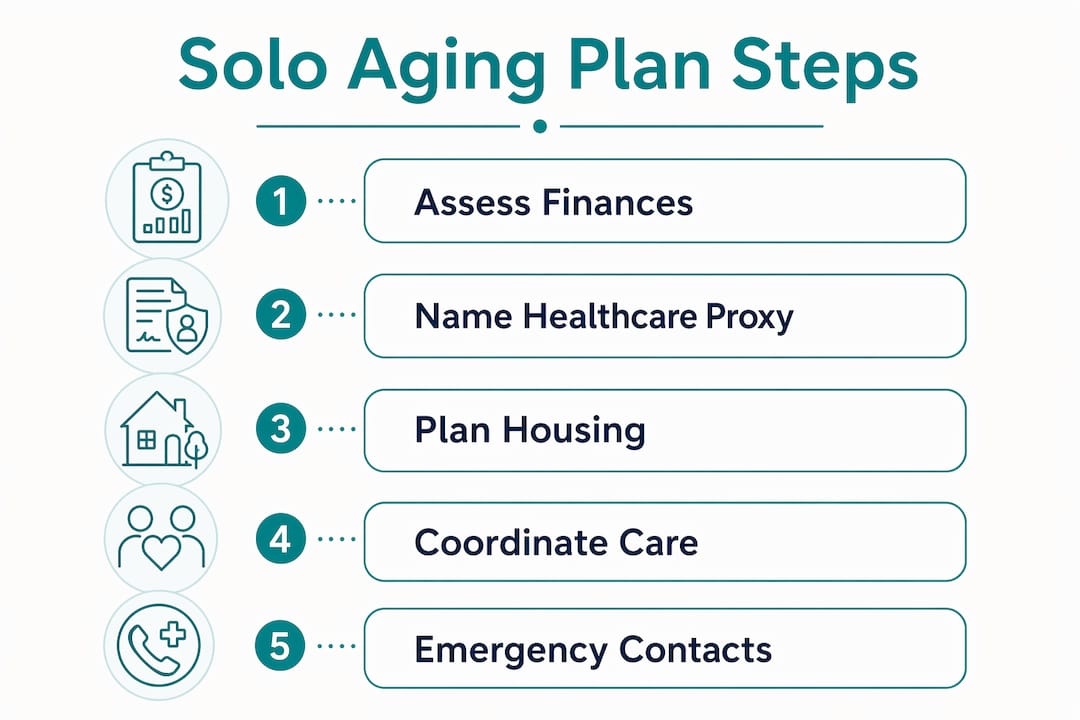
AARP recommends that solo agers build emergency savings covering 12 to 18 months of expenses, compared to the standard 3 to 6 months advised for couples. That gap is significant. It reflects the reality that a solo ager recovering from surgery, for example, may face weeks without income and without anyone to manage daily logistics for free.
Here is what a strong financial foundation looks like for solo agers:
- Emergency fund: Target 12 to 18 months of living expenses in a liquid, accessible account.
- Retirement accounts: Maximize contributions to IRAs or 401(k) plans early, since compounding works harder the sooner you start.
- Health Savings Account (HSA): If you have a high-deductible health plan, an HSA lets you save pre-tax dollars specifically for medical expenses, which tend to rise significantly after 65.
- Long-term care insurance or hybrid policies: These cover home care, assisted living, or memory care costs that Medicare does not. Premiums are far lower when purchased in your 50s than your 60s.
- Professional financial advisor: A fee-only advisor familiar with solo aging can model your specific risk profile and identify gaps you may not see.
Long-term care costs are the most frequently underestimated expense in solo agers financial planning. A private room in a nursing facility can exceed $100,000 per year in many U.S. markets. Without a spouse to provide informal care at home, solo agers are more likely to need paid professional care sooner and for longer. You can review a practical financial safety checklist built specifically for adults living alone to identify where your plan may have gaps.
Pro Tip: Open a dedicated "solo aging fund" separate from your general emergency savings. Label it clearly and treat it as untouchable except for care-related needs. The psychological separation makes it easier to build and harder to raid.
What healthcare advocacy and legal planning mean for solo agers
Without designated advocates, hospitals and courts make decisions for you. That is not a worst-case scenario. It is the legal default when no documents exist.
Only 37% of solo agers have a medical power of attorney, and only 31% have a financial power of attorney, despite 87% expressing worry about cognitive or physical decline. That gap between concern and action is one of the most consequential patterns in solo aging. Worry without preparation leaves you exposed.
Two documents form the backbone of healthcare planning for solo agers:
- Healthcare proxy (medical power of attorney): Names a specific person to make medical decisions on your behalf if you cannot. This is the "who decides" document.
- Advance directive (living will): Specifies your wishes about treatments, life support, and end-of-life care. This is the "what to do" document.
Both are needed. Neither replaces the other. As healthcare advocates note, hospitals without a designated proxy may rely on ethics committees or default institutional protocols, which rarely reflect your personal values or preferences.
The challenge many solo agers face is identifying a trusted agent. You may not have an obvious candidate. A close friend, a trusted neighbor, a professional patient advocate, or a certified geriatric care manager can all serve this role. The key is to have the conversation early, while you can explain your values clearly and while the person you choose has time to understand what the role involves.
AARP frames this plainly: early legal planning is your way of choosing your "second set of hands" before a court does it for you. Waiting until cognitive or mobility decline sets in makes these documents far harder to create effectively.
Pro Tip: After naming your healthcare proxy, write a one-page "values letter" explaining your preferences in plain language. This gives your proxy confidence and clarity when the moment comes.
You can learn more about the process of appointing a healthcare proxy before you need one, including how to choose the right person and what to tell them.
Why housing decisions require earlier attention for solo agers
Housing is where delayed planning becomes most visible. A home that works perfectly at 60 may become unsafe or isolating at 75. The difference between a planned transition and a crisis-driven one is enormous, in cost, in stress, and in the quality of the outcome.
The Wharton Pension Research Council advises that earlier housing planning preserves choice and smooth logistics. Waiting reduces your safe, preferred options and raises both risk and cost. That is not a warning to scare you. It is a practical argument for reviewing your housing situation now, while you have the energy and clarity to evaluate it honestly.
| Housing option | Best suited for | Key planning consideration |
|---|---|---|
| Aging in place | Solo agers with adaptable homes and local support | Assess accessibility, home modification costs, and proximity to services |
| Senior apartment communities | Those seeking social connection and amenities | Research waitlists early; popular communities can have multi-year waits |
| Shared housing arrangements | Solo agers open to companionship and cost-sharing | Establish clear agreements on responsibilities and boundaries upfront |
| Continuing care retirement communities (CCRCs) | Those wanting a full continuum from independent to skilled care | Requires significant financial planning; entrance fees can be substantial |
Your current home may be your greatest asset or your greatest liability. Review whether it can be adapted with grab bars, wider doorways, or a first-floor bedroom. Consider whether your neighborhood offers walkable access to groceries, medical care, and social connection. Proximity to home care services also matters more than most people realize when planning for aging in place.
Pro Tip: Visit two or three senior communities in your area before you think you need them. Touring without pressure gives you a realistic picture and helps you build preferences before a decision becomes urgent.
How coordinated planning keeps solo agers in control
Solo aging requires coordination across health, housing, finances, and people. Neglect one area and the others can unravel. This is the domino effect that integrated planning is designed to prevent.
Think of your plan as having four interdependent parts:
- Legal authority: Who has the power to act on your behalf, and for what decisions? This includes your healthcare proxy, financial power of attorney, and trustee if you have a trust.
- Information access: Where are your documents, accounts, passwords, and medical records? A trusted person needs to be able to find everything quickly in an emergency.
- Timing triggers: What conditions prompt action? Define in advance what level of need activates your plan, such as a hospitalization, a fall, or a diagnosis.
- People and professionals: Who is in your support network? This includes friends, neighbors, a geriatric care manager, a professional fiduciary, and any paid caregivers.
Professional fiduciaries and certified geriatric care managers are particularly valuable for solo agers who lack family nearby. A professional fiduciary can manage finances and legal affairs. A geriatric care manager can coordinate medical appointments, evaluate care options, and serve as a consistent advocate. These are not last resorts. They are legitimate, professional parts of a well-built solo aging plan.
The life care planning process formalizes this coordination, mapping out your preferences, your people, and your triggers before any crisis forces the issue.
Pro Tip: Create a one-page "in case of emergency" document with your key contacts, account locations, medical conditions, and the name of your healthcare proxy. Keep a copy with a trusted friend and one in a visible place at home.
Key takeaways
Solo agers who plan earlier preserve their independence, their choices, and their dignity far more effectively than those who wait for a crisis to force action.
| Point | Details |
|---|---|
| Financial cushion matters more | Solo agers need 12 to 18 months of emergency savings, not the standard 3 to 6 months. |
| Legal documents protect your voice | Only 37% of solo agers have medical POA despite 87% worrying about decline. |
| Housing planning is time-sensitive | Delaying housing decisions reduces options and raises costs significantly. |
| Coordination prevents cascade failures | Legal authority, information access, timing, and people must work together as a system. |
| Early action preserves agency | Documents and plans created while cognition is intact are more effective and more enforceable. |
Why I believe starting early is the most generous thing you can do for yourself
I have spent years working with adults who are preparing for solo aging, and the pattern I see most often is not fear. It is delay. People who are thoughtful, capable, and genuinely concerned about their future still wait. They tell themselves they will get to it. They assume they have more time than they do.
What I have come to understand is that early planning is not about preparing for the worst. It is about giving your future self options. When you build your financial cushion now, you are not being anxious. You are being steady. When you name a healthcare proxy today, you are not being morbid. You are being kind to the people who care about you, and to yourself.
The solo agers I have seen navigate aging with the most grace are not the ones with the most money or the best health. They are the ones who made decisions before they had to. They chose their advocates. They reviewed their housing. They built a small, reliable network of people who knew their wishes. That preparation did not eliminate hard moments. But it meant those moments did not also involve scrambling, confusion, or loss of control.
If you are reading this, you are already ahead. The fact that you are thinking about this now, while you have clarity and capacity, is the most important step. Do not let the size of the task stop you from starting. One document, one conversation, one financial review. That is enough to begin.
— Mike
Start building your solo aging plan with Agingsolo
Agingsolo is built for exactly where you are right now. Whether you are just starting to think about preparing for solo aging or you are ready to fill specific gaps in your plan, the resources here are practical, calm, and designed for real life.
From healthcare proxy guides to financial checklists and housing decision frameworks, Agingsolo gives you the tools to move forward with confidence. You do not need to figure this out alone, and you do not need to do it all at once. Start with one area that feels most urgent. Explore the solo ager planning hub to find guides, checklists, and community resources tailored to adults who are planning independently. Your future self will be glad you did.
FAQ
What does "solo ager" mean?
A solo ager is an adult who is growing older without a spouse, partner, or nearby adult children to provide support during health or financial emergencies. The term was popularized by gerontologist Sara Zeff Geber to describe a growing demographic with distinct planning needs.
Why do solo agers need more emergency savings than couples?
Solo agers need 12 to 18 months of emergency savings because there is no second income or informal caregiver to absorb unexpected costs. A medical event or home repair can create both a financial and a logistical crisis simultaneously.
What happens if a solo ager has no healthcare proxy?
Without a designated healthcare proxy, hospitals may rely on ethics committees or default institutional protocols to make medical decisions. Only 37% of solo agers currently have this document in place, leaving the majority vulnerable to decisions that may not reflect their wishes.
When is the right time to start housing planning as a solo ager?
The right time is before you need to move. Wharton's Pension Research Council advises that earlier housing review preserves your preferred options and avoids crisis-driven transitions that are more costly and more stressful.
Can a professional replace family support for solo agers?
Yes. Professional fiduciaries, certified geriatric care managers, and patient advocates can fill many of the roles that family members typically handle. These professionals are trained specifically to support solo agers with financial management, medical coordination, and care planning.