

Caring calls are regularly scheduled, friendly phone check-ins between a trained volunteer and an older adult living alone — designed to provide companionship, a safety touchpoint, and a steady human connection. If you want to receive calls, start by contacting your local Area Agency on Aging or searching the program pages listed below. If you want to give calls, most programs need volunteers now and ask for just a few hours a week.
- To receive caring calls: Search "caring calls" plus your city or county, or call your local Area Agency on Aging. Ask about wait times, call frequency, and what happens if you miss a call.
- To volunteer as a caller: Visit a program page (DOROT, Northern Light Health, NAMI Greater Cleveland, or your city's social services site) and ask about orientation, background checks, and weekly time commitment.
Key Takeaways
Caring calls reduce loneliness and improve mental health outcomes when delivered consistently by trained volunteers who prioritize listening over scripted responses.
| Point | Details |
|---|---|
| What caring calls are | Scheduled, friendly phone check-ins between a trained volunteer and an older adult, focused on companionship and safety. |
| Evidence base | A JAMA Psychiatry randomized trial found four weeks of empathy-focused calls reduced loneliness, depression, and anxiety in at-risk older adults. |
| Safety protocols matter | Every program should have a documented escalation chain: no answer triggers contact with the emergency contact, then local response. |
| How to find a program | Start with your local Area Agency on Aging or contact DOROT, Northern Light Health, NAMI Greater Cleveland, or the Plano Care Call Program directly. |
| Agingsolo next step | Agingsolo's free guides and 45-minute Solo Aging Clarity Session help solo agers build a full support plan that includes caring calls and more. |
Table of Contents
- What a caring calls program typically looks like
- Who benefits most from these calls
- How to get regular caring calls for yourself or a loved one
- How to volunteer as a caring-calls caller
- U.S. caring-calls programs you can contact today
- How an organization can set up a caring-calls program
- Caller best practices: how to make each call count
- Call schedules and logistics: what to expect
- Privacy, consent, and safety protocols
- What the evidence says about caring calls and loneliness
- Ready-to-use templates for callers and organizers
- How caring calls fit into a solo-aging plan
- Why caring calls matter more than they look like they do
- Agingsolo supports solo agers who want a real plan
- Sources
- FAQ
What a caring calls program typically looks like
Most programs follow a recognizable structure, even when the sponsoring organization differs. A participant completes a short intake, chooses a preferred call window, and provides an emergency contact. A volunteer is then matched to that participant and calls at the agreed time.
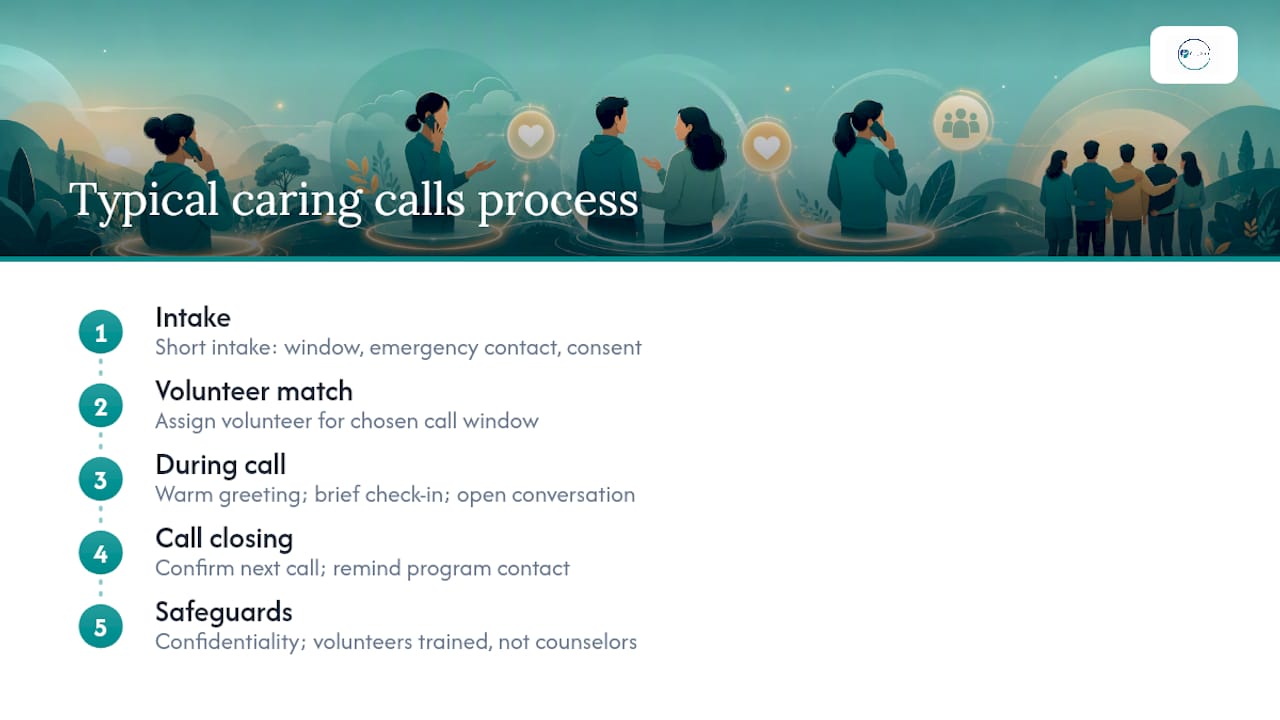
A typical call runs something like this: the volunteer opens with a warm greeting and confirms the participant is doing well. They move into a brief check-in ("How did you sleep? Did you eat today?"), then shift into a genuine conversation about whatever the participant wants to talk about — a memory, a TV show, the weather. The volunteer closes by confirming the next call time and reminding the participant how to reach the program if they need anything sooner.
Programs generally ask participants to agree to a few basics at intake: a preferred call window, the name and phone number of an emergency contact, and permission to share information with that contact if a safety concern arises. Confidentiality is standard. Volunteers are not counselors, but they are trained to listen well and to recognize when something sounds off.
Who benefits most from these calls
The people who gain the most from a caring call program tend to share a few common circumstances. Social isolation among older adults is the clearest driver, but the specifics vary.
Primary beneficiaries include:
- Older adults living alone, especially those without nearby family or regular visitors
- People with limited mobility who cannot easily leave home for social activities
- Adults experiencing grief or recent bereavement, when the quiet feels heavier than expected
- Anyone recently discharged from a hospital who needs a steady daily touchpoint during recovery
Eligibility varies by program. Many serve adults 60 and older, though some mental health-focused programs like NAMI Greater Cleveland serve a broader age range. Geographic limits are real: most programs serve a defined county or service area. Some require participants to be homebound or to have a documented social need; others accept self-referrals with no formal requirement.
Referral pathways are flexible. You can refer yourself, ask a doctor or social worker to refer you, connect through a meals-delivery program like Meals on Wheels, or reach out through your local Area Agency on Aging. If a program has a waitlist, ask to be added and check back in a few weeks.
How to get regular caring calls for yourself or a loved one
The process is shorter than most people expect. Here is a clear path from first search to first call.
- Find a program in your area. Start with your local Area Agency on Aging (search Eldercare), your city's social services page, or the program pages listed in the sources section below.
- Call or complete an online intake form. Most programs offer both options. Have the participant's name, address, and phone number ready.
- Choose a call window. Programs like Northern Light Health's Caring Calls run structured windows (for example, Monday through Friday, 8:00–9:30 AM). Pick the time that works best.
- Provide an emergency contact. This is required by nearly every program. The contact should be someone who can be reached quickly if the program cannot get through to the participant.
- Ask these questions before you confirm:
- How often will calls happen, and who initiates them?
- What happens if I miss a call or don't answer?
- Who has access to my information?
- Can I request a different volunteer if the match isn't working?
- Confirm the start date and first call time. Write it down. Some programs send a confirmation by mail or email.
Pro Tip: When you call to sign up, mention any preferences upfront — morning vs. afternoon, topics you enjoy talking about, or languages you speak. A good program will note all of it and try to match you accordingly.
How to volunteer as a caring-calls caller
Volunteering as a caller is one of the most time-flexible ways to support older adults living alone. Most programs ask for a consistent weekly commitment rather than a large block of time.
- Find an opportunity. Check local nonprofit pages, your city's volunteer portal, your Area Agency on Aging's volunteer listings, or VolunteerME-style directories. Programs like DOROT's Caring Calls actively recruit through community volunteer networks.
- Submit an application. Expect to provide contact information, availability, and a brief statement about why you want to volunteer.
- Complete a background check. Standard for any program that connects volunteers with vulnerable adults.
- Attend orientation. Training typically covers active listening, conversation boundaries, how to recognize safety concerns, and escalation steps. The JAMA Psychiatry research on empathy-focused calls found that briefly trained lay callers can be effective when training emphasizes listening over scripted responses.
- Get matched with a participant. Programs consider availability, shared interests, and language when pairing callers with participants.
- Start calling on your agreed schedule. Most volunteers call the same person at the same time each week or each day, building a real rapport over time.
Typical time commitment: daily check-in programs may ask for a 30-minute shift window, Monday through Friday. Weekly friendship-call programs often ask for one 20–30 minute call per week. Either way, consistency matters more than volume.
A few tips for staying grounded as a caller: follow the participant's lead in conversation, avoid giving advice on medical or legal matters, and always close the call by confirming the next contact time. If something feels wrong, report it to your program coordinator immediately.
U.S. caring-calls programs you can contact today
These four programs represent the range of models currently operating across the United States. Each has a distinct structure, so read the contact notes carefully before reaching out.
-
DOROT Caring Calls for Seniors (New York): DOROT pairs volunteers with older adults for regular friendly calls using an intergenerational model. To participate as a senior or volunteer, contact DOROT directly through their website or via the UJA-Federation volunteer listing. Expect a matching process and a consistent weekly call schedule.
-
Northern Light Health Caring Calls (Maine): This health-system program provides daily phone contact for many participants. Volunteers staff phones Monday through Friday, 8:00–9:30 AM, and participants select a designated call time. If a participant does not answer, the program follows a strict safety protocol. Contact Northern Light Health's Eastern Maine Medical Center to enroll or volunteer.
-
NAMI Greater Cleveland Caring Calls (Ohio): This program offers one-on-one supportive phone calls from trained volunteers or peers, with a focus on mental health support. Referrals come from providers or through self-referral. Contact NAMI Greater Cleveland directly to ask about current availability and the matching process.
-
Plano Care Call Program (Plano, TX): A municipal program run by the City of Plano that provides routine wellness check-ins for residents. This is a good example of a local government model. Contact the City of Plano's social services department to enroll or ask about volunteer roles.
When you call any of these programs, expect intake questions about your schedule, your emergency contact, and what you hope to get from the calls. Programs may have waitlists, so ask about timing and whether there are similar local options if the wait is long. For in-home senior support in the Tucson area, Seniors Helping Seniors Tucson offers a complementary model worth exploring alongside phone-based programs.
How an organization can set up a caring-calls program
Starting a caring-calls program does not require a large budget or a dedicated staff team. A faith group, a nonprofit, or a health system can launch a pilot with a handful of volunteers and a clear protocol.
- Define your scope. Who will you serve? What geographic area? How many participants can you realistically support in the first 90 days?
- Recruit volunteers. Post on local volunteer boards, faith community bulletins, and your organization's newsletter. Aim for at least a 2:1 volunteer-to-participant ratio to allow for absences.
- Design your intake process. Collect participant name, address, phone number, preferred call time, emergency contact name and number, and any health or communication notes relevant to the call.
- Create a safety and escalation protocol. Write it down before the first call goes out (see the privacy and safety section below for a template outline).
- Choose your technology. A shared spreadsheet and a standard phone line work for a small pilot. As you grow, consider a simple CRM like Airtable or a volunteer management tool. Keep participant data in a password-protected system.
- Run a two-week pilot. Pair five volunteers with five participants. Debrief weekly. Adjust the intake form, call schedule, and escalation steps based on what you learn.
- Scale with partnerships. Connect with your local Area Agency on Aging, a meals-delivery program, or a health system to share referrals and reduce duplicated outreach.
Budget note: the core costs are volunteer coordination time and a phone system. Many programs start with existing staff capacity and a free or low-cost conference line. Grants from local community foundations or United Way affiliates are a common early funding source.
Caller best practices: how to make each call count
A good caring call is not complicated. It is steady, warm, and participant-led. These practices make a real difference.
Opening the call:
- "Hi, this is [your name] calling from [program name]. Is this a good time?"
- Confirm the participant is physically okay before moving into conversation.
Check-in prompts:
- "How are you feeling today compared to yesterday?"
- "Did you get outside at all, or have a chance to eat something you enjoyed?"
Conversation starters for older adults:
- What did you watch or listen to recently that you liked?
- Do you have a favorite memory from this time of year?
- Is there anything you've been thinking about lately that you'd like to talk through?
- What's something you used to do that you really miss?
- Did anything make you smile this week?
Closing the call safely:
- "I'm glad we got to talk today. I'll call you again [day/time]. If you need anything before then, here's the number to reach the program."
Red flags to escalate immediately:
- Participant sounds confused, disoriented, or unlike themselves
- Participant mentions thoughts of self-harm or hopelessness
- No answer after two or more attempts within the call window
- Participant reports a fall, pain, or inability to reach help
Pro Tip: The JAMA Psychiatry research on empathy-focused calls describes "empathetic intention" as letting the participant choose the topic and resisting the urge to redirect. The caller's job is to listen, not to fill silence. Sitting with a pause for a few seconds often opens the best conversations.
Call schedules and logistics: what to expect
Frequency and length vary by program type. Here is what the most common models look like in practice.

Northern Light Health's program, for example, runs a daily Monday–Friday call window from 8:00 to 9:30 AM, with participants choosing their designated time within that window. Weekly friendship-call programs tend to run longer and feel more conversational.
A few logistics worth confirming before you start: What happens if the participant doesn't answer? Does the program use voicemail as a check-in method, or does a missed call trigger an escalation? Who is the backup contact if the regular volunteer is unavailable? Getting these answers in writing at intake saves confusion later.
Privacy, consent, and safety protocols
Consent is the foundation of any caring-calls program. Before the first call goes out, participants should confirm:
- Permission for the program to call them at the agreed number and time
- Who may receive updates about their wellbeing (emergency contact, referring provider)
- How their information is stored and who has access to it
Volunteers should never share a participant's personal details outside the program, keep any written notes in a secure location, and report concerns only through the program's official channel.
Escalation flow when a participant cannot be reached:
- Attempt the call at the designated time. If no answer, wait a few minutes and try once more.
- If still no answer, attempt a second call within the call window.
- If the participant remains unreachable, contact the emergency contact provided at intake.
- If the emergency contact cannot confirm the participant's safety, notify the program coordinator.
- The coordinator activates local response, which may include a wellness check by local emergency services.
This safety chain is a defining feature of well-run programs. Northern Light Health's Caring Calls documents its escalation steps explicitly, and that structure is worth replicating in any new program.
Note: caring-calls programs provide social support, not medical care. For any immediate health emergency, call 911.
What the evidence says about caring calls and loneliness
The case for caring calls is not just intuitive. A randomized clinical trial published in JAMA Psychiatry found that a four-week empathy-focused telephone program, delivered by briefly trained lay callers, reduced loneliness, depression, and anxiety among at-risk older adults compared with a control group. Improvements were measurable after just four weeks. The callers were not therapists. They were trained volunteers who prioritized listening over scripted responses.
Study signal: The JAMA Psychiatry trial found meaningful reductions in loneliness, depression, and anxiety scores after four weeks of empathy-focused calls by lay volunteers. Effect sizes were modest but consistent across validated scales, suggesting that regular, warm human contact has measurable mental health value even when delivered by non-clinicians.
For situations that go beyond companionship, the Institute on Aging's Friendship Line fills a different role. It is a 24/7 accredited toll-free line for older adults and adults with disabilities, accredited by the American Association of Suicidology, offering crisis intervention, grief support, and outbound calls on request. Volunteer caring-call programs and services like the Friendship Line are complementary, not interchangeable. The Friendship Line handles what a volunteer caller should not: crisis intervention and suicide prevention.
Addressing isolation proactively matters because the emotional weight of living alone tends to compound quietly. Caring calls interrupt that pattern with something steady and predictable: a voice that shows up.
Ready-to-use templates for callers and organizers
Copy these into a simple form, a shared document, or a printed sheet.
Short call script:
- Opening: "Hi, this is [name] from [program]. How are you doing today?"
- Check-in: "Did you sleep okay? Have you eaten today? Is there anything you need?"
- Conversation: Follow the participant's lead. Use the conversation starters from the caller best practices section.
- Closing: "It was really good to talk with you. I'll call again on [day] at [time]. Take care until then."
Sample intake form fields:
- Participant full name and preferred name
- Phone number (primary and backup)
- Address
- Preferred call days and time window
- Emergency contact name, relationship, and phone number
- Any communication preferences (hearing aids, slower speech, preferred language)
- How they heard about the program
Volunteer training checklist:
- Orientation to program mission and participant confidentiality
- Active listening techniques and empathetic intention
- Recognizing red flags and escalation steps
- Role-play: practice call with a program coordinator
- Documentation: how to log calls and report concerns
- Background check completion
Store all participant data in a password-protected system. Use local emergency services numbers and your regional Area Agency on Aging contact as the primary escalation references. Adapt the intake form to include your organization's name and a local crisis line number.
How caring calls fit into a solo-aging plan
A caring call is one piece of a larger picture. For solo agers, the most resilient plans layer multiple supports so that no single connection point carries all the weight. Caring calls work well alongside telehealth appointments, meal delivery, and a Circle of Care that names who steps in for medical decisions, daily needs, and emergencies.
A few practical integration steps:
- Add your caring-calls program contact to your emergency planning documents alongside your doctor and emergency contact.
- Note your preferred call time and program name in any advance directive or care summary so that future caregivers know the routine.
- If you are building a buddy system or support network, treat your caring-calls volunteer as one node in that network, not a replacement for it.
Caring calls are most effective when they are part of a plan, not a last resort. The Agingsolo support planning guide walks through how to map those layers clearly.
Why caring calls matter more than they look like they do
There is a version of this that sounds small: one person calls another person. They talk for fifteen minutes. Nothing dramatic happens. But that is exactly the point.
For someone who has not heard a friendly voice in three days, that call is not small. It is the thing that confirms they are still connected to the world. And for the volunteer, it is often the most grounding fifteen minutes of their week.
What I find worth saying plainly is this: the research supports caring calls, the programs are real and accessible, and the barrier to starting is lower than most people assume. You do not need a clinical background to make a meaningful call. You need to show up, listen, and let the other person lead. That is a skill almost anyone can learn.
The one thing I would caution against is treating caring calls as a substitute for a full support plan. They are a thread, and a strong one. But solo agers deserve a whole net. Respecting participant autonomy means letting them decide how much of that net they want to build, and at what pace.
Agingsolo supports solo agers who want a real plan
Caring calls are a meaningful starting point, but solo agers who want a complete picture need more than one thread. Agingsolo offers free planning guides, checklists, and practical tools built specifically for adults aging without a built-in support network. The resources cover everything from emergency contacts to Circle of Care planning to daily independence strategies.
If you want personalized guidance, the 45-minute Solo Aging Clarity Session gives you a focused conversation with someone who understands the specific challenges of aging alone. You leave with a clearer picture of your next steps and a plan you can actually use. Visit Agingsolo's aging-in-place guide to explore free resources, or book a Clarity Session when you're ready for a one-on-one conversation.
Sources
- Caring Calls — Northern Light Health
- Caring Calls — NAMI Greater Cleveland
- Plano Care Call Program — City of Plano
If none of the listed programs serve your area, your local Area Agency on Aging is the most reliable starting point. Many health systems and faith communities also run informal versions of caring-call programs that are not widely listed online. Ask directly.
FAQ
What is a care phone call for seniors?
A care phone call is a scheduled, friendly check-in between a trained volunteer or program staff member and an older adult, designed to provide companionship and confirm the person's safety. Most programs run these calls daily or weekly at a consistent time the participant chooses.
Is there a daily check-in service for seniors?
Yes. Programs like Northern Light Health's Caring Calls offer daily Monday–Friday phone contact, and the Institute on Aging's Friendship Line provides 24/7 outreach for older adults who need support at any hour.
Are there volunteer positions to call lonely older adults?
Many programs actively recruit volunteers, including DOROT, NAMI Greater Cleveland, and Northern Light Health. Most ask for a consistent weekly time commitment, a background check, and a short orientation before you begin calling.
Is there a hotline for seniors who need someone to talk to?
The Institute on Aging's Friendship Line is a 24/7 accredited toll-free line for older adults and adults with disabilities. It offers emotional support, crisis intervention, and grief support, and can also make outbound calls to seniors who request regular contact.