

The best health care proxy is the person who will fight for your wishes even when a doctor pushes back or a relative disagrees. Not your closest relative by default, not the person who "should" do it. Choose based on backbone and understanding, name a backup, and then complete your state's durable power of attorney for health care form promptly Give copies to your proxy and your doctor before you need either one.
TL;DR:
- The chosen proxy must be someone who will actively advocate for your wishes and be able to handle stressful hospital conversations, not necessarily the closest relative.
- Legally, your proxy must be a responsible adult, not a healthcare provider involved in your treatment, and must be appointed through proper, signed state-specific documents with witnesses or notarization.
- Quick, ongoing discussions about your values, medical circumstances, and documentation review enhance your proxy’s ability to act according to your preferences in emergencies.
- Giving copies of your signed advance directive to your proxy, healthcare provider, and emergency contacts is critical to ensure it can be accessed instantly during crises.
- Solo agers and those without immediate family can select trusted friends, neighbors, faith leaders, or hired advocates as proxies, emphasizing advocacy over proximity or family ties.
Table of Contents
- What Is a Health Care Proxy, and When Do They Step In?
- Who Can Legally Serve as Your Proxy?
- What Questions Should You Ask Before Choosing?
- How Do You Make the Designation Official?
- How Do You Prepare Your Proxy to Actually Act?
- What Should You Do Right After Naming a Proxy?
- Choosing a Proxy When You're Aging Without Close Family
- Why the "Closest Relative" Rule of Thumb Fails So Many People
- How Aging Solo Helps You Get This Done
- Sources
- FAQ
What Is a Health Care Proxy, and When Do They Step In?
A health care proxy, also called a health care agent or medical power of attorney, is the person you legally authorize to make medical decisions on your behalf when you cannot speak for yourself. That could mean unconscious after a stroke, sedated during surgery, or too confused from illness to weigh options clearly. The proxy only acts when a doctor determines you lack capacity, not before.
This is different from other planning documents you may have heard of:
- A living will states your specific wishes about treatments like ventilators or feeding tubes, but it can't cover every scenario.
- A POLST (Physician Orders for Life-Sustaining Treatment) is a medical order, signed by a clinician, for people with serious illness.
- A health care proxy is a person, empowered to interpret your values in real time when the paperwork doesn't spell out the exact situation.
Skip naming one, and hospitals typically default to a state-mandated next-of-kin hierarchy, or a court may appoint a guardian, according to the National Institute on Aging. Neither of those outcomes guarantees the person speaking for you actually knows what you want.
Who Can Legally Serve as Your Proxy?
Most states require your proxy to be a legal adult, usually at least the age of majority, though a small number set the bar differently. Your state's specific form will spell this out, so don't assume the rules match a friend's experience in another state.
Beyond age, most states legally block certain people from serving:
- Your treating physician or other clinicians directly involved in your care
- Owners, operators, or employees of the facility where you're being treated (unless they're a close relative)
- Someone already acting as proxy for a large number of other patients, which some states cap
Beyond the legal exclusions, use practical judgment. Harvard Health notes that the single most important trait in a proxy is the willingness to advocate for your wishes even when family members or clinicians push in a different direction. Proximity and emotional closeness matter far less than that.
Before you name anyone, ask yourself honestly whether this person can hold their ground in a tense hospital hallway conversation. A sibling you adore but who avoids conflict may be the wrong pick. A steady coworker who says exactly what she thinks might be the right one.
What Questions Should You Ask Before Choosing?
Pick your proxy the way you'd pick someone for a job with real consequences, because that's exactly what this is. Walk through these questions with each candidate in mind:
- Do they understand how you define quality of life? Someone who thinks "keep me alive no matter what" and someone who thinks "no machines, ever" need very different proxies.
- Will they push back on a doctor or a grieving relative? Passive agreeableness is a liability here, not a virtue.
- Can they actually be reached? A proxy three time zones away with a spotty phone signal is a real problem during a fast-moving medical crisis.
- Can they manage paperwork under stress? Faxing forms, tracking insurance calls, and reading medical updates takes organization, not just love.
- Do they have emotional boundaries? A proxy who falls apart at the bedside may struggle to make clear decisions when it counts.
If one person is emotionally right but logistically wrong, split the roles. Name them as your primary and appoint someone more locally available as backup, or bring in a professional patient advocate to handle the practical load while your named proxy handles the values-based calls.
Pro Tip: Run a mock scenario with your chosen proxy before you finalize anything. Ask them, "If I had a massive stroke and the doctors gave me a 10 percent chance of meaningful recovery, what would you tell them?" Their answer will tell you more than any conversation about hypotheticals ever could.
How Do You Make the Designation Official?
Naming someone in conversation means nothing to a hospital legal team. You need the actual paperwork, filled out correctly, signed correctly.
- Locate your state's official durable power of attorney for health care or advance directive form, usually available free through your state health department, state bar association, or a hospital's patient relations office.
- Fill it out completely, naming both a primary and an alternate proxy.
- Follow your state's witness or notarization instructions exactly. Requirements vary. Some states need two witnesses, others require notarization, and a few need both.
- Give signed copies to your proxy, your alternate, and your primary care provider, and ask that it be uploaded to your electronic health record.
Skipping the witnessing or notarization step is one of the most common and costly mistakes people make, which can invalidate the document when you need it most. The document can be ruled invalid at the exact moment you need it most, according to guidance from the National Institute on Aging.
Treat this as a formal legal filing, not a form you toss in a drawer. Aging Solo offers a legal documents checklist that provides guidance on advance directive paperwork.
How Do You Prepare Your Proxy to Actually Act?
Signing the form is the easy part. The harder, more important work is making sure your proxy actually knows what you want when a doctor is staring at them waiting for an answer.
CaringInfo recommends ongoing, values-focused conversations rather than a single sit-down chat, because your proxy needs to understand your reasoning across many possible scenarios, not just memorize a checklist. Talk through what "quality of life" means to you, which interventions you'd want tried and which you wouldn't, and how faith or personal belief shapes those answers.
- Write a short values letter that captures your priorities in your own words.
- Build an info sheet listing your providers, medications, insurance details, and emergency contacts.
- Share both digitally and on paper, and ask your provider about uploading them to your patient portal.
- Revisit the conversation at least once a year, and always after a major health change.
Pro Tip: Keep the values letter to one page. A proxy scrambling through a five-page document in a waiting room won't retain any of it. A one-page cheat sheet, reviewed together in advance, works far better under pressure.
Aging Solo provides a guide on documenting your personal wishes which covers templates for values letters.
What Should You Do Right After Naming a Proxy?
The document only helps if the right people can find it fast.
- Deliver signed copies to your proxy, your alternate, your primary care provider, and one or two close contacts who might be present in an emergency.
- Ask your provider directly whether they can upload the form into your electronic health record so any hospital in the system can pull it up instantly.
- Keep a wallet card noting your proxy's name and number, or store access instructions somewhere on your phone's lock screen.
- Revisit and update the document after a move, a marriage, a divorce, or a new diagnosis. Old paperwork naming an ex-spouse creates real confusion at the worst possible time.
Choosing a Proxy When You're Aging Without Close Family
You don't need a spouse or an adult child down the street to have someone solid in your corner. That belief is one of the most common misconceptions Aging Solo hears from people planning on their own, and it simply isn't true.
Compassion & Choices is direct about this: you are not limited to immediate family. Neighbors, close friends, faith leaders, or hired advocates can all serve as your proxy, as long as they understand and will honor your values. If none of those feel like a fit, most hospital systems also employ patient advocates who can assist with records, communication, and navigating care when you don't have someone to name.
- The longtime neighbor who already checks in on you weekly
- A friend from your book club or faith community who has watched you make decisions for years
- A professional fiduciary or paid patient advocate if no personal relationship fits
Naming any of these people is a real, valid, legal choice, not a fallback. Be direct with them about what you're asking, and be equally direct about the limits. Tell them clearly: "I need you to speak for me, not to manage me." That single sentence removes a huge amount of guesswork and emotional weight from the role.
There are resources available with templates, conversation scripts, and one-on-one planning support for people navigating this without a built-in family structure, including guides on setting up a health care proxy before you need one.
Why the "Closest Relative" Rule of Thumb Fails So Many People
The instinct to default to a spouse or oldest child as your proxy is understandable, but it's often wrong, and I think the conventional advice glosses over that too easily. Emotional closeness and decision-making strength are two different skills, and plenty of loving relatives simply cannot handle the pressure of overriding a doctor or disagreeing with a sibling in a hospital hallway.
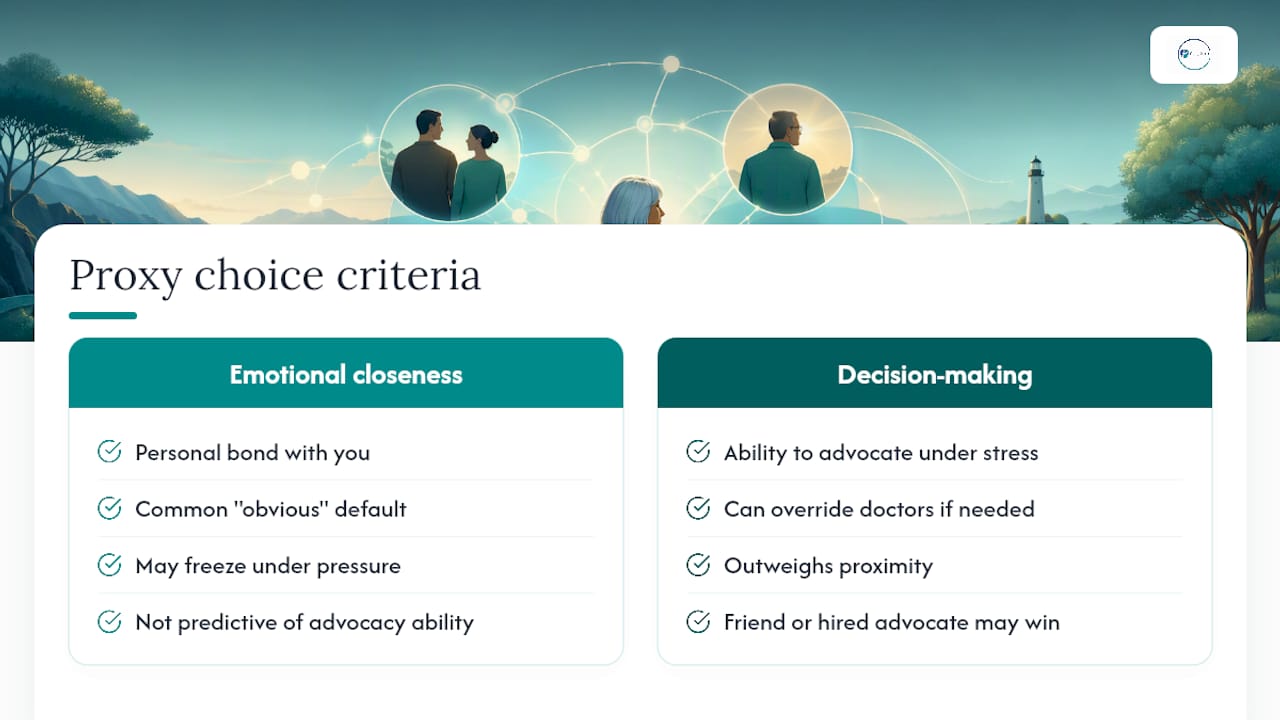
The research on this is consistent: advocacy ability matters more than proximity. That's a harder truth for people to sit with, because it means the "obvious" choice, a spouse, an adult child, isn't automatically the right one. It also means solo agers without a traditional family structure aren't at a disadvantage here. A steady friend or a hired advocate who understands your values can outperform a blood relative who freezes under pressure.
What I'd prioritize first, before anything else on a checklist: have the blunt conversation about tradeoffs before you sign anything. A signature without understanding is just paper.
— Mike
How Aging Solo Helps You Get This Done
Choosing a proxy is a legal decision, but it's also a deeply personal one, and you don't have to sort through it with a blank page and a search engine. Aging Solo publishes free downloadable tools built for exactly this moment, including a values letter template and a provider info sheet you can hand straight to whoever you choose.

If you want help thinking it through out loud rather than alone at your kitchen table, paid one-on-one Solo Aging Clarity Sessions are available as focused Zoom conversations to discuss your specific situation, candidates, and concerns, helping you walk away with a clear plan rather than a folder of open questions. Start with our health and emergency planning guide to see the free resources available, then book a clarity session when you're ready for personalized guidance.
This article is general information, not a substitute for advice from a qualified doctor. Consult a qualified healthcare professional about your own circumstances before acting on anything here.
Sources
- Choosing A Health Care Proxy | National Institute on Aging - NIH
- How to choose and guide your health care proxy - Harvard Health
- Who will speak for you? A guide to choosing a healthcare proxy – Compassion & Choices
- Choosing a Health Care Agent - CaringInfo
FAQ
How Do You Get a Health Care Proxy?
You get one by choosing a trusted adult, completing your state's official durable power of attorney for health care form, and signing it according to your state's witness or notarization rules.
Can a Family Member Override a Health Care Proxy?
Generally no. A legally appointed proxy's authority typically supersedes a family member's opinion, which is exactly why choosing someone willing to hold that ground matters so much.
How Do I Become a Proxy for a Family Member?
You become a proxy by being named on that person's signed advance directive form, then keeping a copy accessible and staying in ongoing conversation with them about their values and wishes.
What's the Difference Between a Health Care Proxy and a Power of Attorney?
A health care proxy, or medical power of attorney, covers only medical decisions, while a general power of attorney typically covers financial and legal matters. Some states use the term "power of attorney for health care" to mean the same thing as a health care proxy.