

Yes, you can name someone outside your family as your power of attorney, and yes, it holds up legally in every state. You'll want a trusted non-family adult or a paid professional fiduciary, plus separate documents for health and finances so nothing falls through the cracks. Skip this step and a court, not you, decides who manages your care and your money.
TL;DR:
- Most states permit any competent adult, including friends or neighbors, to serve as a power of attorney, provided they understand the responsibilities involved.
- Professional fiduciaries and trust companies are suitable alternatives when no trusted person in your life can take on the role or if you have complex financial needs.
- Without a power of attorney, a court must appoint a guardian or conservator, a lengthy process that can take weeks or months and incur significant legal costs.
- Naming separate agents for health care and finances is recommended, with clear discussions and written instructions to ensure your wishes are understood and followed.
- Proper legal documentation, including state-specific forms and possible trust structures, is essential for effective planning, especially if you own substantial property or need to avoid court oversight.
Table of Contents
- Who Can Serve as Your Power of Attorney Without Family?
- Professional Fiduciaries and Trust Companies as an Alternative
- What Happens Without a Power of Attorney?
- How to Choose Your Agent (And Talk to Them About It)
- Which Documents Do You Actually Need?
- A Note on Being Solo, Not Alone
- Getting Guided Help With Your Planning
- Sources
- FAQ
Who Can Serve as Your Power of Attorney Without Family?
Most states let any competent adult act as your agent, whether that's a longtime friend, a neighbor, or a cousin you actually talk to. A handful of states exclude certain facility staff or paid caregivers from serving, so check your state's rules before you ask.
A close friend often knows your values better than a distant relative ever could, but availability matters just as much as loyalty. Someone who lives three states away can't run to the hospital at 2 a.m. Someone local who barely knows your medical history might hesitate at the worst possible moment.
Before you ask anyone, confirm a few things directly:
- Are they actually willing, not just flattered to be asked?
- Do you have their current phone number and address on file?
- Do they understand what the role requires, including paperwork and hard calls?
- Can they get to you within a reasonable window if something goes wrong?
Attorneys and accountants who already know your finances sometimes make excellent agents too, especially for the financial side of things.
Professional Fiduciaries and Trust Companies as an Alternative
A professional fiduciary is a licensed individual paid to manage your affairs. Duties usually include paying bills, filing taxes, coordinating with your attorney, and reporting on your finances. Many solo agers hire one specifically because it removes emotional strings from financial decisions.
Corporate fiduciaries and bank trust departments offer a similar service, often serving as successor trustee within a revocable trust. That structure lets a trust company step in and manage trust assets without touching your checking account or your day-to-day care decisions.
A paid fiduciary makes the most sense when:
- No one in your life is willing or able to take on the responsibility
- Your finances are complex enough to need professional oversight
- You want a neutral party with no personal stake in your estate
Setting up a durable POA with an attorney typically runs a few hundred dollars, a modest cost when weighed against what happens without one. A revocable trust with a corporate trustee can also keep many of your assets out of court oversight entirely, though you'll still want a POA covering anything outside the trust, like retirement accounts.
What Happens Without a Power of Attorney?
No document means no one automatically has legal authority over your finances, not even someone who's been paying your bills for years. If you become incapacitated without a POA, a court has to step in.
- A family member, friend, or public agency petitions the court for guardianship or conservatorship.
- The court schedules a hearing, sometimes issuing a temporary emergency order first if the situation is urgent.
- A judge reviews the petition, appoints an evaluator in many cases, and decides who gets authority.
- The appointed guardian or conservator reports back to the court, often for years, at added cost.
The full process can take weeks to months and cost thousands of dollars in legal and court fees, money that could have covered a properly drafted POA many times over.
Medical decisions work a little differently. Most states have default surrogate laws that let a hierarchy of people, usually a spouse, then adult children, then parents or siblings, make health decisions on your behalf if you can't. If you have none of those people, or you'd rather someone outside that list speak for you, a healthcare POA is the only way to make that choice yourself. Courts also consider lighter-touch options first, including limited guardianship, supported decision-making arrangements, or a representative payee for benefit income, before resorting to full guardianship.
How to Choose Your Agent (And Talk to Them About It)
Pick someone with good judgment under pressure, not just someone you're fond of. A person who freezes during conflict or avoids paperwork isn't the right fit, no matter how much you trust their heart.
Look for:
- Sound, calm decision making, especially in a crisis
- Realistic availability, including geography if hospital visits matter
- Comfort handling forms, calls, and financial institutions
- A track record of following through on responsibilities
Consider naming different people for health and finance decisions. A friend who knows your medical wishes inside and out might not be the person you'd trust to manage your investment account, and that's fine. Name an alternate for each role too, since your first choice may not always be available when it counts.
When you talk to your chosen agent, walk through your values, your specific health preferences, where your financial documents live, and when they should call your attorney. Regular, honest conversations matter more than the signature on the form.

Pro Tip: Write down two or three specific medical scenarios and how you'd want handled, then talk them through out loud with your agent. It's the rehearsal that makes the real moment easier, not the document sitting in a drawer.
Keep a simple contact sheet with your agent's information, your attorney's number, and where copies of your documents live, and give a copy to your healthcare proxy directly.
Which Documents Do You Actually Need?
You likely need three separate documents, each covering different ground. A durable financial power of attorney lets your agent manage money and property even after you're incapacitated. A healthcare power of attorney lets your agent make medical decisions when you can't speak for yourself. A living will spells out your treatment wishes directly, so your agent isn't guessing.
- Get your state's official advance directive and POA forms, available through your state health department or state bar association.
- Confirm witness and notarization requirements. They vary by state and an improperly executed form can be challenged or rejected.
- Consider a revocable trust with a named successor trustee if you own significant property, which can keep those assets out of conservatorship entirely.
- Talk to an attorney if your finances or family situation are complicated, then give signed copies to your agents, alternates, and your physician.
Documenting your specific wishes before a crisis hits gives whoever you name a real chance to follow through the way you'd want.
A Note on Being Solo, Not Alone
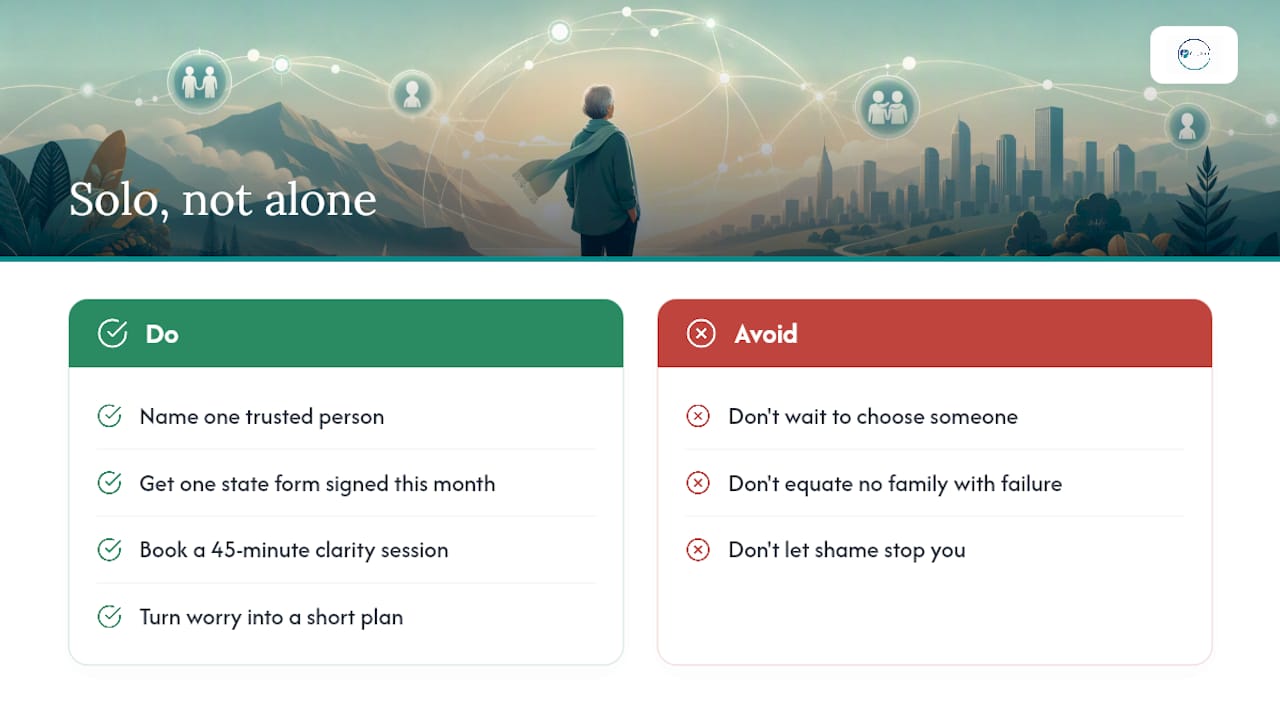
I think a lot of people hear "no family to name" and feel a quiet kind of shame creep in, like they've failed at something everyone else figured out. You haven't. Plenty of people build rich, connected lives without a spouse or nearby kids, and the absence of family on a legal form says nothing about the fullness of your life.
Here's what actually moves the needle: name one person you trust and get one state form signed this month. That's it. If you want help thinking it through out loud, a 45-minute clarity session can turn a vague worry into a short, doable plan. Either way, this isn't about bracing for the worst. It's one more way you're choosing, on your own terms, how your life keeps looking like yours.
— Mike
Getting Guided Help With Your Planning
If reading through court fallbacks and state form requirements left you wanting a second set of eyes, that's exactly what Agingsolo's Solo Aging Clarity Session is for. It's a focused, 45-minute Zoom conversation built specifically for adults planning without a spouse or nearby kids to lean on, where you'll walk through who to name, what documents you actually need, and how to have the conversation with your chosen agent.

The session won't replace an attorney for drafting your actual POA or trust, and you'll still need your state's official forms, but it will help you walk into that appointment knowing exactly what you want instead of guessing. Agingsolo also offers free downloadable guides on documenting your personal wishes and setting up a healthcare proxy, so you can start clarifying your plan today even before you book anything. When you're ready for the deeper conversation, book a Solo Aging Clarity Session and get a plan that actually fits your life.
Sources
- Designating a Power of Attorney: Choices for Those Without Immediate Family — E.A. Goodman Law
- How to choose and guide your health care proxy — Harvard Health
- What Happens If You Have No One for Power of Attorney? — LegalClarity
- Choosing a health care proxy — National Institute on Aging (NIA)
This article is general information, not a substitute for advice from a qualified lawyer. Consult a qualified legal professional about your own circumstances before acting on anything here.
FAQ
Who can be my power of attorney if I have no family?
Any capable adult you trust can serve, including a friend, neighbor, or distant relative, or you can hire a professional fiduciary or trust company if no one in your life is available or willing.
Can a non-family member legally be a power of attorney?
Yes, most states allow any competent adult to serve as an agent, with a few states restricting certain paid caregivers or facility employees from acting in that role.
Can a power of attorney be sued?
An agent can face legal action if they breach their fiduciary duty, misuse funds, or act outside the authority the document grants them, which is one reason choosing someone trustworthy and well briefed matters so much.
How long does a power of attorney last?
A durable power of attorney generally stays in effect until you revoke it, become deceased, or specify an end date, and it typically remains valid through incapacity unless you write it otherwise.
What happens if I never name a power of attorney?
Without one, a court may need to appoint a guardian or conservator on your behalf, a process that can take weeks to months and cost thousands of dollars in legal fees.