
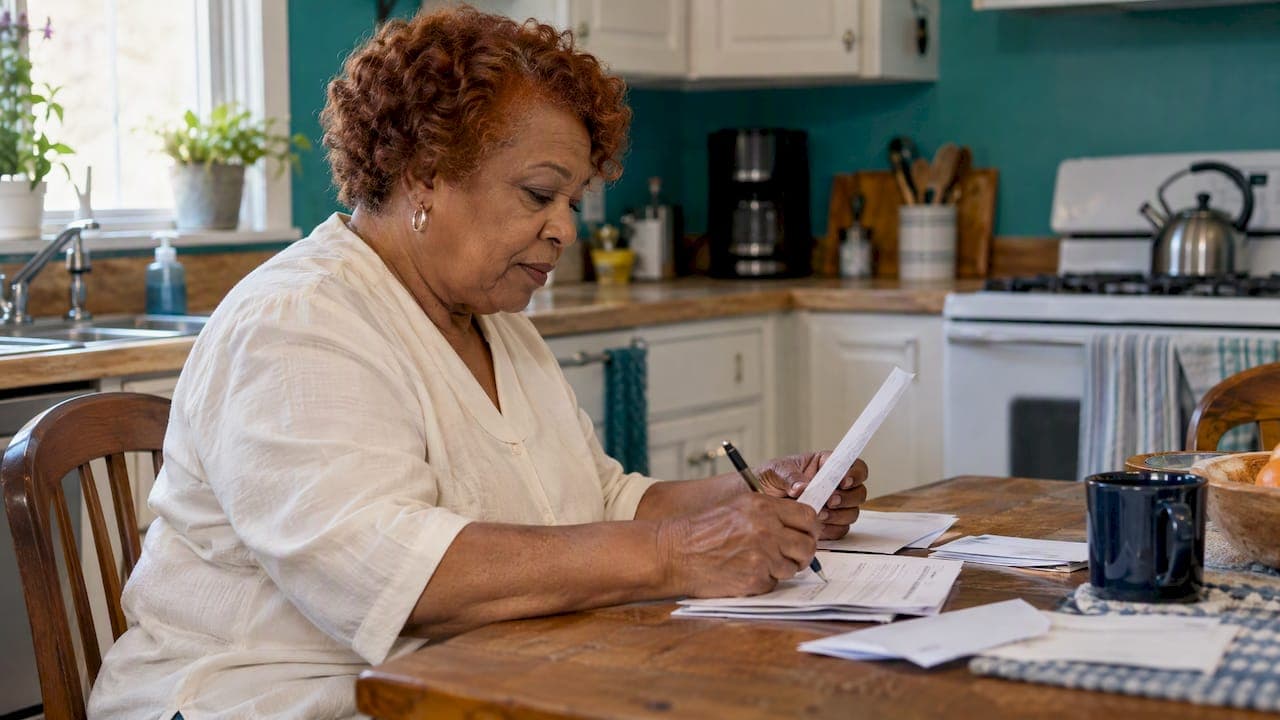
It's a Thursday afternoon. The sun is on the porch, a friend has just texted about a walk, and you're at the kitchen table with a pile of mail, a laptop and a feeling you can't quite name. A statement you don't recognize. A bill you think you paid. A portal that wants a new password again. The walk starts to feel like something you'll do once this is sorted. And it never quite is.
If that sounds familiar, you're in good company, and nothing is wrong with you. Living on your own means every envelope lands on one desk. A daily money manager (often called a DMM) is a professional who takes on the routine money tasks, like paying bills and keeping records in order, so they stop crowding out the parts of life you'd rather be living. This article explains what one does, what it costs, who it suits, and how to find someone you trust.
TL;DR
- A daily money manager handles everyday financial chores such as paying bills and keeping records. They are not an investment advisor, an attorney or a tax preparer.
- Routine help can run a few hundred dollars a month, while a big first-time cleanup of overdue bills and messy paperwork can cost much more.
- If cost is the barrier, local nonprofit programs may offer basic bill-paying help. The Eldercare Locator (1-800-677-1116) can point you to them.
- For many solo agers, the real payoff isn't tidier files. It's the hours and calm you get back.
Table of Contents
- What a daily money manager actually does
- Why this matters more when you live alone
- A small scene: what "handing it off" can look like
- What it costs
- Choosing someone you can trust
- A DMM, a friend, or doing it yourself?
- Our perspective
- Where to begin this week
- Talking it through with us
- Frequently asked questions
- Sources
What a daily money manager actually does
Think of a DMM as a capable, discreet helper for the paperwork side of life. Investopedia describes a daily money manager as a professional who handles routine financial tasks for individuals, with bill paying at the center. In practice, that usually means a mix of things like these:
- Paying bills on time and keeping track of what's due
- Sorting mail and spotting statements or charges that look off
- Balancing checkbooks and reconciling accounts
- Organizing records and tax documents so your accountant gets a tidy folder instead of a shoebox
- Tracking insurance premiums and benefit payments, including long-term care coverage
- Talking with insurers or providers about a confusing statement
The American Association of Daily Money Managers, a national professional organization, says DMMs serve both individuals and businesses. It also runs a directory where you can look for someone in your area.
What a DMM generally doesn't do matters just as much. They don't pick your investments, give legal advice or serve as your attorney. If you need long-term financial planning, that's a different professional. Industry voices at the AADMM note that pairing a DMM for daily tasks with a separate CPA or financial planner for long-term advice can reduce costs and builds in a system of checks and balances.
Why this matters more when you live alone
When there's a partner or grown child nearby, money chores often get shared without anyone naming it. One person remembers the property tax. Another notices the odd charge. Living solo, you are the whole system, and that's fine on a good week. On a hard one, say after surgery, during a stretch of grief, or in the middle of a move, the system can wobble.
The AADMM lists older adults among the people who may benefit, because handling bills, deposits and payments can get harder as we age. It also names people who are constantly on the road or simply stretched thin. You don't have to be struggling to use one. Plenty of capable, independent people hand off paperwork the way they hand off house cleaning or lawn care: not because they can't, but because their time is worth more spent elsewhere.
There's a quieter reason too. Paperwork piles up fastest when you're feeling low or isolated, and then it makes you feel worse. Lifting that weight is a small kindness to yourself. If the quiet at home has been feeling heavier than you expected, our Hidden Loneliness Checklist for Solo Agers may help you put words to it.

A small scene: what "handing it off" can look like
Imagine a retired teacher, call her Marguerite. This is a composite picture, not a real client. She has always paid her own bills, and she's good at it. Then a hip replacement keeps her on the couch for six weeks, and the mail stacks up. A friend mentions that someone comes by twice a month to go through bills, flag oddities and file what's left.
Marguerite hesitates. It feels like admitting something. Then she realizes she's not giving up control. She's deciding who does what, which is what independence has always meant. By spring she's back to paying her own bills, but she keeps the twice-monthly visit. She uses the saved hours for a pottery class.
That's the shape we hope for: not dependence, but room.
What it costs
Prices vary by region and by how much work you bring. The Seattle Times reports that routine management might cost a few hundred dollars a month, but cleaning up an "avalanche" of overdue bills and chaotic paperwork at the start can run into the thousands. So the first month often looks very different from the tenth.
Two things tend to drive the bill:
- The state of your paperwork. Organized records mean less cleanup time.
- How often you want help. A monthly check-in costs less than weekly visits.
Before you sign anything, ask how fees are structured (hourly or flat monthly), whether there's a separate setup charge, and what happens if you need extra hours. A good professional will answer plainly and put it in writing.
If the cost doesn't fit your budget, you aren't out of options. Non-profit elder-assistance agencies often provide basic financial help such as bill paying. The CFPB says you can find them through your local Area Agency on Aging or the federal Eldercare Locator, at eldercare.acl.gov or 1-800-677-1116.
Choosing someone you can trust
A DMM sees your accounts, your mail and sometimes your signature. Trust isn't a bonus here. It is the whole job. A few questions are worth asking in a first conversation, and you can treat it as a friendly interview rather than an interrogation.
Ask how they work. Do they pay bills from your accounts, or prepare payments for you to approve? Many people feel best starting with the second arrangement, where you keep the final say.
Ask about safeguards. Is the person bonded and insured? Will they provide references? Can you see activity on your accounts yourself, at any time? Anything less than full transparency is a reason to keep looking.
Ask about their lane. A good DMM is clear about what they won't do, such as investment advice or legal counsel, and will happily work with your accountant or attorney.
Start small. You don't need to hand over everything on day one. Begin with one task, say paying the monthly bills, and let trust build.

A practical note about legal authority: giving someone access to your money can be done in several ways, and they carry different levels of risk. The CFPB explains options such as convenience accounts, trusted contacts and power of attorney for bill paying and banking. A power of attorney is a legal document with real consequences, so talk with an elder law attorney in your state before you sign one, and ask your bank what it offers for an authorized helper. You can look for a DMM through the AADMM directory, and many people simply ask friends, their attorney or their accountant who they'd recommend.
For solo agers without children or close relatives, there's one more thing to think about: who steps in if you can't manage at all? A DMM isn't a substitute for that person, but they can make it much easier for someone else to step in later, because the records are already in order. Our Living Alone Financial Safety Checklist for Adults 50+ walks through that in plain language.
A DMM, a friend, or doing it yourself?
There's no single right answer. Here's an honest comparison.
| Option | Best for | Watch out for |
|---|---|---|
| Doing it yourself | People who enjoy it and have the energy | Burnout during illness, grief or a move |
| A trusted friend or relative | Light, informal help | Blurred boundaries, and friendships strained by money |
| A professional daily money manager | Ongoing help, a backlog, or a big life change | Cost, and the need to check credentials |
| A nonprofit or community program | Basic bill-paying on a tight budget | Limited hours and local availability |
Many people mix and match. You might keep paying bills yourself, use a professional for tax-season paperwork, and lean on a friend for a second pair of eyes. The point is to have a plan that feels like yours.
Our perspective
We started Aging Solo Today because the founder is a solo ager, and we've seen how often practical help is treated as a sign of decline. We see it differently. A full solo life usually rests on a few quiet supports that let you spend your energy on the good stuff: friends, travel, projects, a long lunch with a book.
A daily money manager can be one of those supports. It isn't right for everyone, and we don't think anyone should be pushed into it. But if the paperwork has become the thing that keeps you from the walk, the dinner out, the trip, then getting help is not a retreat. It's a choice made on your own terms.
We also believe in sharing the load across a circle. A professional for the bills, a neighbor who knows your routine, a friend who checks in. If you'd like to build that circle, start with Build Your Support Circle or read about why independence is not isolation.
— Mike Crawford
Where to begin this week
You don't need to hire anyone today. Two gentle moves are enough.
First, notice which money task drains you most. For some people it's the monthly bills. For others it's insurance statements or a drawer of old paperwork. That single answer tells you what kind of help you actually want.
Second, make one phone call. Look up a local professional in the AADMM directory and ask for a short introductory chat, or call the Eldercare Locator at 1-800-677-1116 to learn what your area offers. Asking questions commits you to nothing.
Then go for the walk. The mail will still be there, and it will feel lighter.
Talking it through with us
If you're weighing all this and want a thoughtful second voice, we offer the Solo Aging Clarity Session: a 45-minute Zoom conversation for $97, one time. It's personalized planning for solo agers, a chance to talk through what's weighing on you, what support might look like, and what you'd like your days to hold. There's no obligation beyond the session, and our free guides, like Solo Aging 101, are always there if you'd rather explore on your own first.
Frequently asked questions
What is a daily money manager?
A daily money manager is a professional who handles routine financial tasks for individuals, such as paying bills, organizing records and tracking statements. They don't give investment or legal advice. Think of them as a practical helper for the paperwork side of life.
Can I hire someone to pay my bills?
Yes. A daily money manager is one route, and some people begin by having the manager prepare payments that they then approve. If cost is a concern, a local Area Agency on Aging or the Eldercare Locator can point you to nonprofit help.
How much does a daily money manager cost?
It depends on where you live and how much help you need. Routine management may run a few hundred dollars a month, and a first-time cleanup of overdue bills and disorganized records can cost considerably more. Ask any provider for their fee structure in writing.
Is a daily money manager worth it if I'm still managing fine?
Often the answer is yes, in specific seasons: recovery from surgery, a move, a loss, or a stretch when your time is better spent elsewhere. You can also begin with one task and see how it feels. Many people find the benefit is less about ability and more about the peace of mind.
Sources
- Daily Money Manager (DMM): Your Guide to Managing Finances, Investopedia
- A Coach, Mechanic or Housekeeper, but for Your Finances, The Seattle Times
- Can a family member or friend help me with bill paying and banking? Consumer Financial Protection Bureau
- American Association of Daily Money Managers
- DMMs and You, AADMM