
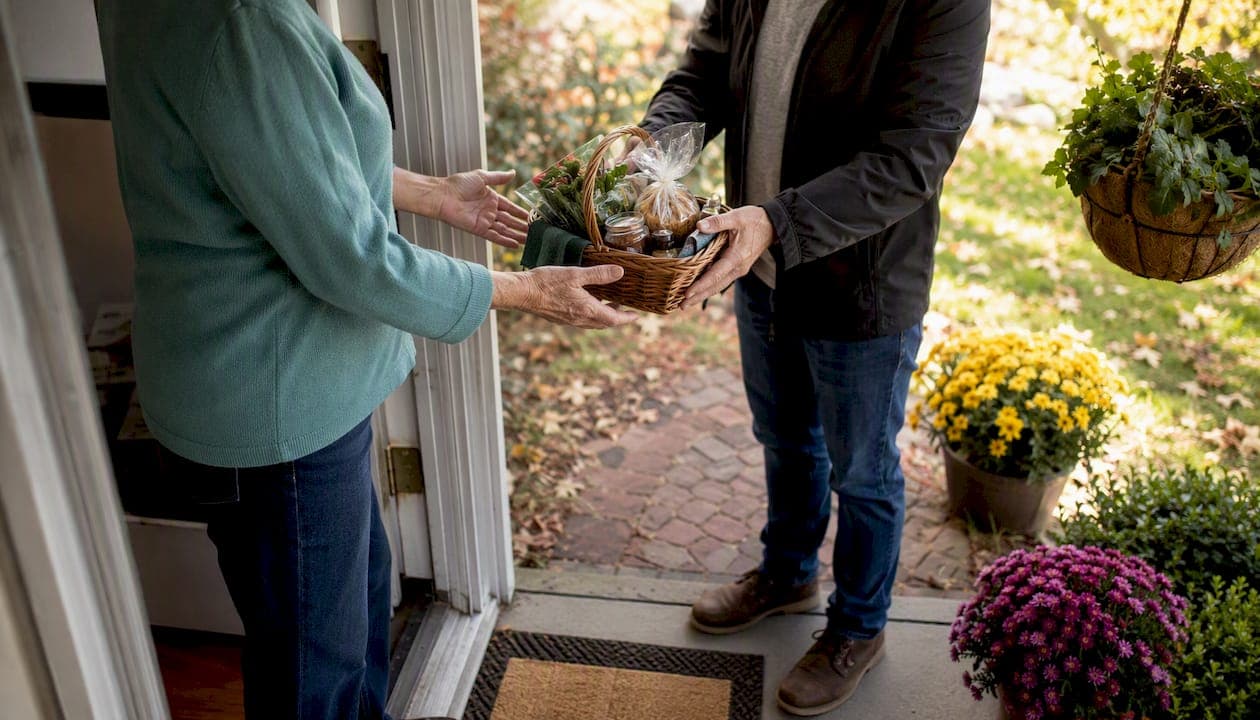
A friendly visitors program connects an older adult who is isolated or homebound with a trained, screened volunteer who visits regularly for companionship. These programs are almost always free to participants and are non-medical in scope. To get started right now:
- Call 211 and ask for friendly visitor or companion visiting programs in your county.
- Search online using "friendly visitors program + [your county or city]" to find local options.
- Contact Meals on Wheels in your area — many local chapters offer friendly visits, calls, and mail alongside meal delivery.
- Boston-area residents can reach FriendshipWorks directly. New York City residents can contact NYC Aging for a city-funded match.
- To volunteer, use the same contacts above and ask about the volunteer application process.
Key Takeaways
Friendly visitor programs are free, non-medical companionship services that connect isolated older adults with trained, screened volunteers for regular in-person, phone, or video visits.
| Point | Details |
|---|---|
| Usually free to participants | Most programs are grant-funded or nonprofit-run; participants pay nothing. |
| Matching takes 2–6 weeks | Programs weigh shared interests, personality, geography, and schedule before introducing a pair. |
| Volunteers need background checks | Criminal background checks and orientation training are standard requirements before any visit. |
| Start with 211 or your local AAA | Calling 211 or visiting eldercare.acl.gov connects you to nearby programs fastest. |
| Agingsolo supports your planning | Use Agingsolo's guides and checklists to prepare for and integrate friendly visiting into a broader support plan. |
Table of Contents
- What does a friendly visitors program actually look like?
- Who qualifies for a friendly visitor program?
- What do volunteers do — and what's off-limits?
- Why these programs matter — benefits for seniors and volunteers
- How screening, matching, and follow-up work
- How to apply or refer a senior to a program
- How to sign up as a volunteer
- Where to find friendly visitor programs across the U.S.
- How to make visits meaningful from the very first one
- What to ask any program about safety and privacy
- Why relationship-based visiting is worth more than people expect
- Agingsolo supports solo agers in building the right support network
- Sources
- FAQ
What does a friendly visitors program actually look like?
These programs go by several names — companion visiting, friendly visiting, or visitor engagement programs — but the core idea is the same: a real person shows up (or calls) regularly, just to connect.
Common formats include:
- In-home visits: A volunteer comes to the senior's home, usually once a week, for an hour or two.
- Phone calls: Scheduled check-in calls for seniors who prefer phone contact or live in areas without local volunteers.
- Video visits: Virtual visits via tablet or smartphone, often supported by the program coordinator.
- Friendly mail: Handwritten cards or letters for seniors who enjoy written correspondence.
Typical activities during a visit are simple and warm: conversation, card games, reading aloud, short walks, shared meals, or working on a hobby together. Meals on Wheels programs have expanded this model beyond meal delivery to include all three formats, recognizing that loneliness is as pressing as hunger for many homebound seniors.
One thing to be clear about: these programs offer companionship and light assistance, not medical or personal care. A volunteer is not a home health aide, and the scope is intentionally limited to protect both parties.
Who qualifies for a friendly visitor program?
Most programs serve adults aged 60 or older, though some set the threshold at 55. The typical eligibility criteria look like this:
- Homebound or mobility-limited — difficulty leaving home without assistance
- Socially isolated — living alone, with limited family contact, or recently bereaved
- Residing within the program's service area — geographic boundaries vary significantly
- Not requiring medical or personal care during visits
Programs often have waiting lists, especially in urban areas, so applying to more than one program at the same time is a practical move. Service areas can be surprisingly narrow; a county program may only serve unincorporated areas, not nearby cities.
Seniors with mild cognitive impairment can often participate, but programs like Shepherd's Center of Northern Virginia are clear that volunteers are not trained or equipped to provide dementia-specific or hospice-level care unless they have received specialized training. If the person you're referring has moderate to advanced dementia, ask the coordinator directly whether the program is a good fit before completing an intake.
What do volunteers do — and what's off-limits?
Volunteers typically provide:
- Friendly conversation and active listening
- Playing games, reading, or working on puzzles together
- Accompanying the senior on short walks (where program policy allows)
- Phone check-ins between in-person visits
- Light errands in some programs (picking up a library book, for example)
Volunteers do not provide:
- Personal care (bathing, dressing, toileting)
- Lifting or physically assisting a fallen person
- Medical tasks of any kind
- Handling money or financial matters
- Transportation in most programs
York County, VA's Friendly Visitors Program explicitly prohibits personal care tasks and, in some cases, transporting participants — a common boundary across county programs nationwide.
Time commitment: Most programs ask for one visit per week, typically an hour or two. Some offer phone-only or group roles for volunteers with tighter schedules. NYC Aging asks volunteers to commit to six months or longer, which reflects how much programs value consistency over short-term help.

Why these programs matter — benefits for seniors and volunteers
The benefits run in both directions, and they're meaningful.
For older adults:
- Reduced feelings of loneliness and social isolation, which research links to serious health risks including depression and cognitive decline
- Improved mood and a sense of being seen and valued
- A regular, predictable connection that can serve as an informal safety check
- Caregiver respite — family members and caregivers get a reliable break
For volunteers:
- A genuine sense of purpose and contribution
- New perspectives from spending time with someone from a different generation or background
- The satisfaction of a relationship that deepens over time
The Alliance for Better Long Term Care notes that volunteers in their one-to-one nursing home visiting program gain life satisfaction alongside the residents they visit, making the benefit genuinely bidirectional. Programs that acknowledge this tend to retain volunteers longer.
How screening, matching, and follow-up work
The process from application to first visit usually takes 2–6 weeks. Here's what to expect:
- Application — Both the senior (or their caregiver) and the volunteer complete an intake form covering interests, schedule, location, and any relevant health or mobility notes.
- Interview — A coordinator speaks with both parties, often by phone, to assess fit and answer questions.
- Background check — Volunteers undergo a criminal background check. Many programs, like the Town of Warwick's Neighbors Helping Neighbors, cover this cost entirely.
- Training and orientation — Volunteers complete a program orientation covering boundaries, safety, communication, and what to do in an emergency.
- Matching — Coordinators weigh shared interests, personality, geography, and schedule. FriendshipWorks emphasizes that chemistry matters more than logistics alone; a good personality match outlasts a convenient schedule.
- Introduction — The coordinator often facilitates the first contact or visit.
- Ongoing follow-up — Coordinators check in regularly with both parties. If a match isn't working, rematching is standard practice, not a failure.
How to apply or refer a senior to a program
Step-by-step:
- Call 211 and say: "I'm looking for a friendly visitor or companion visiting program for an older adult in [city/county]."
- Contact your local Area Agency on Aging (AAA) — find yours at eldercare.acl.gov.
- Reach out to Meals on Wheels in your area and ask specifically about friendly visiting services.
- Try FriendshipWorks (Boston area) or NYC Aging (New York City) if you're in those regions.
- Search county websites using "friendly visitors program + [county name]."
What programs typically ask during intake:
- Senior's name, address, and phone number
- Emergency contact information
- Any health conditions or mobility limitations relevant to visits
- Preferred visit days and times
- Hobbies, interests, and language preference
- Whether the senior lives alone
Sample referral script for caregivers: "Hi, I'm calling to ask about your friendly visitor program. I'm a caregiver for [name], who is [age] and lives alone in [city]. She/he has limited mobility and doesn't get many visitors. I'd like to find out if she/he qualifies and how to get started."
How to sign up as a volunteer
- Find a program using the search steps above, or visit FriendshipWorks, NYC Aging, or your county's aging services page.
- Submit a volunteer application — most are available online or by phone.
- Complete an interview with the program coordinator.
- Pass a background check — standard across virtually all programs; some reimburse older volunteers for mileage.
- Attend orientation and training — typically a few hours, covering safety, boundaries, and communication skills.
- Get matched and meet your senior for the first time, often with coordinator support.
Tips for lasting volunteer relationships:
- Show up consistently. Reliability matters more than any single visit.
- Set a regular day and time and stick to it — predictability is comforting.
- Let the senior lead the conversation, especially early on.
- Keep visits within program scope; if you're unsure whether a task is allowed, ask your coordinator.
Where to find friendly visitor programs across the U.S.
| Entry Point | What It Offers | How to Reach It |
|---|---|---|
| 211 Helpline | Connects you to local programs by ZIP code | Call or text 211 |
| Area Agencies on Aging | Local coordinators for all senior services | eldercare.acl.gov |
| Meals on Wheels (local chapters) | Friendly visits, calls, and mail alongside meals | mealsonwheelsamerica.org |
| FriendshipWorks | Boston-area in-home and phone matching | fw4elders.org |
| NYC Aging | NYC-funded visiting for homebound residents | nyc.gov/aging |
| County aging services | Varies widely; often free, locally run | Search "[county] friendly visitor program" |
| Alliance for Better Long Term Care | Nursing home visiting programs | alliancebltc.org |
Contacting two or three entry points at once is worth doing. Wait lists are real, and one program may have capacity when another does not.
Search phrases that work: "friendly visitor program near me," "companion visiting [county name]," "volunteer visitor program [state]."
How to make visits meaningful from the very first one
The first visit sets the tone. Keep it low-pressure and short — 30–45 minutes is plenty.
Pro Tip: Bring a simple conversation starter: a photo, a newspaper clipping, or a question about the senior's hometown. Memory cues like old photos or familiar music open conversations that feel natural, not forced.
Building rapport over time:
- Establish a small routine — the same greeting, the same chair, the same opening question. Routine is reassuring.
- Try a shared micro-activity: a 15-minute word puzzle, a short walk to the window, or listening to a favorite radio program together.
- Notice small changes in mood, appearance, or home condition. These are worth mentioning to a coordinator.
When to escalate:
- Signs of a fall, injury, or sudden confusion — call 911 first, then the coordinator.
- Expressions of hopelessness or talk of self-harm — contact the coordinator immediately.
- Significant changes in hygiene, weight, or home safety — report to the coordinator at the next check-in.
Volunteers are not case managers, but they are often the most consistent presence in a senior's week. That position carries real responsibility, and good programs train for it.
What to ask any program about safety and privacy
Before enrolling a senior or signing up to volunteer, ask these questions directly:
- Does every volunteer receive a criminal background check? Who pays for it?
- Are volunteers covered by the program's insurance during visits?
- What training is required before the first visit?
- What is the emergency protocol if a volunteer finds the senior unresponsive or injured?
- How is the senior's medical information handled and who has access to it?
- Does the senior (or their legal representative) sign a consent form before the match begins?
- Are photos or personal stories shared publicly without explicit permission?
A well-run program answers all of these without hesitation. Vague answers about background checks or insurance are a reason to look elsewhere. The Council on Aging of Southern California conducts in-home assessments and builds individualized care plans, which reflects the more thorough intake process you should expect from established programs.
Why relationship-based visiting is worth more than people expect
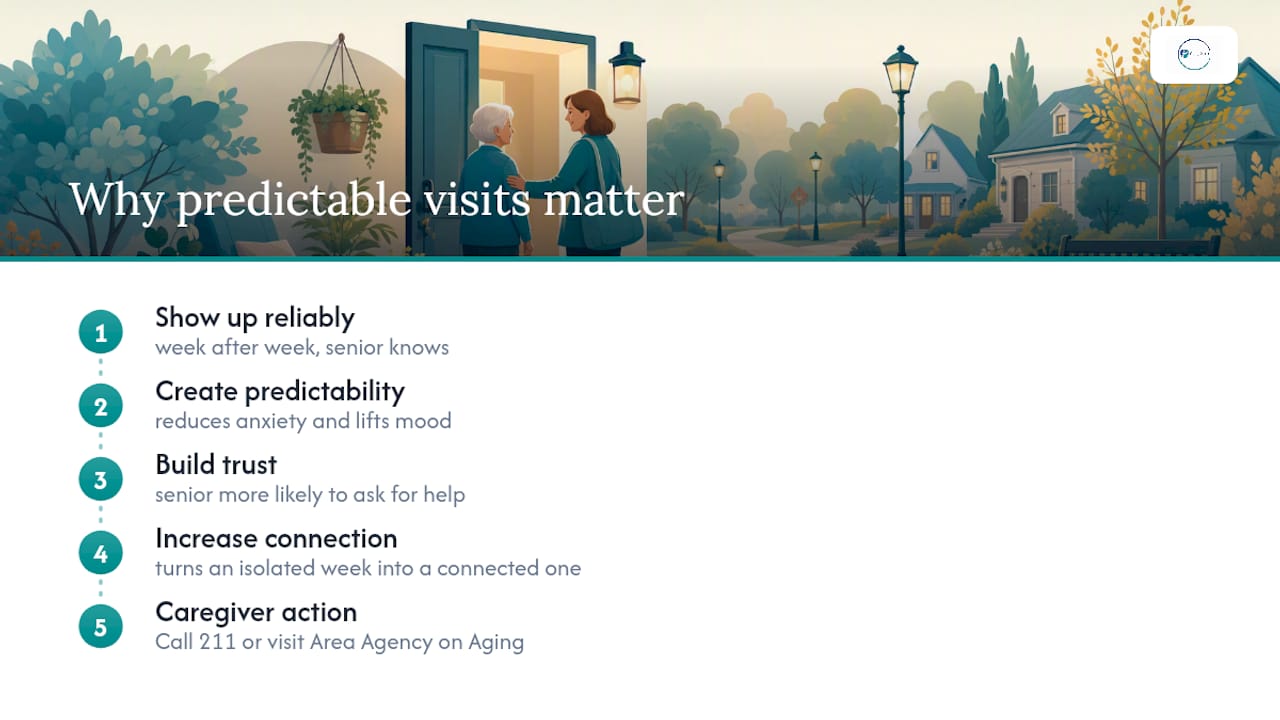
Most people underestimate what a consistent, caring presence actually does for an isolated older adult. The conversation itself is not the point. The point is that someone shows up, reliably, week after week, and that the senior knows they will. That predictability is what reduces anxiety, lifts mood, and builds the kind of trust that makes a senior more likely to ask for help when they genuinely need it.
Friendly visiting is not a substitute for medical care or family contact. But for a solo ager living alone, it can be the difference between a week that feels connected and one that doesn't. If you're a caregiver reading this, the most useful thing you can do today is call 211 or visit your local Area Agency on Aging page and start the referral process. Don't wait for the isolation to deepen.
Agingsolo has guides and planning tools specifically for solo agers navigating exactly this kind of decision. Start with the isolation challenges guide if you're trying to understand the full picture.
Agingsolo supports solo agers in building the right support network
Friendly visiting programs are one piece of a larger support plan. Knowing how to find them, vet them, and integrate them into daily life takes some preparation, and that's where Agingsolo comes in.
Agingsolo offers practical, plain-language guides built for adults aging without a built-in support system. The aging in place guide walks you through how to prepare your home and your plan for receiving support like friendly visiting. The Build Your Support Circle resource helps you map out who is in your corner and where the gaps are. Agingsolo is not a visiting service, but it helps you ask the right questions, organize your information, and feel ready before you make that first call. If you want a personalized conversation about your situation, a 45-minute Solo Aging Clarity Session is available by booking directly on the site.
Sources
- Friendly Visiting | FriendshipWorks
- Friendly Visiting - NYC Department for the Aging
- Friendly Visitor Program - Neighbors Helping Neighbors - Town of Warwick
- Friendly Visitor Program – Meals On Wheels in Greater New Brunswick
- Friendly Visitors Program - Alliance for Better Long Term Care
- Friendly Visitor Program — Shepherd's Center of Northern Virginia
FAQ
What is a friendly visitors program?
A friendly visitors program pairs a trained, screened volunteer with an isolated or homebound older adult for regular companionship visits. The service is non-medical and usually free to participants.
How long does it take to get matched with a volunteer?
Most programs complete the matching process within 2–6 weeks, depending on volunteer availability and how closely your preferences align with available matches.
Do volunteers go through background checks?
Yes. Criminal background checks are standard across virtually all established programs, and most cover the cost for volunteers. Training and orientation are also required before the first visit.
Is there a cost for seniors to participate?
No. Friendly visitor programs are almost always free to participants, funded through grants, municipal budgets, or nonprofit support.
Can someone with dementia participate in a friendly visitor program?
Mild cognitive impairment is often compatible with participation, but volunteers are generally not trained for dementia-specific or hospice-level care. Ask the program coordinator directly about the senior's specific needs before completing an intake.