

A friends caller is a scheduled telephone reassurance or friendly-caller program—a regular phone check that combines genuine companionship with safety monitoring for older adults living alone. If you want one set up quickly, call the national Area Agency on Aging locator at 1-800-677-1116 or save your local non-emergency police number today.
Here is what a typical program looks like from day one:
- Call frequency: daily or weekly, at a time you choose
- What happens: a volunteer or staff member calls, you confirm you're okay, and you have a brief friendly chat
- Escalation: if you don't answer, the program contacts your designated emergency contacts and, if needed, requests a welfare check
- Cost: many programs through Area Agencies on Aging are free
Key Takeaways
A telephone reassurance program is one of the most reliable, low-cost safety tools available to solo agers, and most communities offer one for free through their local Area Agency on Aging.
| Point | Details |
|---|---|
| Start with your AAA | Call 1-800-677-1116 or visit eldercare.acl.gov to find free local programs. |
| Escalation is built in | Programs contact emergency contacts and dispatch a welfare check if you don't answer. |
| Notify before travel | Failing to report absences is the leading cause of unnecessary emergency dispatches. |
| DIY is a real option | A rotating roster of 3–5 neighbors with a clear missed-call protocol works when no formal program exists. |
| Agingsolo supports the plan | A Solo Aging Clarity Session helps you integrate telephone reassurance into a full safety and support plan. |
Table of Contents
- What is a friends caller program, exactly?
- Where can you find a telephone reassurance program near you?
- How does a typical check-in call work?
- How do you enroll in a friends caller program?
- Questions to ask before you sign up
- What does a friends caller program cost?
- Safety, privacy, and background checks
- When should you request a welfare check?
- How to build your own DIY calling roster
- Ready-to-use call scripts and checklists
- Why telephone reassurance matters for solo agers
- Agingsolo can help you build a plan that holds
- Useful resources
- Sources
- FAQ
What is a friends caller program, exactly?
Telephone reassurance is the formal industry term. Area Agencies on Aging define it as regular phone interactions designed to reduce social isolation and confirm health and safety, a commonly recognized practice in aging support. A friends caller program delivers that through scheduled calls by volunteers, agency staff, or automated systems.
The social side matters as much as the safety side. For many solo agers, the daily call is their most meaningful conversation of the week. Volunteer programs emphasize friendly conversation first, with safety monitoring built in quietly behind it.
What these programs are not:
- A replacement for a medical alert device (they don't detect falls in real time)
- A social networking app or video chat service
- A home health or nursing service
Pro Tip: Match the program model to the person's needs. Someone who craves conversation benefits most from a live volunteer caller. Someone with higher medical risk needs a program with a clear, fast escalation path.
Where can you find a telephone reassurance program near you?
Start with these sources, in order of reliability:
- Area Agency on Aging (AAA): your single best starting point; call Eldercare to find your local AAA
- Local senior centers: many run or refer to telephone reassurance programs directly
- Meals on Wheels: deliveries create face-to-face contact that functions as an informal wellness check, and coordinators often know local call programs
- Faith-based organizations: churches, synagogues, and mosques frequently run volunteer caller programs for congregants and the wider community
- Municipal police or sheriff departments: police-run daily check-in programs have been used for decades and have saved lives
- Nonprofit community organizations: search "[your county] telephone reassurance program" to find local nonprofits
Step-by-step search:
- Call 1-800-677-1116 and ask for your local AAA.
- Ask the AAA: "Do you operate or refer to a telephone reassurance or friendly-caller program?"
- If they don't run one directly, ask for referrals to senior centers or nonprofits that do.
- Contact your local senior center and ask the same question.
- Ask your post office about the USPS Carrier Alert program, which flags missed mail delivery to social service agencies.
- If no program exists locally, see the DIY section below.
How does a typical check-in call work?
The call itself is brief. A volunteer or automated system rings at the scheduled time. You answer, confirm you're okay, and share a few minutes of conversation. The call is logged.
Automated systems run a slightly different flow: a reminder text or call arrives, you respond by pressing a number or replying, and if you don't respond within the configured window, the system alerts your care circle automatically.
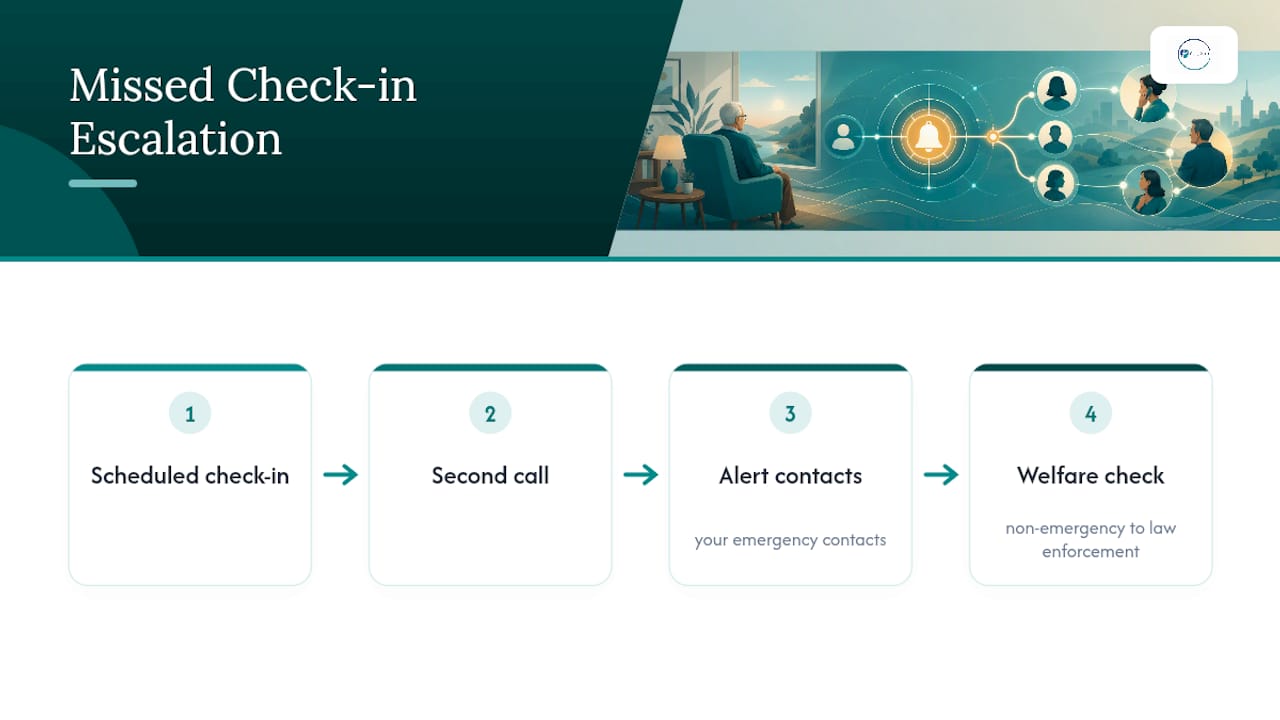
Escalation sequence for a missed call:
- Attempt 1: second call or text within minutes
- Attempt 2: call to your first emergency contact
- Attempt 3: call to your second emergency contact
- Attempt 4: non-emergency police dispatch or welfare check request
The biggest cause of unnecessary emergency dispatches is a participant forgetting to notify the program about travel or a phone outage. Program coordinators consistently identify this as the leading source of false alerts.
Pro Tip: Before you enroll, ask the program: "What is your exact escalation timeline, and who gets called in what order?" Write it down. That sequence is your real safety net.
How do you enroll in a friends caller program?
- Identify your provider using the search steps above.
- Call or complete an intake form. Enrollment in most programs requires a short phone call or form submission.
- Provide participant details: full name, address, home phone number, and any alternate numbers.
- Set your call schedule: preferred time of day and frequency (daily is recommended for solo agers living alone).
- Name emergency contacts: at least two people, with current phone numbers.
- Designate a key holder: someone who can enter the home if a welfare check is needed.
- Confirm the escalation list and ask how long the program waits before activating it.
Most programs will ask for:
- Participant name, address, and phone number
- Preferred call time and frequency
- Two emergency contacts with current numbers
- Key-holder name and contact
- Any medical conditions relevant to an emergency response (optional but helpful)
If you are enrolling someone else, ask the program about consent requirements. Most require the participant's verbal or written agreement before calls begin.
Questions to ask before you sign up
A good program answers these clearly. Vague answers are a warning sign.
- Who makes the calls? Trained volunteers, paid staff, or an automated system?
- What is the escalation timeline? How many minutes or attempts before emergency contacts are called?
- How are emergency contacts notified? Phone call, text, or both?
- Is there a background check or screening policy for volunteers?
- What personal data does the program collect, and who can access it?
- What happens if I need to pause calls for a vacation?
Write the answers down and keep them with your emergency contact list. If two programs are available locally, these answers will tell you which one fits better.
What does a friends caller program cost?
Many programs through AAAs, police departments, and volunteer organizations are free. AAA-operated telephone reassurance programs may be funded through federal Older Americans Act dollars, local government grants, or nonprofit budgets, which keeps costs low or zero for participants.
Private paid services typically charge a flat monthly fee, a per-call rate, or a tiered plan based on call frequency and escalation features. Pricing varies widely by provider and region.
If cost is a concern:
- Ask your local AAA about sliding-scale fees or waivers
- Ask whether the program accepts payment from a caregiver's budget or a family account
- Check whether your county has a grant-funded program that covers enrollment at no charge
- Layering free services (AAA calls + Meals on Wheels visits) often provides stronger coverage than a single paid service
Safety, privacy, and background checks
Before enrolling, confirm these protections are in place:
- Volunteer screening: background check, reference check, and supervision by a program coordinator
- Data handling: ask what personal information is stored, who can see it, and whether notes are shared with outside agencies
- Escalation contact privacy: confirm that emergency contacts are used only for escalation, not for marketing or unrelated outreach
Your responsibilities matter too. The most common cause of unnecessary emergency responses is failing to notify the program about travel, a phone outage, or a change in daily routine. Build a simple habit: call the program the day before any absence.
Pro Tip: Keep your emergency contact list current and give a spare key to a trusted neighbor. If a welfare check is dispatched, having a key holder on file means officers can enter safely without forcing a door.
For broader guidance on safe independent aging, Agingsolo has practical resources that complement a telephone reassurance program.
When should you request a welfare check?
A welfare check is a non-criminal request routed to the law enforcement agency where the person lives. Anyone can request one using the local non-emergency number, and officers handle it as a routine call.
Use 911 when there is an immediate medical emergency or signs of danger. Use the non-emergency line when you have concern but no confirmed emergency.
Step-by-step:
- Find the non-emergency number for the police department in the person's city or county (not yours, if you live elsewhere).
- Call and say: "I'd like to request a wellness check."
- Provide: participant's full name, address, last known contact, any medical vulnerabilities, and your name and relationship.
- Ask for a case number and follow up with emergency contacts.
Have this information ready:
- Full name and home address of the person
- Your name, phone number, and relationship
- Last time you had contact and what concerned you
- Any medical conditions, medications, or mobility issues
- Key-holder name if one exists
If the person's program triggers an escalation and you still can't reach them, skip the non-emergency line and call 911.
How to build your own DIY calling roster
No formal program nearby? You can build one. A small, rotating group of friends, neighbors, or faith community members can cover daily check-ins reliably.
Build the roster in four steps:
- Recruit 3–5 people willing to call on assigned days. Rotating reduces burnout.
- Create a shared schedule (a simple group text thread or a shared calendar works).
- Agree on a missed-call protocol: if the participant doesn't answer, the caller texts the next person on the list within 15 minutes.
- Designate one person as the escalation lead who calls emergency services if the chain fails.
Escalation plan for a DIY roster:
- Caller 1 tries twice, 10 minutes apart
- Caller 1 texts Caller 2 and the escalation lead
- Escalation lead calls emergency contacts
- If no contact within 30 minutes, escalation lead calls the non-emergency police line
Meals on Wheels deliveries and community group visits layer well with a DIY call roster, adding face-to-face contact that a phone call cannot replicate. For ideas on building a support circle, Agingsolo's guide walks through the process step by step.
Ready-to-use call scripts and checklists
Short daily check-in script (30–60 seconds)
"Hi [Name], it's [Your Name] calling for your daily check-in. How are you feeling today? Is there anything you need help with? Great, I'll call again tomorrow at [time]. Take care."
Friendly conversation script (2–3 minutes)
"Hi [Name], it's [Your Name]. How did you sleep? Have you had a chance to eat today? Anything on your mind? I'm glad to hear it. I'll check in again [day/time]. Call me if you need anything before then."
Caller checklist
- Confirm the participant answered and sounds well
- Note any mention of pain, confusion, or unusual mood
- Log the call with date, time, and brief notes
- If no answer: follow the escalation plan immediately
Participant checklist
- Keep your phone charged and near you at call time
- Write your scheduled call time somewhere visible
- Notify the program or your roster at least one day before any travel or absence
- Update emergency contacts whenever a number changes
Print both checklists and keep them near the phone. Agingsolo's resource clearinghouse has downloadable planning tools that pair well with these.
Why telephone reassurance matters for solo agers
Solo agers face a specific kind of quiet that can settle in without warning. No partner to notice a bad morning. No adult child down the hall. The daily call from a friends caller program does something simple and steady: it puts another person in your corner, on a schedule you can count on.
The safety value is real. Police-run check-in programs have documented cases where a missed call led to a welfare check that found someone who had fallen and couldn't reach a phone. But the social value runs just as deep. For many participants, that brief morning call is the most consistent human contact in their week.
Telephone reassurance works best as one layer in a broader plan, not a standalone solution. Pair it with Meals on Wheels, a community group, and a clear emergency plan, and you have something genuinely solid. The goal isn't to cover every risk. It's to make sure someone notices, and knows what to do, when something goes wrong.
Agingsolo can help you build a plan that holds
Setting up a friends caller program is a strong first step. Knowing how it fits into your full safety picture is what makes it stick.
Agingsolo offers a 45-minute Solo Aging Clarity Session via Zoom where you can work through your specific situation: which programs to enroll in, how to build your emergency contact list, and what gaps still need filling. It's a focused, practical conversation, not a sales pitch. Free downloadable checklists are also available at the Agingsolo resource clearinghouse, including tools for emergency planning and support network building. For readers who want a broader planning foundation, the elder planning guide covers the full picture. Book your clarity session at Agingsolo when you're ready for a personalized next step.
Useful resources
- Eldercare Locator (1-800-677-1116): find your local Area Agency on Aging and telephone reassurance programs
- Meals on Wheels America: locate local meal delivery programs that also provide informal wellness monitoring
- USPS Carrier Alert: ask your local post office to enroll you; letter carriers flag missed mail to social service agencies
- LegalClarity: Welfare Check Guide: step-by-step guidance on requesting a wellness check from law enforcement
- PBS News: Police Check-In Programs: real-world examples of police-run daily check-in programs
Sources
- Local police departments restore peace of mind by phoning senior citizens once a day | PBS News
- What Is a Welfare Check and How Do You Request One? | LegalClarity
- What Is a Wellness Check for Seniors? (2026) | CheckRise
- 320 Telephone Reassurance :: Policy and Manual Management System (PAMMS)
- REASSURANCE (SCUCS Telephone Reassurance flyer)
FAQ
What is a friends caller program?
A friends caller program, formally called telephone reassurance, is a scheduled phone check-in service for older adults living alone that combines brief companionship with safety monitoring and a built-in escalation plan if someone doesn't answer.
Are telephone reassurance programs free?
Many programs through Area Agencies on Aging, police departments, and volunteer organizations are free; private paid services charge a monthly or per-call fee, and your local AAA can advise on sliding-scale options.
What happens if I miss a scheduled check-in call?
The program follows an escalation sequence: a second call, then alerts to your emergency contacts, and if no one can confirm you're safe, a non-emergency welfare check request to local law enforcement.
How do I request a welfare check for someone I'm worried about?
Call the non-emergency police line for the city or county where the person lives, provide their name and address, your relationship, and the reason for concern; anyone can make this request and it is handled as a routine, non-criminal call.
Can I set up my own calling system without a formal program?
Yes. A rotating roster of 3–5 trusted neighbors or friends, a shared schedule, and a clear missed-call protocol can function as a reliable DIY telephone reassurance system until a formal program is available.