
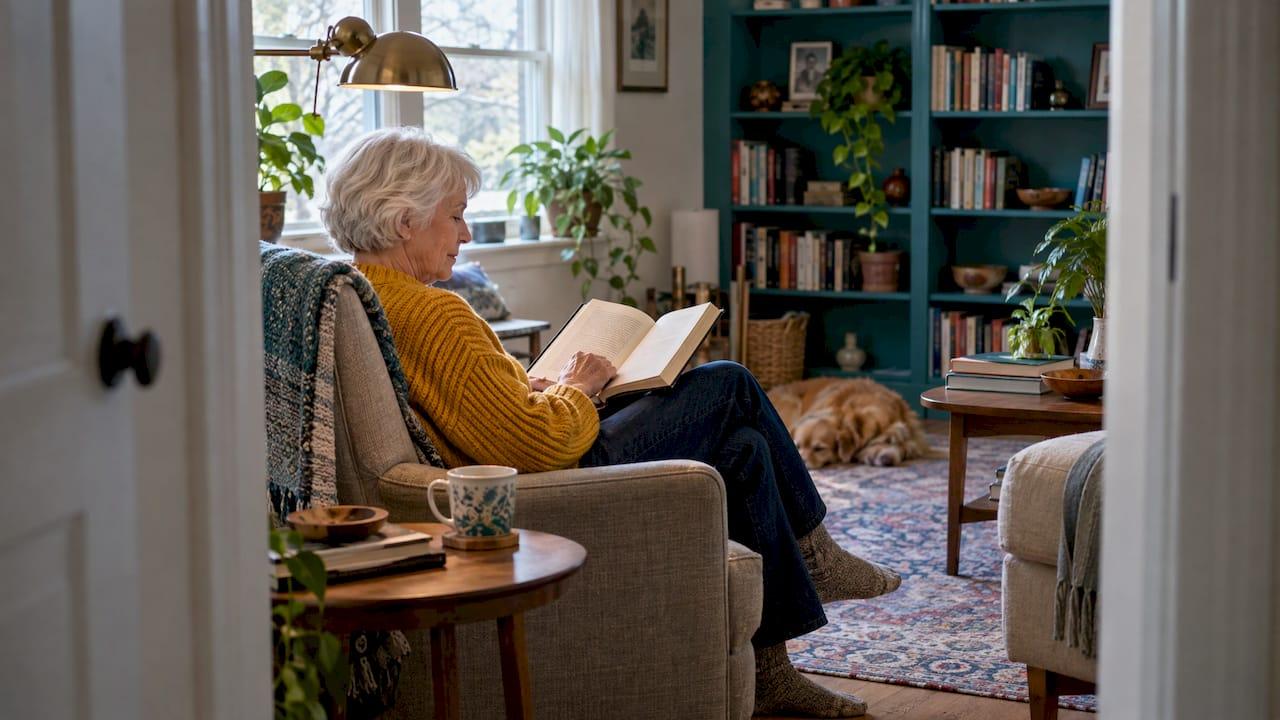
It's a Saturday morning, a little after nine. The coffee is the way you like it, because nobody else's preferences got a vote. Sunlight is crossing the kitchen floor. You have nowhere to be until noon, and for a moment the quiet feels like a gift. Then, some mornings, it feels heavier than you expected. Both moments are real, and both are part of being happy living alone.
Yes, you can be happy on your own, and many people over 50 are. Happiness in a solo life rarely comes from filling every hour. It comes from choosing how you spend your own company, and from keeping a few warm threads of connection running through your week.
TL;DR
- Being alone and being lonely are different things. Solitude you choose and enjoy is linked to better well-being, even into the eighties.
- Enjoying your own company is a skill that grows with small, repeated pleasures, not big life overhauls.
- Connection doesn't need a crowd. Neighbors, a regular café, a class or a cause can be enough to make a week feel full.
- If the quiet starts to feel heavy for long stretches, that's information, not failure. Reaching out is part of living well alone.
- A solo life can be a complete life. Plenty of people are living one right now.
Table of Contents
- You are in good company
- Alone is not the same as lonely
- Learning to enjoy your own company
- Connection without a crowd
- Confidence in a life you built
- When the quiet gets heavy
- Our perspective
- Talk it through with someone who gets it
- A week that feels like yours
- FAQ
- Sources
You are in good company
It helps to know how ordinary your situation is. According to U.S. Census Bureau data cited by KFF Health News, about 28% of Americans 65 and older live by themselves. In 1950 it was about 1 in 10. That's slightly fewer than 6 million men and slightly more than 10 million women.
So when you eat dinner at your own table, you're one of millions of people doing the same thing. Some chose it. Some arrived here through divorce, widowhood, or a life that simply never included children or a partner. Many of them are quietly having a very good time.
That doesn't erase the hard days. It just means you don't have to treat your living situation as a problem waiting to be solved.
Alone is not the same as lonely
This is the single most useful idea in the whole topic, so it's worth sitting with. Being alone describes a fact: nobody else is in the room. Loneliness describes a feeling: you want more connection than you have. You can feel lonely in a crowded room and perfectly content in an empty house.
Research backs this up. A 2023 peer-reviewed study of 397 residents of senior living communities, with an average age of 83, looked at why people spend time alone. Residents with low or positive motivations for solitude showed greater well-being, and the group with positive reasons for solitude showed significantly greater psychological richness. In plain terms, people who were alone because they enjoyed it, not because they were avoiding something, tended to be doing better.
A 2021 study of older adults in Japan adds some texture. It found that enjoying solitude, and being productive during it, were related to positive well-being. What you do with your time alone matters as much as how much of it you have.
So the question isn't "How do I get rid of the alone time?" It's "How do I make this time mine?"
Learning to enjoy your own company
Nobody hands you a manual for this. Many of us spent decades arranging our days around other people: a spouse, kids, coworkers, a standing Friday dinner. When that scaffolding changes, your own company can feel unfamiliar, like a person you haven't properly met.
Here's the good news. You can get to know that person the same way you'd get to know anyone else, with curiosity and a little time.
Give yourself something to look forward to
One idea that works for a lot of people is a standing date with yourself. Not a vague intention to "do something nice," but a specific, recurring thing. Tuesday morning at the farmers market, with a pastry. Thursday evening at the same counter seat at your favorite restaurant. A Sunday drive to a town you've never walked through.
The repetition is the point. When something is on your week by default, the days around it feel anchored. You're no longer waiting for the phone to ring. You've got somewhere to be, and the one expecting you is you.
If eating out alone feels awkward at first, start with a counter seat or a lunch hour, when solo diners are everywhere. Bring a book or don't. After three or four visits, the staff will probably know your order, and that's a small piece of belonging you built yourself.
Follow the thing you've been curious about
Most of us have a short list of things we always meant to try: pottery, birdwatching, learning to cook Thai food, a language, a long walking trail, an instrument we abandoned at 30. Living alone means you control the calendar, and nobody has to agree it's a sensible hobby.

NAMI's guidance on loneliness suggests using alone time for hobbies that build mastery, time outdoors, gratitude, and caring for or volunteering with animals. It also says purpose can be rediscovered through causes and values that matter to you. That's a nice reframe: your quiet hours aren't empty, they're open.
If you're not sure where to start, browse what's happening close to home. A local guide to fun activities near you can turn a shrug into a plan. Pick one thing that sounds mildly interesting, not impressive. Interest tends to grow once you're doing the thing.
Make your home feel like it's yours
A home built for one person can be wonderfully particular. Put the good lamp where you read. Play music while you cook. Leave the book open on the arm of the chair. Keep the dishes however you want them.
It sounds small, but there's real joy in a space that fits you exactly. Many people who have lived alone for years describe a quiet pride about it: this is my place, and it works.
Connection without a crowd
Here's something the "happy alone" articles sometimes skip. The happiest solo people usually aren't hermits. They have a handful of regular, easy connections, and they've built them on purpose.
You don't need a big circle. You need a few threads. The National Institute on Aging suggests finding an enjoyable activity or class, scheduling daily time to stay in touch with family, friends, and neighbors, introducing yourself to neighbors, and checking out your local senior center and public library. It also mentions video chat and smart speakers for keeping in touch when distance gets in the way.
The power of small hellos
The Greater Good Science Center points out that small interactions with neighbors, café staff, or other people in your community can strengthen your sense of belonging. That's good news if big social events feel like a lot. A nod at the mail carrier, a few words with the barista, a wave across the fence all count.
If you want a second idea to try, make one of your weekly outings a place you return to at the same time. Familiar faces turn into friendly faces surprisingly fast.
Friends take time, and that's fine
Making friends after 50 isn't like making them at 20. Nobody puts you in a dorm hallway together. A piece from the American Society on Aging on building a local support network reminds solo agers to be patient, because forming new relationships can take years. It suggests scheduling local activities and sharing your list of supports with neighbors and peers so they grow into something like a club.
Translation: if your first book club or class doesn't produce a best friend by week three, nothing has gone wrong. You're planting something slow.
If you'd like more on this, we've written about how to build your circle at this stage of life.
Chosen family is real family
People aging without children or a spouse often lean on a wider web. A study using National Health and Aging Trends Study data found that adults aging solo were more likely to include other family, friends, neighbors, and paid aides in their networks. Siblings and friends each handled about a third of unpaid help, and neighbors nearly a quarter.
So the picture of a solo ager as someone with nobody doesn't hold up. Most are surrounded by a patchwork of people, and the patchwork can be as strong as any traditional family tree.
Some communities make this even easier. The Village to Village Network supports neighborhood groups of older adults who help one another stay in their own homes. As of a 2017 report, there were 215 villages in operation nationwide, starting with Beacon Hill Village in Boston in 2001. Besides practical help, these groups tend to be full of social events, outings and new friends. It's worth a search to see whether one exists near you.
Confidence in a life you built
The quiet confidence of a solo person doesn't come from never needing anyone. It comes from knowing you can handle your own days, and knowing who's in your corner when you want company.
That confidence is built through small proofs. You went to the movie alone and it was lovely. You booked the trip. You hosted dinner for four. You learned the thing. Every time, the story you tell about yourself shifts a little from "I'm on my own" to "I'm good at this."
Try thinking of your independence as a practice, the way a gardener thinks about a garden. You tend it a little each week and it rewards you. If you'd like ideas for how that looks in daily life, our guide to thriving alone after 50 goes deeper.
When the quiet gets heavy
Let's be honest about this part, because pretending doesn't help anyone. Some days the silence is loud. A holiday arrives, a friend moves away, a birthday passes with two texts. Feeling that ache doesn't mean you chose wrong or that your solo life isn't working. It means you're a person who likes connection, which is a fine thing to be.
When it happens, a few gentle moves tend to help. NAMI's guidance suggests reconnecting with old friends, joining a club, class, support group or workshop, volunteering, or stopping by your local library. The Greater Good Science Center suggests telling someone you trust that you're feeling lonely, and setting up an in-person coffee or walk. Saying it out loud often takes the sharpest edge off.
If the heaviness lingers and starts to feel like real distress, NAMI recommends talking with a mental health professional. That's not a sign you're doing solitude wrong. It's what a person who values their well-being does. In the U.S., you can also call or text 988 to reach the Suicide and Crisis Lifeline at any hour if things feel darker than lonely.
Our hidden loneliness checklist is a free, gentle way to notice what's behind a rough patch, and our piece on common loneliness triggers may help you name what's happening.
Here's the thing to hold onto. NAMI's guidance treats connection and fulfilling solitude as complementary, not rivals. You can want both. Most happy solo people do.
Our perspective
Mike Crawford here. I started Aging Solo Today as a solo ager, and I've learned the same lesson many times over: a life on your own can be a whole life, not a waiting room for a different one.
What we see at Aging Solo Today is that the people who are happiest living alone tend to do two things. They stop apologizing for their situation, and they start building a life with intention. That might be a travel plan, a dinner-for-one ritual, a neighborhood friendship, a romance, or simply a Saturday that belongs to them.
We believe the best support is calm, realistic and respectful of your independence. That's why our articles and free resources start with lived experience and possibility, and why our one-on-one Solo Aging Clarity Session is a conversation, not a lecture. It's a place to talk through your own situation, at your own pace, with someone who gets it.
Alone doesn't have to mean lonely. It can mean free, curious and fully yourself.
Mike Crawford
Talk it through with someone who gets it
Sometimes the most helpful thing is a real conversation about your life, not a general one. Our Solo Aging Clarity Session is a 45-minute Zoom call for $97, a one-time fee. We talk about what a good life on your own looks like for you, and where you'd like more support or connection.

You can book a Solo Aging Clarity Session whenever you're ready. If you'd rather start on your own, our free checklists and resources are open to everyone, and our philosophy page explains how we think about this stage of life.
A week that feels like yours
What does it look like when it works? Maybe something like this.
Monday, a walk with a neighbor you met by the mailboxes. Tuesday, the farmers market and a pastry, eaten on a bench. Wednesday, a phone call that runs an hour. Thursday, your seat at the counter, where the server says your usual order before you do. Friday, a class where you're a beginner and laughing about it. Saturday, nothing at all, and you love it. Sunday, a long video call with a friend three states away while you cook something nice.

None of that is dramatic. It adds up to a life with texture, a rhythm and people in it, and you're the one holding the pen.
FAQ
Is it normal to be happy living alone?
Yes. Millions of older Americans live alone, and research on older adults suggests that people who enjoy their solitude tend to report greater well-being. Liking your own company isn't a sign something is wrong with you.
How do I enjoy my own company if I'm not used to it?
Start small and repeat it. Pick one recurring thing, like a weekly market visit, a class, or a favorite café seat, and build from there. Time and repetition make solitude feel familiar and often enjoyable.
What's the difference between solitude and loneliness?
Solitude is time alone that you choose or welcome. Loneliness is the painful feeling of wanting more connection than you have. You can experience either one whether you live alone or with others.
What should I do if living alone starts to feel lonely?
Reach out to an old friend, join a club or class, volunteer, or visit your local library. Tell someone you trust how you feel and plan a coffee or walk together. If the feeling is heavy and doesn't lift, talk with a mental health professional.
Can I make new friends after 50?
Absolutely, though it often takes longer than it did when you were younger. Regular activities, familiar places and neighbors are the best soil. Be patient and keep showing up.
Sources
- Happy Alone? Motivational Profiles of Solitude (PubMed, 2023)
- Examining the Relationship Between Preference for Solitude and Well-Being in Older Adults (PMC, 2021)
- Historic Numbers of Americans Live by Themselves as They Age (KFF Health News)
- I am feeling lonely and isolated. What can I do? (NAMI)
- Loneliness and Social Isolation: Tips for Staying Connected (National Institute on Aging)
- 11 Things to Do When You Feel Lonely (Greater Good Science Center)
- Solo Aging and the Importance of Building a Local Support Network (American Society on Aging)
- Solo but not alone: social and help networks (PMC)
- It's neighbor helping neighbor as community programs help people age in place (Boston Globe, 2017)