

Legacy planning without heirs means building a plan around people, not paperwork: a small circle of trusted helpers, a written care vision, and documents anyone in your corner can actually find when it matters. The single best place to start is naming one or two people today and writing a short, honest paragraph about how you want to live and be remembered. If you want structured help turning that into a full plan, the Solo Aging Clarity Session offers personalized guidance for this moment.
TL;DR:
- Most solo agers should have three to five trusted people filling clear roles, including medical advocate, emergency checker, and practical helper, to reduce reliance on a single person.
- Writing a care vision and personal legacy, including daily routines and end-of-life preferences, provides clear guidance for loved ones in an emotionally resonant way.
- Keep an up-to-date, concise information file with medications, contacts, and key documents stored both physically and digitally to ensure quick access during emergencies.
- Review and rehearse the support plan annually or after significant health or environmental changes to identify and fix gaps before a crisis occurs.
- Share tailored plan details gradually with your care circle, focusing on what each person needs to know, and avoid combining non-legal planning with legal documents unless necessary.
Table of Contents
- Build a Role-Based Support Network (Your Care Circle)
- Document Your Care Vision and Personal Legacy
- Where Should You Keep This Information So People Can Find It?
- How Often Should You Test and Update the Plan?
- How Do You Talk to Your Circle About the Plan?
- What About Day-to-Day Living, Not Just Medical Decisions?
- How Does Mental and Emotional Well-Being Fit Into the Plan?
- How Do You Balance Independence With Getting Support?
- What Nonlegal End-of-Life Preferences Should You Write Down?
- A Life, Not Just a Plan
- Ready for a Guided Next Step?
- Where to Learn More
- Sources
- FAQ
Build a Role-Based Support Network (Your Care Circle)
Nobody needs a village. You need three to five people who know their job.
Experts who study solo aging consistently land on the same number: three to five trusted people, each with a clearly defined role. A single friend carrying every responsibility, medical decisions, daily check-ins, financial questions, is a plan with one point of failure. Spread the weight, and the whole thing gets sturdier.
Think in roles, not just names:
- Medical advocate: talks to doctors, understands your wishes, shows up for appointments if needed.
- Emergency checker: the person who notices if you go quiet and knows what to do next.
- Daily practical helper: groceries, rides, the small stuff that adds up.
- Pet or house logistics: waters the plants, feeds the cat, grabs the mail.
- Financial liaison: helps monitor for anything unusual, but does not hold sole control.
Keep medical and financial roles separate whenever you can. One insider practice worth borrowing is naming different people for advocacy and money matters, so no single person carries both the emotional weight and the technical tasks.
Asking for help does not require a speech. Try something simple: "I'm putting together a small support plan and I'd love for you to be my emergency contact. It would mean checking in if you don't hear from me for a day or two. Would you be willing?" Write down who said yes, in what order you'll call them, and what they agreed to. AARP's guidance on building a network of friends to rely on makes a point worth repeating: chosen family rarely just appears. You find it by joining groups, volunteering, and showing up more than once.
Pro Tip: Name a first, second, and third contact for both medical and practical emergencies, and tell your care circle where they rank. Clarity now prevents confusion later.
Document Your Care Vision and Personal Legacy
A care vision is not a legal document. It is a written answer to the question: how do I want to live, and what do I want people to remember about me?
Start with where and how you want to live day to day, what quality of life actually means to you, and where your dealbreakers sit. Maybe staying in your own home matters more than almost anything. Maybe you are flexible on location but rigid about keeping your dog with you. Write it down in plain language.
From there, build a short ethical will or values statement. Try these prompts:
- What has mattered most to me in this life?
- What do I want the people who love me to know, even if I never say it out loud?
- What stories do I want remembered?
- What do I hope people feel at my memorial, and what would that gathering look like?
- Are there causes or organizations I'd want honored in lieu of flowers?
Format matters less than getting it out of your head. A letter, a recorded voice memo, a memory book, a folder of photos with captions, all count. Attach simple metadata: date written, who should receive it, and where the original lives.
This kind of work tends to hit harder than people expect. Groups exist specifically to help with it. Legacy writing workshops, the kind covered in reporting on solo agers who want to be remembered, give people structured time and company while they put values and memories into words. You do not have to do this alone, even the writing part.
Pro Tip: Record memorial preferences separately from your care vision, ceremony tone, music, a favorite charity, so anyone helping plan a gathering has clear direction without guessing.
For a longer walkthrough on capturing these wishes before a crisis forces the issue, Aging Solo's guide on documenting your personal wishes offers more templates to work from.
Where Should You Keep This Information So People Can Find It?
A plan that exists only in your head, or buried in a drawer nobody knows about, is not a plan. It is a guess.
Build one concise information file. Keep it to the essentials:
- Current medications and allergies
- Primary care physician and specialists, with phone numbers
- Insurance details and policy numbers
- Emergency contacts, in order
- Where key documents live (physical and digital)
- Home access instructions, who holds keys or codes
- Pet care instructions
Store a physical copy somewhere your emergency contact knows about, and a digital backup in a shared folder or password manager with limited access. Practical planning guidance for solo agers puts real weight on this exact habit: an up-to-date medication list and a clear contact hierarchy, shared with named people in advance, not discovered during a crisis.
Split access deliberately. Give one person medical information access and another financial oversight, and set up alerts for unusual account activity so no single helper carries both trust and temptation. A common and preventable failure, according to solo aging research, is having the right documents but nobody knowing where to look. Accessibility beats perfection here. A messy file everyone can find beats a flawless one locked away.
How Often Should You Test and Update the Plan?
Plans go stale. Medications change, phone numbers change, the friend who agreed to be your emergency contact two years ago might have moved across the country.
Set an annual review, ideally tied to something memorable like your birthday. Each time, check:
- Contact information for everyone in your care circle
- Your current medication list
- Access to any online portals or accounts your helpers might need
- Whether physical keys or codes still work and who has them
Then rehearse it. Run a missed check-in drill: ask your emergency checker what they'd actually do if they didn't hear from you for two days. Confirm someone can locate and open your concise information file without your help. Verify who takes your pet if you're hospitalized unexpectedly. Testing the plan with simple rehearsals tends to surface gaps you'd never catch just by thinking it through.
Some events should trigger a faster reassessment: a fall, a driving incident, repeated missed medications, or a helper showing signs of burnout.
Pro Tip: If a rehearsal reveals a gap, a geriatric care manager or elder law attorney can help you close it. An elder law attorney focuses on legal protections, while a geriatric care manager coordinates day-to-day support, so know which one you actually need before you call.
How Do You Talk to Your Circle About the Plan?
A plan nobody knows exists is a secret, not a safety net.
Share it in pieces, not all at once. Tell your medical advocate specifically what they need to know about your health wishes. Tell your emergency checker exactly what "checking in" looks like and when it should escalate. You do not need to hand everyone the same information. A financial liaison does not need your memorial preferences, and your emergency checker does not need your bank details.
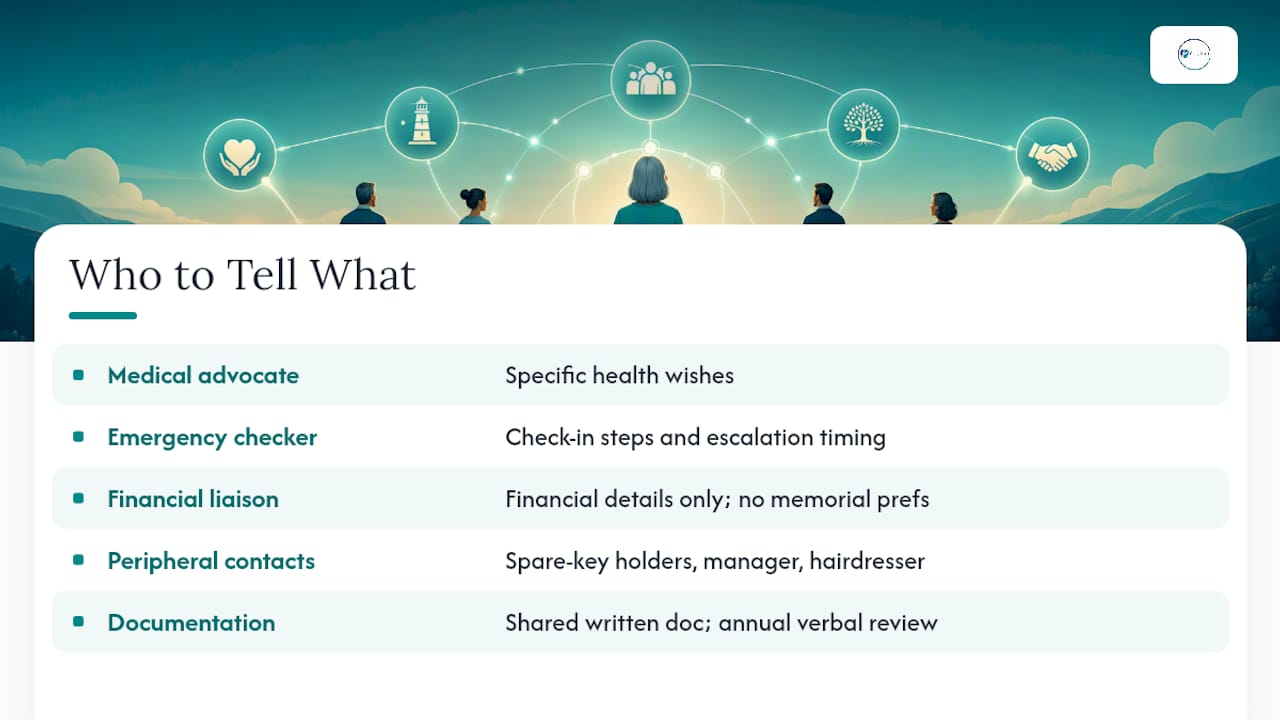
Put the plan in writing, even a simple shared document, and revisit it out loud once a year. Conversations fade from memory faster than most people expect. A short annual coffee or phone call where you walk through "here's what's changed" keeps everyone current without turning it into a formal event.
Also loop in anyone outside your immediate circle who might need context: a neighbor who has a spare key, a building manager, a longtime hairdresser who'd notice if you missed an appointment. These peripheral relationships often catch what your closest circle misses simply because they see you regularly in a different setting.
If a conversation feels hard to start, borrow language from The Conversation Project's prompts for talking about care wishes. Practical phrasing, not clinical scripts, tends to land better with the people who love you.
What About Day-to-Day Living, Not Just Medical Decisions?
Medical directives cover crisis moments. They say nothing about a regular Tuesday.
Write down your preferences for daily living the same way you'd write a care vision: Do you want to stay in your current home as long as possible, or would you consider downsizing if it meant more built-in support? Who handles your laundry or lawn if you're temporarily laid up? What does your ideal week look like, and what parts of your routine matter most to protect?
This matters more than it sounds like it should. A friend who knows you love your Sunday morning walk to the farmer's market can help you preserve that even during a rough patch, but only if they know it matters. Personal care preferences, meal habits, sleep routines, how you like your space organized, are the texture of a full life. Naming them out loud, or in writing, means the people helping you do not have to guess.

How Does Mental and Emotional Well-Being Fit Into the Plan?
A legacy plan focused only on logistics misses half the point. Living alone does not mean living lonely, but it does mean being intentional about connection.
Name who you'd call on a hard day, separate from your medical advocate or emergency checker. That might be a therapist, a close friend, a faith community, or a peer group of other solo agers who simply get it. Write that name into your plan the same way you'd write down a physician.
Watch, too, for signs that isolation is creeping in rather than solitude you've chosen. There's a real difference between a quiet Tuesday you enjoy and weeks where you haven't spoken to anyone who knows you well. Build in a rhythm, a standing call, a weekly class, a volunteer shift, that keeps you connected on your own terms, not out of obligation.
How Do You Balance Independence With Getting Support?
Independence is not the same as doing everything alone. It is being the one who decides how and when help shows up.
Give yourself permission to accept help earlier than pride might suggest, and revisit that line as circumstances shift, keeping in mind the importance of mobility and joint health as key to aging well. A ride to a doctor's appointment today does not mean giving up your car altogether. Support can be small and specific: someone to carry groceries up the stairs, someone to sit with you during a hard diagnosis, without it meaning a loss of control over your own life.
Reassess this balance regularly, the same way you'd review your care circle. What felt like plenty of independence at 68 might need a slight adjustment at 78, and that is not failure. It is calibration. The goal is staying yourself, on your own terms, for as long as possible, adjusting the support around you rather than letting circumstances dictate the terms for you.
What Nonlegal End-of-Life Preferences Should You Write Down?
Beyond medical directives sit the details that shape how people remember your final days, and these are worth naming while you still can.
Who do you want in the room, if anyone? What kind of environment feels comforting: music, quiet, familiar objects nearby? Do you want a religious or spiritual practice observed, or specifically not? Many solo agers, according to end-of-life planning research, have not documented these preferences at all, leaving friends to guess during an already difficult time.
Write down your preferred caregivers by name if you have them in mind. Note any rituals that matter, a favorite song, a specific person to hold your hand, a request for quiet over conversation. None of this requires a lawyer. It requires a page in your file and a conversation with whoever you've asked to carry it out.
A Life, Not Just a Plan
I think about a woman I heard about who lived alone for twenty years after her divorce, no kids, no nearby siblings, and had one of the fullest lives I'd ever heard described. Book club on Tuesdays, a standing dinner with two neighbors, a notebook of stories she wanted her goddaughter to have someday. She was not lonely. She was specific about what she wanted and who she trusted with it.
That is the real work here. Two things you can do today: write one paragraph describing how you want to live and be remembered, and message one person with a single, bounded ask, "will you be my emergency contact?" If you want help going further, Aging Solo has templates and the Solo Aging Clarity Session waiting whenever you're ready.
— Mike
Ready for a Guided Next Step?
You've just done the hard part: thinking through who matters, what you want, and where the gaps might be. Turning that into a plan you can actually use, though, sometimes benefits from a second set of eyes. That is what the Solo Aging Clarity Session is for: a focused 45-minute Zoom conversation offering personalized next steps instead of another generic checklist.
This guidance is designed specifically for people planning without a built-in family safety net, focused on solo agers' real-world situations rather than family-centered advice. If you'd rather start on your own first, the free Growing Old Alone guide and the Circle of Care resource walk through building your support network step by step, no sign-up required. When you're ready for a plan shaped around your specific life, book a Clarity Session and bring your questions.
Where to Learn More
- AARP's solo ager network guide for building chosen family and finding local Village to Village or Area Agency on Aging programs.
- The Karen Turner PhD guide for role-based care circle templates and information file checklists.
- The Aging Solo book by Michael Crawford for a fuller walkthrough of planning without traditional family support.
Sources
- What Happens If I Grow Old Alone?
- Aging Alone: Build a Network of Friends to Rely On
- Planning for Solo Aging - PSS
- Solo agers too want to be remembered
- Solo Aging and End-of-Life Planning: The Complete Guide
FAQ
What Is Legacy Planning Without Heirs?
It is a people-centered plan built around a small support network, a written care vision, and accessible documents, not a legal document distributing assets. The focus is on how you want to live, be supported, and be remembered.
How Many People Should Be in My Care Circle?
Most guidance points to three to five people, each holding a distinct role like medical advocate, emergency checker, or daily helper. Spreading roles across a few people prevents one person from carrying the entire load.
Do I Need a Lawyer for This Kind of Planning?
No. Legacy planning without heirs in this sense is nonlegal: care visions, support networks, and accessible information files. An elder law attorney becomes useful for legal documents like health care proxies, while this planning fills in everything paperwork alone can't cover.
How Much Does the Solo Aging Clarity Session Cost?
The Solo Aging Clarity Session is a 45-minute Zoom consultation focusing on personalized planning steps; current pricing is available on the official site.
How Often Should I Update My Plan?
Review it at least once a year, and sooner if a fall, health change, or a shift in your support circle happens. Rehearsing a missed check-in drill during that review often reveals gaps faster than just reading through the document.