

There are five main types of surrogate family arrangements for solo agers: legal proxies (healthcare and financial powers of attorney), supported decision-making networks, chosen-family caregiving agreements, paid and professional caregivers, and community and shared models like The Backup Plan, home-sharing, and village programs. The single most urgent step you can take right now is executing a healthcare proxy and sharing its location with at least two trusted contacts.
Your three immediate actions:
- Sign a healthcare power of attorney (POA) naming a primary agent and at least one backup.
- Tell both agents where the document is stored and how to reach your doctor.
- Place a laminated emergency card in your wallet listing agent names, phone numbers, and your primary physician.
Pro Tip: Name at least two backup agents, not one. People move, get sick, or become unavailable. A second name on that document could be the difference between someone you trust making decisions and a stranger doing it.
Key Takeaways
Building a reliable surrogate family arrangement requires at least one legal designation, at least two named contacts, and a written plan that gets reviewed every year.
| Point | Details |
|---|---|
| Sign a healthcare proxy first | This single document overrides default state surrogate statutes that exclude chosen friends. |
| Name two agents, not one | A backup agent protects you when your primary contact moves, gets sick, or becomes unavailable. |
| Combine arrangement types | A proxy plus a caregiving agreement plus one community model creates the redundancy a solo plan needs. |
| Review your plan annually | Confirm agents are still willing, update contact lists, and re-read your advance directive each year. |
| Agingsolo supports your planning | The Agingsolo clarity session helps you prioritize documents, agreements, and community options in 45 minutes. |
Table of Contents
- What are the main types of surrogate family arrangements?
- How do U.S. legal designations work, and why do you need them?
- How do you formalize a chosen-family caregiving plan?
- When do paid caregivers and professional fiduciaries make sense?
- What community-based models can extend your support network?
- How do you choose, set up, and test your plan?
- How do you keep your plan reliable over the years?
- Practical templates and your first five steps this week
- Why starting early is the most protective thing you can do
- Agingsolo can help you build your plan with confidence
- Sources
- FAQ
What are the main types of surrogate family arrangements?
The Society of Actuaries Solo-Agers Decision Guide frames solo ager planning around four pillars: legal documents, a healthcare proxy, a support network, and housing. The five arrangement types below map directly onto that framework.
| Arrangement Type | Legal Authority | Caregiving Capacity | Typical Cost | Setup Speed | Long-Term Viability |
|---|---|---|---|---|---|
| Legal proxies (POA, advance directive) | Full medical and/or financial | Decision support only | Low attorney fee | Days to weeks | High if updated regularly |
| Supported decision-making network | None formal | Advice and advocacy | Low to none | Weeks | Moderate; depends on relationships |
| Chosen-family caregiving agreement | None (informal) | Hands-on and logistical | Low to moderate | Weeks | Moderate; needs written terms |
| Paid/professional caregivers and fiduciaries | Fiduciary has legal scope | Hands-on and decision support | Moderate to high | Weeks to months | High with proper contracts |
| Community and shared models | None formal | Logistical and social | Low to none | Weeks to months | High with program structure |
Three use cases that show which type fits:
- You have one close friend nearby but no family. A healthcare POA naming that friend, plus a written caregiving agreement, gives you both legal coverage and day-to-day support.
- Your closest contacts live out of state. A geriatric care manager (Aging Life Care Manager) as a local paid professional fills the hands-on gap while remote friends hold your POA.
- You want community without burdening any single person. The Backup Plan model or a village program distributes support across a group, reducing pressure on any one relationship.
How do U.S. legal designations work, and why do you need them?
NAELA reports that 46 states have default surrogate consent statutes that create a family-based hierarchy for medical decisions. If you have no spouse or adult children, those laws may reach distant relatives before a close friend ever gets a say. A named proxy overrides that hierarchy.
Four documents every solo ager needs:
- Healthcare power of attorney / health care proxy — authorizes your named agent to make medical decisions if you cannot.
- Durable financial power of attorney — covers banking, bills, and property management.
- Advance directive / living will — records your treatment preferences so agents know your wishes.
- HIPAA release — allows your chosen contacts to receive health information from providers, even without full proxy authority.
Steps to create and store these documents:
- Download your state's free forms from your state bar association website or CaringInfo (a program of the National Hospice and Palliative Care Organization).
- Sign in front of the required witnesses (most states require two) and a notary if your state mandates it.
- Give signed copies to your named agents, your primary care physician, and any hospital you use regularly.
- Store one paper original in a fireproof box at home and one scanned copy in a secure cloud folder.
- Review and re-sign every three to five years, or after any major health or relationship change.
The risk of doing nothing: Without a named proxy, a hospital social worker or a court-appointed guardian may make decisions for you. In most states, a close friend has no legal standing until every relative on the statutory list has been contacted and declined. That process takes time you may not have in a crisis.
When no trusted friend is available, a professional fiduciary or corporate trustee can serve as your financial agent. AdvisorGuide recommends naming a professional fiduciary or corporate trustee early, before a crisis, and notes that licensed fiduciaries typically charge hourly or a percentage of assets managed.
How do you formalize a chosen-family caregiving plan?
AARP cites research noting it takes roughly 200 hours of interaction to build a close friendship capable of providing deep caregiving support. That means you need to start investing in relationships well before you need help, not after.
Many people aged 65 and older live alone in the U.S., highlighting the prevalence of solo aging without specific numeric detail. Most of them have no written plan for who shows up when something goes wrong. A simple caregiving agreement changes that.
What a basic caregiving agreement should cover:
- Names and contact information for both parties
- Specific tasks (grocery runs, medication pickup, driving to appointments)
- Schedule and frequency (weekly check-in call, monthly in-person visit)
- Compensation or expense reimbursement terms, even if it's just gas money
- A review date (every 12 months is reasonable)
- A clear exit clause so either party can step back without guilt
Pair the agreement with a HIPAA release form so your friend can speak with your doctor about routine matters without needing full proxy authority. The HIPAA release is narrow: it allows information sharing, not decision-making. Think of it as the first layer, with the healthcare POA as the backup layer.
Recruiting tips: Ask two or three people, not one. Be direct about what you need. Most people are honored to be asked. Build your support circle intentionally, scheduling regular shared activities to reach that 200-hour threshold over time.
When do paid caregivers and professional fiduciaries make sense?
Paid professionals fill gaps that friends and neighbors cannot. They show up reliably, carry liability insurance, and have no competing personal obligations.
Common paid roles and what they do:
- Home health aide — hands-on personal care (bathing, mobility, medication reminders) under a care plan.
- Private caregiver / companion — lighter daily support, errands, and companionship without clinical licensing.
- Geriatric care manager (Aging Life Care Manager) — assesses needs, coordinates services, and acts as a local advocate; particularly valuable for solo agers whose family lives far away.
- Professional fiduciary — manages finances, pays bills, and can serve as a durable POA agent.
- Corporate trustee — manages trust assets long-term with institutional oversight.
Hiring checklist:
- Verify state licensure and any required certifications.
- Run a background check through a licensed agency or state registry.
- Request three professional references and call them.
- Get everything in writing: scope of work, hours, rate, and termination terms.
- Clarify who supervises the caregiver if you are incapacitated.
Funding options include long-term care insurance (best purchased before age 65), personal savings, and Medicaid for those who qualify after spending down assets. A geriatric care manager hired before a crisis costs far less than emergency placement arranged under pressure.
What community-based models can extend your support network?
Community models distribute support across a group, which reduces the risk of losing your entire plan when one person moves or becomes unavailable.
The Backup Plan is an evidence-based group model developed through Living at Home/Block Nurse Programs. Minnesota pilot groups reported practical improvements in planning tasks, including identifying emergency contacts and completing advance care directives. The model brings small groups of solo agers together to build mutual backup plans and decision-support networks.
Other community models:
- Home-sharing programs — match older adults who have extra space with housemates who provide light help in exchange for reduced rent. KFF Health News coverage notes that home-sharing typically covers logistical support but not personal care.
- Village programs — member-run networks that coordinate volunteers for transportation, errands, and social connection. Most charge modest annual membership fees.
- Faith-based volunteer networks — congregation care teams that provide meals, rides, and check-in calls, often at no cost.
- Municipal pilot programs — growing in cities across the U.S., these pair older residents with trained community navigators.
Quick pros and cons:
| Model | Pros | Cons |
|---|---|---|
| The Backup Plan | Structured, evidence-based, builds mutual accountability | Requires a facilitator; not yet available everywhere |
| Home-sharing | Reduces housing costs; daily presence | Housemate vetting is critical; no personal care |
| Village programs | Broad volunteer pool; social connection | Volunteer capacity varies; not a substitute for legal docs |
| Faith/volunteer networks | Free; relationship-based | Informal; no guaranteed availability |
To join or start a program, contact your local Area Agency on Aging, search the Village to Village Network directory, or ask your faith community's pastoral care coordinator. Any community arrangement should be paired with, not substituted for, your legal designations. See community group benefits for more on how group models work in practice.
How do you choose, set up, and test your plan?
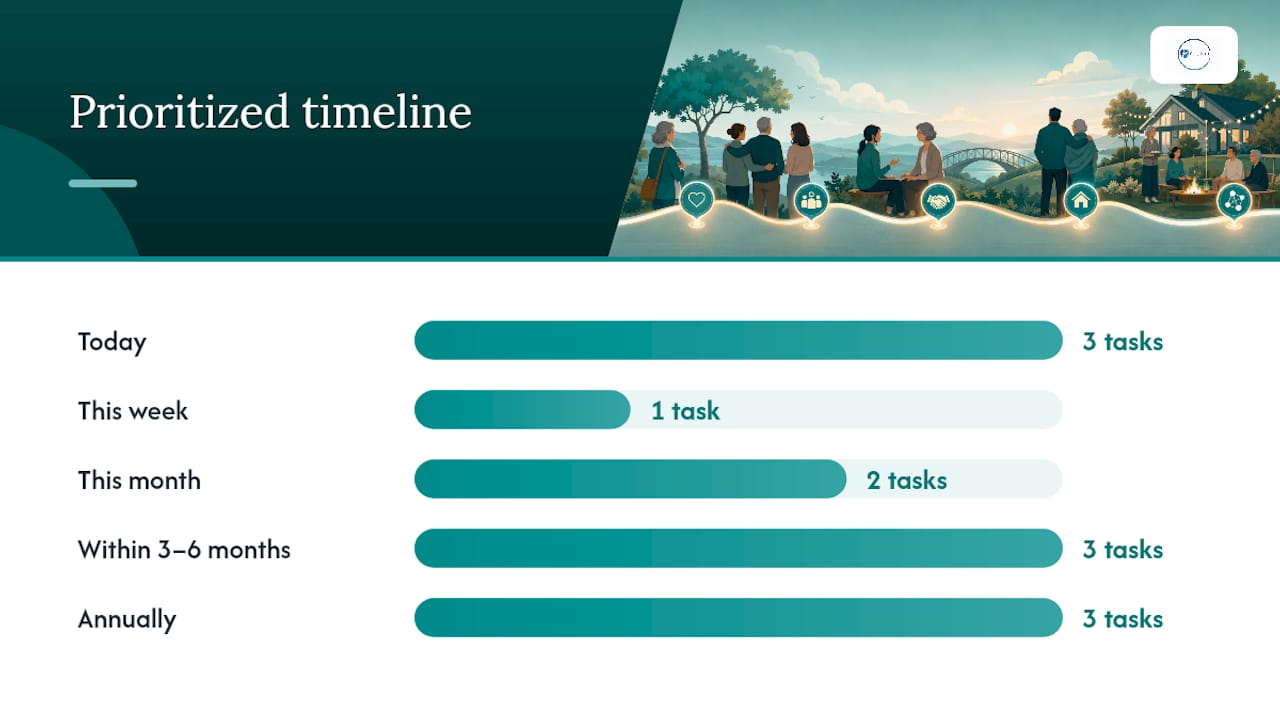
Your prioritized timeline:
- Today: Sign your healthcare POA and financial POA. Tell your agents where the documents are.
- This week: Have honest conversations with your chosen contacts about what you're asking of them.
- This month: Draft a written caregiving agreement and complete HIPAA releases for your key contacts.
- Within 3–6 months: Research and join a village program or The Backup Plan group in your area, or hire a geriatric care manager for an initial assessment.
- Annually: Review all documents, confirm agents are still willing and able, and update contact lists.
Decision questions to ask yourself:
- Do I have at least two people who could act on my behalf in an emergency?
- Are any of my contacts likely to move or become unavailable in the next five years?
- Do I need hands-on help, decision support, or both?
- Can I fund paid care if my informal network shrinks?
Red flags to watch for:
- Relying on a single person with no backup named
- No written agreement of any kind
- Agents who don't know where your documents are stored
- Compensation arrangements that are vague or unspoken
Sample recruiting script: "I'm putting together a backup plan in case I ever need help in an emergency. I'd like to name you as one of two people I trust. It doesn't mean you'd be doing everything, just that you'd be my first call. Can we talk about what that would look like?"
The strongest plans combine a legal proxy, a written chosen-family agreement, and at least one community or paid professional backup. No single arrangement covers every scenario.
How do you keep your plan reliable over the years?
A plan that isn't reviewed is a plan that quietly stops working. People move. Relationships change. Your health needs shift.
Annual review checklist:
- Confirm each named agent is still willing, able, and reachable.
- Update phone numbers and addresses on your emergency card.
- Re-read your advance directive to confirm it still reflects your wishes.
- Check that your HIPAA releases name current contacts.
- Schedule one "rehearsal" conversation with your primary agent: walk through what they would do if you were hospitalized tomorrow.
Document storage: Keep one signed paper original at home in a fireproof location. Store a scanned copy in a password-protected cloud folder (Google Drive or Dropbox both work). Give your primary care physician a copy and confirm it's in your medical record.
Keeping social supports healthy takes the same intentionality as legal documents. Schedule regular shared activities with your chosen contacts, not just check-in calls. Reciprocal favors, helping them with something they need, build the kind of mutual investment that holds up over years. Rotate tasks among multiple people to prevent any one person from burning out.

PSS Life U notes that where you live, your sense of purpose, and your support structure are all moving parts, and warns against assuming current friends will remain available for hands-on care two decades out. Build redundancy now, while you have time to be deliberate.
Practical templates and your first five steps this week
Templates to gather or create:
- Short caregiving agreement (one page: tasks, schedule, compensation, review date)
- HIPAA release form (your state's version or a standard template from your physician's office)
- Emergency card (wallet-sized: agent names, phone numbers, physician, pharmacy, insurance ID)
- Healthcare proxy checklist (one page: document location, agent contacts, hospital preferences)
- Rehearsal script (a short written scenario your agent can walk through with you)
Your five-step week plan:
- Day 1: Download your state's healthcare POA form and read it through.
- Day 2: Choose your primary and backup agents and call them to ask.
- Day 3: Sign the form with witnesses and/or a notary.
- Day 4: Write your emergency card and laminate it.
- Day 5: Draft a simple one-page caregiving agreement and share it with your primary contact for feedback.
The friendship-based care network guide at Agingsolo includes sample caregiving agreement language and a rehearsal script you can adapt. Free downloads and planning checklists are also available through the Agingsolo toolkit.
Why starting early is the most protective thing you can do
Most people wait until a health event forces the conversation. By then, the choices are narrower, the stress is higher, and the people you'd want involved may not have legal standing to help. Planning now, while you're well, is what keeps you in control of who shows up and what they're authorized to do.
The surrogate family arrangements described here aren't about giving up independence. They're about protecting it. A signed healthcare proxy doesn't hand your life over to someone else. It puts the right person in the room when decisions are being made, someone who knows you and will advocate for what you actually want.
Start small. Sign one document this week. Have one honest conversation. Build from there. Redundancy doesn't require a perfect plan on day one. It just requires a first step.
Pro Tip: Tell your agents where your documents are stored before you need them to know. A proxy no one can find is the same as no proxy at all.
Agingsolo can help you build your plan with confidence
Sorting through legal documents, caregiving agreements, and community programs on your own takes real time. Agingsolo's Solo Aging Clarity Session is a focused 45-minute Zoom call that helps you move from scattered notes to a clear, prioritized plan.
In a single session, you'll identify which arrangement types fit your situation, clarify which documents to sign first, and leave with a short list of next steps you can actually follow through on. No generic advice. No overwhelming homework. Just a calm, direct conversation about your specific circumstances.
What to expect:
- A pre-session checklist so you arrive prepared
- Honest guidance on legal designations, chosen-family agreements, and paid options
- A written summary of your priorities after the call
Ready to move from "I should do this" to "I've done this"? Start with the Agingsolo planning guide and book your clarity session when you're ready.
Sources
- Solo Agers: Planning Strategies for Independent Older Adults Facing Unique Aging Challenges NAELA Publications
- Solo agers: caregiving basics — AARP
- The Backup Plan — pilot materials and findings (Living at Home/Block Nurse Programs)
- Solo-Agers survey report overview — Society of Actuaries
- Aging alone: financial and legal planning when you have no family backup — AdvisorGuide
FAQ
What is a surrogate family arrangement for a solo ager?
A surrogate family arrangement is a planned network of trusted people, paid professionals, or community programs that provide the support and decision-making backup that family members typically offer. It is built intentionally through legal documents, written agreements, and ongoing relationships.
Which legal document should a solo ager sign first?
A healthcare power of attorney (health care proxy) is the most urgent document. It names someone to make medical decisions on your behalf and overrides the default family-based hierarchy that exists in 46 states under surrogate consent statutes.
Can a close friend legally make medical decisions for me without a proxy?
In most U.S. states, no. NAELA reports that default surrogate consent laws prioritize relatives over friends, meaning a close friend may have no legal standing until all relatives have been contacted and declined.
What is The Backup Plan and how does it help solo agers?
The Backup Plan is an evidence-based group model that helps solo agers build mutual community backup plans and decision-support networks. Minnesota pilot groups reported improvements in completing planning tasks like identifying emergency contacts and advance care directives.
How often should I update my surrogate family plan?
Review your plan every year and after any major life event, such as a move, a health change, or a shift in a key relationship. Confirm that named agents are still willing and reachable, and update your emergency card and document storage locations accordingly.