

A letter of instruction is an informal, nonbinding companion to your will or trust. It won't move a dollar or transfer a deed, but it does something your legal paperwork can't: it tells your executor and heirs exactly where things are, who to call, and how you want small decisions handled. Groups like AARP and the IRS both point to it as one of the simplest ways to ease the load on the people settling your affairs.
TL;DR:
- A letter of instruction is a non-binding document that clarifies personal details, account locations, and wishes to help your executor manage your estate efficiently.
- It should include key contacts, detailed account and legal document locations, digital asset information, and funeral, pet, or sentimental item preferences, with precise location details.
- Organize the letter in a logical order, sign and date each version, and keep the master copy with your attorney and a secure, accessible place for your executor.
- Never include legal or beneficiary change instructions, passwords in plain text, or anything that could be mistaken as a legal amendment.
- Update the letter at least once a year or after significant life events, and communicate its existence to trusted individuals who will handle your estate.
Table of Contents
- What Is a Letter of Instruction for an Estate?
- What Should You Include in a Letter of Instruction?
- How Should You Organize and Format the Letter?
- What Should You Never Put in a Letter of Instruction?
- Where Should You Keep Your Letter of Instruction?
- How Often Should You Update Your Letter of Instruction?
- A Sample Letter of Instruction You Can Copy
- Why This Letter Matters More When You're Doing This Alone
- Get Help Turning This Into a Finished Plan
- Sources
- FAQ
What Is a Letter of Instruction for an Estate?
A letter of instruction for an estate is a personal, plain-language document that sits alongside your will, not inside it. It has no legal force. It can't reassign your house to a niece or override what your trust says about your retirement accounts. Investopedia describes it as a supplement designed to translate legal documents into something a grieving or overwhelmed person can actually use.
Your will handles who gets what. Your letter handles everything nobody thinks to write down: the name of your insurance agent, the fact that your safe deposit box is at the branch on Fifth Street, or that you'd rather have a small backyard gathering than a formal funeral.
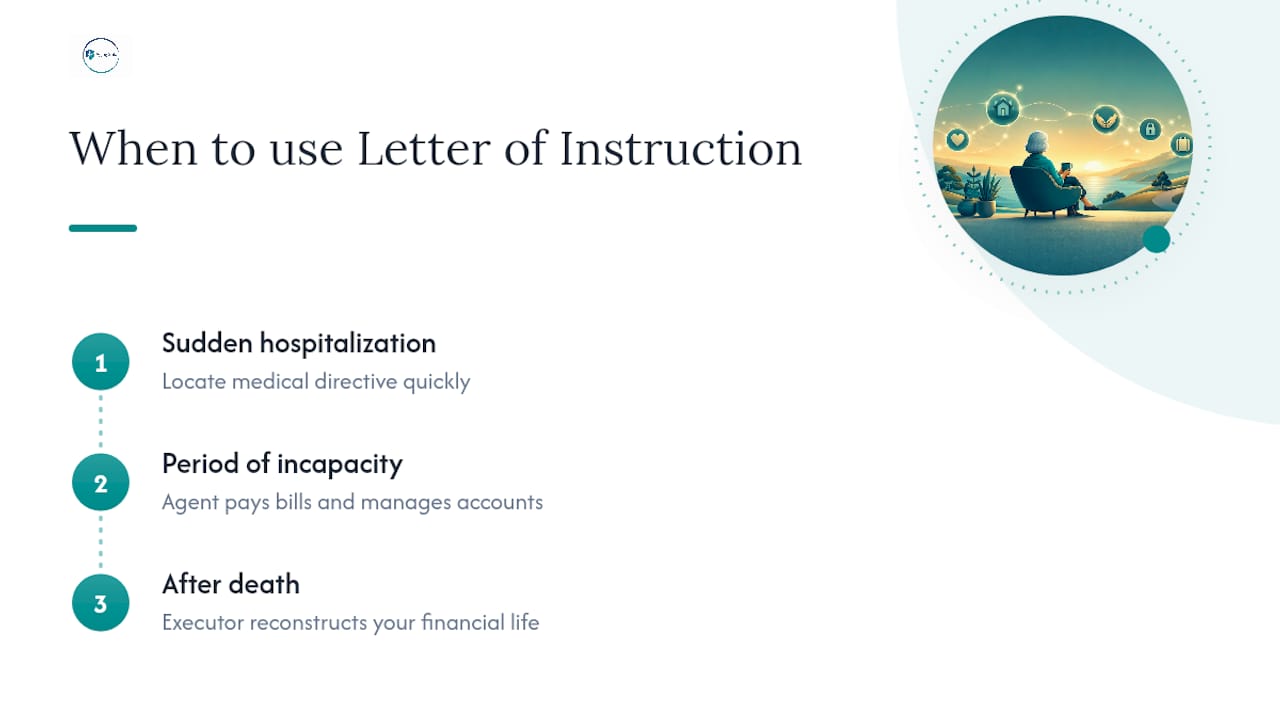
This kind of letter earns its keep in three specific moments. The first is a sudden hospitalization, when someone needs to find your medical directive fast. The second is a period of incapacity, when a family member or agent under power of attorney has to keep your bills paid and your accounts running. The third, obviously, is after you're gone, when your executor is trying to piece together a financial life that only existed in your head. Solo agers face all three of these moments without a spouse to fill in the blanks, which is exactly why documenting personal wishes ahead of time matters more, not less.
What Should You Include in a Letter of Instruction?
Think of this as a priority order, starting with what your executor needs on day one and working down to what matters most to the people you love.
- Key contacts. List your attorney, CPA, financial advisor, insurance agent, and executor, with phone numbers and email addresses. This single page can save weeks of searching.
- Account inventory. Every bank, brokerage, and retirement account, plus life insurance policies. Name the institution, the account number, and exactly where the statements live, physically or digitally.
- Legal documents. Your will, trust, property deeds, vehicle titles, and past tax returns. Say precisely where each one is kept and how to get access, whether that's a drawer, a filing cabinet, or an attorney's office.
- Digital assets. Email accounts, social media, subscriptions, and cloud storage. Note how logins are recovered and mention a password manager if you use one, since guessing at two-factor authentication after the fact is nearly impossible.
- Funeral and obituary wishes. Burial or cremation preference, service style, even the music you want played.
- Pets. Who takes them, what they eat, and their vet's contact information.
- Sentimental items. A short line of explanation next to any meaningful bequest goes further than people expect.
That last point isn't a minor nicety. AARP's research on family estate conflict found that a brief explanation of "why" behind a sentimental gift prevents more disputes than a long list of rules ever does. If your grandmother's ring is going to your youngest daughter because she's the one who used to sit with her every Sunday, say so. That sentence might do more for family peace than anything in your trust.
Pro Tip: Be exact with locations. "In my desk" isn't as useful as "top left drawer of the desk in the office, brown accordion folder labeled Legal." Executors waste real time on vague directions.

Don't forget the physical stuff, either. If you have a safe deposit box, write down the bank, branch, box number, and where the key is kept. The same goes for a home safe or any hidden spare key.
How Should You Organize and Format the Letter?
A logical sequence beats a clever one. Most people do best moving through contacts, then accounts, then legal documents, then digital assets, then funeral wishes, pets, and finally a personal note.
- Start with a date at the top of the page, every single time you revise it.
- Sign each version, even informally. A signature and date make it obvious which copy is current.
- Choose your format: a printed copy in a locked file works fine, and an encrypted cloud copy adds a backup your executor can reach remotely.
- If you use a password manager, note that it exists and how your executor gets the master credentials. Never write plaintext passwords directly into the letter.
- Decide if you need more than one letter. A private, financially detailed version for your executor and a warmer, more personal version for beneficiaries often works better than trying to write one letter that serves both purposes.
None of this needs to be fancy. A word processing document with clear headings does the job as well as anything elaborate.
What Should You Never Put in a Letter of Instruction?
Keep the legal decisions in your legal documents. Anything that touches who inherits what belongs in your will or trust.
- Don't try to name new beneficiaries or change asset distribution here. It has no legal weight and could create confusion during probate.
- Avoid language that sounds like an amendment or codicil, phrases like "I want my will changed to say" have no place in an informal letter.
- Never store plaintext passwords or full account numbers in an unsecured file, physical or digital.
- If any part of your letter could be read as altering your estate plan, Fidelity recommends having an attorney review it before you finalize anything.
Where Should You Keep Your Letter of Instruction?
Give your attorney a copy and keep one somewhere your executor can actually find, not locked in a box nobody knows exists. Encrypted cloud storage or a reputable password manager both work well for the digital version; the tradeoff is that whoever needs it must know how to get in, so write that access path down somewhere separate and secure.
Tell your executor and one or two trusted people that the letter exists and roughly where it lives. A single sentence in your will, something like "see my letter of instruction, filed with my attorney," closes the loop without turning the will itself into a filing cabinet.
How Often Should You Update Your Letter of Instruction?
Once a year is a reasonable baseline, and Fidelity treats the letter as a living document that should shift as your life does. Update it sooner after a marriage, divorce, birth, adoption, a move, or the death of someone named in it.
Date every revision and keep a one-line change log at the top, something as simple as "March 2026: updated bank accounts, removed old insurance policy." Pairing this review with tax season or one dedicated planning day a year turns it into a habit instead of a chore you keep postponing.
A Sample Letter of Instruction You Can Copy
Here's a bare-bones structure you can paste into a document and start filling in today.
- Key Contacts: attorney, CPA, financial advisor, insurance agent, executor (names, phone, email)
- Accounts: bank, brokerage, retirement, insurance policies (institution, account number, statement location)
- Legal Documents: will, trust, deeds, titles, tax returns (exact locations, access notes)
- Digital Assets: email, social media, subscriptions, password manager name, 2FA notes
- Funeral Wishes: burial or cremation, service preferences, obituary notes
- Pets: caretaker, feeding routine, vet contact
- Personal Notes: short explanations for sentimental items, one line each
Sign and date the bottom of every version. Keep the master copy with your attorney and a duplicate wherever your executor already knows to look, whether that's a shared drive or a labeled folder in your files. Detail matters more than polish here. Nobody settling an estate cares how the document looks; they care whether it tells them what they need to know.
Why This Letter Matters More When You're Doing This Alone
I think about a friend of mine who lived by herself for the better part of two decades, fiercely independent, the kind of person who fixed her own garbage disposal. When she was hospitalized unexpectedly, it wasn't her will anyone needed first. It was her list: which pharmacy, which neighbor had a spare key, what her cat ate. That's the part nobody plans for, and it's the part a letter of instruction actually solves.
For solo agers, this document isn't about fear. It's about making sure the people who show up for you, a friend, a niece, a neighbor, have what they need without guessing. Pair it with a broader look at elder planning when you're ready, but don't wait for a perfect version. Write three lines tonight. Add three more next month. A letter that's half finished and sitting in a drawer helps more than the perfect one you never start.
— Mike
Get Help Turning This Into a Finished Plan
Writing the letter is the easy part. Adapting it to your specific accounts, your specific family situation, and your specific worries is where most people get stuck, especially when there's no spouse to talk it through with over dinner. This resource is built to address that gap.

Start with the free legal documents checklist to see how your letter fits alongside your will, power of attorney, and healthcare directive. If your digital life is more complicated than a single password manager can handle, the guide on digital legacy planning walks through crypto, two-factor authentication, and account recovery in more depth than most estate guides bother with.
If you want a second set of eyes on the whole thing, consider booking a personalized planning consultation. It's a focused, one-on-one call built to take your half-finished draft and turn it into something your executor can actually use. Get started with the full Elder Planning Guide and see where a clarity session fits into your next step.
Sources
- Letter of Instruction: Why Your Heirs Will Thank You For Leaving One | Investopedia
- Letter of Instruction: Preparing Your Intentions for Your Estate | AARP
- Publication 559 (2025), Survivors, Executors, and Administrators | IRS
This article is general information, not a substitute for advice from a qualified lawyer. Consult a qualified legal professional about your own circumstances before acting on anything here.
FAQ
How Do You Write a Letter of Instruction for Heirs and Beneficiaries?
Start with your key contacts, then list accounts, legal documents, digital assets, funeral wishes, and any sentimental items with a short explanation for each. Keep the tone plain, sign and date it, and store a copy where your executor can find it.
Does a Letter of Instruction Need to Be Notarized?
No. A letter of instruction is informal and nonbinding, so it doesn't require notarization or witnesses the way a will does.
What Is an Example of a Letter of Instruction?
A typical example lists your attorney and financial advisor's contact information, your bank and retirement account details with their locations, instructions for digital accounts, funeral preferences, pet care arrangements, and brief notes on sentimental bequests.
What Does a Letter of Instruction Mean in Estate Planning?
It means a practical, non-legal document that supplements your will or trust by giving your executor and heirs the day-to-day details, account numbers, passwords, and personal wishes, that formal legal paperwork doesn't cover.
Can a Letter of Instruction Replace a Will?
No. It has no legal authority and cannot distribute assets or name beneficiaries; those decisions must stay in your will or trust.