

A surrogate decision maker is the person legally authorized to make medical choices for you when you cannot speak for yourself, whether through a signed proxy form or, absent one, your state's default hierarchy. Their legal duty is to honor what you would have wanted, or act in your best interest if your wishes are unknown. The single most useful thing you can do this month is name that person and actually talk with them about it.
TL;DR:
- Many states rely on a default hierarchy for surrogate decision makers that may not reflect personal relationships or preferences, especially if no trusted person is named.
- Legally appointing a surrogate involves completing a straightforward form, choosing primary and backup agents, and following state-specific witnessing or notarization rules.
- Surrogate authority begins when a medical professional determines you lack decision-making capacity, and their decisions must respect your known wishes or prioritize your best interests.
- Clear communication with your medical team and detailed documentation are essential for your surrogate to accurately interpret your values and preferences during a crisis.
- Naming a trusted person as your surrogate is a vital act of self-respect, ensuring your choices are honored and reducing potential conflicts or court interventions later.
Table of Contents
- What Is a Surrogate Decision Maker, Exactly?
- Who Can Be a Surrogate, and What Happens If You Don't Choose One?
- How Do You Legally Appoint a Surrogate?
- When Does a Surrogate's Authority Actually Begin?
- What Does a Surrogate Actually Do at the Bedside?
- What Happens When Family Disagrees or No Surrogate Exists?
- What About Dementia, Minors, and Other Special Situations?
- Where Do You Find the Right Forms for Your State?
- How Do You Cope With the Weight of Being Someone's Voice?
- How Should You Talk to Doctors When You're the Decision Maker?
- What Legal Risks Do Surrogates Actually Face?
- An Aging Solo Perspective on Choosing Your Voice
- Ready to Put a Plan Behind This Conversation?
- Sources
- FAQ
What Is a Surrogate Decision Maker, Exactly?
You may have heard this role called a healthcare proxy, a health care agent, or a medical power of attorney. They all mean the same thing: a person with legal authority to make medical decisions on your behalf when a doctor determines you can't make them yourself. The paperwork varies by state, but the function does not.
This isn't an abstract legal concept reserved for people with complicated family situations. It shows up in ordinary, frightening moments. A car accident leaves you unconscious in the ER. A stroke takes away your ability to communicate clearly. A diagnosis of advanced dementia slowly erodes your capacity to weigh treatment options. In every one of these scenarios, someone has to answer questions you can't answer, often within hours.
It helps to understand how this role fits with two other documents you've probably heard of:
- A living will states your treatment preferences in writing, but it can't cover every possible medical scenario.
- A POLST (Physician Orders for Life Sustaining Treatment) converts your preferences into actual medical orders that emergency teams follow immediately.
- A healthcare proxy or surrogate fills the gap between the two. They interpret your wishes in real time, in situations no form could have predicted.
Living wills and POLST forms are static documents. Your surrogate is a living, thinking advocate who can respond to nuance, ask questions, and push back when something doesn't sit right, exactly as advance directives, living wills, and POLST forms are designed to work together rather than in isolation.
Who Can Be a Surrogate, and What Happens If You Don't Choose One?
Almost any competent adult can serve as your surrogate. Most states set the minimum age at 18, though some states may require the agent to be older for certain forms. Beyond age, states generally look for someone who understands your values well enough to make decisions consistent with them, not necessarily your closest relative or your most medically savvy friend.
If you never fill out a proxy form, most states step in with a default hierarchy. It typically runs starting with a spouse or registered domestic partner, then typically adult children, parents, and adult siblings, with some states allowing a close friend familiar with your wishes.
This is where the default surrogate hierarchy set by state law becomes a real problem for a lot of people, not just solo agers. Maybe your spouse died years ago and the state still lists an estranged sibling above your closest friend of thirty years. Maybe you have three adult children who disagree sharply about your care, and none of them knows what you actually want because you never told them. Default laws exist as a safety net, but they were never designed to reflect the specific, textured relationships that actually make up your life.
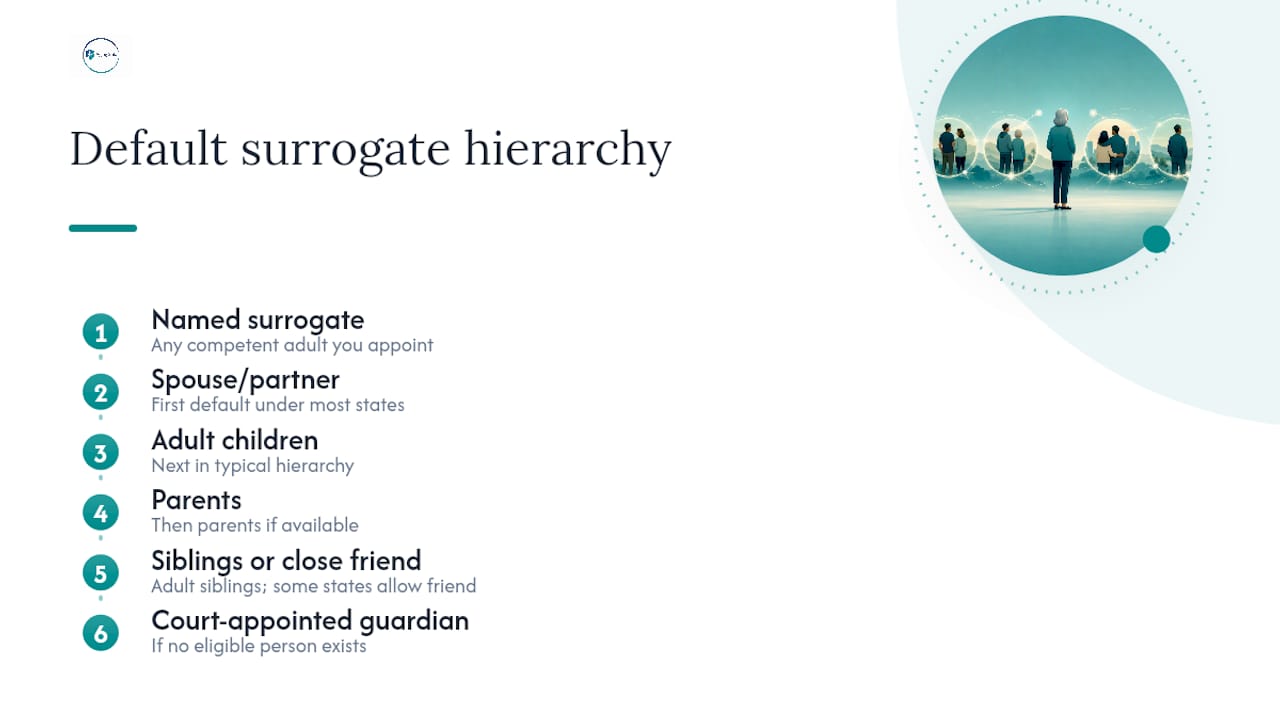
The bigger risk for solo agers is having no one in the hierarchy at all. When there's no spouse, no children, no parents, and no siblings, hospitals may turn to a court for a guardian, a process that's slower, more expensive, and handed to someone who has never had a conversation with you about what matters. Naming your own person, even if that person is a close friend rather than a blood relative, keeps that decision in hands you actually trust.
How Do You Legally Appoint a Surrogate?
The paperwork itself is more straightforward than people expect. In most states, you'll complete one of two documents, sometimes combined into one form: a durable power of attorney for health care, which names your agent, or a health care proxy form, which does the same thing under different naming conventions depending on the state.
Here's the practical sequence:
- Find your state's official form. Your state health department or state bar association typically hosts a free, current version.
- Choose your primary agent and at least one backup. Backups matter enormously, since your first choice might be unavailable, traveling, or incapacitated themselves when a decision is needed.
- Sign according to your state's rules. Most states require either two adult witnesses or notarization, and a handful require both. Witness and notarization requirements vary by state, so don't assume your neighboring state's rules apply to yours.
- Distribute copies. Give one to your named agent, your backup, your primary doctor, and anyone else likely to be present in a medical crisis.
- Upload it to your patient portal. Many hospital systems let you attach advance directive documents directly to your electronic medical record, so it surfaces automatically during an admission.
The form typically takes effect only once a physician determines you lack the capacity to make your own decisions, not the moment you sign it. You keep full decision-making authority as long as you're able to exercise it.
Pro Tip: Keep a card in your wallet or a note in your phone's medical ID listing your agent's name and phone number. Paramedics and ER staff check these first, often before anyone thinks to look for a filed document.
When Does a Surrogate's Authority Actually Begin?
A surrogate's authority isn't triggered by a diagnosis or an accident. It's triggered by a clinical determination that you can no longer understand your medical situation, weigh options, or communicate a choice. Usually this means one attending physician, and sometimes a second consulting physician for major decisions, formally documents that you lack decision-making capacity.
Once that determination is made, your surrogate is bound by a specific legal standard, not their own personal preferences:
- Substituted judgment applies when your wishes are known. Your surrogate is legally required to make the choice you would have made, even if they personally disagree with it.
- Best-interest standard applies when your wishes are unknown or unclear. Here the surrogate weighs the benefits and burdens of treatment as a reasonable person would, factoring in what's known about your general values.
Surrogates are legally obligated to prioritize the patient's expressed wishes over their own beliefs, which is exactly why the conversation you have before a crisis matters as much as the form itself. A surrogate who knows you refused a ventilator after watching your father spend six weeks on one faces a much clearer path than one who's guessing.
There are limits, too. Some states restrict a surrogate's authority over artificial nutrition and hydration, requiring documented evidence of the patient's own wishes on that specific issue before an agent can authorize or refuse it. If you have strong feelings about feeding tubes or IV nutrition, say so explicitly in writing, and read Aging Solo's health and emergency planning guidance for state-specific nuances your family can reference.
What Does a Surrogate Actually Do at the Bedside?
Being named someone's surrogate sounds like an honor until you're standing in a hospital hallway at 2 a.m. trying to understand what a neurologist just said. The job is less about legal authority and more about translation: turning a person's values into a specific yes or no on a specific treatment.
A few things separate an effective surrogate from an overwhelmed one:
- Ask for the diagnosis and prognosis in plain language, not medical shorthand.
- Request the likely outcome with treatment and without it, described in terms of time and function rather than survival statistics alone.
- Write down what's said, including who said it and when, since these conversations blur together under stress.
- Ask directly: "What would this look like if it goes well? What does it look like if it doesn't?"
One tactic used by experienced surrogates and patient advocates: ask clinicians to frame outcomes as the likely outcome with and without treatment in time-and-function terms, such as the chance of returning to independent living within six months. That framing turns an abstract medical decision into something closer to what the patient would actually recognize as their own values.
Converting a broad value like "I don't want to be kept alive on machines" into a decision about a specific ventilator setting takes real judgment. This is where documented conversations pay off. If your agent knows you meant "no prolonged ventilator support with no realistic path to recovery" rather than "no ventilator under any circumstance," they can make a faster, more confident call.
Pro Tip: If a decision feels genuinely unclear, or family members are pulling in different directions, ask the care team directly for an ethics consultation. Most hospitals have one, and requesting it is not an escalation, it's a normal part of good care.
What Happens When Family Disagrees or No Surrogate Exists?
Conflict tends to erupt in two predictable situations: when the patient's wishes were never clearly stated, or when several people share the same statutory priority and can't agree. Three adult children with three different opinions about their mother's care is one of the most common scenarios hospital ethics teams encounter.
If you're in the middle of a disagreement, a few concrete steps can lower the temperature quickly:
- Request an ethics committee consult. Most hospitals have one, and it's free to the patient's family.
- Ask about mediation services, which some hospital systems and local legal aid organizations offer specifically for these disputes.
- Contact your state or county legal aid office if the disagreement escalates toward litigation.
- Where multiple people share equal priority, some institutions ask the group to designate a single spokesperson to avoid decision paralysis at a critical moment.
When no resolution is possible internally, or when no one in the statutory hierarchy is available or appropriate, the case may move to court for a guardian or conservator to be appointed. This process typically takes weeks, sometimes longer, and hands the decision to someone with no personal relationship to the patient. People without close family are considerably more likely to end up with a court-appointed guardian, which is one of the clearest, most practical reasons to name your own agent well before you need one.
What About Dementia, Minors, and Other Special Situations?
Dementia deserves its own mention because it breaks the usual timeline. Most people think about a healthcare proxy in the context of sudden events, accidents, strokes, emergencies. Dementia progresses slowly enough that by the time a family recognizes the need for a proxy conversation, the person may already lack the capacity to participate meaningfully in it. Planning has to happen while you're still fully able to articulate what matters to you, not after a diagnosis.
A few other situations shift the standard rules:
- Minors generally have parents or legal guardians making medical decisions on their behalf, though emancipated minors and certain reproductive or sexual health decisions carry state-specific exceptions.
- POLST forms work alongside a proxy rather than replacing one. If a POLST exists and conflicts with what a surrogate wants in the moment, the POLST typically governs because it represents a physician's order, not just a preference.
- Organ and tissue donation decisions often fall to the surrogate or next of kin if the patient never registered a decision, and state donor registries take precedence when one exists.
- Autopsy authority typically follows the same surrogate or next-of-kin hierarchy, unless a medical examiner's investigation requires one regardless of family wishes.
Where Do You Find the Right Forms for Your State?
Every state has its own proxy or durable power of attorney form, and using an outdated or wrong-state version can create real problems when a hospital tries to verify it. Your state health department's website is usually the first stop, followed by your state bar association, which often publishes plain-language guidance alongside the actual PDF.
Before you sign anything, check these three things:
- Confirm the form matches your current state of residence, not a state you used to live in.
- Verify whether your state requires two witnesses, notarization, or both, since requirements differ.
- Make sure the version you're using is current. States occasionally update these forms, and hospitals may hesitate over an outdated one.
If your situation involves blended families, estranged relatives, or overlapping legal documents from a previous marriage, an elder law attorney is worth the consultation fee. For straightforward situations, a free state form completed correctly holds up just as well in a medical setting. Roughly most states now require agents to be at least 18, a baseline detail worth double checking against your specific state's language before you sign.
How Do You Cope With the Weight of Being Someone's Voice?
Nobody prepares you for how heavy this role feels once you're actually in it. Making a life-or-death decision for someone you love, even with clear instructions in hand, carries a kind of grief and doubt that doesn't show up in any legal training. Surrogates commonly report guilt long after the decision is made, wondering if they chose correctly, even when they followed the patient's wishes exactly.
That emotional weight is real, and it deserves attention separate from the legal mechanics. Hospital social workers and chaplains are available to surrogates, not just patients, and most people don't realize they can ask for that support directly. Many hospitals also have palliative care teams whose job includes supporting the family member making decisions, not only managing the patient's symptoms.
If you're currently serving as someone's surrogate, give yourself permission to ask for a second conversation with the medical team when something doesn't feel resolved. You're allowed to say "I need more time" or "can we talk through this again tomorrow" when a decision doesn't have to happen in the next ten minutes. And afterward, whether the outcome was what you hoped for or not, talking with a counselor or a support group for grieving families can help you process a decision that never should have felt like it was yours to carry alone.
How Should You Talk to Doctors When You're the Decision Maker?
The best communication tool a surrogate has is a short, specific question asked at the right moment. "What happens if we do nothing?" cuts through more confusion than almost any other question you can ask a physician mid-crisis.
A few habits make these conversations go better:
- Ask one clear question at a time rather than a list, and wait for a full answer before moving to the next.
- Request the attending physician by name during rounds, since the person you spoke to yesterday may not be on shift today.
- Repeat back what you heard in your own words: "So you're saying without the surgery, she has maybe a 30 percent chance of walking again?" This catches misunderstandings before they become decisions.
- If English isn't the patient's or family's first language, ask explicitly for a medical interpreter rather than relying on a bilingual family member, since interpretation errors carry real consequences.
Bring a notebook or your phone to take notes, and don't hesitate to ask a nurse to slow down or repeat something. If a decision involves durable medical equipment for ongoing care at home, ask the discharge team directly what equipment and support the patient will actually need, since this shapes both the medical decision and the practical planning that follows it.
What Legal Risks Do Surrogates Actually Face?
Most surrogates worry about legal liability far more than the law actually exposes them to. In practice, a surrogate who acts in good faith, follows the patient's known wishes, and documents their reasoning is very rarely held personally liable for the outcome of a medical decision, even a decision that turns out badly.
Where surrogates run into real legal trouble is different: acting outside the scope of their authority, ignoring clearly documented wishes in favor of their own preferences, or making decisions after the patient has actually regained capacity. Courts and hospital ethics boards look closely at whether a surrogate followed the substituted judgment or best-interest standard in good faith, not whether the medical outcome was good or bad.
Documentation is your protection here. Keeping notes on what you were told, when, and by whom gives you a clear record if a decision is ever questioned later by another family member or a hospital review. It also protects you emotionally, since a written record of your reasoning is something you can return to and trust, even months later when doubt creeps in.
An Aging Solo Perspective on Choosing Your Voice
If you're aging without a spouse or nearby adult children, naming a healthcare proxy isn't just a legal task, it's one of the clearest acts of self-respect you can take. It says: I know what I want, and I trust this person to speak it when I can't. That's not fear talking. That's clarity.
A close friend, a cousin you trust, or even a professional fiduciary can serve as your proxy just as well as a spouse would. Name a backup too, since your first choice might not always be reachable. Pair the legal form with a short written note about your values, and read why solo agers should set up a healthcare proxy before they need one for a fuller walk through choosing that person well.
This work isn't about bracing for the worst. It's about making sure the people who love you, however that love shows up in your life, get to act on your behalf with confidence instead of guesswork. That's a gift you give yourself now, so you're freer to enjoy the life you've actually built.
— Mike
Ready to Put a Plan Behind This Conversation?
Reading about surrogate decision makers is one thing. Actually choosing the right person, writing down your values, and getting the paperwork filed is another, and that's exactly where a lot of solo agers get stuck. Agingsolo built its resources around that exact gap: the space between knowing you should plan and having someone walk through it with you.

Beyond this article, Agingsolo's guides cover health and emergency planning, backup decision-making structures for when family isn't nearby, and the broader question of staying independent while aging alone. If you want personalized guidance rather than a general checklist, A personalized clarity session gives you focused time on a Zoom call to talk through who should hold this role for you and how to prepare them. Visit the Aging Solo resource hub to book a session or download the tools that fit your situation.
Sources
This guide draws on the National Institute on Aging's proxy guidance for legal form and witness rules, Merck Manual's overview of default surrogate laws for state hierarchies and legal standards, Harvard Health's practical guidance on preparing your proxy through conversation, and the NCBI overview of advance directives explaining how proxies, living wills, and POLST forms interact. Always confirm current form requirements on your own state's official page.
- Default Surrogate Decision Making - Merck Manual (consumer)
- Choosing a health care proxy | National Institute on Aging
- Advance Care Planning and Advance Directives (NCBI Bookshelf)
FAQ
Who Can Be a Surrogate Decision Maker?
Almost any competent adult you trust can serve, typically starting at at least age 18, whether they're a spouse, adult child, close friend, or another person who understands your values.
What Happens If I Don't Name a Surrogate?
Most states apply a default hierarchy, usually spouse, then adult children, then parents, then siblings, and if no one in that line is available, a court may need to appoint a guardian.
Is There High Demand for Professional Healthcare Surrogates?
Demand for professional fiduciaries and healthcare agents has grown alongside the rising number of solo agers without nearby family, making early planning and clear backup choices increasingly important.
Do I Need a Lawyer to Name a Healthcare Proxy?
No, most states offer free official forms that are legally valid once signed with the correct witnesses or notarization, though an attorney is worth consulting for complex family situations.
Can My Surrogate Override My Written Wishes?
No, a surrogate is legally required to follow your clearly expressed wishes under the substituted judgment standard, and can only use their own judgment about your best interest when your wishes are unknown.