
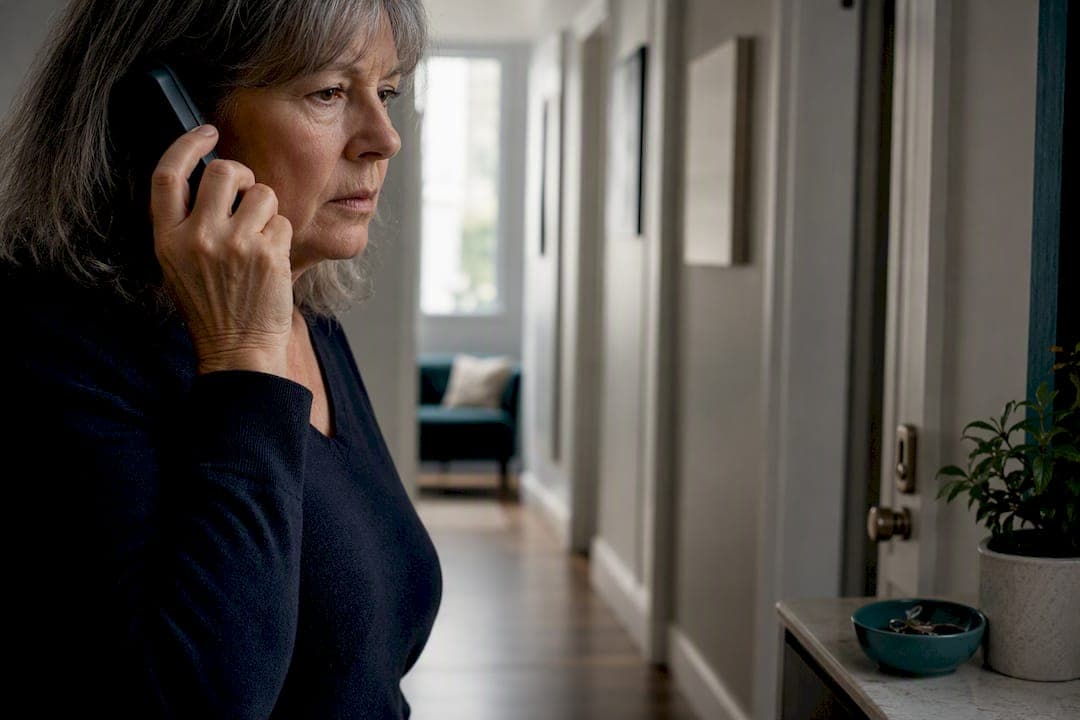
If someone you love has gone quiet and you're scared, act on the danger level you actually see. Call 911 now if there's any sign of immediate danger. Call your local police non-emergency line for a welfare check if the silence is worrying but nothing points to a crisis in progress. Call or text 988 if this is about suicide risk or a mental health crisis, not a medical emergency.
TL;DR:
- Calls for a welfare check should be made immediately for signs of active danger such as violence, overdose, or medical collapse, by dialing 911.
- For concerning but non-urgent situations like prolonged silence or missed medications, contact the non-emergency line instead, providing detailed information and safety considerations.
- Dispatchers need specific details including the person's name, address, medical history, and safety risks to prioritize response times effectively.
- Police generally cannot enter homes without clear signs of emergency unless exigent circumstances exist, requiring reasonable belief that someone inside needs urgent help.
- Alternatives like calling or texting 988 for mental health crises can often prevent police involvement in non-physical emergencies, especially with access to crisis teams.
Table of Contents
- When Does a Situation Call for a Welfare Check Request?
- How Do You Request a Welfare Check?
- [What Happens After You Call for a Well-Check?](#what-happens-after-you-call-for-a-well-checkhttpswell-checkcomhow-well-check-works)
- What Are the Legal Limits on a Welfare Check?
- Are There Alternatives to Calling the Police?
- When Silence Feels Loud
- How Aging Solo Helps You Worry Less Between Check-Ins
- Sources
- FAQ
When Does a Situation Call for a Welfare Check Request?
A welfare check is a free, non-criminal service. You don't need proof anything is wrong, just a genuine reason for concern, and any concerned party, not only immediate family, can request one.
The number you dial depends entirely on how urgent the danger sounds, not on how worried you feel. Some situations are obvious calls for 911:
- You hear sounds of a struggle, screaming, or a fall through the phone or door.
- There's evidence of an active overdose or suicide attempt.
- Someone describes symptoms of a medical collapse, like slurred speech or chest pain, then goes silent.
- You see signs of forced entry or violence at the residence.
Other situations call for the non-emergency line instead, because they're worrying but not clearly life-threatening at this moment:
- Someone who calls every day has gone silent for several days with no explanation.
- A person has missed multiple medications or medical appointments in a row.
- Social media posts sound uncharacteristically dark or final.
- Mail and packages are piling up at a home that's usually tidy.
Shrink that window when the person is high-risk. An older adult managing diabetes, someone recently discharged from the hospital, or a person with serious mobility limits can decline fast. For those cases, a shorter period of unexplained silence is enough to justify a call.
Response times vary more than most people expect. Departments triage by urgency, so a high-priority call might get officers there in minutes, while a lower-priority welfare check can take hours depending on staffing and call volume that day.
How Do You Request a Welfare Check?
The number you call matters as much as what you say once someone picks up. Use your local non-emergency line for the address in question, dial 911 only when danger is immediate, and reach out to 988 when the core issue is suicidal thoughts or psychiatric crisis rather than physical danger.
Here's what dispatchers need to move fast and get the right response:
- Full name and exact address, including apartment or unit number, gate code, or landlord contact if you have it.
- Physical description and the last time you had confirmed contact with the person.
- Specific reasons for concern, stated plainly rather than in vague terms like "something feels off."
- Relevant medical or mental health history, since a known heart condition or history of depression changes how officers approach the door.
- Anything that affects safety on scene, including weapons in the home, an aggressive dog, or a spare key location.
If the person lives in another city or state, call the police department that covers their address, not your own local 911. Dispatch can sometimes transfer you, but you'll get faster action going straight to the source. Cross streets, building names, and a property manager's number all help officers who don't know the area.
A workable script sounds like this: "I'd like to request a welfare check. My aunt, Linda Marsh, lives at 214 Oak Street, Apartment 3B. She calls me every morning and I haven't heard from her in three days. She has type 1 diabetes and lives alone."
Pro Tip: Specificity is what moves your call up the priority list. "She hasn't answered in three days and missed her insulin refill" gets a faster response than "I'm worried about my aunt."
Departments generally accept anonymous requests too, but staying anonymous usually means dispatch can't call you back with an update, and it may lower how urgently your request gets handled.
What Happens After You Call for a Well-Check?
Dispatchers sort calls by risk the moment they come in. A caller describing an active overdose gets units rolling in minutes. A caller worried about three days of silence from an otherwise healthy neighbor might wait longer while higher-priority calls get handled first.
Once officers arrive, the process is fairly routine:
- They knock, announce themselves, and wait for a response.
- If no one answers, they'll often walk the exterior, checking windows and doors for anything alarming.
- They may talk to neighbors or a building manager to confirm the last time anyone saw the person.
- In some cases, they check nearby hospitals or jail bookings if there's reason to think the person is somewhere else.
The outcome usually falls into one of a few categories. The person is found safe and the caller is often notified. The person needs medical transport. The person is connected to a mental health evaluation. Or officers make no contact and simply document the attempt, since privacy rules limit how much detail they can share back with you, especially if you're not next of kin.
If concern persists after a no-contact outcome, you can request another check, ideally with new information, like a second day of silence or a call from another relative confirming the same worry.
What Are the Legal Limits on a Welfare Check?
Officers generally can't force entry into someone's home just because a family member is worried. The exigent circumstances doctrine, sometimes called the emergency-aid exception, is what allows warrantless entry, and it only applies when officers have a reasonable belief that someone inside needs immediate help.
A few things are worth understanding before you call:
- The person being checked on isn't required to open the door, and usually won't be forced to, unless officers see or hear clear signs of an emergency.
- A routine welfare check can shift into a medical or criminal response the moment officers spot something like visible injuries or drug paraphernalia.
- Good-faith requests are protected. You won't face consequences for a check that turns out to be unnecessary.
- Knowingly filing a false report to harass someone is a different matter and can carry real penalties.
Are There Alternatives to Calling the Police?
Not every worry needs a squad car. If the core issue is suicidal thoughts, depression, or a mental health spiral rather than a physical emergency, calling or texting 988 connects you to trained crisis counselors, and in many cities, they can dispatch a mobile crisis team instead of police.
Some other paths worth knowing:
- If you suspect ongoing neglect or abuse rather than a single bad day, Adult Protective Services handles investigation and long-term support in a way a one-time police visit doesn't.
- Mobile crisis team availability varies a lot by city. Your local health department website or a call to 988 will tell you what's actually running in your area.
- For the loved ones you check on often, setting up a lightweight system like a Friends Caller check-in gives you an early warning long before a welfare check becomes necessary.
Pro Tip: Save the non-emergency number and 988 in your phone right now, next to each other. In a stressful moment, you won't want to be searching for either.
When Silence Feels Loud
I think about a woman named Carol, though she could be anyone's aunt or neighbor. She calls her niece every Sunday at 4 p.m., without fail, for six years. One Sunday the phone just rings.

That kind of silence has a specific weight to it. It's not paranoia to notice it. It's paying attention to a pattern that matters.
If that's you right now, make the call that fits what you're seeing, whether that's 911, the non-emergency line, or 988. Then, once the immediate worry is settled, consider setting up something steadier, a regular Buddy System check-in or a Friends Caller routine, so the next quiet Sunday doesn't feel like a mystery. Asking for a welfare check isn't an overreaction. It's one of the most caring things you can do for someone who still deserves to live life on their own terms, safely and with dignity intact.
— Mike
How Aging Solo Helps You Worry Less Between Check-Ins
A welfare check request handles the emergency in front of you, but it can't fix the pattern that led to that scared phone call in the first place. Aging Solo is built for the space between crises. It gives solo agers and the people who love them a way to catch a bad day before it turns into a 911 call.
Free resources, including check-in frameworks and practical safety checklists, help you build a rhythm of contact that makes silence stand out fast instead of stretching for days. For anyone who wants a more personal plan, a clarity session consultation can walk through your specific situation on a Zoom call, covering communication systems, emergency readiness, and support network gaps that make welfare checks necessary in the first place. None of this replaces 911, your non-emergency line, or 988. It just means you'll need them less often. Start with the Solo Aging guide to see where your own plan has gaps.
This article is general information, not a substitute for advice from a qualified doctor. Consult a qualified healthcare professional about your own circumstances before acting on anything here.
Sources
- Welfare Checks — Mississippi School of Mathematics and Science (example police/campus page)
- Los Angeles County DMH crisis guidance (988)
- How long does a police welfare check take? — LegalClarity
- Request a Welfare Check form — Randolph County Sheriff’s Office (example form fields)
FAQ
Can Anyone Request a Welfare Check?
Yes. Any concerned person, whether family, a friend, or a neighbor, can request a welfare check, and you don't need to prove a crime happened to ask.
What Justifies a Welfare Check?
Prolonged uncharacteristic silence, missed medications or appointments, alarming social media posts, or any credible reason to believe someone can't reach help on their own all justify a request.
Will Police Enter a Home for a Wellness Check?
Only if they have a reasonable belief someone inside needs immediate help, under what's known as the exigent circumstances doctrine. Otherwise, the person isn't required to open the door.
How Do I Anonymously Ask for a Wellness Check?
Most departments accept anonymous requests, but leaving out your contact information means dispatch usually can't follow up with you, and it may lower how the call gets prioritized.
Should I Call 911 or 988 for a Welfare Check?
Call 911 for immediate physical danger, and call or text 988 when the concern centers on suicidal thoughts or a mental health crisis rather than a medical emergency in progress.