

Yes, adults over middle age often benefit from having a health advocate because advocacy closes the gaps that hurt people most: missed follow-ups after a hospital stay, denied insurance claims nobody appealed, and medication lists that never quite match between doctors. A narrative review published by PMC found that adults without an advocate are more likely to be overlooked by the very systems meant to help them, especially during care transitions. If you live alone or are planning to age without a nearby family safety net, the smartest move you can make today is calling the Eldercare Locator at 1-800-677-1116 or checking Medicare.gov's "Talk to Someone" tool to see what's already available to you, free.
Key Takeaways
Health advocacy works because it closes the exact gaps, missed follow-ups, medication conflicts, and unappealed denials, that leave unrepresented older adults at higher risk of poor outcomes.
| Point | Details |
|---|---|
| Advocacy prevents system gaps | Adults without an advocate face increased risk during care transitions like hospital discharge, according to peer-reviewed research. |
| Match advocate type to need | Family, hospital, volunteer, private, and geriatric care manager options differ sharply in cost, scope, and credentials. |
| Medicare rarely pays directly | Verify coordination benefits through your specific Medicare Advantage plan rather than assuming coverage. |
| Prepare documents in advance | A medication list, insurance cards, and a signed HIPAA release let an advocate act immediately. |
| Aging Solo supports solo-ager planning | A Solo Aging Clarity Session helps you decide which type of advocate fits your situation and what to prepare first. |
This article is general information, not a substitute for advice from a qualified doctor. Consult a qualified healthcare professional about your own circumstances before acting on anything here.
Table of Contents
- Why 50 Plus Adults Need Health Advocates in the First Place
- What Do You Actually Gain From Having One?
- When Should You Ask for a Health Advocate?
- Which Type of Advocate Fits Your Situation?
- Does Medicare pay for a health advocate?
- How Do You Find and Vet a Health Advocate?
- What Should You Prepare Before You Bring an Advocate In?
- What Does the Research Actually Show?
- Why This Matters More When You're Aging Solo
- Get Personalized Help Building Your Advocacy Plan
- Sources
- FAQ
Why 50 Plus Adults Need Health Advocates in the First Place
A health advocate is someone who speaks for you, or helps you speak for yourself, inside a system that was not built for patience. That could be a spouse, an adult child, a hospital-employed patient advocate, a volunteer, a private professional, or a geriatric care manager. What they share is the job, not the job title.
The core work usually breaks down into a handful of tasks:
- Coordinating care between specialists who rarely talk to each other directly
- Translating medical jargon during appointments and asking the questions you might not think to ask
- Managing paperwork: consent forms, insurance claims, appeal letters
- Overseeing safe discharge planning after a hospital or rehab stay
- Catching medication conflicts before they become emergency room visits
Picture a typical scenario: your cardiologist adds a new blood pressure medication, but your primary care doctor never sees the updated list. An advocate catches that before it becomes a problem. Or think about an insurance denial letter that arrives with a 30-day appeal window. An advocate knows the deadline exists and knows how to write the appeal. Johns Hopkins Medicine notes that having someone in the room during medical visits measurably improves how well patients understand and follow through on their own care plans.
What Do You Actually Gain From Having One?
The benefits are not abstract. They show up in fewer hospital readmissions, safer medication routines, and appointments that actually resolve something instead of generating three more questions you forget to ask.
- Better care coordination. When one person tracks every specialist, test result, and referral, nothing falls through the cracks between providers who don't share a chart.
- Medication safety. An advocate cross-checks new prescriptions against existing ones, a step that frequently prevents dangerous drug interactions in older adults taking five or more medications.
- Fewer readmissions. Discharge instructions are confusing on a good day. An advocate makes sure you understand them, have the right supplies at home, and get to your follow-up appointment.
- Faster problem resolution. Insurance denials, scheduling snarls, and billing errors get resolved in days instead of months when someone is actively pushing on your behalf.
- Emotional steadiness. Sitting across from a doctor delivering hard news is easier with someone beside you, someone who remembers what was said after the fog of the moment clears.
The stakes are real. Research on unrepresented older adults, published in PMC, found that people without an advocate are consistently more vulnerable to poor outcomes and unmet needs, particularly at moments of transition like hospital discharge or a new diagnosis. That is not a hypothetical risk. It is the documented cost of navigating a fragmented system alone.
For a solo ager, these benefits stack. There is no spouse to double check the discharge papers, no adult child three towns over who can make a call during business hours. One practitioner writing for SeniorSteps put it plainly: having appointments is not the same as having advocacy. Access gets you in the door. Advocacy makes sure something good happens once you're inside.
When Should You Ask for a Health Advocate?
Some situations call for an advocate immediately. Others are worth setting up before you need one, which is always the better plan if you can manage it.
Watch for these signals:
- A dementia or cognitive impairment diagnosis, yours or a loved one's, where retaining and relaying medical information becomes unreliable
- Managing three or more chronic conditions across multiple specialists
- Managing multiple prescription medications, a pattern known as polypharmacy
- Two or more hospitalizations within the past year
- Living alone with no one nearby who attends appointments with you
- A diagnosis that feels rushed, contested, or poorly explained
- An insurance denial for care your doctor says you need
If you are facing a hospital discharge this week or an insurance appeal deadline, the need is immediate. Call the hospital's patient advocate office today. If none of these apply yet but you live alone and are past 50, this is exactly the moment to line up support before a crisis forces the decision. A solo ager who waits until the emergency room visit is choosing the hardest possible time to start building a plan for safe, independent aging.
Which Type of Advocate Fits Your Situation?
Not every advocate does the same job, and the differences matter more than most people realize until they're comparing options under pressure.
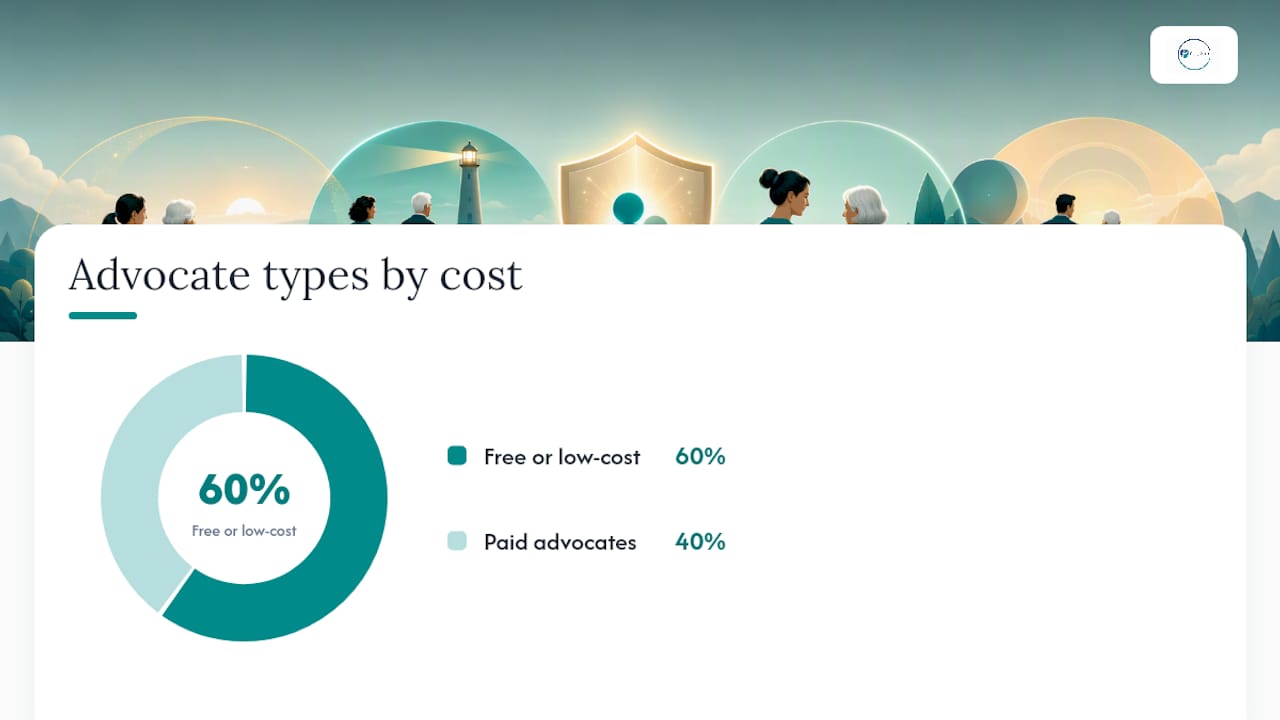
Family or friend advocates are usually free and already know your history, but they may lack medical fluency and can burn out fast if the workload grows. Hospital-employed patient advocates, sometimes called patient representatives, work inside the hospital system, help resolve complaints, and typically cost nothing, but their loyalty and scope stop at the hospital's front door. Volunteer patient advocates, often coordinated through Area Agencies on Aging, provide light-touch support at no cost but usually cannot handle complex, ongoing coordination. Private patient advocates are hired professionals, often nurses or social workers, who charge hourly or flat fees and can dig into insurance appeals, second opinions, and long-term coordination. Geriatric care managers, formally known as Aging Life Care Managers, offer the most comprehensive service: in-home assessments, ongoing coordination across providers, and crisis management, usually for a retainer or hourly rate. The National Institute on Aging describes these care managers as coordinators who make home visits and connect older adults to the full range of home-based services, from meal delivery to skilled nursing.
| Best for | Services typically provided | Typical cost / who pays | How to find / credentials | Availability |
|---|---|---|---|---|
| Simple, occasional support | Appointment attendance, note-taking, basic follow-up | Free (informal) | Trusted relationship, no credential | Wherever you already have one |
| Hospital-based issues | Complaint resolution, discharge questions, billing disputes | Free, hospital-funded | Ask hospital admissions or patient relations desk | In-hospital only |
| Occasional check-ins, light coordination | Basic appointment support, referrals to local services | Free or low-cost | Volunteer programs via Area Agencies on Aging | Varies by region |
| Complex insurance or care disputes | Appeals, second opinions, ongoing coordination | Hourly fee or flat project rate | Aging Life Care Association directory, referrals | Private practice, nationwide |
| Complex, multi-provider, long-distance care | Full care coordination, home visits, crisis management | Hourly or monthly retainer | Certified Aging Life Care Manager (CMC) credential | Private practice, regional |
Pro Tip: Look for the CMC (Certified Care Manager) credential, an RN or LCSW license, or membership in the Aging Life Care Association before hiring a private advocate. If someone guarantees a specific outcome, like winning an insurance appeal, treat that as a red flag rather than a selling point. No ethical advocate promises results they cannot control.
Does Medicare Pay for a Health Advocate?
Medicare does not pay for a private patient advocate or a geriatric care manager directly. There is no standard Medicare billing code for hiring someone to coordinate your care in that sense. What Medicare and Medicaid do fund is the underlying care itself, and some Medicare Advantage plans include care coordination or case management as a built-in benefit worth checking for.
Here's how the payment landscape actually breaks down:
- Hospital-employed advocates and volunteer advocates typically cost nothing directly. Hospitals fund patient representative offices as part of standard operations, and volunteer programs are usually grant or nonprofit funded.
- Private advocates charge hourly rates or a retainer, similar to hiring any independent professional; expect this to be an out-of-pocket cost unless a long-term care insurance policy specifically covers it.
- Geriatric care managers often bill similarly, hourly or by retainer, and some long-term care insurance plans do reimburse a portion.
Your next step should be concrete: call your Medicare Advantage plan directly and ask whether "care coordination" or "case management" is a covered benefit, since terminology varies by insurer. Justice in Aging emphasizes that Medicare and Medicaid remain the backbone of access to health and long-term services for older adults, which is exactly why verifying what your specific plan covers, rather than assuming, matters so much. You can also use Medicare.gov's "Talk to Someone" feature to get a live person on the phone who can walk through your specific plan's coordination benefits.
How Do You Find and Vet a Health Advocate?
Start with the resources that cost nothing and carry government or nonprofit backing before paying for a private option.
- Call the Eldercare Locator at 1-800-677-1116 or search by ZIP code for local Area Agency on Aging referrals.
- Search the Aging Life Care Association's directory for Certified Aging Life Care Managers in your area.
- Ask your hospital's patient advocate or patient relations office what free support they offer, even if you're not currently admitted.
- Use Medicare.gov's resources to confirm coverage questions before you commit to a paid option.
- Check with local nonprofits and senior centers, which often maintain informal referral lists.
Once you have a shortlist, bring these questions to an interview:
- What is your professional background: nursing, social work, or something else?
- Are you a Certified Aging Life Care Manager or do you hold another credential?
- How do you bill, and can I see a written fee schedule?
- Can you provide two references from current or past clients?
- How do you handle emergencies outside business hours?
- What happens if I'm unhappy with the arrangement partway through?
- Will you coordinate directly with my existing providers?
- How do you document and share updates with me?
- What is not included in your services?
- How many clients do you currently manage?
Red flags include vague or unwritten fees, no verifiable references, promises of guaranteed outcomes, and reluctance to explain their credentials clearly. Always call the references yourself rather than accepting a name on a business card as proof.
What Should You Prepare Before You Bring an Advocate In?
An advocate can only move as fast as the information you hand them. Gathering these items before your first meeting saves real time when it matters most.
- A current medication list, including dosages and prescribing doctors
- A list of every provider you see, with contact information
- Copies of insurance cards, both sides
- Advance directives and a healthcare proxy or durable power of attorney for healthcare
- Notes or discharge summaries from any recent hospitalizations
- A signed HIPAA release authorizing your advocate to speak with your providers
A one-page health summary, updated after every major appointment, makes this dramatically easier to maintain. Keep it in a labeled folder or as photos on your phone so it travels with you. If you haven't yet designated a healthcare proxy, that decision should come before, not after, you bring in outside support, since your advocate will need legal standing to act on your behalf in a crisis.
What Does the Research Actually Show?
The evidence supporting advocacy is not just anecdotal. Government resources and peer-reviewed research both point the same direction: structured support changes outcomes.
- The PMC narrative review on unrepresented adults documents how people without an advocate become effectively invisible to care systems during critical transitions, a pattern tied to worse outcomes.
- The National Family Caregiver Support Program has funded respite and support services that reduce caregiver strain and help older adults remain at home longer, evidence that structured support programs produce measurable benefits.
- Justice in Aging frames Medicare and Medicaid protections as essential infrastructure, arguing that policy-level advocacy directly shapes whether older adults can access appropriate care at all.
- Johns Hopkins Medicine confirms that advocates improve communication and follow-through at the individual appointment level, not just in system-wide policy terms.
The limits of this evidence are worth naming honestly: much of it is descriptive rather than a controlled trial measuring advocate impact directly. But the direction of the findings is consistent across a government-funded program, a peer-reviewed review, and a leading academic medical center, which is about as much agreement as you'll find on a topic this specific.
Why This Matters More When You're Aging Solo
Advocacy is not a luxury for people who happen to have a large family. It's a structural piece of any solid solo-ager plan, sitting right alongside your emergency contacts, your healthcare proxy, and your home safety checklist. When you don't have a built-in advocate living down the hall, you build one deliberately, through documents, relationships, and a short list of people who know what to do if you can't speak for yourself that day. Aging Solo's planning resources exist for exactly that reason: to help you put those pieces in place before you need them, not after.
Get Personalized Help Building Your Advocacy Plan
Reading about advocacy is one thing. Knowing exactly which document to sign first, which questions to ask a geriatric care manager, or how to structure your own advocacy network when you live alone is another. That's what the Solo Aging Clarity Session is built for: a focused 45-minute Zoom conversation where you walk through your specific situation, not a generic checklist.

During the session, you'll work through what matters most for your circumstances: whether a private advocate or a geriatric care manager fits your needs and budget, which documents to gather first, and how to sequence your next steps so nothing gets missed. It's a practical planning conversation, not a sales pitch for ongoing services. If you'd rather start with free tools first, Aging Solo's guide on maintaining independence while aging at home is a solid starting point. When you're ready for a session tailored to your own health and support situation, you can book a Solo Aging Clarity Session directly through Aging Solo.
Sources
- Eldercare Locator (Administration for Community Living)
- Adults Without Advocates and the Unrepresented: A Narrative Review — PMC (NCBI)
- Advocating for Older Adults in 2025 — Justice in Aging
- The Power of a Health Care Advocate — Johns Hopkins Medicine
FAQ
When should you ask for a patient advocate?
Ask immediately if you're facing a hospital discharge, an insurance denial with an appeal deadline, or a new dementia diagnosis. For ongoing chronic conditions or polypharmacy, set up support before a crisis forces the decision.
Does Medicare pay for a health advocate?
Medicare typically does not pay directly for a private advocate or geriatric care manager, though some Medicare Advantage plans include care coordination benefits worth verifying with your specific plan.
Why would someone with dementia need an advocate?
Dementia affects the ability to retain medical information, track medications, and communicate symptoms accurately, making a dedicated advocate essential for safe, coordinated care.

What are the benefits of having a patient advocate?
Advocates improve care coordination, catch medication conflicts, reduce hospital readmissions, resolve insurance problems faster, and provide emotional support during difficult diagnoses, according to research from Johns Hopkins Medicine.
How is a health advocate different from a geriatric care manager?
A health advocate can be anyone, family, volunteer, or professional, who supports your care needs, while a geriatric care manager is a credentialed professional (often a Certified Aging Life Care Manager) offering comprehensive, ongoing coordination.