
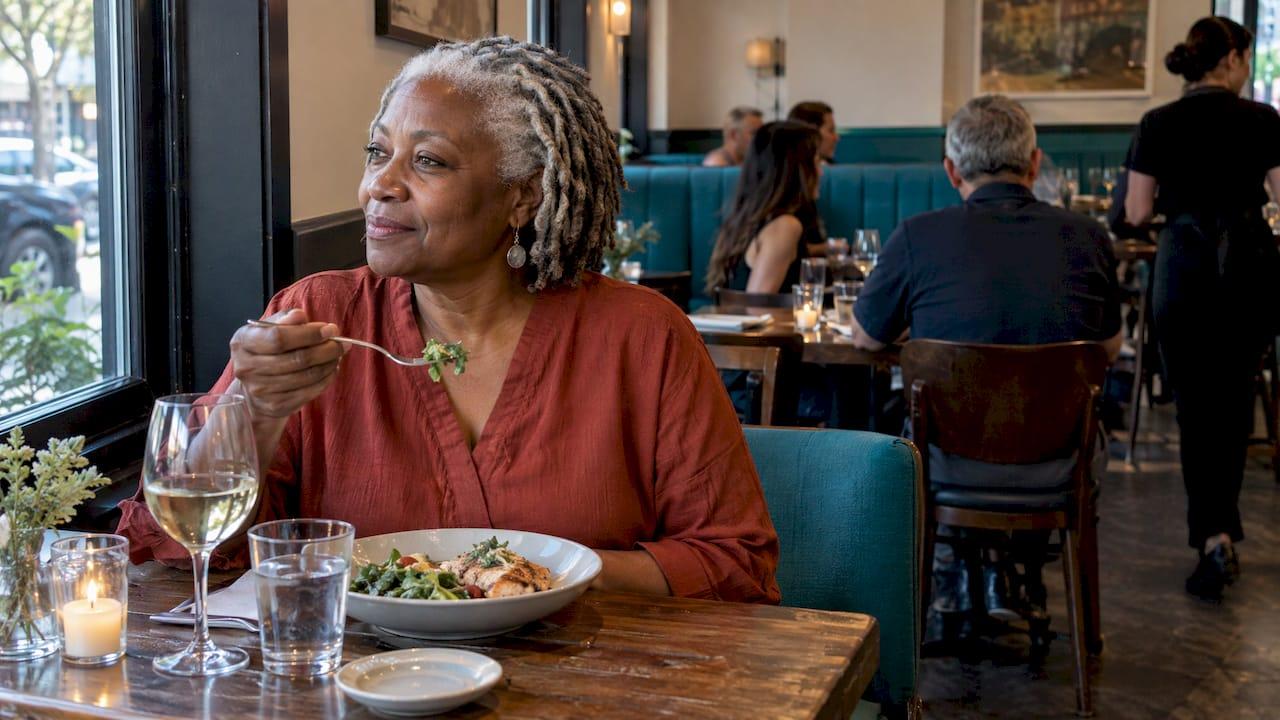
The host looks up from the stand, glances past your shoulder, and waits for someone to appear. You say, "Just one." Your voice comes out a little smaller than you meant it to. Then you are walked past the two-tops full of conversation to a table near the kitchen, and for a moment the whole room seems to be watching.
If you have been there, you are in good company. That first minute is the hardest part of dining alone, and it passes faster than it feels like it will. What follows it can be one of the quietest, most satisfying hours of your week.
TL;DR
- Feeling self-conscious the first time is common, and it usually eases once you are seated and the food arrives.
- Start small: a coffee, a counter seat, a quiet hour. Confidence grows from repetition, not from one brave night.
- Solo diners are a growing group in the U.S., so you are less conspicuous than you imagine.
- Put your attention on the food, the room, and your own pleasure, not on who might be looking.
- Alone is not the same as lonely. A meal by yourself can be a chosen, full-hearted way to spend an evening.
Table of Contents
- Why that first minute feels so loud
- Is it okay to go out to dinner by yourself?
- Start where the stakes are low
- What to do once you are seated
- What about the "Just one?" moment
- Taking yourself out, not just eating alone
- When the quiet feels heavier than expected
- If you want a thinking partner for what comes next
- A first solo meal, in a few easy scenes
- Questions people ask about eating out alone
- The meal that belongs to you
- FAQ
- Sources
Why that first minute feels so loud
Most of the discomfort comes from a story we tell ourselves: that people will notice we are alone and decide something about us. Researchers who study this have a name for the worry. Rebecca Ratner and Rebecca Hamilton found that reluctance to do things alone in public is partly driven by a fear that others will assume we have no friends.
Here is the gentle twist in their work. When people actually tried an activity alone, such as visiting an art exhibit, solo visitors enjoyed it about as much as those who came with a friend, even though they had been less enthusiastic beforehand. Psychology Today's summary of the research makes the same point: we probably worry more about doing things alone than we need to.
In other words, the dread is mostly in the anticipation. The experience itself tends to be kinder.
It also helps to know the world is moving your way. According to OpenTable data cited by The New York Times, solo dining reservations in the U.S. are up 64% since 2019. AP News reported, also citing OpenTable, that solo reservations rose 29% over a two-year span. Look around on your next night out. Chances are you will spot another person with a book, a glass of wine, and a look of perfect contentment.

Is it okay to go out to dinner by yourself?
Yes. Completely. Food writers have been saying so in print: one piece on the underrated joy of going to a restaurant alone argues that it is catching on and should not feel weird.
That said, "it's okay" and "it feels okay" are different things. You are allowed to feel a little shy and go anyway. Confidence is rarely a feeling you wait for. More often it is something that shows up on the third or fourth visit, when you realize nobody ever looked twice.
Start where the stakes are low
You do not have to begin with a white-tablecloth dinner on a Saturday night. Calm's guidance on eating alone suggests easing in with low-pressure places, such as a café, a food truck, or a bookstore with a coffee bar.
This is where solo coffee dates come in, and they may be the gentlest on-ramp there is. A coffee date with yourself has a built-in time limit, a small bill, and a ready-made prop: the cup in your hands. Try it on a weekday morning at a place with a window seat. Order something you would not make at home. Stay twenty minutes longer than you planned.
A few ways people ease in:
- A late breakfast. Mornings are often relaxed, and many people are alone with a newspaper or a phone.
- The counter or the bar. Sitting side by side with others, rather than facing an empty chair, can feel less exposed.
- An early or off-peak dinner. Calm also suggests picking a quieter time, and looking at the menu online beforehand so there are no surprises.
- A place you already love. A familiar room makes a new habit easier.
None of these is a test. They are simply ways to let your nervous system learn that this is fine.
What to do once you are seated
The awkward part is the first five minutes, before the food arrives. Here is what tends to help.
Give your attention a place to rest
Calm suggests noticing the discomfort without letting it take over, and moving your focus to how your food tastes instead of who might be watching. It sounds almost too simple, but it works the way a good conversation does: attention goes where the interest is.
Try it. What is the first flavor you notice? Is the bread warm? Is there a sound in the room, a clatter or a laugh, you would not have caught if you had been busy talking?
Bring something, or nothing
A book, a crossword, or a postcard to write can make the table feel like yours. So can bringing nothing at all. Some of the best solo meals are the ones where you simply watch the room: the server who knows every regular, the couple splitting dessert, the kitchen door swinging.
If your phone is your comfort, that is fine too. But if you can, set it face down for the first course and see what happens.
Order the way you want to
There is a quiet freedom in a table for one. No one needs to agree on an appetizer. No one is hungry earlier or later than you. You can order dessert first, or just three small plates, or the thing no one else in your life likes.
Menus built around big shareables can be a bit frustrating alone. Restaurant-industry writing notes that small plates, tasting menus, and smaller menus make solo ordering easier. So when you choose where to go, scan for places with half portions, small plates, or a good bar menu.

Choose your seat
You may be offered a spot by the kitchen. You are allowed to ask for something else: a window, a booth, a seat at the bar. Restaurants that welcome solo guests often set aside stools at the bar or a high-top by a window, and some use communal tables to signal that diners on their own belong there, as the same industry source describes.
A simple line works well: "A table for one, please. Is the window seat free?" Said warmly and without apology, it tends to get a warm answer.
What about the "Just one?" moment
Some hosts say "just you today?" and mean nothing by it. The same industry guidance actually advises staff to leave out the word "just," because it can make guests feel judged. So if you hear it, you have heard a habit, not a verdict.
You can answer it in a way that keeps your footing. "Yes, one, and I'm looking forward to it" does a lot. You are not explaining yourself. You are telling the room you chose to be here.
Taking yourself out, not just eating alone
There is a difference between eating a meal alone and taking yourself out. The first can feel like a gap to be filled. The second feels like an invitation you extend to yourself.
Taking yourself out has a rhythm, and you can build it a little at a time:
- Pick a place because it appeals to you, not because it is convenient.
- Dress in something that makes you feel like yourself.
- Make it a small occasion: a favorite table, a drink you enjoy, a walk afterward.
- Let it repeat. Many people settle into a standing date, perhaps the first Friday of the month or after a Tuesday errand.
Over time, the meal stops being something you do instead of dining with others. It becomes its own thing. Plenty of people find that solo dinners are where they hear their own thoughts most clearly, sort out what they want for the coming week, or simply enjoy being unhurried.
That is the heart of what we believe at Aging Solo Today: a solo life can be a complete life. Our piece on thriving alone after 50 explores that further, and our thoughts on building confidence after 50 pair well with the habit of dining out on your own.
When the quiet feels heavier than expected
Honesty matters here. Some evenings, a table for one is a delight. Other evenings, you may notice the empty chair more than the food. Both are real, and neither means you are doing it wrong.
Calm points out that dining solo can carry a social stigma, especially if you already feel self-conscious or anxious, and that this is no reason to avoid it. If you find that a quiet dinner sometimes turns into a lonely one, try changing the setting rather than giving up. Go to the bar instead of a booth. Pick a place where the staff know you. Or choose a spot where there is a little life around you, such as a market hall or a sidewalk café.
And if what you are really craving is company, that is useful information, not a failure. Solo dining and friendship are not rivals. Many people find the confidence to eat alone makes it easier to say yes to other things: a class, a lunch group, a neighbor's invitation. Our pages on social connection for seniors and the hidden loneliness checklist are there for those seasons.
Our perspective
We started Aging Solo Today because the story told about people on their own is too small. It says solo means lonely, and that a full life needs a partner across the table. Our experience, as people who live this way, says otherwise.
A meal out alone is one of the simplest places to find that out for yourself. It asks very little: one reservation, one chair, an hour. And it gives back something real, the knowledge that you can walk into a room by yourself and belong in it.
That confidence does not stay at the restaurant. It follows you into travel, friendships, new interests, and into the bigger decisions about how you want to live as the years go on. We think the people who enjoy their own company are often the ones who make the clearest, calmest choices about what they want next.
So we encourage you to go out, to linger, and to treat your own company as worth the effort.
Mike Crawford
If you want a thinking partner for what comes next
Dining out alone is a small act of independence, and many readers tell us it opens a larger question: what do I want the next chapter of my solo life to look like?
If that is where you are, our Solo Aging Clarity Session is a 45-minute Zoom conversation, priced at $97, designed to help you think through your own situation with someone who lives this life too.
You can learn more about the Solo Aging Clarity Session or start with the free Solo Aging 101 guide at your own pace.
A first solo meal, in a few easy scenes
If you would like a picture of what a good first time might look like, here is one.
It is a Wednesday, just after five. You walk to the neighborhood place with the good soup. The host asks how many, and you say one, and you add that you would love a seat near the window. You are shown there. You order tea first, then the soup, then a small plate you have been curious about.
For a few minutes your heart is a little fast. Then the soup arrives, and it is hot, and you taste the pepper, and you notice a man at the bar laughing with the bartender. You think, I could come here every week.
That is it. That is the whole thing. No grand breakthrough, just a warm bowl and a chair that suited you.
Questions people ask about eating out alone
This is not the end of the article, but a few answers may help before you head out.
The meal that belongs to you
There is a particular pleasure in being the person who decides: where to eat, how long to stay, whether to order the pie. It does not come from having no one to share with. It comes from knowing you are a good companion for yourself.
So choose a place with something on the menu that makes you smile. Say "table for one" like you mean it. Let the first bite arrive, and let the evening be yours. Plenty of people have found that the room looks friendlier once they stop bracing for it, and that a meal with only your own company can be one of the most contented hours of the week.
FAQ
Is it okay to go out to dinner by yourself?
Yes. Solo dining is increasingly common in the U.S., with OpenTable data reported by AP showing solo reservations up 29% over two years. Feeling a bit self-conscious the first time is normal, and it usually fades once you are seated and enjoying your food.
What should I do at a restaurant alone?
Focus on the meal: the taste, the room, the small pleasures. You can bring a book or a puzzle, or simply people-watch. Picking a seat you like, such as a window or the bar, makes the experience feel more like yours.
How do I get comfortable with solo coffee dates?
Start with a café at a quiet time, since low-pressure settings are an easy first step. Order something you enjoy, bring a book or a journal if you like, and give yourself permission to stay a while. Repeating it a few times is what builds comfort.
What if I feel lonely while eating alone?
That can happen, and it does not mean you should stop. Try a livelier spot, like a bar seat or a market hall, or a place where staff know you. If loneliness is showing up often, our guide to aging confidently after 50 offers ideas for building connection.
Sources
- Table for One: Research Reveals the Power of Solitude, University of Maryland Robert H. Smith School of Business
- How It Really Feels to Be Alone in Public, Psychology Today
- Why Is Dining Alone So Difficult?, The New York Times
- Restaurants are catering to a growing number of solo diners, AP News
- The Underrated Joy Of Going To A Restaurant Alone, Delish
- Dining solo? Here's how eating alone can affect your mental health, Calm
- How To Attract More Guests With Smart Solo Dining Options, TouchBistro