
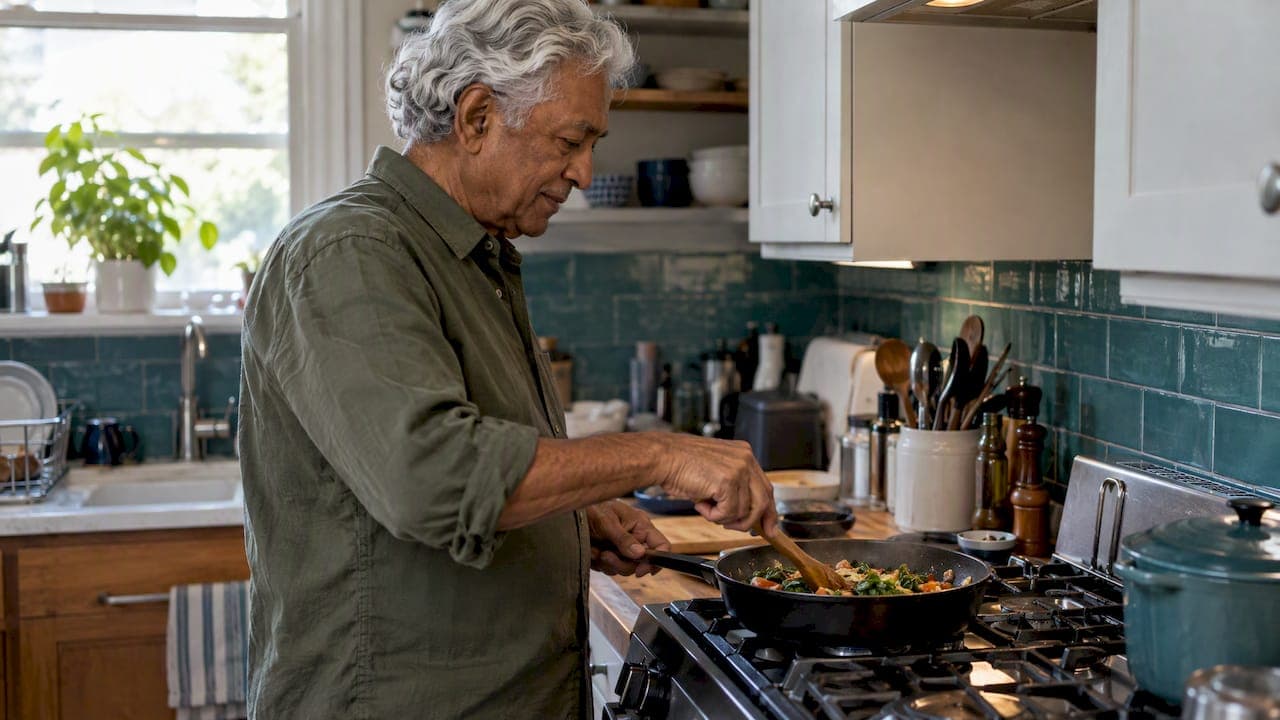
It's a quiet Tuesday evening. You've got a pan of onions going, a podcast on, and the phone rings. It's your friend from the walking group, and she wants to talk about the trip you've both been circling for months. Twenty minutes later you wander back to the kitchen and the onions are past golden and heading somewhere darker. Nothing terrible happened. But your heart ticked up, and you thought: when it's just me in here, who notices?
That feeling is common, and it says nothing bad about you. Cooking for one is one of the real pleasures of a solo life, and a few easy habits let you keep it. This article is about those habits: the ones that keep a pan of onions from becoming a fire, so the kitchen stays yours for as long as you want it.
TL;DR
- Unattended cooking is the habit most tied to kitchen fires. Stay close when the burner is on, and let a timer be your second set of eyes.
- Short, close-fitting sleeves and a clear stovetop do more than you'd expect.
- If grease catches, slide a lid over the pan, turn off the burner, and never use water. If it doesn't go out, leave and call 911 from outside.
- Smoke alarms belong on every level and in every bedroom, tested monthly, and about 10 feet from the stove so they don't cry wolf.
- A kitchen can change with you over time. Adjusting it is a sign of a person taking care of a home they love.
Table of Contents
- Alone in the kitchen is not the same as lonely in the kitchen
- Staying with the pan
- What you wear and what sits near the burner
- When grease catches
- Smoke alarms that let you cook in peace
- Letting people into your circle, on your terms
- Changing the kitchen as you change
- Cooking is part of the good life
- Want a thinking partner for the bigger picture?
- FAQ
- Sources
Alone in the kitchen is not the same as lonely in the kitchen
Many people who live on their own tell a similar story. The first few months of cooking for one feel flat. A big pot of soup makes no sense. A proper dinner feels like too much effort for an audience of one. Then something shifts. You start making the dish you actually want, at the hour you actually want it, with the music you actually like. The kitchen becomes a room of your own.
That's worth protecting, and it's why we think about kitchen safety a little differently than most fire-prevention pages do. We're not trying to scare you out of the kitchen. We're trying to help you stay comfortably in it.
The good news is that the biggest risks in a home kitchen are quite ordinary, and the fixes are ordinary too. The National Fire Protection Association (NFPA) reports that cooking is the number one cause of home fires and home injuries, and that the leading cause of kitchen fires is unattended cooking. Not bad cooks. Not old kitchens. Cooking that was left alone for a while.
That's a very human thing. And it's where living solo changes the picture a little: in a shared household, someone else is often wandering through who might catch the smell of scorching butter. When you're on your own, your attention is the system. So let's make it easy on your attention.
Staying with the pan
Here's the single most useful idea in this whole article. Be in the room when the heat is on, or turn the heat off when you leave.
The numbers behind it are striking. NFPA's research, using 2020 to 2024 annual averages, found that 25% of reported home cooking fires and 50% of the associated deaths involved cooking equipment that was left unattended. Half of the deaths. That's the one habit worth changing if you only change one.
NFPA's guidance is that you stay in the kitchen while you are frying, grilling, boiling, or broiling food. For simmering, baking, or roasting, check on the food regularly, remain in the home while it cooks, and use a timer to remind you. You can read it all on the NFPA cooking safety page.
Make the phone call work with you
The interruption is the real enemy, whether it's a phone call, a knock at the door, or a good book on the couch. Some ideas that fit real life:
- Take the call in the kitchen. Put your friend on speaker and keep stirring. Most of us talk better with our hands busy anyway.
- Turn it off when you step away. Even for "just a minute." Reheating takes a minute. Burned oil doesn't care about your good intentions.
- Carry the timer. A cheap kitchen timer you can clip to a collar or drop in a pocket follows you from room to room. Your phone can do the same job. Set it whenever anything is simmering or in the oven, even if you swear you'll remember.
None of that is a rule you have to follow perfectly. It's a way of letting a small gadget carry a bit of the mental load so your mind can be on the conversation, the book, or the garden.
Be honest about your energy
The U.S. Fire Administration (USFA) makes a point that's easy to skip past: don't cook if you're sleepy, if you've been drinking alcohol, or if you've taken medicine or drugs that make you drowsy. That comes straight from its Fire Safety for Older Adults guide. It also says to stay watchful and alert while you cook.
That's a kind rule, really. Some evenings the best dinner is cold cheese, good bread, and a pear. A glass of wine with dinner is one of life's pleasures too, and the sensible order is to cook first, pour second. If a new medication makes you groggy, ask your pharmacist when it's best to stay away from the stove. That's a question they're glad to answer.
What you wear and what sits near the burner
It sounds fussy until you've reached across a burner for the salt. Loose clothing can catch fire if it touches an electric burner or a gas flame, and the USFA recommends short, close-fitting, or tightly rolled sleeves while cooking. That bathrobe with the wide cuffs you love for slow mornings? Lovely for the couch. Maybe not for the stove.
A few other things from the USFA's older adult guidance that are easy to fold into your routine:
- Turn pot handles toward the back of the stove, so you don't bump them with a hip or an elbow.
- Keep anything that can burn away from the stovetop. The San José Fire Department puts it plainly: food packaging, oven mitts, paper towels, and dish towels have no business sitting beside a burner. Most of us park them there out of habit, because they're handy.
The fix is simple, and it's really about where things live. Give the stove a little breathing room. Move the towel hook a few feet to the side. Keep the mitts in a drawer you can reach without crossing the burners. Once it's arranged, you stop thinking about it, and that's how safe habits should feel.
If you'd like more everyday kitchen routines written for people cooking solo, our piece on kitchen safety habits that keep solo agers cooking independently goes deeper on the rhythm of a well-set-up kitchen.
When grease catches
Let's talk about the moment nobody wants to imagine, so that if it ever comes, your hands already know what to do. A pan of oil gets too hot, or a bit of bacon fat flares, and flames jump up. This is where fear makes people do the wrong thing, usually reaching for water.
Here's what NFPA advises for a grease fire in a pan:
- Slide a lid over the pan to smother the flames.
- Turn off the burner.
- Keep the pan covered until it has cooled completely. Lifting the lid early can let air back in and the flames can return.
- Never throw water on it. Water and hot grease are a dangerous mix.
That's the whole routine, and it's on the NFPA cooking safety page if you want it in the source's own words.
There's an easy way to be ready: know where the lid for your biggest skillet is. Right now. If it's lost under a pile of Tupperware, find a new one this week. A lid you can grab with one hand is the best fire tool in a kitchen, and it costs a few dollars.

The part about leaving
Here's the permission slip that matters most. If you don't feel comfortable sliding a lid over the pan, or if the fire doesn't go out, NFPA says to get out of the home, close the door behind you, and call 911 from outside.

You are allowed to leave. A pan is replaceable, and so are the curtains. You are not. Many people who live alone worry they'll freeze or feel foolish for calling. Fire crews would much rather arrive at a small fire that was already smothered than a big one that wasn't.
It can help to keep your phone in a pocket or on a belt clip when you're cooking, so that the thing you need to call from comes with you. If you want to make the whole idea feel less scary, we wrote about calm emergency drills that rehearse agency, not panic. A little rehearsal in your head, on a calm afternoon, turns a frightening scene into a familiar one.
Smoke alarms that let you cook in peace
One reason people quietly disable their smoke alarms is that the thing goes off every time they sear a steak. It's so common that it's worth planning for. An alarm that's been unplugged protects no one, so the goal is an alarm you can live with.
The USFA guidance gives you the layout: smoke alarms on every level of the home, inside bedrooms, and outside sleeping areas, tested monthly. It also advises placing them at least 10 feet from the stove or bathroom to cut down on false alarms from cooking smoke or shower steam.
There's a technical wrinkle too. According to the USFA's Fire Safe Seniors Implementation Guide, ionization alarms are better at detecting fast, flaming fires such as grease fires, but they are also more sensitive to steam than photoelectric alarms. That makes them likelier to trigger nuisance alarms when installed near a kitchen. So distance from the stove matters, and the type of alarm matters. If yours keeps crying over toast, moving it or swapping the type is a better answer than pulling the battery. A local fire department can often help you work out which, and the guide above notes that home assessments for fire hazards are part of comprehensive fire safety for older adults.
If your hearing isn't what it was
When you live alone, no one else wakes up to the alarm. The USFA notes that for older adults with hearing loss, specialized devices such as bed shakers, strobes, or low-frequency audible signals are available so you're warned of a fire while sleeping. If you've noticed you don't always catch the beep from across the house, that's a good reason to ask about them.
For more on where alarms go and why, see our guide to smoke alarm placement when you live alone. And since the same hallway often holds both devices, our note on carbon monoxide detector placement is a natural companion.
Letting people into your circle, on your terms
Something we hear often from solo agers: they don't want to be watched. They want to be known. There's a difference, and it matters here.
A neighbor who has a spare key and knows to knock if your blinds stay shut is not surveillance. A friend who texts "dinner tonight?" and gets a reply is a safety net made of affection. Some people also like having technology in the mix. If you're curious how a camera setup might work for an older person who wants a loved one to check in, this overview of how camera systems monitor elderly parents at home shows what's possible. Whether that suits you is entirely your call. Plenty of people prefer a simple phone call every evening.
The larger point: your kitchen habits don't have to be a solo project. Ask the person you eat with most often to notice whether you seem tired, or whether the pots look a little more scorched than usual. People who care about you want that job.
Changing the kitchen as you change
Here's the question many solo agers carry quietly: what if cooking gets harder? Hands get less steady. Memory has its off days. Standing for a long time becomes less appealing.
The honest answer is that the kitchen can keep up with you. Staying independent doesn't mean doing everything the same way forever. It means noticing what's shifted and adjusting early, while it's still your choice.
A few ways people do that:
- Cook with the stove when you feel your best, and lean on the microwave, slow cooker, or toaster oven when you don't.
- Choose recipes that reward being close, like a quick sauté you stand over, and save the long simmers for company days.
- Bring in a second opinion. Your doctor, a pharmacist, an occupational therapist, or your local fire department can look at your specific situation. We're not medical people, and a worry about memory or balance deserves a real professional, not a guess from a website.
If you notice more close calls than before, that's not failure. It's information, and acting on it keeps you in charge. Our wider piece on the top safety risks for seniors living alone can help you see the whole house at once, so the kitchen isn't the only room carrying your worry.
Cooking is part of the good life
There's a reason we keep returning to the kitchen when we talk about aging solo. Food is where a lot of joy lives. It's the Sunday pancakes, the soup you bring a neighbor, the first tomatoes of August, the table where a new friend sits for the first time.
A safe kitchen isn't a joyless one. It's one where you can sing along to the radio, chat on speaker with a friend, and trust that the details are handled: the lid is where it should be, the sleeves are snug, the alarm is a sensible distance from the stove, the timer is in your pocket. Then your attention can go where you want it, to the cooking itself, and to the people who'll be sitting down with you.
Our perspective
When I started writing about aging on your own, I assumed the kitchen would be a footnote. It turned out to be one of the most emotional rooms in the house. For many of us, cooking is the daily proof that we're still running our own lives.
That's why I'm wary of advice that treats a solo ager's stove as a problem to be managed. The better question is how to keep you cooking, happily and for a long time. Most kitchen fire prevention comes down to attention and a little setup, and both are well within your control.
We built Aging Solo Today around that idea: that a solo life can be a full one, and that the practical support underneath it should feel like a steady hand, not a lecture. A thoughtful circle of people, a kitchen that suits you, and a plan you made yourself are what let you say yes to the dinner party, the trip, and the new recipe.
What we offer is built on that belief. Our free resources help you think things through at your own pace, and a one-on-one conversation helps when you'd like someone to think it through with you.
Mike Crawford
Want a thinking partner for the bigger picture?
Kitchen habits are one piece of living well on your own. If you'd like to talk through the rest, such as who you'd call, how your home fits you now, and what you'd like it to look like in five years, we offer the Solo Aging Clarity Session: a 45-minute Zoom conversation, built around your situation, for $97. You can book a Solo Aging Clarity Session and bring any questions, including the small, practical ones.

Prefer to start on your own? Our free checklists and resources are there for self-paced planning, no purchase needed.
FAQ
What is the most common cause of kitchen fires?
Unattended cooking. NFPA names it as the leading cause of kitchen fires, and its 2020 to 2024 averages show that unattended equipment was involved in 25% of reported home cooking fires. Staying in the kitchen while you fry, boil, grill, or broil, and using a timer for baking or simmering, addresses it directly.
What should I do if grease catches fire in a pan?
Slide a lid over the pan, turn off the burner, and leave the lid on until the pan has cooled completely. Never pour water on it. If you aren't comfortable covering the pan, or the fire doesn't go out, get outside, close the door behind you, and call 911 from outside.
How can I cook more safely on my own as I get older?
Stay alert and skip the stove when you're drowsy, have had alcohol, or have taken medicine that makes you sleepy. Wear short or close-fitting sleeves, turn pot handles toward the back, and keep towels, packaging, and mitts away from the burners, as the USFA's older adult fire safety guide recommends. If cooking is getting harder, talk with your doctor or an occupational therapist about adjustments that keep you cooking.
Where should the smoke alarm go if it keeps going off when I cook?
The USFA advises placing alarms at least 10 feet from the stove or bathroom, while still keeping them on every level, in bedrooms, and outside sleeping areas. Because ionization alarms are more sensitive to steam, a different alarm type can also help, according to the Fire Safe Seniors guide. Move or replace the alarm rather than removing its battery, and your kitchen can stay as lively as you like.
Sources
- Safety with cooking equipment, NFPA
- Fire Safety for Older Adults, U.S. Fire Administration
- Fire Safe Seniors Implementation Guide, U.S. Fire Administration
- Fire Safety in the Kitchen, City of San José