
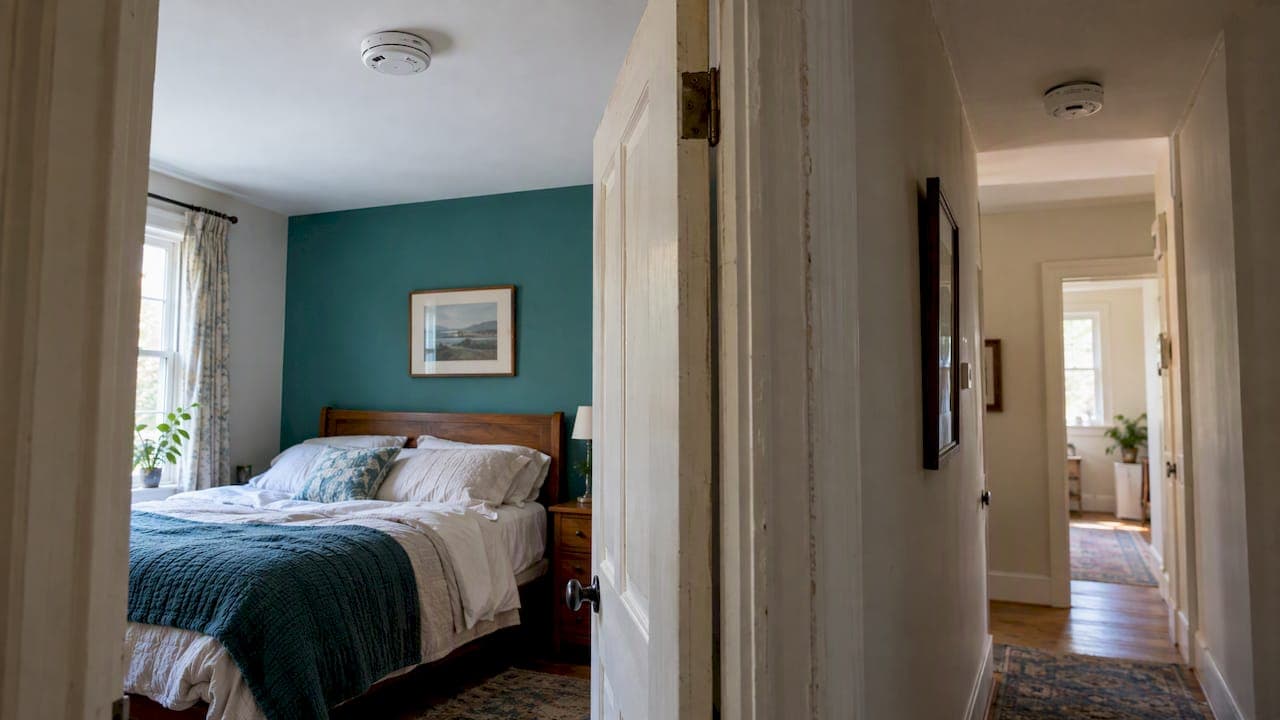
It's a Tuesday night. You're settled on the couch with a book and a cup of tea, and the house is quiet in the good way. Then you hear it: one thin chirp from somewhere down the hall. Ten minutes later, another. You can't tell which room it's coming from, and there's no one to ask, "Did you hear that?"
If that's you, you're in good company. Living alone means every small household job is yours, and that can feel like a lot. It can also feel like freedom. This guide helps you do this one job well, once, so you can stop listening for chirps. The short answer: put an alarm inside every bedroom, outside each sleeping area, and on every level of your home. Then mount them high, away from the stove and the shower.
TL;DR
- Put smoke alarms inside every bedroom, in the hallway outside the sleeping area, and on every level, including the basement.
- Mount them on the ceiling, ideally in the center. On a wall, the top of the alarm should sit within 12 inches of the ceiling.
- Keep them away from kitchens and bathrooms so cooking and steam don't set them off.
- Choose interconnected alarms if you can, so one sounds them all, and test monthly.
- Alarms work best alongside a simple, comfortable plan for getting out.
Table of Contents
- Why a home for one still deserves a few alarms
- The rooms that need one
- Ceiling, wall, and the awkward corners
- What the ".7 rule" means (and whether you need it)
- National advice versus your local code
- Making sure you'll actually hear it
- A plan that feels like yours
- Our perspective
- Want a hand thinking through your home?
- Questions people ask
- Sources
Why a home for one still deserves a few alarms
When you live with other people, someone else is often awake. When you live alone, the alarm is the one who stays awake for you. That's a lovely thing to hand off, and it's why the number of alarms matters more than you'd think.
The U.S. Fire Administration says to place alarms inside and outside each bedroom and sleeping area, and on every level of the home. The reason for the hallway one is practical: a closed door can slow the spread of smoke, heat, and fire. The same logic runs the other way for sound. The fire chiefs' association IAFC notes that a closed bedroom door can cut an alarm's sound from 85 decibels to 46. If you sleep with your door shut, an alarm only in the hall may not wake you the way you'd hope.
That's the whole case for the bedroom alarm. It isn't about fear. It's about a good night's sleep, with the door closed the way you like it.
The rooms that need one
Here's the layout, walked through the way you'd move through your own home.
Bedrooms and the hall outside them
Start where you sleep. NFPA, the national fire protection association, recommends an alarm inside every bedroom, outside each separate sleeping area, and on every level. If you've turned a spare room into a studio, a guest room or a reading nook, count it as a bedroom if anyone, including a visiting friend, might sleep there.
In the hallway, IAFC advises ceiling placement outside sleeping areas and along the routes you'd use to leave the bedroom. It also cites a Kidde recommendation that a hallway longer than 30 feet gets an alarm at each end. The Consumer Product Safety Commission puts the same idea simply: alarms along escape paths help when visibility is poor.

Living areas and stairways
On a level without bedrooms, NFPA suggests the living room, den, family room, or an area near the stairway to the upper level. IAFC adds a useful detail: the alarm belongs near the stairway, but not in the stairway itself.
The basement
Basements get skipped because we rarely spend time there. They still count as a level. NFPA recommends putting the basement alarm on the ceiling at the bottom of the stairs leading to the next level.
How many for a three-bedroom house?
There's no single national number, because it depends on your layout. But you can count it yourself from the rules above. Take a two-story home with three bedrooms:
| Spot | Alarms |
|---|---|
| Inside each bedroom | 3 |
| Hallway outside the bedrooms | 1 |
| Main living level, near the stairs or in the living room | 1 |
| Basement, bottom of the stairs (if you have one) | 1 |
That's five without a basement and six with one. A single-story ranch with three bedrooms and no basement lands at five: three bedrooms, one hall, one living area. If a long hall or a separate wing adds another sleeping area, add one more. Think of it as a count, not a target.
Ceiling, wall, and the awkward corners
Smoke rises, so alarms live high. But "high" has a few specifics.
On a flat ceiling. CPSC describes the general placement as the center of the ceiling. The Texas Department of Insurance adds a 4-inch clearance from the nearest wall for ceiling mounting. Corners are dead air, where smoke is slow to arrive.
On a wall. NFPA says wall-mounted alarms should sit no more than 12 inches from the ceiling, measured to the top of the alarm. CPSC gives a range of 6 to 12 inches below the ceiling, and Texas says 4 to 12. The numbers differ a little, so a sensible middle is to put the top of the alarm a few inches to a foot below the ceiling. Always read the instructions that came with your model, too.
On a pitched or vaulted ceiling. NFPA says to place the alarm within 3 feet of the peak but not in the apex itself, with the cited guidance specifying four inches down from the peak. Reaching a vaulted ceiling can be a real task. If a ladder makes you nervous, skip the heroics and ask a friend, a neighbor, or a handyperson to hold the ladder or do the install. That's what a good support circle is for.

Places to avoid
CPSC advises keeping alarms away from kitchen appliances, fireplaces, bathrooms, heating appliances, windows and ceiling fans. Each of these either triggers false alarms or pushes air around so smoke doesn't reach the sensor.
How far is far enough? The sources differ, and it helps to know why:
| Source | From the stove | From the bathroom |
|---|---|---|
| U.S. Fire Administration | At least 10 feet | At least 10 feet |
| IAFC | At least 20 feet | At least 10 feet |
In a small apartment, 20 feet from the stove may be impossible. A reasonable approach is to get at least 10 feet, and further if your layout allows. If toast still sets it off, move the alarm a little farther away rather than taking out the battery. A silenced alarm protects no one.
A few kitchen habits help too, and we cover them in kitchen safety habits that keep solo agers cooking independently.
What the ".7 rule" means (and whether you need it)
You may have seen this in a search. It comes from NFPA 72, the national fire alarm code, and it's aimed mostly at commercial and larger buildings. On a smooth ceiling, detectors are normally spaced at a nominal 30 feet. The alternative is that every point on the ceiling be within 0.7 times 30 feet, or 21 feet, of a detector. Corridors can stretch farther, up to 41 feet depending on width.
For an ordinary home, you can set this aside. Follow the bedroom, hallway, and level guidance above. It only comes into play with a very large open room, where it's a reminder that one alarm in the middle won't cover a great hall.
National advice versus your local code
The placement advice above is national guidance from NFPA, USFA, and CPSC. What you're legally required to have is a different question, and it depends on where you live and whether you own or rent. State and local fire codes differ, particularly on whether alarms must be hardwired or interconnected, and what applies to existing homes versus new construction. Your local fire department or building office can tell you what applies to your address. If you rent, your landlord may also have duties to provide working alarms.
The happy overlap: following the national recommendations almost always satisfies or exceeds what a local code asks.
Making sure you'll actually hear it
Placement is half of it. The other half is whether the sound reaches you and you can respond.
The U.S. Fire Administration's fire safety guide for older adults suggests:
- Test each alarm monthly to make sure everyone can hear it while asleep.
- Use interconnected alarms, so when one sounds, they all sound.
- If hearing loss makes an alarm hard to hear, consider low-frequency signals, bright lights, vibration, or a bed shaker.
- Keep a phone within reach next to the bed.
Interconnection is especially nice when you live alone. A small alarm in the basement can be too faint to wake you upstairs. Linked alarms mean the whole house speaks up together.
On upkeep, CPSC recommends testing monthly, replacing batteries at least once a year, and replacing alarms that are more than 10 years old. USFA adds that you can vacuum or clean the alarm each year when you change the battery. Many alarms print a manufacture date on the back, so check yours.
If testing is hard, because of reach or balance, the USFA's Fire Safe Seniors flyer says you can ask a family member, home-care assistant, or case worker to do it monthly. If you don't have those people nearby, a friend or neighbor works. Turn it into a small ritual: the first of the month, coffee, test, done. That's a reason to have someone over.
A plan that feels like yours
CPSC treats working alarms and a practiced escape plan as complementary protections. The older-adult guidance from USFA suggests planning around your own abilities and, when possible, identifying two ways out of each room. If a fire starts, get out and stay out.
Don't make it a grim project. Walk it once, in daylight, at your own pace. Notice whether a rug catches your foot or a chair blocks a doorway. If you like a calm approach, our piece on rehearsing agency instead of panic shows how. If you'd like a second set of eyes on your whole home, a room-by-room home audit can help you see which doors, windows and alarms deserve attention.
And if your alarm is also meant to work alongside carbon monoxide detection, see carbon monoxide detector placement for solo agers. The rules are different, so they get their own page.
Our perspective
We started Aging Solo Today because a solo life can be a full one, and the people living it deserve plain, unhurried guidance. Smoke alarm placement is a good example. It's a one-afternoon job, not a lifestyle. Do it, and you get to stop thinking about it.
What we notice is that the people who put it off aren't careless. They're busy living: traveling, hosting, volunteering, starting a new hobby. They just don't have someone down the hall to say, "Hey, when did we last change those batteries?" So we suggest making alarms part of your own rhythm, tied to something you already enjoy.
Alone doesn't mean on your own for everything. Ask a neighbor to hold the ladder. Trade a favor for a battery swap. Those small exchanges are how connection actually gets built, and they make a house feel more like a home.
— Mike Crawford
Want a hand thinking through your home?
If you'd like to talk through the bigger picture, your home, your support, and what you want your next few years to feel like, we offer a 45-minute Solo Aging Clarity Session on Zoom for $97. It's a conversation, shaped around you. Our free guides, like living alone emergency planning, are there if you'd rather work at your own pace.
Questions people ask
Should I really put a smoke alarm in every bedroom?
Yes. Both NFPA and the U.S. Fire Administration recommend an alarm inside every bedroom and sleeping area, plus one outside each sleeping area. A closed door can sharply reduce how loud a hallway alarm is, so the one in your room is what reliably wakes you.
Is it better to mount a smoke alarm on the ceiling or the wall?
The ceiling, in the center, is the standard recommendation from CPSC. If you must use a wall, NFPA says the top of the alarm should be no more than 12 inches from the ceiling. Avoid corners, where air barely moves.
How far should a smoke alarm be from the kitchen?
The U.S. Fire Administration says at least 10 feet from the stove or bathroom, and IAFC recommends at least 20 feet from cooking appliances. Choose as much distance as your layout allows. Repeated nuisance alarms are a sign to relocate it, never to remove the battery.
Do I have to follow these rules by law?
The guidance here is national, but legal requirements come from state and local codes and can differ for owners, renters, and new construction. Call your local fire department or building office to confirm what applies to your address.
How often should I replace smoke alarms?
Test them monthly, change batteries at least once a year if they use replaceable ones, and replace the whole alarm every 10 years, or sooner if it fails a test. Both CPSC and the U.S. Fire Administration say so.
Sources
- Installing and maintaining smoke alarms, NFPA
- Smoke Alarms, U.S. Fire Administration
- Smart Choices in Smoke Alarm Placement, IAFC
- Smoke Alarms, Consumer Product Safety Commission
- Smoke alarms: Where to put them, Texas Department of Insurance
- Fire Safety for Older Adults, U.S. Fire Administration
- Fire Safe Seniors Smoke Alarms and Escape Planning flyer, U.S. Fire Administration
- What's the Correct Measurement? Electrical Contractor Magazine