
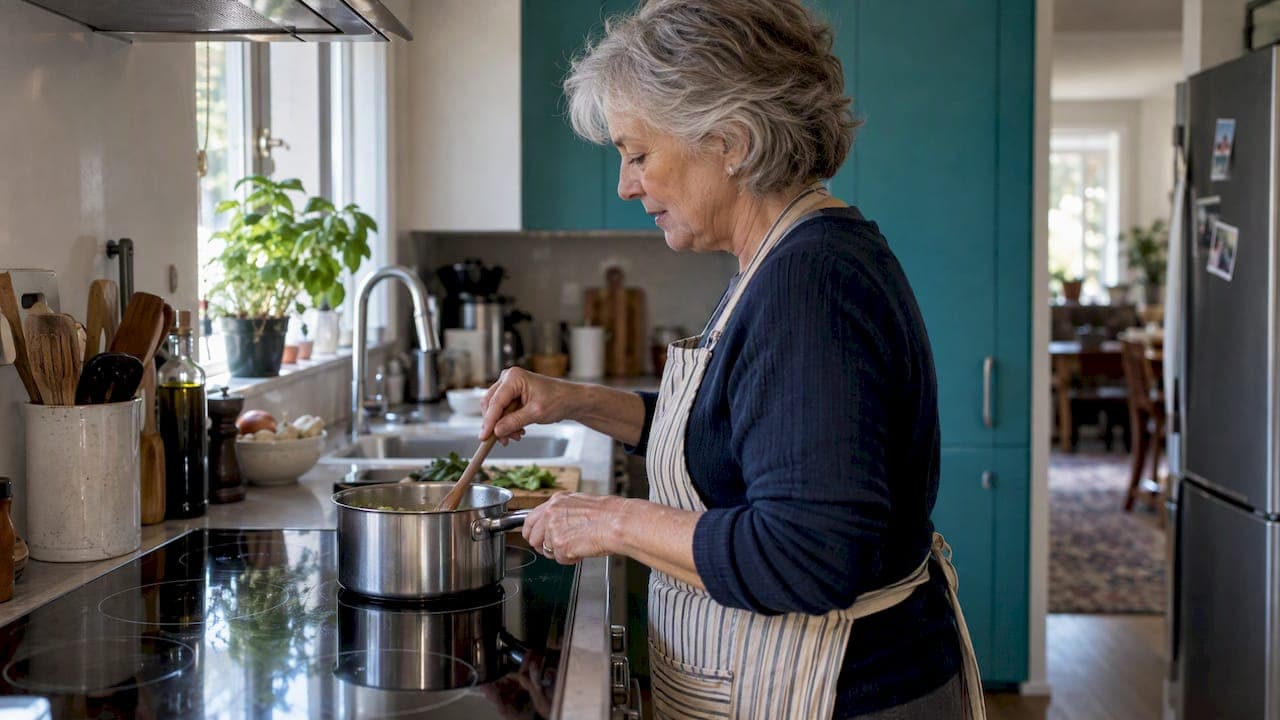
It is 6:40 on a Tuesday evening. You are halfway through a good pot of soup when the phone rings. It is your friend from the book group, and she wants to talk about Saturday. You stay on for twenty minutes, laughing. Then, somewhere in the middle of the conversation, a small voice asks: did I turn the burner off?
If you cook for one, you know that voice. It does not mean you are careless. It means you are the only person in the house, and you take that seriously. The good news is that an induction cooktop answers that voice better than any other kind of stove. It heats the pan, not the glass, and it stops when the pan leaves. It is not magic, though, and a few things are worth knowing before you love it.
This guide covers how induction safety really works, what still gets hot, which risks remain, and how to set one up so the kitchen feels like yours again.
TL;DR
- An induction burner only heats when a compatible pan sits on it. Turn it on with no pot and it will not heat up, and lifting the pan stops the heating.
- The glass is not always cool. It warms from the hot pan, so give any spot that just held a pot a little respect.
- No flame and no gas combustion means no open fire and none of the nitrogen oxides a gas burner puts into your air.
- Unattended cooking is still the main cause of kitchen fires on any stove, so stay in the room when you are frying.
- Have an electrician check your wiring before installing. It is usually a short, affordable visit.
Table of Contents
- Why induction feels different when you live alone
- What happens when you walk away from the pan
- What still gets hot
- Risks that induction does not remove
- Do your pans work? The magnet test
- The electrical side: ask before you install
- Induction, gas, and the air you breathe
- A quick comparison
- Our perspective: a solo kitchen should feel like yours
- Bringing the joy back to cooking for one
- If you are weighing a bigger kitchen decision
- FAQ
- Sources
Why induction feels different when you live alone
A gas flame asks something of you all the time. You watch it, you adjust it, you remember it. A traditional electric coil stays red-hot after you switch it off, so you remember that too. Over years, that quiet vigilance adds up. When you are the only one in the house, there is nobody to glance over and say, "You left that on."
Induction works differently. Beneath the glass is a coil that creates an electromagnetic field. According to the U.S. Department of Energy, that field transfers currents directly into the cookware, so the heat is created in the pan itself rather than on the surface. Take the pan away and the heating stops.
That design shift matters for how it feels. You are no longer the sole safety system. The stove takes some of the job. Many solo agers describe the change less as learning new technology and more as setting down a small weight they had carried for years.
What happens when you walk away from the pan
Here are the situations people actually worry about, and what induction does in each.
You switch on the wrong burner. Maybe you reached for the front left and hit the back right. Consumer Reports notes that induction has a built-in safety feature here: if you turn on a burner with nothing on it, it does not heat. A stray dish towel or a paper bag left on top will not catch from a glowing element, because there is no glowing element.
You lift the pan to stir or pour. The heating stops while the pan is off the glass and resumes when you set it back. That is the same detection at work, and it is why cooks find the response so quick.
You get distracted. This is the one to be honest about. Induction heats fast. The Department of Energy says it can boil water 20 to 40 percent faster than gas or radiant electric. Fast is wonderful for a cup of tea. It also means a pan of oil can get very hot, very quickly, so a twenty-minute phone call is not the moment to leave something frying.
Some models also add timers, automatic shut-off after a set period, and pan-overheat protection. Features vary by brand and price, so check what a specific model offers rather than assuming. If you are shopping, those are the features worth asking about.

What still gets hot
This is the part most articles skip. Many people assume an induction surface stays cool everywhere. It does not.
The glass warms through contact with the hot pan. Consumer Reports explains that it stays much cooler than a radiant electric cooktop, and it will not burn you if you touch an active but empty burner. Still, the spot where a hot pot just sat can burn you.
Most cooktops show a residual heat light for this reason. Learn to read it. A simple habit works well: when you finish cooking, glance at that light before you wipe down or set anything on the glass.

The pan itself, of course, gets as hot as any pan. Handles, lids and steam are the same as ever. Use sturdy oven mitts and keep pan handles turned inward.
Risks that induction does not remove
Induction is safer, not safe from everything. A few honest points:
- Unattended cooking. The National Fire Protection Association reports that cooking caused an average of 158,400 reported home fires per year, and that unattended cooking was the leading contributing factor. That is true whatever your stove runs on.
- Cooking oil. Oil can ignite if it overheats, and induction gets it there fast. Heat it gradually, stay close, and keep a lid nearby to slide over a pan if it flares.
- Loose fabric and clutter. The Consumer Product Safety Commission's cooking guidance is a good refresher on keeping things that can burn away from the cooking area. A heat-free burner does not make a pile of paper towels a good neighbor for a hot pan.
- Hot pans on a warm surface. A pan that just came off the heat will still warm a towel set beneath it.
One gentle idea that fits most kitchens: pick a spot for your phone that is in the kitchen. If you take a call while cooking, take it there. A small timer on your wrist or the counter does the rest. That is it. No system needed, just a kitchen where your attention naturally stays close.
For more on keeping your kitchen comfortable as the years go by, our piece on kitchen safety habits that keep solo agers cooking independently goes further.
Do your pans work? The magnet test
Induction needs cookware that a magnet will stick to. You do not necessarily need a new set. Consumer Reports suggests taking any kitchen magnet and holding it to the bottom of a pot. If it sticks firmly, the pot will work. Cast iron and many stainless steel pieces pass. Aluminum and copper pots alone, and glass, do not.
Two practical notes for comfort and safety:
- Weight. Heavy cast iron is wonderful but can be hard on wrists. If lifting a full Dutch oven makes you wince, a lighter stainless pan with a magnetic base is a kinder choice, and it is worth testing in a store.
- Fit. A pan that is close to the size of the burner heats well and sits steadily. A tiny pan on a big zone, or a warped bottom, can wobble.
That little magnet test is also a nice excuse to stand in your kitchen, open every cupboard, and rediscover which pans you love.
The electrical side: ask before you install
This is the one place where I would say "get a professional," without hedging.
If you are swapping a gas range for induction, Consumer Reports describes the need for a high-amperage circuit, 40 or 50 amps at 240 volts, with a four-prong outlet and thick wire. The cost depends on your panel. Their reporting puts a basic wiring adjustment in the range of $50 to $100, and a service upgrade to 200 amps at roughly $750 to $2,000, varying by region and home. Costs differ widely, so get a local quote.
Even if you already have a 240-volt outlet for an old electric range, do not assume it is ready. Older homes with 60- or 100-amp panels may need a load calculation. Skipping it can mean tripped breakers or worse. One visit from a licensed electrician settles the question.
If you are remodeling anyway, thinking through where outlets and circuits go before walls are closed saves rework. This kitchen outlet planning guide explains the logic well, even though the contractor behind it works in a different country.
A practical tip for solo agers: ask the electrician to look at the whole kitchen while they are there. Is the lighting over the stove bright enough? Are outlets reachable without stretching? Good lighting is a safety feature you will use every day.
Induction, gas, and the air you breathe
Safety is not only about burns and fires. Gas burners release combustion byproducts into your home. Consumer Reports notes that induction eliminates the nitrogen oxides tied to gas stoves, and unlike gas it does not depend on a range hood to manage those emissions. If you spend a lot of time at home, as many of us do, that is a real comfort.
If you stay with gas for now, ventilate every time and read more about gas stove indoor air and how exposure can be reduced. And if you keep any fuel-burning appliance, a working carbon monoxide detector is non-negotiable. Our guide to carbon monoxide detector placement for solo agers shows where they belong.
A quick comparison
| Induction | Gas | Radiant electric | |
|---|---|---|---|
| Open flame | No | Yes | No |
| Heats with no pan present | No | Yes | Yes |
| Surface stays hot after cooking | Warm, from the pan | Grates hot | Very hot, for a while |
| Combustion emissions in the home | None | Yes | None |
| Needs magnetic cookware | Yes | No | No |
| Wiring | 240 V circuit, check first | Gas line | 240 V circuit |
The table comes with a caveat: any stove can cause a fire if you leave it alone with hot oil. Induction removes several of the quiet hazards. It does not replace your attention.
Our perspective: a solo kitchen should feel like yours
We write this from the point of view of people who live alone, and who hear from many others who do. Here is what we have noticed.
The kitchen is where independence is most visible and most tested. It is also where it is most enjoyed: the Sunday roast for one, the eggs on a slow morning, the soup you make for a neighbor. When people start to feel unsure at the stove, they often stop cooking real food. They turn to cold sandwiches and takeout, and a little joy leaves the day.
We do not think the answer is to cook less. We think the answer is to make the kitchen work with you. For many solo agers, induction does that. It takes the nagging question off the table, so you can enjoy the cooking, the phone call, the garden visit, and the evening.
We also think tools are best chosen calmly, on your own timeline, and not out of fear. You do not need to replace a stove that works well for you today. But if you are redoing a kitchen, or you have noticed yourself doubling back to check the burner, it is a good moment to look. Our broader view of technology and solo aging safety is the same: choose what supports a life you love, and skip what does not.
— Mike Crawford
Bringing the joy back to cooking for one
Once the worry fades, something nice happens. You start cooking again, and not only out of necessity.
- Try the thing you stopped making because it was "too much for one." Induction's quick, controllable heat suits a small pan of risotto or a perfect omelet.
- Invite someone over. A stove you trust makes a casual dinner for two feel easy. Cooking together is one of the oldest ways to make a friend.
- Make tea with the same quiet pleasure you would give a guest. A kettle on an induction burner boils fast, and it is about the nicest small ritual there is.
- Cook a big batch on a Sunday, and share a container with the neighbor down the hall.
A solo life can be a full one, and a good meal, made with confidence, on a stove that has your back, is part of that.
If you are weighing a bigger kitchen decision
Sometimes a stove question is really a larger one: Is this home still right for me? What if I need help someday? Who would I call? Those are good questions and they deserve a calm, unhurried conversation.
That is what a Solo Aging Clarity Session is for. It is a 45-minute Zoom conversation for $97, built around your own situation as someone living on your own terms. You bring the questions, kitchen included, and leave with a clearer sense of what to do next and what can wait.
FAQ
Are induction cooktops safe for older adults living alone?
They are generally considered one of the safer options, mainly because they only heat when a compatible pan is present and stop when it is removed. The glass can still get warm from a hot pan, and unattended frying is still a fire risk. Staying in the room while you cook matters on any stove.
Do induction cooktops emit harmful radiation?
They create a localized electromagnetic field to heat cookware, and it is strongest right at the surface. If you have a pacemaker or other implanted medical device, ask your cardiologist or the device manufacturer before using one, and follow the guidance in your device manual. We are not able to give medical advice, and that conversation is worth having.
Do induction stoves need special wiring?
Yes, usually. Most need a dedicated 240-volt circuit, often 40 or 50 amps, and some homes need a panel upgrade. Consumer Reports recommends having an electrician confirm what your home needs. Do this before you buy, not after.
Do I have to replace all my pots and pans?
Not necessarily. Hold a magnet to the bottom of each pan. If it sticks firmly, the pan works. Many people find they already own several pieces that pass.
Can an induction cooktop still cause a fire?
Yes, though the risk is lower than with open flame or hot coils. Oil that overheats, or flammable items left near a hot pan, can still ignite. Keep towels and paper away, heat oil gradually, and stay nearby while you cook.
Sources
- Making the Switch to Induction Stoves or Cooktops, U.S. Department of Energy
- Pros and Cons of Induction Cooktops and Ranges, Consumer Reports
- CR's Complete Guide to Induction Cooking, Consumer Reports
- Change Gas Stove to an Induction Range, Consumer Reports
- Home Cooking Fires, National Fire Protection Association
- Recipe for Safer Cooking, U.S. Consumer Product Safety Commission