

The most effective scam prevention plan for seniors comes down to three moves: naming a trusted contact at your bank, turning on account alerts, and building a personal pause before any money moves. In the next two days, do two things. Call your bank or brokerage and add a trusted contact to your accounts, and turn on transaction alerts for anything over a set dollar amount. Those two steps close the gap scammers count on: silence and speed.
TL;DR:
- Adding a trusted contact at your bank and enabling transaction alerts over set amounts can significantly delay scammer access and raise early warnings of fraud.
- Implementing a pause-and-verify step, such as waiting 24 hours before transferring money after a suspicious call, is a simple yet powerful safeguard.
- Requiring verification for large wire transfers and using reversible payment methods like credit cards reduces scammers' ability to steal funds irreversibly.
- Regularly reviewing bank and credit statements, ideally with a trusted person, helps detect unauthorized activity early before losses escalate.
- Educating oneself with ongoing scam awareness resources and involving family or caregivers in a clear, pre-planned way enhances overall financial safety.
Table of Contents
- What a Scam Prevention Plan for Seniors Needs to Cover
- Red Flags and the Psychology Scammers Exploit
- A Practical Prevention Plan Checklist Solo Agers Can Implement
- Bank, Account, and Credit Protections to Set Up Now
- If You or a Loved One Has Been Scammed
- Trusted Resources and Hotlines to Bookmark
- Education and Awareness Training Built for Seniors
- Bringing Family and Caregivers Into the Plan
- Legal Protections and Power of Attorney Considerations
- Watching Your Statements and Credit Reports
- Author Perspective: A Calm, Human Example for Solo Agers
- Aging Solo Resources for Your Scam Prevention Plan
- Sources
- FAQ
What a Scam Prevention Plan for Seniors Needs to Cover
Scammers don't need to be clever. They need you to feel rushed, embarrassed, or alone in the moment. A workable scam prevention plan for seniors removes those three conditions, and it does it with a short list of habits rather than a stack of new software.
The most common approaches follow a pattern:
- Government impersonation — a caller claims to be from the IRS, Social Security, or Medicare and threatens arrest or benefit loss unless you pay immediately, usually by phone.
- Tech support scams — a pop-up or unsolicited call warns your computer is infected and asks for remote access or payment to "fix" it.
- Grandparent or relative impostor scams — a caller or texter claims to be a grandchild in jail or a hospital, pleading for secrecy and quick cash.
- Romance scams — a new online contact builds a relationship over weeks, then asks for money for an emergency, travel, or an "investment."
- Investment and crypto schemes — a contact (often via social media or a dating app) promises guaranteed high returns on a crypto platform.
- Gift card and wire-transfer requests — any legitimate agency asking you to pay in gift cards or wire funds is a scam, full stop.
- Charity and home-repair scams — a door-to-door contractor or a caller soliciting for a disaster relief fund pressures for cash or a deposit before work begins.
Phishing and spoofed calls or texts were the single most common fraud type reported by older adults in 2025, accounting for more than 48,000 complaints, or over 24% of all senior-related fraud claims. Investment and crypto schemes, along with government impersonation, tend to produce the largest individual losses because victims are coached to move large sums quickly.
Red Flags and the Psychology Scammers Exploit
Every scam that succeeds relies on the same emotional lever: urgency. A caller who says "act now or lose your benefits" is trying to short-circuit the part of your brain that would normally pause and think. Secrecy is the second lever. If someone tells you not to mention this to family, that instruction is itself the warning sign.
Watch for these signals:
- Pressure to act within minutes or hours, with no time to "check with anyone."
- A request to keep the situation secret from family, friends, or your bank.
- Insistence on gift cards, wire transfers, or cryptocurrency, since none of those can be reversed.
- A sudden request to switch from a phone call to text or an app like WhatsApp.
- Anyone claiming to represent a government agency who threatens immediate arrest.
Shame is often the real accomplice here, not the scammer's script. Many people quietly believe "I'm too smart to fall for this," and that belief is exactly what keeps them from asking someone else to look at a suspicious message. Experts who study these tactics point out that professional service reps are trained to reassure you, while criminals are trained to create anxiety and urgency on purpose because a calm, unhurried person is much harder to con.
Pro Tip: Keep a small card near your phone with one sentence written on it: "I don't make financial decisions on the spot. I'll call you back." Reading it out loud in the moment works better than trying to remember it.
A Practical Prevention Plan Checklist Solo Agers Can Implement
If you live alone, your plan needs to work without anyone else in the house to catch a mistake before it happens. That's not a weakness. It just means the plan has to be a little more deliberate.
- Set a trusted contact with your bank and brokerage. Call the customer service line and ask specifically to "add a trusted contact person" to your accounts. This person can be contacted if the bank suspects exploitation, and CFPB guidance identifies this as one of the most durable protections available to older account holders.
- Turn on account alerts. Set a threshold, say $200 or $500, so you get a text or email any time a transaction crosses it. Add a daily balance alert too, so a drained account gets noticed within hours, not weeks.
- Limit how money can leave your accounts. Ask your bank about requiring a phone verification or a delay on outgoing wires above a certain amount. This one step blocks the single fastest way scammers empty an account.
- Choose reversible payment methods. Pay with a credit card when possible. Gift cards, wire transfers, and crypto payments can't be undone once sent, while credit card charges and ACH transfers usually carry dispute rights.
- Block robocalls and verify independently. Use your carrier's call-blocking feature, and never trust caller ID alone. If a call claims to be your bank, hang up and dial the number printed on your card.
- Use a pause-and-verify script. End the call, look up the organization's number yourself, and wait 24 hours before moving any money. This three-step habit is one of the simplest, most effective defenses available.
- Share the plan with one trusted person. Send them a short message: "If I ever call you sounding panicked about money, ask me to hang up and call you back on this number."
- Build a weekly check-in. A five-minute call with a friend or neighbor, even just to talk about the week, keeps you connected to someone who'd notice if something felt off.
Pro Tip: One small habit, like a daily account-alert email plus a weekly call with one trusted person, does more to lower your risk than a dozen scattered precautions ever will.
The Living Alone Financial Safety Checklist walks through each of these steps in order, so you're not trying to hold the whole plan in your head at once.
Bank, Account, and Credit Protections to Set Up Now
Your bank can do more for you than most people realize, but only if you ask.
- A trusted contact lets the bank reach someone you name if they see unusual activity. It does not give that person access to your money or account details.
- Ask specifically for alerts on foreign transactions, transfers over a set dollar amount, and daily balance changes.
- Request that any outgoing wire above a certain threshold require a callback verification. Most banks will set this up on request, though it's rarely offered automatically.
- Consider a credit freeze through Equifax, Experian, and TransUnion, which blocks new accounts from being opened in your name. A fraud alert is lighter weight and easier to lift temporarily if you're actively applying for credit.
If You or a Loved One Has Been Scammed
Speed matters here more than almost anything else.
- Call your bank or credit card company immediately to stop or reverse the payment if possible, and change your online banking password.
- Change passwords on your email and any account the scammer may have touched, and turn on two-factor authentication where you can.
- Report the scam to the FBI's Internet Crime Complaint Center (IC3) and file a complaint with the FTC at reportfraud.ftc.gov.
- Call the National Elder Fraud Hotline at 833-372-8311, and contact your state attorney general's consumer protection office.
- Write down everything you remember: dates, times, phone numbers, what was said, and screenshots of texts or emails.
- Call local police if you're dealing with an in-person scam, a threat, or theft from your home; use federal channels for phone, online, or financial fraud.
Reporting matters even when the money feels gone for good. Investigators use every report to map active scam networks and stop them before they reach the next victim.
Trusted Resources and Hotlines to Bookmark
Save these before you need them, not after.
- IC3 (ic3.gov) for reporting any internet-based fraud to the FBI.
- FTC's reportfraud.ftc.gov for filing a consumer complaint that feeds national fraud databases.
- National Elder Fraud Hotline (833-372-8311) staffed specifically for older adults and their families.
- CFPB's consumer guides for plain-language advice on trusted contacts and financial exploitation.
- FDIC's Money Smart for Older Adults, a free curriculum with printable modules built for seniors and their caregivers.
- AARP's Fraud Watch Network for ongoing scam alerts and a free helpline.
Print the phone numbers and tape them near your phone. In a stressful moment, scrolling through a search engine wastes exactly the time you need.
Education and Awareness Training Built for Seniors
Scam education works best when it's ongoing, not a one-time pamphlet you read once and forget. Community centers, senior centers, and public libraries across the country regularly host free workshops through local Area Agencies on Aging, often in partnership with AARP chapters or state consumer protection offices. These sessions typically run an hour and use real, recent examples, which matters because scam scripts shift constantly.
The FDIC's Money Smart for Older Adults curriculum offers something more self-paced: printable modules covering identity theft, financial exploitation, and healthcare fraud that you can work through at your own speed, alone or with a caregiver. It's free, doesn't require registration, and was designed specifically for people outside a classroom setting.
Online options fill the gap for anyone who prefers learning at home. Short video series from AARP's Fraud Watch Network cover specific scam types in five or ten minutes rather than demanding a long class commitment. For people who learn better with paper in hand, printed guides from the National Institute on Aging break down common scam categories in large, readable print, which some people simply prefer over a screen.
None of this needs to happen all at once. A short session every few months, especially after you hear about a new scam type in the news, keeps your awareness current without turning fraud prevention into a chore.
Bringing Family and Caregivers Into the Plan
A scam prevention plan works better with a second set of eyes, and that doesn't mean giving up your independence. It means choosing, on your own terms, who gets a heads-up if something looks wrong.
Start with a direct conversation rather than a surprise. Tell your adult child, sibling, or close friend exactly what role you want them to play: "If my bank calls you about my account, please call me first before doing anything." That sentence alone prevents most of the confusion that happens when family members find out about a trusted-contact arrangement after the fact.
Caregivers and family members can also help spot patterns a single person might miss, like a string of small withdrawals or a new "friend" who suddenly needs money, highlighting the importance of mental-health support in safeguarding wellbeing. But this only works if the conversation happens before a crisis, not during one. Consider setting a recurring reminder, maybe every six months, to review the plan together: Is the trusted contact still the right person? Are the alert thresholds still accurate? Has anything changed?
For solo agers without nearby family, this role can go to a close friend, a neighbor, or even a fee-based professional fiduciary. What matters isn't the relationship label. It's that one person outside your own head knows the plan exists and has agreed to help you check something before money moves.
Legal Protections and Power of Attorney Considerations
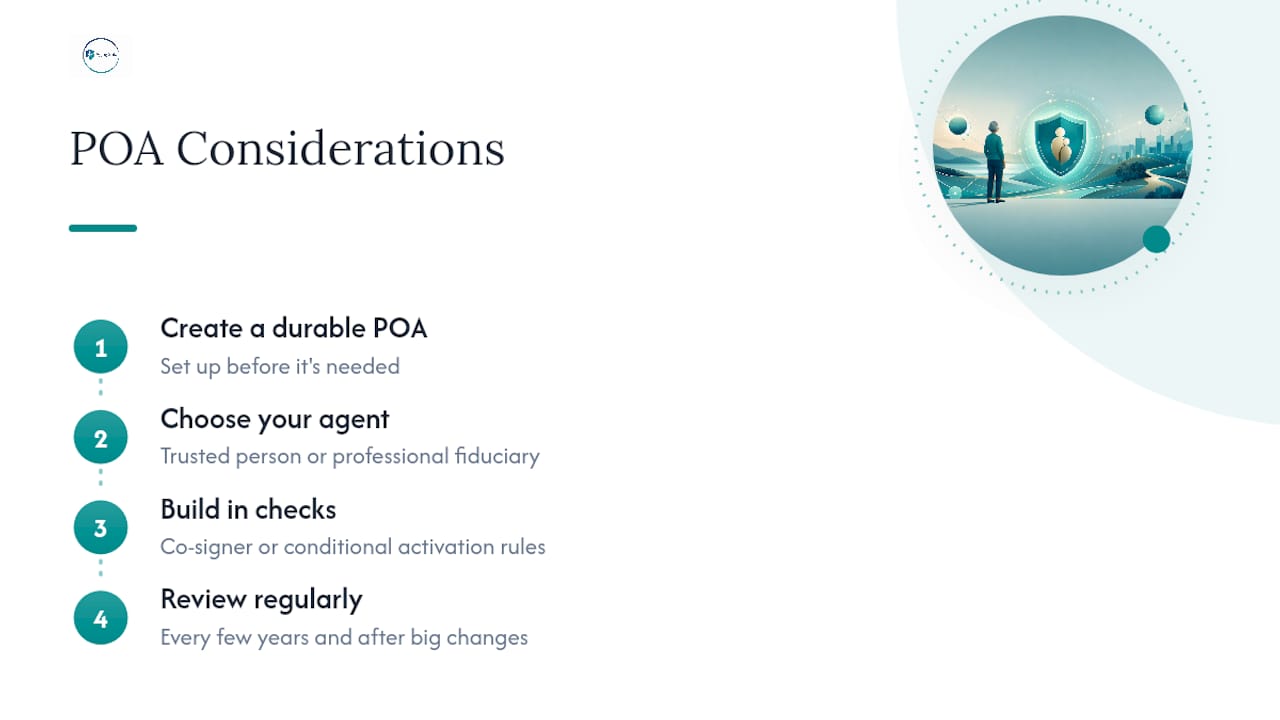
A durable power of attorney lets someone you choose step in and manage your finances if you're ever unable to, and setting one up before it's needed is far safer than doing it under pressure. Without one in place, a court may have to appoint a guardian, a process that's slower, more expensive, and gives you far less say over who ends up in charge.
Choose your agent carefully. This person will have real authority over your accounts, so the relationship needs to be built on trust that's been tested over time, not just convenience. Many people name a family member, but a professional fiduciary or elder law attorney can serve this role too, especially for solo agers without a natural first choice.
Build in checks even with someone you trust completely. Some elder law attorneys recommend requiring a co-signer on transactions above a certain amount, or setting the power of attorney to activate only under specific conditions rather than immediately. These aren't signs of distrust. They're just good structure, the same way a company requires two approvals for a large purchase.
Review the document every few years, and definitely after any major life change, a move, a new diagnosis, or a falling out with the person named. A power of attorney drafted a decade ago may no longer reflect who you'd actually want managing your affairs today. Legal and financial planning tools built specifically for solo agers navigating these decisions can help you think through the right structure before you ever need it.
Watching Your Statements and Credit Reports
Fraud almost always leaves a trail before it becomes a crisis, but only if someone is actually looking. A single unfamiliar charge on a statement, caught within days, is a minor annoyance. The same charge, ignored for three months, can become a pattern that's much harder to unwind.
Set a standing habit: review bank and credit card statements at least monthly, and pull your free credit report from each of the three major bureaus on a rotating basis so you're checking one every four months instead of all three at once. Look specifically for accounts you didn't open, addresses you didn't provide, and hard inquiries you don't recognize.
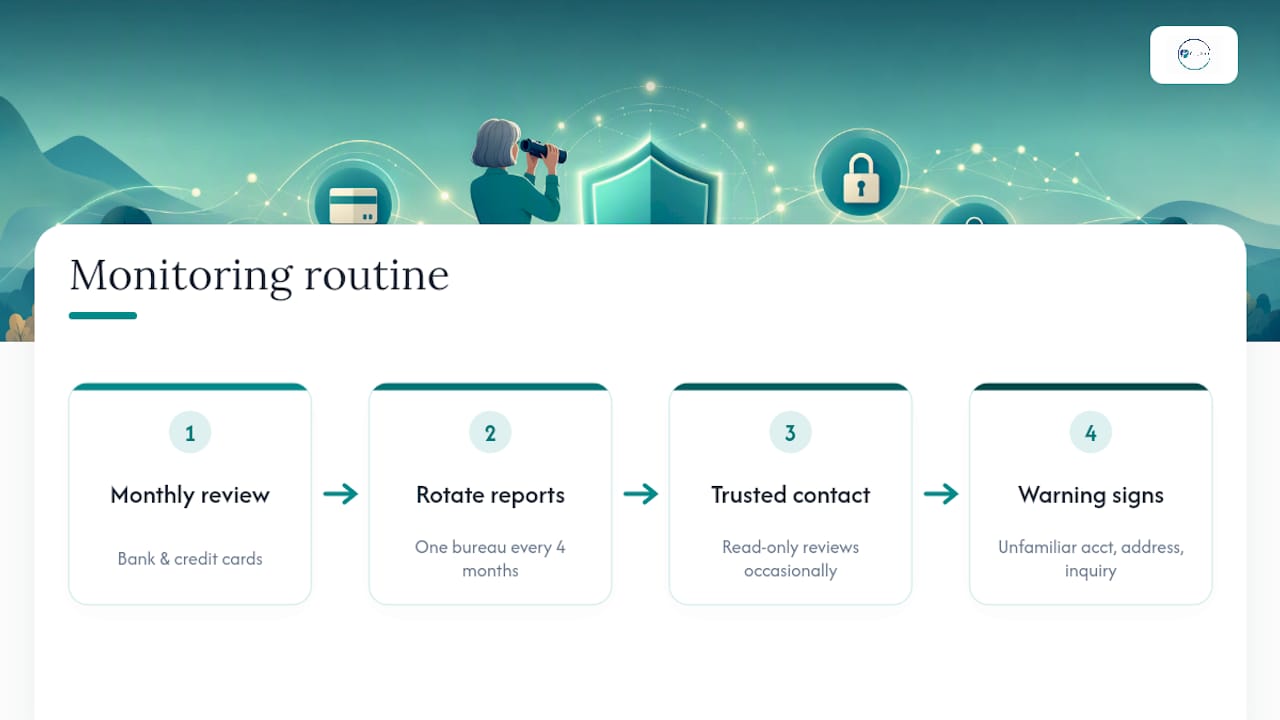
If you've set up a trusted contact, consider giving that person limited, read-only access to review statements alongside you every so often, not to take over, but to add a second perspective. A fresh set of eyes catches things familiarity makes easy to skip past. This doesn't require handing over control of anything. It's simply asking someone to look with you once in a while.
Author Perspective: A Calm, Human Example for Solo Agers
A call came in claiming to be my bank's fraud department, warning of "suspicious activity." Instead of answering their questions, I said, "I'll call the number on my card and call you right back." I hung up, called the real number, and the bank had no record of any alert. That thirty-second pause was the entire defense. Living alone doesn't mean you handle every pressure test by yourself. It means you get to decide, calmly, who's in your corner before you ever need them.
— Mike
Aging Solo Resources for Your Scam Prevention Plan
Agingsolo built the free Living Alone Financial Safety Checklist to turn everything in this article into something you can actually work through, one item at a time, without needing a family member sitting next to you to do it. It maps directly to the trusted contact, alert, and pause-and-verify steps covered above, so you're not starting from a blank page.

If you'd rather talk it through with someone instead of working alone, consider a paid, one-on-one clarity session designed to provide personal support on financial safety setup. It's a good fit if you've read this far and thought, "I know what I need to do, I just want help actually doing it." You can review the checklist first and bring your questions to the session, or start with the Solo Aging Advantage guide if you want the bigger planning picture before narrowing in on fraud protection specifically. Either way, the next step is simple: download the checklist and book a session when you're ready to walk through it with someone.
This article is general information, not a substitute for advice from a qualified financial advisor. Consult a qualified financial professional about your own circumstances before acting on anything here.
Sources
- Scammers target older adult victims — FBI
- False alarm, real scam: how scammers are stealing older adults’ life savings — FTC
- Protecting older adults from fraud and financial exploitation — CFPB
- 25 ways to help you avoid scams — AARP
FAQ
Can a scammer access my bank account with my phone number?
A phone number alone typically isn't enough to access your account, but scammers can use it for "SIM swapping" or to intercept text-based verification codes, so avoid sharing codes sent to your phone with anyone who calls you unprompted.
How do you stop seniors from getting scammed?
The most effective combination is a trusted contact at your bank, active transaction alerts, and a personal pause-and-verify rule before sending any money, paired with reversible payment methods like credit cards instead of gift cards or wires.
How can you protect elderly bank accounts?
Add a trusted contact, set alerts for large or unusual transactions, request verification requirements on outgoing wires, and review statements monthly, ideally with a second trusted person checking in periodically.
How do you protect elderly parents from scam phone calls?
Help them set up call blocking through their carrier, agree on a family password or phrase for emergency requests, and reinforce a simple rule: hang up and call back using a number you looked up yourself, never one given by the caller.