

For solo agers, "village movement seniors" means something practical: the planning resources, checklists, and support structures that help you stay independent without a spouse or nearby adult children. The next move is simple. Start a compact plan built around three things: a small support network, your core legal and financial documents, and a basic emergency-readiness setup. Aging Solo's guides and checklists are built to get you moving on all three this week, not someday.
TL;DR:
- Building a support network with four to six role-specific people, started early, ensures redundancy and reduces reliance on a single helper.
- Key legal documents include a durable power of attorney, healthcare proxy, advance directive, HIPAA release, and a will or trust, with costs averaging around $20 per hour for professional help.
- Conducting simple home audits and planning transportation options prevent crises, especially when mobility or driving abilities decline.
- Fewer gadgets and a one-page medical summary, shared with trusted contacts, form an effective safety system paired with a human backup.
- Starting small with one relationship and one document now, using free local resources, lays the foundation for a durable, layered personal support system.
Table of Contents
- Building a Village Movement Seniors Can Actually Rely On
- Legal and Financial Essentials Every Solo Ager Needs Now
- Home, Daily Living, and Transportation: Staying Independent on Your Terms
- Technology and Emergency Readiness That Actually Works
- How Aging Solo Helps You Build This Plan
- What Is the Village Movement, and Why Does It Matter for Solo Agers?
- How Do Costs and Expectations Work in Support Networks?
- What Do Strong Solo-Ager Support Systems Look Like in Practice?
- Getting Started: Your First Moves This Month
- What Actually Keeps Solo Agers Connected
- If You Want Help Now: Aging Solo's Quick Supports
- Sources
- FAQ
Building a Village Movement Seniors Can Actually Rely On
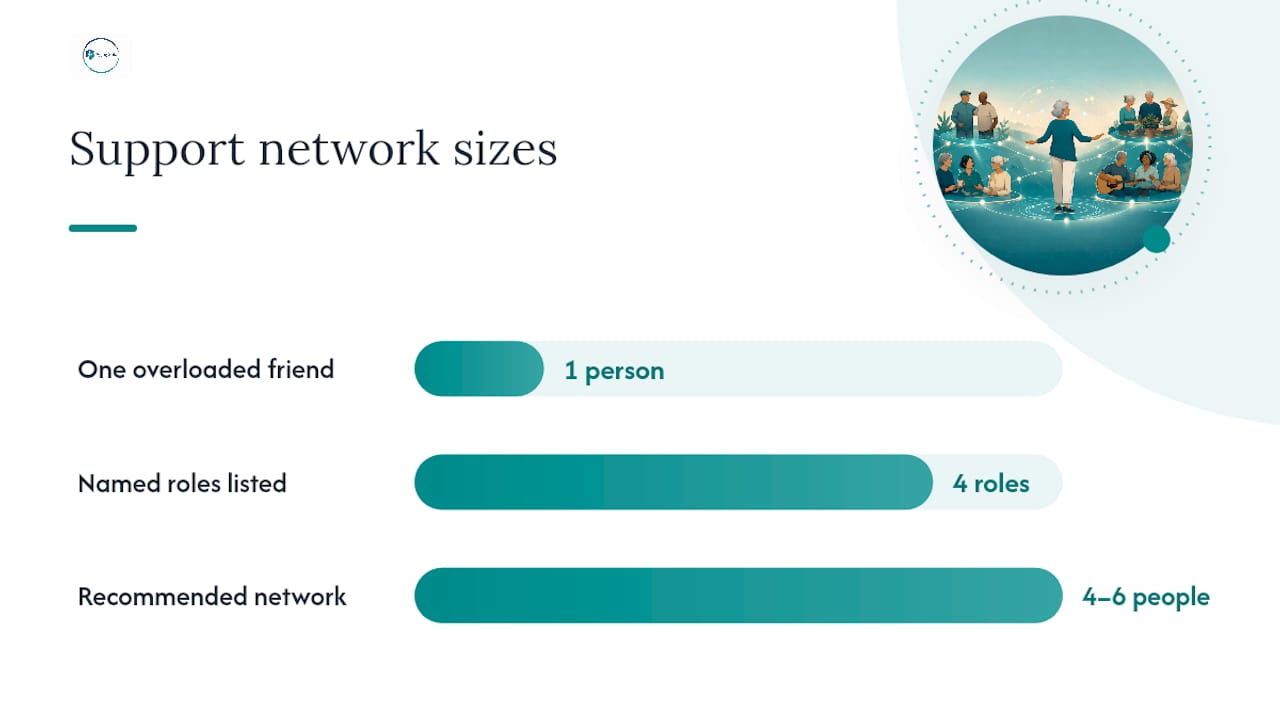
A support network doesn't have to be large to work; it has to be intentional. Most solo agers do best with four to six people who each know their specific role, rather than one overloaded friend trying to do everything.
Friendship takes real time to build, and that's worth knowing upfront so you don't get discouraged. Research cited by AARP suggests that building a friendship takes significant time investment, so starting early is important. That's not a reason to wait. It's a reason to start now and stay consistent.
A role-based structure removes the guesswork. According to guidance from Aging Solo, naming roles explicitly, rather than assuming someone will "figure it out," reduces confusion when something actually happens. Consider assigning:
- An emergency contact who gets the first call
- A healthcare advocate who can ask doctors hard questions
- A money manager who reviews bills and spots problems early
- A daily or weekly helper for errands and check-ins
To meet people who could fill these roles, try volunteering at a food pantry, joining a walking group, taking a class at a community college, or showing up regularly at a faith organization or senior center. Meetup groups work well for interest-based connections. Once someone's role is clear, formalize it. A short written agreement, a paid arrangement for regular tasks, or a swap system (you handle their mail while traveling, they handle yours) all work. For anything requiring real expertise, hire a professional and check credentials through your local Area Agency on Aging.
Pro Tip: Don't wait for a "big ask." Invite someone to a standing Tuesday coffee first. Roles tend to emerge naturally once the relationship has a rhythm.
Legal and Financial Essentials Every Solo Ager Needs Now
Without a spouse or adult child to step in automatically, your legal paperwork is what keeps decisions in your own hands instead of a court's. Five documents matter most:
- Durable power of attorney (finance) — names someone to manage money and pay bills if you can't.
- Health care proxy — names someone to make medical decisions on your behalf.
- Advance directive or living will — spells out your treatment wishes in writing.
- HIPAA release — lets your chosen people actually get information from doctors.
- Will or trust — directs what happens to your belongings and assets.
If you don't have family to name as your agent, you have real options. Elder-law attorneys, professional fiduciaries, and geriatric care managers can serve in these roles for a fee. Verify credentials through your state bar association or the National Academy of Elder Law Attorneys before signing anything.
Budget matters here too. Independent home-based help averages around $20 an hour in broad national estimates, though rates vary significantly by region, according to a Society of Actuaries survey report. Planning for this cost now, while you're not under pressure, gives you far more control than scrambling for it during a crisis.
Pro Tip: Store copies of every document with your healthcare advocate, your attorney, and one backup person. Three copies beats one perfect original nobody can find.
Home, Daily Living, and Transportation: Staying Independent on Your Terms
A quick home audit beats a major renovation. Start with lighting in hallways and bathrooms, grab bars near the tub and toilet, and clearing loose rugs that catch feet. If stairs are becoming a strain, think about how much of your daily life could shift to a single floor, even if that just means moving your bedroom.
For housekeeping and yard work, you don't need to do it all yourself or hire full-time help. Many communities have volunteer programs through senior centers, or you can find vetted help through your Area Agency on Aging.
Transportation planning matters more than most people expect, especially once driving becomes harder or stops. Worth exploring:
- Public transit routes and senior discount passes
- Volunteer driver programs through local nonprofits
- Paratransit services for door-to-door rides
- A monthly rideshare budget as a backup, not a default
If your home requires stairs you can no longer manage safely, or transportation options in your area are genuinely limited, that's a signal to research housing alternatives before it becomes urgent, not after. A detailed home-safety checklist can help you prioritize what to fix first, and transportation planning resources walk through options by region and mobility level.
Technology and Emergency Readiness That Actually Works
The goal isn't more gadgets. It's fewer gaps. A reliable medical alert device, a shared calendar with your emergency contact, medication reminders, and one simple smart speaker for voice-activated calls cover most of what you actually need.
When choosing a medical alert system, look for fall detection, a battery that lasts through a power outage, and a monitoring center that speaks clearly to your specific health situation. Tell your emergency contacts exactly what the device does and doesn't do, so nobody assumes it calls 911 automatically if it doesn't.
Two low-tech tools matter just as much:
- A one-page medical summary with medications, allergies, and your doctors' names, kept somewhere visible
- A simple, secured password list so someone can access accounts if needed
Add a daily or every-other-day buddy check-in by text or call. It's the human backup behind the technology. On privacy, share access selectively. Give your healthcare advocate medical information and your money manager financial access. Nobody needs all of it. Simple technology paired with human backup functions as an effective safety net, according to the National Institute on Aging.
How Aging Solo Helps You Build This Plan
You don't have to build any of this from scratch. Aging Solo's Soloist's Toolkit includes downloadable checklists for exactly the steps above: support-network worksheets, legal-document trackers, and emergency-prep templates.
If you want a faster path, the 45-minute Solo Aging Clarity Session walks through your specific situation over Zoom and produces a prioritized action plan, not generic advice. It's designed for people who know they need to plan but don't know where to start first.
A realistic afternoon: pull the support-network checklist, invite one neighbor to coffee using the role-based framework above, then fill out your one-page medical summary while you're already in planning mode. That's real progress in under two hours.
What Is the Village Movement, and Why Does It Matter for Solo Agers?
You may have heard of "villages" in the context of senior living, membership-based, community-run networks where neighbors coordinate volunteer rides, small home repairs, and social events so older adults can stay in their own homes longer. That community model matters, and it reflects a broader truth solo agers already know: independence and isolation are not the same thing.
The core benefit of any village-style support system, whether it's a formal membership organization or the informal network you build yourself, is redundancy. When you have several people who each know a piece of your life (your medication schedule, your emergency contacts, your weekly routine), no single person's unavailability creates a crisis. That's the real value behind "village" thinking: distributed responsibility instead of one point of failure.
For a solo ager building a personal plan, this translates directly. Your goal isn't finding one heroic helper. It's building enough small, reliable connections that the loss or absence of any one person doesn't derail your week. A neighbor who checks in Tuesdays, a friend who handles doctor appointments, a paid helper for yard work. Each relationship covers a slice, and together they function the way a formal village network does: as a web, not a chain.
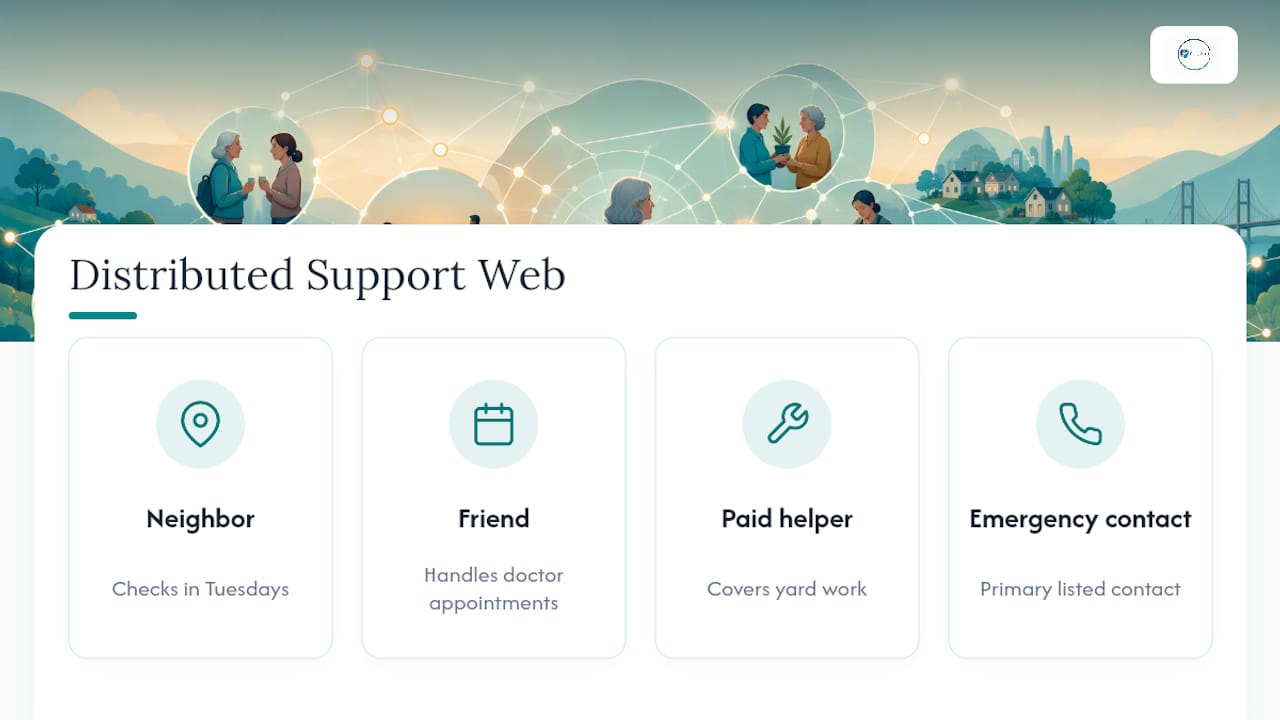
This is why Aging Solo frames planning around a role-based circle rather than a single caregiver model. It borrows the strongest idea from community village networks (shared, distributed support) and applies it at the personal level, where you control who's involved and how.
How Do Costs and Expectations Work in Support Networks?
If you're building your own version of village-style support rather than joining a formal membership organization, costs and expectations look different from what you might expect. There's no membership fee to pay. Instead, the "cost" is time and reciprocity.
Some arrangements cost nothing but attention. A neighbor who walks your dog in exchange for you watering their plants during vacations. A friend who drives you to appointments because you help with their grocery runs. These swap systems work well precisely because neither person feels like they're taking charity.
Other arrangements involve paying for reliability, especially for tasks requiring skill or consistent availability. Housekeeping, yard maintenance, or regular check-in visits from a paid companion typically run in the range cited earlier by home-care estimates, roughly $20 an hour on average, though your region will shift that number up or down.
The expectation to set clearly, whether the help is paid or reciprocal, is scope. Vague arrangements ("just call if you need anything") tend to fall apart when actually tested. Specific arrangements ("Tuesdays at 10am, thirty minutes, grocery run") hold up. Write it down, even informally. A shared note or a recurring calendar entry works fine. The goal isn't paperwork for its own sake. It's making sure both people remember what they agreed to three months from now.
What Do Strong Solo-Ager Support Systems Look Like in Practice?
The most durable networks share a pattern: they're built before they're needed, and they're layered rather than dependent on one person.
Picture a woman in her late 60s in a mid-sized city who has no children nearby. Over eighteen months, she built her circle by volunteering weekly at a library, joining a book club through her local senior center, and asking a longtime neighbor to be her emergency contact. None of these relationships started as "support network" recruitment. They grew into that role because she showed up consistently and asked for small things early, before she needed big ones.
Contrast that with someone who waits until after a health scare to start looking for help. The options are thinner, the relationships are shallower, and the paid professionals available on short notice often cost more and know less about your history.
The pattern that works isn't about finding extraordinary people. It's about layering ordinary ones: a neighbor, a volunteer group, a paid helper, a professional advocate, so that no single relationship carries the whole weight. That's the version of "village" thinking solo agers should borrow, regardless of whether a formal membership organization exists in their zip code.
Getting Started: Your First Moves This Month
Waiting for a clear sign that you "need" support is the single most common planning mistake. Many Area Agencies on Aging offer low-cost or free care management services you can use well before any disability arises, and using them early expands your options rather than signaling weakness.
Start with one relationship, not five. Pick a neighbor, a fellow volunteer, or a friend you already trust, and have one direct conversation about being your emergency contact or healthcare advocate. Most people say yes when asked clearly and specifically.
Next, get one document signed. A durable power of attorney or health care proxy takes one appointment with an attorney or, in many states, a notarized form you can complete yourself. Don't wait to have all five documents ready. Get the most urgent one done first.
Then, search your specific location using the Eldercare Locator or by calling 800-677-1116. Within a few minutes, you'll have a list of local programs, from transportation to meal delivery to volunteer visitor programs, tailored to your zip code.
Finally, revisit your plan every six months. Circumstances change, friendships deepen or shift, and health needs evolve. A support network isn't something you finish. It's something you tend.
What Actually Keeps Solo Agers Connected
I keep coming back to a conversation I imagine happening in kitchens across the country: a solo ager on the phone with an old friend, laughing about something small, feeling completely fine. Not lonely. Not waiting for rescue. Just living, on their own terms, with people woven through the week in ways that matter.
That's the piece the planning conversation often misses. Alone doesn't mean lonely, and a good plan isn't a hedge against disaster. It's the scaffolding that lets you keep showing up for the life you actually want.
Two small moves matter more than any checklist. First, invite someone into a standing routine this week, coffee, a walk, a phone call that happens the same day every week. Second, sit down for twenty minutes and write your one-page medical summary, then hand a copy to that same person. Neither move is about fear. Both are about making your independence sturdier, not smaller.
You don't need a perfect network. You need a few people who know you, and a life full enough that being alone sometimes just means having the house to yourself.
— Mike
If You Want Help Now: Aging Solo's Quick Supports
Agingsolo is the direct alternative to piecing this together alone from scattered blog posts and generic checklists. Instead of guessing which legal form or safety fix matters most, you get a plan built specifically around your situation.
The 45-minute Solo Aging Clarity Session, held over Zoom, produces a prioritized action plan covering your support network, your legal documents, and your emergency readiness, tailored to what you've already got in place and what's missing. It's a single focused conversation, not a sales pitch dressed up as advice.
If you're not ready to book yet, start with the free tools. The Soloist's Toolkit has downloadable checklists for every domain covered here. The aging-in-place guide walks through home-safety priorities room by room. And the full 2026 planning guide ties every piece together in one place.
Whichever you choose, the next step is the same: pick one document, one conversation, or one checklist, and start today.
Sources
- Aging Alone: Build a Network of Friends to Rely On | AARP
- Aging in Place: Growing Older at Home | National Institute on Aging
FAQ
What Does "Village Movement Seniors" Mean for Solo Agers?
In this context, it refers to solo-aging planning resources, guides, checklists, and support tools that help adults aging without a spouse or nearby family build a network and stay independent.
How Long Does It Take to Build a Support Network?
Real friendships take time; research cited by AARP suggests roughly 50 hours to become casual friends and about 200 hours to become close friends, so start well before you need help.
What Legal Documents Should a Solo Ager Prioritize First?
A durable power of attorney for finances and a health care proxy are the two most urgent documents, since they name someone to act if you can't.
How Much Does Paid Home Help Typically Cost?
Independent home-based help averages around $20 an hour in broad national estimates, though costs vary by region according to a Society of Actuaries survey.
Where Can I Find Local Services for Aging in Place?
The Eldercare Locator (800-677-1116) connects you to your local Area Agency on Aging, which offers transportation, meal, and care-management resources.