
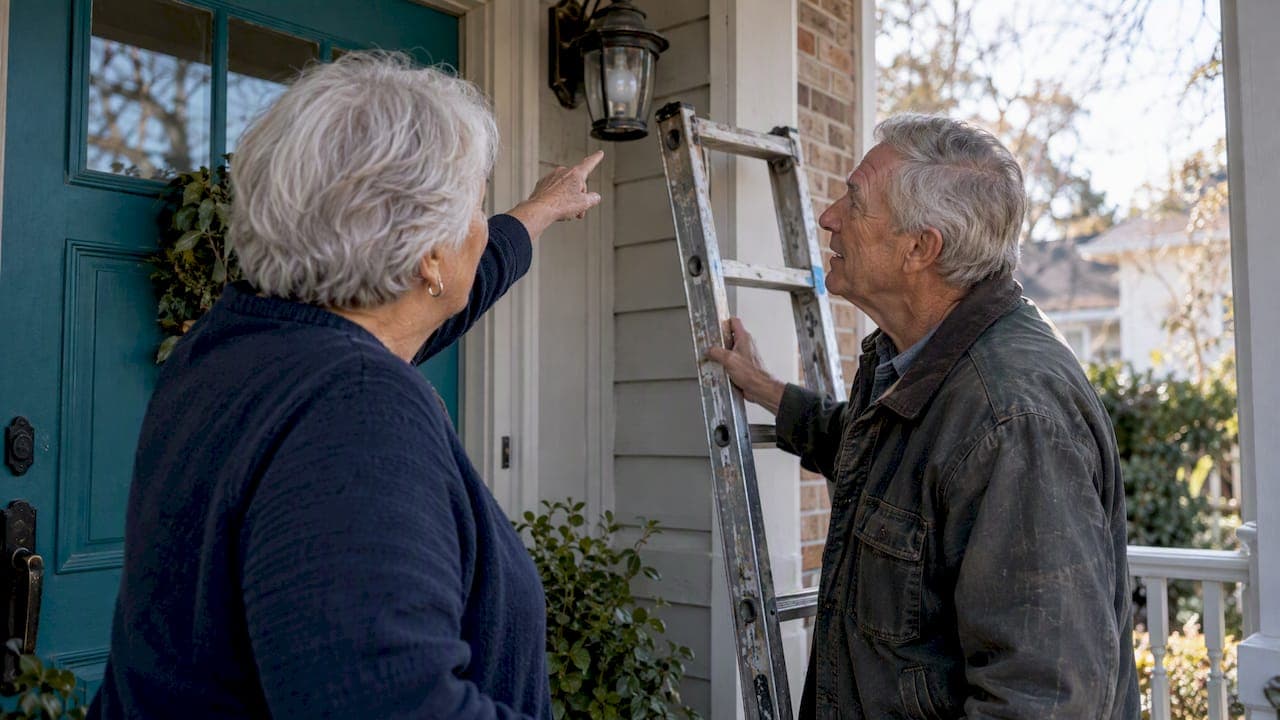
It's a Tuesday evening and the porch light has burned out. It's one of those fixtures with a cover held on by four tiny screws, and the ladder is in the back of the garage. You stand in the driveway, looking up, and you notice your neighbor across the street watering her tomatoes. You have waved at her for six years. You could not tell her your last name.
You could ask. You don't. You go inside, and the porch stays dark for another month.
If that scene feels familiar, you are in good company. Asking a neighbor for help is one of the quietest hard things about living on your own. It isn't hard because neighbors are unkind. It's hard because asking feels like admitting something, and because you've spent a lifetime being the capable one.
Here is the reframe we'd offer: a small ask is rarely a burden. More often it is an invitation. This guide is about how to extend that invitation in a way that feels natural, keeps your independence intact, and lets your street start to feel like yours.
TL;DR
- Start with a small, easy ask (a ladder, a package, a recipe), not a big favor. Small asks build the relationship that big ones need later.
- Introduce yourself first if you haven't. A name and a hello change everything.
- Make it mutual. Offering something back, even something small, turns a favor into a friendship.
- Be specific and give people an easy way to say no. Clear asks get warmer answers.
- If your street is quiet, other doors exist: neighborhood networks, community groups, and your local Area Agency on Aging.
Table of Contents
- Why asking feels so much harder than it should
- Start with a hello, not a favor
- Your first ask: small, specific, easy to say yes to
- Make it a two-way street
- When the street is quiet: other places to find your people
- Why this is worth the small awkwardness
- A gentle word on the bigger asks
- Our perspective
- Want a hand thinking it through?
- A scene to end on
- FAQ
- Sources
Why asking feels so much harder than it should
Most of us were raised to be self-sufficient. For many solo agers, that independence is a point of pride, and it has served you well. But it can quietly turn into a rule: never be the one who needs something.
There is also a very human worry underneath. We assume we will be an imposition. Researchers who study social support in older adults have noted that the inability to reciprocate can be a barrier to asking for help from family, friends, and neighbors. In other words, many of us hold back because we don't want to take more than we can give.
But consider the other side of the fence. When someone asks you to hold a ladder, how do you feel? Usually a little flattered. Trusted. Useful. The National Institute on Aging notes that helping others through volunteering can bring a sense of purpose and is linked with lower loneliness. Your neighbor isn't just doing you a favor. She may be getting something out of it too.
Alone does not mean lonely. But a street full of people you only wave at can make quiet feel heavier than you expected. Asking is one of the gentlest ways to change that.
Start with a hello, not a favor
If you don't know your neighbors yet, the first step isn't an ask at all. It's a name.
The NIA's guidance on staying connected suggests introducing yourself to neighbors and joining local groups or shared-interest activities as practical ways to build local ties. It doesn't need to be a production. Try one of these on a day when you feel okay about it:
- Walk over while they're outside and say, "I realized after all this time I never learned your name. I'm Ruth, from number 14."
- Leave a note with your first name and phone number after a storm: "Just checking you're all right."
- Bring back something small, like a plate of cookies or a few tomatoes from your own garden, when a package gets delivered to the wrong house.
That first conversation does a quiet job. It moves you from "the person in that house" to "Ruth." The next time you need a hand, you are no longer asking a stranger.
Your first ask: small, specific, easy to say yes to
The best first favor is one that takes your neighbor five minutes and makes them feel good. Think of it as a tiny trial run for both of you.
Some ideas that tend to land well:
- A little muscle. "Would you mind holding the ladder while I change the porch bulb? It'll take two minutes."
- A little local knowledge. "Do you know a plumber you trust? I'd love a name." People enjoy being asked for recommendations.
- A little borrowing. A drill, a stepladder, a cup of flour. It also gives you a reason to return it with a thank-you.
- A little watching. "I'm away this weekend. Would you mind bringing in my mail?"
Notice what they have in common. Each ask is specific, bounded, and clearly finished when it's done. Vague asks ("Could you keep an eye on me?") are harder to answer, because the other person doesn't know what they're agreeing to.
A few phrasing habits help:
- Say exactly what and how long. "Ten minutes Saturday morning" is easier to agree to than "sometime."
- Leave a graceful exit. "If it's not a good week, no worries at all." It sounds like a courtesy, and it makes a yes more genuine.
- Say thank you, and mean it. A thank-you note, a loaf of banana bread, or simply telling them later how it went. Gratitude is the glue.
And if someone says no? That's okay. It usually says more about their week than about you. Try someone else, or try again another day.
Make it a two-way street
If the idea of taking help makes you squirm, flip it. What can you offer?
You don't need to match favor for favor like a ledger. Think of it as a loose, friendly rhythm. Maybe you're the one home during the day, so you can take in packages. Maybe you bake. Maybe you have a green thumb, a good ear, or a car and a free afternoon. Maybe you're the one who remembers everyone's birthday.
A neighbor named Dolores might not need anything from you in particular. She might simply love that someone knocks on her door. This is what "mutual" really means: you each bring something, and the street gets a little warmer.
The AARP's community resource, Create the Good, describes how a neighborhood support network can organize meals, snow shoveling, rides to church or the grocery store, and neighborhood walks. Every one of those is an exchange, not a handout.

When the street is quiet: other places to find your people
Sometimes you do everything right and the block just isn't the friendly type. Maybe everyone works long hours. Maybe you're in a condo building where people nod and disappear. That doesn't mean you're stuck.
Widen what "neighbor" means
Your neighbors can be the people in your zip code who share your interests: the Thursday walking group, the garden club, the library book circle, the community center's coffee morning. If you're in Southern California, a local guide to activities and spots in the region can spark ideas for places where you'll naturally bump into the same friendly faces each week. Wherever you live, the pattern is the same: show up regularly, and familiar faces become neighbors in spirit.
We write more about this in our guide to building your circle through social connection and about the benefits of aging solo community groups.
Look for neighbor-to-neighbor networks
Some communities have organized this for you. Village organizations are member-run groups in which neighbors support one another so they can stay in their own homes. The Eldercare Locator, a public service of the Administration for Community Living, can connect you with your local Area Agency on Aging, which can tell you about programs for transportation, meals, and in-home help in your area. You can also call 1-800-677-1116.
The Village model varies from place to place, with different membership fees, activities, and services. Common supports include rides, errands, yard help, friendly visits, and small home projects. If there's one near you, it may be a very comfortable way to ask for help, because everyone has joined precisely to give and receive it.
Try a friendly visitor
The NIA also points out that some older adults who live alone simply need someone to check in. Volunteer friendly visitor and senior companion services are often available at no cost, though they are generally not covered by Medicare or private insurance if you go through a paid agency. Think of it as a hello that arrives on a schedule.
Why this is worth the small awkwardness
It isn't only about the porch light. Connection itself matters. The CDC has described social isolation and loneliness as distinct but related risks for older adults: loneliness is a feeling, while isolation is an objective lack of meaningful contact. You can be happily solo and still benefit from a few ties close to home.
The CDC's own advice for older adults on barriers to social connectedness is to name what's getting in your way and talk it through with a friend, family member, or doctor. If you notice that the quiet is starting to weigh on you, that's worth saying out loud to someone, rather than carrying alone. If it feels heavy for more than a short while, your doctor is a good person to talk to.
Our own piece on common loneliness triggers for adults 50 plus may help you name what's behind a hard stretch.
A gentle word on the bigger asks
Once you've got a friendly rapport, you may want to talk about the more serious stuff someday, such as who has a spare key or who could be called if something went wrong. It doesn't have to be a heavy conversation, and it doesn't need to happen on day one.
FEMA's guidance for older adults says preparedness shouldn't be a solo act and encourages including neighbors in your plan, ideally long before a crisis. When you've already traded porch-light favors and cookies, this talk goes easily. It becomes: "Would you be my person for a spare key? And can I be yours?" You can read how we think about that in our emergency contact plan for solo agers.
Notice the order, though. Friendship first, logistics second. The relationship is the point. The safety net is a lovely side effect.
Our perspective
We started Aging Solo Today because a solo life can be a complete one, full of friendship, adventure, purpose, and everyday joy. We've seen how often readers tell us the same thing: they are not unhappy living alone, but they dread being the person who has to ask.
Our view is that asking is a skill, and like any skill it gets easier with practice. We'd rather you practice on a lightbulb than wait until you urgently need something. A neighbor who has laughed with you over a borrowed ladder is a very different person to call than a stranger.
We also believe independence and interdependence are not opposites. Being independent doesn't mean doing everything yourself. It means choosing, on your own terms, who you lean on and who leans on you. That is what living on your own terms looks like at 55, 70, or 90.
Our guide Independence Is Not Isolation goes deeper on that idea.
— Mike Crawford
Want a hand thinking it through?
Sometimes it helps to talk it over with someone who has been there. Our founder is a solo ager himself. The Solo Aging Clarity Session is a 45-minute Zoom conversation, $97, where we help you think through your own support circle: who's already in it, who you might invite in, and how to ask in a way that feels like you. There's no pressure, and plenty of free resources are available on the site too, including our guide to building your support circle.
A scene to end on
Picture that same Tuesday evening, a few weeks on. The porch light is working. Your neighbor across the street, the one with the tomatoes, held the ladder, and you handed her a jar of your peach jam as thanks. She stayed for twenty minutes. Now she waves from across the street and calls your name.
On Saturday she's inviting you over for iced tea. You say yes. That's the real prize: not a fixed bulb, but a street where you're known.
You don't have to wait until you need something. You just have to knock.
FAQ
How do I ask a neighbor for help if I barely know them?
Start by introducing yourself and having a short, friendly chat. When you do ask, keep it small and specific, like holding a ladder or bringing in your mail for a weekend. Offer an easy way out, and follow up with a sincere thank-you.
What if my neighbor says no?
It's okay. People have busy weeks, and a no is rarely personal. Thank them for listening, then try another neighbor, a community group, or a neighbor-to-neighbor network in your area.
Is it okay to ask for help if I can't return the favor?
Yes, though you may find you can return more than you think. Baking, watching a house, sharing a recommendation, or just being friendly counts. Reciprocity doesn't have to be equal or immediate.
Where can I find help if I don't have neighbors I can ask?
The Eldercare Locator at eldercare.acl.gov or 1-800-677-1116 can connect you to your local Area Agency on Aging. They can point you to programs for transportation, meals, and home-based help. You can also look for a Village organization, a friendly visitor program, or a community group in your area.
Sources
- Loneliness and Social Isolation: Tips for Staying Connected, National Institute on Aging
- Services for Older Adults Living at Home, National Institute on Aging
- Eldercare Locator, Administration for Community Living
- Build A Caring Community Network, AARP Create the Good
- Concept Clarification and Assessment of Social Isolation and Social Support in Older Adults, ACL
- Loneliness Puts Older Adults at Risk, CDC
- Information for Older Adults, Still Going Strong, CDC
- Disaster Preparedness Guide for Older Adults, FEMA
- Neighbors Helping Neighbors: The Village Movement, Aging Wisdom