
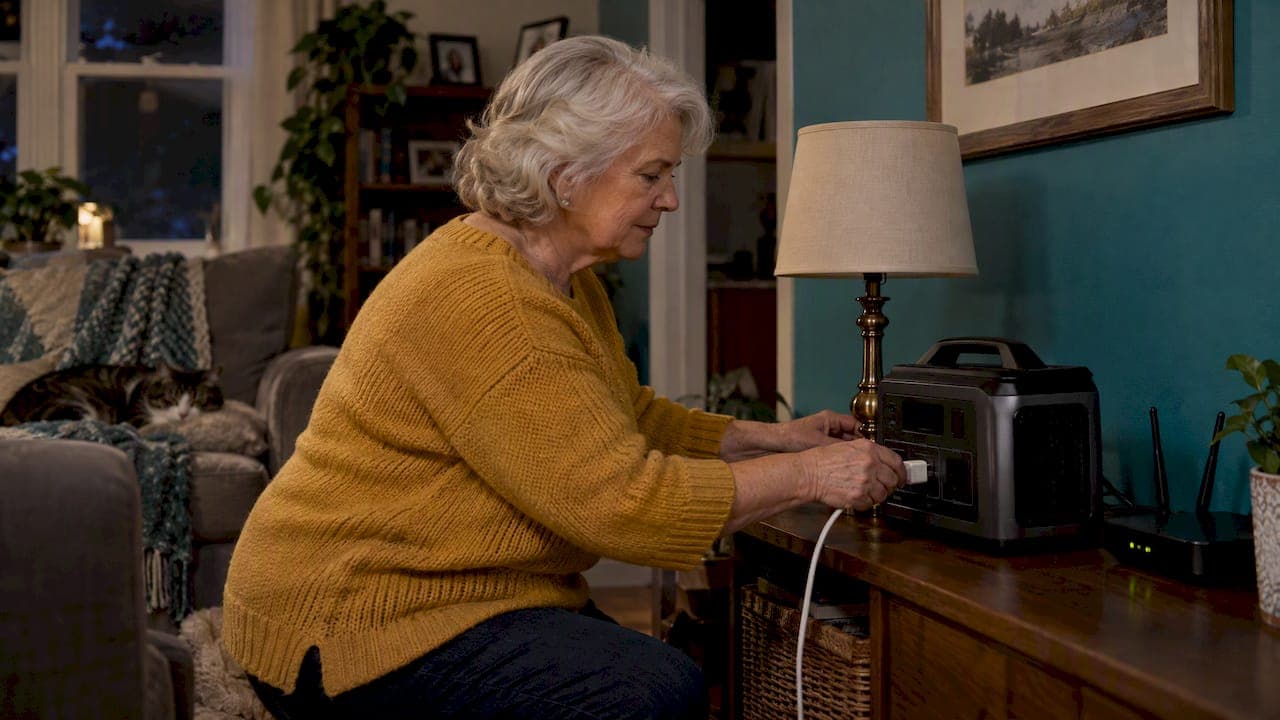
It's a Tuesday evening. Soup is warming on the stove, your friend's text about Thursday's pottery class just landed, and then the whole house goes quiet. The refrigerator stops humming. The little glow from the router disappears. You stand in the kitchen with your phone flashlight and notice something odd: it isn't scary. It's just very, very still.
That stillness is a good moment to ask what kind of backup power would suit the way you actually live. For most solo households the short answer is this: a battery (a portable power station or a home battery) is the calm, quiet choice for the typical outage, and a generator is the workhorse for long ones. Many people end up happiest with a small battery for everyday outages and a plan for the rare long one.
TL;DR
- Battery backup is silent, safe indoors, and starts instantly. It suits short outages and a handful of essentials, but it holds a finite amount of energy.
- Generators make power from fuel, so they can run for days with refueling. They are loud, must stay outdoors, and need someone to haul, fill, and start them.
- Typical prices run $500–$2,500 for portable power stations, $400–$2,000 for portable generators, and $3,500–$7,000 for standby generators before installation, according to Consumer Reports.
- Living alone changes the question. The best choice is often the one you can set up, move, and use easily by yourself, on a bad night, without help.
- Most people don't need the biggest system. Decide what you want to keep running, then size to that.
Table of Contents
- What an outage really looks like at home
- Three kinds of backup, in plain words
- What will each one actually keep running?
- The question that changes when you live alone
- Keeping the small things on: the part that feels like connection
- Our perspective
- When one of each makes sense
- Where a conversation can help
- How to choose, in the way you actually live
- Back to the quiet kitchen
- FAQ
- Sources
What an outage really looks like at home
Most outages are short. In 2024, the average U.S. residential outage lasted about 11 hours, which is an evening, a night, and a slow morning. Some storms stretch it to days, and those are the ones that shape the choice between a battery and a generator.
So it helps to picture two different nights. One is the 11-hour kind, where you'd like the lamp on, the phone charged, the Wi-Fi alive so you can video call your sister, and the refrigerator not worrying you. The other is the three-day kind after a major storm, where you may also want heat or cooling, a medical device, or a way to keep a full freezer cold.
A battery handles the first night beautifully. A generator handles the second. Knowing which night you're more likely to have, where you live, is most of the decision.
Three kinds of backup, in plain words
The names get muddy, so here is how they sort out.
Portable power stations are rechargeable battery boxes with an outlet built in. They give silent, indoor-safe power for a limited time, and then they need to be recharged. Think of the size of a small cooler or a carry-on bag.

Home batteries are bigger, permanently installed units that back up selected circuits or the whole house. Typical home-battery sizes are far larger than portable stations, roughly 5 to 30 kWh or more, and they are usually installed by an electrician, often alongside solar.
Generators burn fuel in an engine to make electricity. A portable one sits outside and you plug cords into it. A standby generator is installed beside the house and switches on automatically.
| Portable power station | Home battery | Portable generator | Standby generator | |
|---|---|---|---|---|
| Typical cost | $500–$2,500 | Installed system, quote needed | $400–$2,000 | $3,500–$7,000 before installation |
| Noise | Silent | Silent | Loud | Loud |
| Where it runs | Indoors or out | Installed on a wall | Outdoors only | Outdoors, fixed |
| Runs how long | Until empty, then recharge | Until empty, then recharge or solar | As long as you have fuel | As long as fuel supply lasts |
| Your effort in an outage | Almost none | None | Carry, fuel, start, refuel | None once installed |
The price ranges come from Consumer Reports' generator buying guide, which also notes that installing a standby unit can more than double the cost. Home battery prices vary too much by size and installer to quote a single number, so get a written quote before you decide. And if you were counting on a federal tax credit for home batteries, note that it reportedly ended on December 31, 2025, so check current incentives with your state or utility.
What will each one actually keep running?
Two numbers matter, and people mix them up. Watts tell you how much you can run at once. Watt-hours tell you how long. A system can hold plenty of stored energy and still fail to start a refrigerator or well pump if its output or surge rating is too low, as this sizing explanation lays out.
Here is what that looks like for the things most people care about.
The refrigerator and freezer
This is the big worry, and it's less urgent than it feels. Ready.gov says an unopened refrigerator keeps food cold for about four hours, and a full freezer holds for about 48 hours. If you keep the doors shut, you have breathing room.
For a mid-size power station, one independent testing roundup estimates a 1,024-Wh unit runs a typical refrigerator for roughly 8.5 to 18 hours. A larger 4,096-Wh unit stretches that to about 33 to 71 hours. The wide range exists because refrigerators cycle on and off, and a hot kitchen makes them work harder.

Lights, phone, Wi-Fi, a fan
These are small loads. A battery can run them for a long time, often through a full night with charge left over. This is where batteries shine, and where a generator is overkill.
Bigger loads
Window air conditioners, space heaters, electric stoves, and well pumps eat power fast. The Associated Press notes that fuel-powered portable generators can run refrigerators, freezers, window air conditioners, fans and televisions, typically for about 6 to 12 hours per tank, longer with a lighter load or more fuel. If heavy loads are what you need in a long outage, a generator or a large installed system is the more realistic fit.
So, can a battery-powered generator run a house? A large one can feed selected circuits through a transfer switch, but it's limited by what it has stored. Running a whole house on a portable power station isn't realistic. Running the parts of your house that matter most to you is.
The question that changes when you live alone
Most comparison articles stop at cost and runtime. If you're the only one home, there's another column worth adding: effort.
Picture a portable generator at 9 p.m. in a cold rain. Someone has to wheel it out, set it at least 20 feet from the house with the exhaust pointed away, as Consumer Reports advises, run a long cord, fill it with gasoline, and pull the start cord. Then do it again for refueling, in the dark. If you're strong, handy, and enjoy that kind of self-reliance, that's a perfectly good plan. Plenty of people do. But it's worth being honest about whether it's a plan you'll want to run alone at 2 a.m.
A power station asks for nothing like that. You press a button. The tradeoff is time: it can take hours to recharge once it's depleted, while a generator can be refueled with only a brief interruption.
A standby generator or a home battery removes the effort altogether, since both kick in on their own. They cost more and need installation, which is the price of never having to think about it.
A word on carbon monoxide
This is the one place to be firm. Never run a generator inside a home, basement, or garage, and keep it at least 20 feet from windows, doors, and vents, per the CDC. Carbon monoxide has no color or smell, and portable generators are linked to roughly 80 to 100 U.S. deaths a year. A battery-powered station, by contrast, produces no toxic fumes and can be used indoors, according to the EPA. If you choose a generator, a battery-operated CO alarm near where you sleep is a sensible companion. And don't backfeed your house through a dryer outlet; a transfer switch or interlock installed by an electrician is the safe route.
Keeping the small things on: the part that feels like connection
Here's something that surprises people. When the power goes out, what most solo agers miss first isn't the refrigerator. It's the link to other people: the phone, the tablet, the video call, the text thread that tells everyone you're fine.
That's good news, because those loads are tiny. A modest battery can keep your phone charged for days and a router running through a long night. If your internet equipment is the part you care about, a small uninterruptible power supply can bridge short blips and keep the connection alive; this guide to sizing a home network UPS walks through what to buy for your router and modem.
Two doable ideas, and that's all:
- Decide what "enough" means for you. Not the whole house. Maybe a lamp, your phone, the router, and a fan. Once you name it, the right size gets much smaller and cheaper.
- Tell one person your evening plan. A friend who knows you have a battery for the lamp and Wi-Fi, and who'll get your text, makes any outage feel like an evening in, not a test. If you're still building that circle, Build Your Support Circle is a good place to start.
For fuller outage thinking, including food, we've written about a 72-hour power outage plan for solo seniors and the four-hour keep-or-toss decision for food.
Our perspective
We're a resource built by a solo ager, so we look at this question differently than a product page does. Backup power is not really about gear. It's about whether an interruption can stay a small thing, an odd quiet evening, rather than becoming the thing that makes you doubt living on your own.
That's why we lean toward the simplest setup you will honestly use. A power station that sits in a closet and works at the press of a button beats a generator you admire but dread. A modest system you understand beats a big one you don't. And whatever you choose, we'd rather you spend more of your energy on the people and plans that make a quiet house feel like yours: the neighbor who texts back, the friend who'd notice, the Thursday class you don't want to miss.
You're allowed to want power that is easy. Independence has never meant doing everything the hard way.
— Mike Crawford
When one of each makes sense
It isn't always either/or. Generac's own comparison describes batteries as quiet and instant, and generators as better for long, heavy demand, and suggests pairing them. That pairing is real: the battery covers the quiet hours indoors and overnight, and the generator, if you own one, handles heavy loads and recharges the battery during a long event.
For most solo households, though, a staged approach feels better than buying everything at once:
- Start with a right-sized power station. It covers the typical 2-to-24-hour outage, according to this buyer's guide, which also notes that generators hold the runtime advantage in multi-day events if fuel is available.
- Add solar panels or a second battery later if your area has frequent long outages and you like the idea of recharging with no fuel.
- Consider a standby generator or installed battery if you own your home, live where storms regularly knock out power for days, and want zero effort on the night itself.
If you rent or live in an apartment, the choice is easy: a power station, used indoors, is the realistic option, since generators can't safely run in or near multi-unit buildings.
Where a conversation can help
If you're weighing this alongside a lot of other decisions, who you'd call, where you'd go, what you'd want in place, it can help to talk it through with someone who has lived it. Our 45-minute Zoom Solo Aging Clarity Session is $97, one time, and it's built around your situation: your home, your people, and the choices that would make your days feel steadier. Many readers use it to turn a pile of open questions into a few clear next moves.
How to choose, in the way you actually live
Skip the spec sheets for a minute and ask yourself a few honest questions.
Do you want to hear anything? If a roaring engine outside the window sounds miserable, that matters. A battery is silent and you can sleep through the night.
Are you comfortable hauling fuel? Gasoline is heavy and needs safe storage. Engines also need oil changes, and old fuel can gum up a carburetor. Batteries generally ask for less maintenance.
How long are your outages? If yours are mostly hours, a battery is plenty. If your region sees multi-day storms, a generator or large home system earns its cost.
Do you depend on anything medical or climate-related? If a device or a heat or cooling need is part of your life, talk to the device maker or your care provider about backup requirements before you buy. Then size to what they say.
What can you comfortably spend? A power station can start around $500, while a standby generator usually begins at $3,500 before installation. There is a real option at every budget, and none of them is the wrong answer.
For wider thinking about living well on your own terms, our guide to aging alone and what every solo ager needs to know is a gentle place to wander next.
Back to the quiet kitchen
So, back to that Tuesday. The soup is still warm in the pot. You plug in a small battery, the lamp comes on, the router blinks back to life, and your friend's text about pottery gets an answer: Still on for Thursday. Power's out here, but I'm cozy.
That's what good backup power buys you. Not just electricity, but the ease to carry on being yourself: curious, connected, and entirely at home.
FAQ
What is the cheapest way to power a house during an outage?
A portable generator is usually the lowest upfront cost, with typical prices of $400 to $2,000, but you add fuel costs and the effort of running it safely outdoors. A small power station can be a better value if you only need a few essentials. Neither will run a whole house cheaply.
How long will a battery run a refrigerator?
It depends on the battery size and how hard the refrigerator works. Independent estimates put a 1,024-Wh unit at about 8.5 to 18 hours, and a 4,096-Wh unit at roughly 33 to 71 hours. Keeping doors closed also helps, since an unopened refrigerator holds its cold for about four hours on its own.
Can a battery-powered generator run a whole house?
Not a portable one, in practice. Large units can feed selected circuits through a transfer switch, but they hold a limited amount of energy. Most people use them for lights, devices, internet, and a refrigerator, and that's often all they need.
Is a home battery or a generator better for a long outage?
A generator, as long as you can get fuel, since you can keep refueling. A home battery is better for short outages because it is quiet and automatic, and it lasts longer if solar panels recharge it. Pairing a battery with a generator covers both.
Sources
- Generator Buying Guide, Consumer Reports
- Best Portable Power Stations, Consumer Reports
- Power Outages, Ready.gov
- Power Outages and Indoor Air Quality, US EPA
- What to Do to Protect Yourself During a Power Outage, CDC
- How to choose the best backup power when the lights go out, Associated Press
- Generator safety ahead of the storm, WSAW
- Portable Power Station vs Generator vs Whole-Home Battery
- What Will It Run? Power station and generator runtimes
- Backup Power: Types, Uses and How to Choose
- Home Battery vs. Generator: 2026 Buyer's Guide
- Home network UPS: what to buy and how to size it