
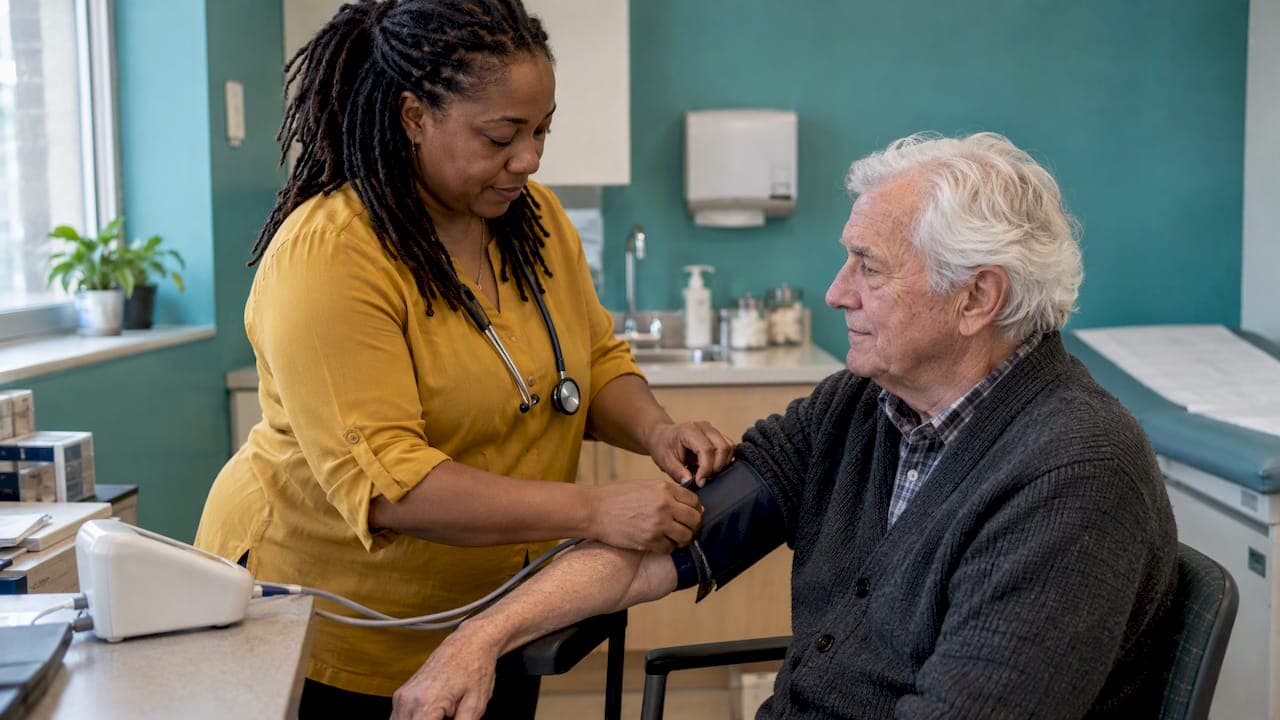
Picture a Tuesday morning. You're at the kitchen table with coffee, a letter from your pharmacy, a portal login that won't work, and a clinic phone tree that has already asked you to press three. Nothing is wrong, exactly. It's just a lot of small tasks, and all of them land on you. A community health worker is a person who can sit down next to you for exactly this kind of morning. They help older adults get through the health and social service maze, and they are often a neighbor-like presence rather than a clinical one.
If you live on your own, that matters. Being solo doesn't mean being lonely, and it doesn't mean doing everything yourself. It means choosing who's in your corner. This guide explains what a community health worker does, how they help older adults, what it may cost, and how to find out what's offered where you live.
TL;DR
- A community health worker (CHW) is a trusted frontline public health worker who links people to health care and social services, explains health information, and advocates for them.
- For older adults, that can mean help with appointments, medications, rides, groceries, housing paperwork, and advance directives.
- Coverage varies by state and program. Some states reimburse CHW services through Medicaid, and many programs are run through health systems or community groups.
- A CHW is not a doctor or a nurse. Ask about their training and what they can and can't do before you start.
- Used well, a CHW frees up your energy for the parts of life you actually enjoy.
Table of Contents
- What a community health worker actually does
- How a CHW can help when you live on your own
- Working alongside your doctor
- Does it cost anything, and how do you find one?
- What to ask before you say yes
- Let them carry the logistics, keep the good stuff
- Want a thinking partner? Try a Clarity Session
- FAQ
- Sources
What a community health worker actually does
The American Public Health Association describes a CHW as a trusted frontline public health worker who acts as a liaison between the community and health and social systems. The word "trusted" does a lot of work in that sentence. Many CHWs come from the same neighborhoods, cultures, or language communities as the people they serve. That shared ground is why people often tell them things they'd never say in a ten-minute exam room visit.
The National Heart, Lung, and Blood Institute lists the day-to-day work: health education, informal counseling on health behaviors, translation, advocacy, and some direct services such as blood pressure screening. The Minnesota Department of Health frames the role as bridging the gap between communities and social service systems, helping people navigate those systems, speaking up for individual needs, and building community capacity.
In plain terms, a CHW is part guide, part translator, part advocate. They aren't there to tell you how to live. They're there to make the systems around you easier to use.
You may also hear other names for similar work: patient navigator, promotora, peer health coach, outreach worker. The titles differ by region and program. The core idea is the same: someone who knows how the system works and is on your side while you work it.
How a CHW can help when you live on your own
Family members often handle the logistics of aging: driving to appointments, sorting out paperwork, noticing when something has changed. If you're aging without children or nearby relatives, those jobs don't disappear. They need another home. That's where a CHW can fit.
Research on older adults describes several kinds of help:
- Everyday logistics. Programs that include CHWs have arranged grocery and medication delivery and helped older adults work out public transportation, offering an alternative to family-based support.
- Housing steadiness. The same review describes CHWs helping older adults stay housed by completing paperwork and coordinating with social workers and landlords.
- Community connections. The National Rural Health Association notes that CHWs improve access, support care coordination, and address needs like food and transportation, especially for rural older adults.
- Health at home. Oregon Health & Science University describes CHWs doing in-home medication reviews, fall risk assessments, and support with advance directives as part of geriatric care.
That last item connects to a framework you may hear from your doctor's office: the 4Ms of age-friendly care. They are Mentation, Mobility, Medication, and What Matters Most. The last one is the heart of it. It asks what you want your days to look like, and then builds health care around that, rather than the other way around.
Mobility is a good example of how a conversation with a CHW can lead somewhere fun. Someone who wants to keep walking a favorite trail or travel on their own might start by learning about bone health after 50, then bring their questions to a doctor. The goal isn't to be careful for its own sake. It's to keep doing the things you love for as long as you can.
A different kind of company
One study found that CHWs placed in public housing provided case management and motivational interviewing, and 96.6 percent of residents reported satisfaction with the program. That number is from one setting, so don't read it as a promise. But it suggests something many people already sense: help feels different when it comes from someone who treats you as a whole person, not a chart.
The same Alzheimer's Association guide describes CHWs encouraging early detection of cognitive concerns and helping caregivers find support. If you're a friend, neighbor, or chosen family member helping someone who lives alone, a CHW can be a resource for you too.
Working alongside your doctor
Anyone who has walked out of an appointment and thought, "I forgot to ask the one thing I came for," knows the gap a CHW can fill.
According to the Minnesota Department of Health's role guide, CHWs can help schedule appointments, prepare you for visits, explain information in plain language, and follow up on referrals. They can also address barriers like having no ride or finding medical language hard to follow. During visits, a CHW may help you list questions and bring your medications, take notes, and then go over what was said afterward in everyday words. They can relay messages to and from your care team and help with medication refills.
This is a quiet kind of support, and for someone who lives alone it can be a big one. Having a second set of ears in the room means you can focus on the conversation. It also means that what you decided with your doctor is still clear to you three days later.

The CDC's guidance for public health practitioners also points out that integrating CHWs into care teams can make those teams more effective, particularly in underserved communities. In other words, a CHW isn't an add-on to your care team. In a well-run program, they're a working member of it.
There's a bigger picture too. The National Rural Health Association expects the U.S. CHW workforce to grow 13 percent, from 127,100 to 144,100, by 2029. Researchers also describe a shortage of geriatrics-trained health workers and see CHWs as one strategy for reaching vulnerable older adults. So you're likely to hear about this role more often, not less.
Perspective
We started Aging Solo Today because a solo life can be a complete life, and still a life that benefits from good company. When people think about getting help, they often picture giving something up. We see it the other way around. The right helper takes the paperwork, the phone trees, and the guesswork off your plate so that you have more of yourself left for friends, travel, a good meal out, a new interest.
That's why we like the community health worker model. It's built on trust and on meeting people where they live. It treats you as the person in charge of your own life and offers a steady hand with the logistics. It sits comfortably next to the other things we encourage: a circle of people who know you, a few reliable contacts, a clear sense of what matters most to you.
What we've learned is that most people don't need a big overhaul. They need one or two real conversations with someone who listens and knows the landscape. That's what we aim to be in a Clarity Session, and it's what a good CHW can be in your neighborhood.
Mike Crawford
Does it cost anything, and how do you find one?
The honest answer is that it depends on where you live. The National Rural Health Association notes that coverage differs by state: which services and populations are covered, how and how much providers are paid, and what authorization is required. Some states reimburse CHW services through Medicaid. In many places, CHWs work through hospitals, clinics, health plans, health departments, or community organizations, and the service is offered as part of a program rather than billed to you directly. Whether you qualify can depend on the program's rules, your coverage, and sometimes your age or income.
There's no single national front door, so a few phone calls are the practical route. Good places to start:
- Your primary care office or clinic. Ask whether they have a CHW, patient navigator, or care coordinator, and how patients are referred.
- Your health plan. Ask whether it offers care coordination or community-based support to members.
- Your local health department. Many run outreach programs for older residents.
- Your Area Agency on Aging. These agencies are a hub for services for older adults. Our guide to what an Area Agency on Aging is and how it helps walks you through the call.
If you want a broader map of what's out there, our senior resources guide covers more options. And if transportation is the hurdle, see our piece on getting around without driving.
It's fine to call and say, "I'm not sure what you offer. Can you tell me what's available for someone who lives alone?" That's a perfectly good question, and it's the one these programs exist to answer.
What to ask before you say yes
Training varies a lot. A systematic review sorts CHWs into lay health workers with little or no formal education and a few days to weeks of informal training, and paraprofessionals at two levels with more schooling and, at the higher level, formal training. The National Rural Health Association adds that the Affordable Care Act authorizes funding for CHW workforce development, but the absence of national certification standards leads to differences between states. It also says efforts such as the National C3 Council Project have set nationally recognized roles and core competencies.
That means two CHWs in two programs may offer quite different things. A few friendly questions help you find out what you're getting:
- "What does your day-to-day work with someone like me look like?" You're listening for concrete examples, such as rides, refills, forms, or visit prep.
- "What training have you had, and who do you work with?" A CHW linked to a clinic or health system can often coordinate with your care team directly.
- "What are you not able to do?" A CHW isn't a physician or nurse and shouldn't diagnose or change a prescription. A good one will say so clearly and tell you who to call.
- "How will you share my information, and with whom?" You decide what gets passed along and to whom.
- "How often will we talk, and for how long?" Some programs are short and focused. Others are ongoing.
Most CHWs are women of color with a high school degree or less, and many earn below the national average. Their strength is lived knowledge and trust, and that's worth respecting. Treat the relationship as a partnership: tell them what matters to you, and let them know when something isn't working.
Let them carry the logistics, keep the good stuff
Here's the part that doesn't show up in program descriptions. When the logistics get lighter, life gets bigger. The morning you used to spend on hold becomes a morning for a walk and a long lunch with a friend. The refill is handled, so you can say yes to the weekend trip. The paperwork gets filed, so there's room in your head for the book you've been meaning to start.
That's what we'd like for you. Not a life organized around what could go wrong, but one with enough steady support that you can enjoy it. If you'd like to think about building that circle, our guides on social connection for seniors and practical tips for adults 50+ living alone are good places to start. If the question that's been nagging you is how you feel more than what you need, our Hidden Loneliness Checklist can help you name it, without judgment.
Want a thinking partner? Try a Clarity Session
Sometimes the hardest part is figuring out where to begin. In our Solo Aging Clarity Session, you and I talk for 45 minutes over Zoom about your situation, your priorities, and the kinds of support that would suit you. It's a conversation, not a lecture, and it costs $97 one-off.
You can book a Solo Aging Clarity Session when you're ready. If you'd rather start on your own, Solo Aging 101 is a clear first read, free to explore.
FAQ
What does a community health worker do for seniors?
A community health worker helps older adults use health and social services. That can include scheduling appointments, preparing for visits, explaining medical information in plain language, and following up on referrals. Depending on the program, they may also help with rides, groceries, medication deliveries, housing paperwork, and advance directive support.
Is a community health worker the same as a nurse or caregiver?
No. A CHW is a trained but non-clinical guide and advocate, and their training varies by state and program. They don't replace your doctor or nurse, and they usually aren't a home care aide. Think of them as the person who helps you make the most of the care and services you already have access to.
Are community health worker services free for older adults?
Often the service is offered through a program at no direct charge to you, but it depends on your state, your coverage, and the program's rules. Some states reimburse CHW services through Medicaid. Ask your clinic, health plan, or local Area Agency on Aging what's available where you live.
Can I use a community health worker if I live alone and have no family nearby?
Yes, and living alone is a good reason to ask. Research describes CHWs helping older adults with groceries, medication delivery, and transportation in ways that offer an alternative to family-based support. Eligibility is set by each program, so call and describe your situation.
Sources
- Community Health Workers, American Public Health Association
- Community Health Workers: Role, NHLBI, NIH
- Community Health Worker Roles in Chronic Disease Prevention, Minnesota Department of Health
- The Role of Community Health Workers in the Health and Well-Being of Older Adults, PMC
- Community Health Workers: Expanding Capacity to Serve Rural Older Adults, OHSU
- Community health workers and rural age-friendly care, National Rural Health Association
- Community Health Workers: A Resource for Healthy Aging and Addressing Dementia, Alzheimer's Association
- Community Health Worker Interventions for Older Adults, PMC
- Collaborating with Community Health Workers, CDC
- Who is a community health worker? A systematic review, PMC
- Healthy aging and bones for 50+