
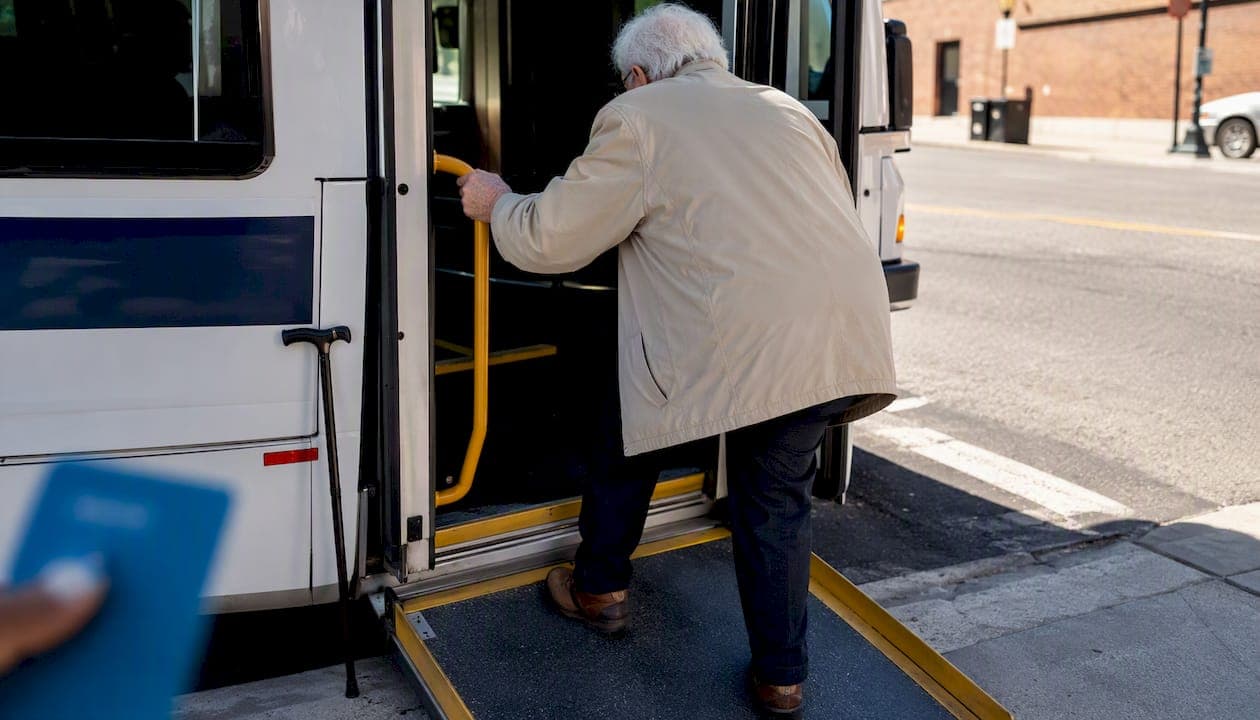
ADA complementary paratransit eligibility comes down to three categories, and none of them are about your age or your diagnosis. You qualify if you cannot board, ride, or get off a regular bus or train independently, if you need an accessible vehicle that isn't available on your route, or if a specific condition prevents you from safely traveling to or from the nearest stop. That's the whole test under 49 CFR § 37.123. Turning 70 doesn't automatically get you in the door, and neither does a diagnosis on paper. What matters is what your body and mind can actually do on a given day.
If you think you might qualify, the first move is simple: contact your local transit agency's paratransit or ADA eligibility office and ask for an application. You don't need to wait for a crisis to do this.
Before you pick up the phone, here's the short version of what you're dealing with:
- Category 1: You can't independently board, ride, or exit a regular bus or train, even with the vehicle's accessibility features.
- Category 2: You could ride fixed-route transit, but only on a vehicle with a lift or ramp, and your route doesn't reliably have one.
- Category 3: You could physically ride the bus, but a specific condition (vision loss, extreme cold sensitivity, a mobility limitation on hills) keeps you from safely getting to or from the stop itself.
You only need to fit one category to qualify. And you can be conditionally eligible, meaning you qualify for paratransit only on days or trips where your condition actually interferes with fixed-route travel.
Key Takeaways
Paratransit eligibility for seniors depends entirely on documented functional ability to use fixed-route transit, never on age or diagnosis alone.
| Point | Details |
|---|---|
| Three eligibility categories | You qualify if you can't board independently, need an unavailable accessible vehicle, or face a specific barrier reaching your stop. |
| Function over diagnosis | Describe specific travel tasks you can't perform rather than naming a medical condition. |
| 21-day provisional rule | If your agency doesn't decide within 21 days of a complete application, you're provisionally eligible until they respond. |
| Documentation wins cases | Bring ID, proof of address, a mobility-aid list, and a short written account of your worst travel days. |
| Aging Solo fills the planning gap | Use Aging Solo's free guides and Clarity Sessions to prepare your application and line up backup transportation options. |
Table of Contents
- What Is Paratransit Eligibility for Seniors, and How Is It Different From Age-Based Programs?
- What Are the Three ADA Paratransit Eligibility Categories?
- How Do Transit Agencies Decide Who Qualifies?
- How Do You Apply for Paratransit Step by Step?
- What Do Paratransit Fares, Service Areas, and Booking Rules Look Like?
- What Happens After the Decision, and How Do You Appeal a Denial?
- What Transportation Options Exist if You Don't Qualify for Paratransit?
- What Practical Steps Improve Your Chances of a Successful Application?
- A Perspective on Facing the Paratransit Process Alone
- How Aging Solo Helps You Plan Beyond the Paratransit Application
- Where to Find Official Paratransit Rules and Local Contacts
- Sources
- FAQ
What Is Paratransit Eligibility for Seniors, and How Is It Different From Age-Based Programs?
ADA complementary paratransit is a federally required, door-to-door (or curb-to-curb) service that transit agencies must run alongside their regular bus and rail systems. It exists for one reason: to give people with disabilities equivalent access to public transit when the fixed-route system itself isn't usable for them. The service area is tied to the fixed-route network, generally covering locations near an existing bus route or rail station, as described by the Disability Rights Education and Defense Fund.
Here's where seniors and caregivers get tripped up. Many cities and counties also run separate, locally funded senior transportation programs that have nothing to do with the ADA. These programs base eligibility on age or residency, not on functional ability, and they set their own hours, coverage areas, and fares. A policy brief from the University of Texas makes the distinction clear: these are two different systems with two different rulebooks, and confusing them can cost you time.
Take a 78-year-old who still drives but wants a backup for evenings. She probably won't qualify for ADA paratransit, since she can physically ride a bus. But her town's senior van program, which only requires proof of age and residency, might serve her just fine. Meanwhile, a 68-year-old with Parkinson's tremors that make gripping a bus rail dangerous almost certainly qualifies for ADA paratransit, regardless of age.
| Factor | ADA complementary paratransit | Local senior transportation program |
|---|---|---|
| Eligibility basis | Functional ability to use fixed-route transit | Age and/or residency |
| Who runs it | Public transit agency (federally required) | City, county, or nonprofit (locally funded) |
| Required documentation | Application plus functional assessment | Proof of age and address |
| Service area | Within 3/4 mile of fixed-route service | Set locally, often wider or narrower |
| Fare rules | Capped at twice the fixed-route fare | Varies, sometimes free or donation-based |
Before you apply anywhere, find out which program you're actually contacting. Ask directly: "Is this ADA paratransit, or a local senior ride program?" The answer changes what you need to bring and what rights you have if you're turned down.
What Are the Three ADA Paratransit Eligibility Categories?
Federal regulation lays out three distinct paths to eligibility, and each one covers a different kind of real-world barrier.
Category 1: Unable to board, ride, or disembark independently. This covers people whose vision, cognitive function, psychiatric condition, or physical mobility makes it unsafe or impossible to use a regular bus or train alone. A senior with moderate dementia who can't reliably recognize her stop, or someone recovering from a stroke who can't grip a handrail steadily, both fit here.
Category 2: Needs an accessible vehicle that isn't available. This applies to wheelchair and scooter users when their route doesn't consistently run lift-equipped or low-floor vehicles. If the bus that serves your street is accessible only some of the time, and you can't predict which one shows up, you likely qualify under this category.
Category 3: A specific impairment-related condition prevents travel to or from the stop. This is the category people most often overlook, because it's about the environment around the stop, not the vehicle itself. Someone with severe arthritis who can't manage a steep hill to reach the nearest stop qualifies. So does someone whose lung condition makes extreme heat or cold dangerous during a wait. Snow and ice are common triggers here too, especially for anyone with balance issues.
Eligibility also comes in three flavors, and this distinction matters more than most applicants realize:
- Unconditional eligibility means you qualify for paratransit for all trips, all the time.
- Conditional eligibility means you qualify only for specific trips or conditions, such as during winter weather or on days your symptoms flare.
- Temporary eligibility covers a defined recovery period, like the months following knee replacement surgery, after which your status gets reevaluated.
Conditional eligibility trips up a lot of applicants because they assume it's all or nothing. According to guidance from National RTAP, agencies are expected to account for exactly this kind of variability rather than force a binary yes or no.
How Do Transit Agencies Decide Who Qualifies?
Agencies are testing function, not chasing a diagnosis. A caseworker doesn't care that you have osteoarthritis; they care whether you can climb three steps onto a bus, hold your balance while it's moving, and find your way to the right stop. That's a deliberate design choice under federal guidance from the Federal Transit Administration, and it's the single biggest thing applicants misunderstand.
Most agencies use some combination of these methods:
- A phone interview asking about specific travel tasks you struggle with.
- A written application, sometimes requiring a professional's signature confirming a stated limitation.
- An in-person functional assessment, which might include a simulated boarding test, a short walk, or a cognitive screening.
- Supplemental documentation from a doctor, occupational therapist, or other professional, used to support (not replace) the functional picture.
Here's the part almost nobody knows to expect: if the agency doesn't issue a decision within 21 days of receiving your complete application, you become provisionally eligible and can start using the service until they formally deny you.
The 21-day rule exists precisely because agencies sometimes let applications sit. If you submit a complete application and haven't heard back in three weeks, federal regulation entitles you to provisional service in the meantime, under 49 CFR § 37.125.
That protection only works if you can prove when you applied, so keep a dated copy of everything you send in. Agencies must also send written notice of their decision, and if they don't, that silence works in your favor.
One more detail caregivers should know: you can bring a personal care attendant or family member to the assessment, and agencies typically record that support person's presence as part of your file. Speak up about this when scheduling.
How Do You Apply for Paratransit Step by Step?
Applying isn't complicated, but it rewards precision. Vague answers get vague results.
- Find your local transit agency. Search "[your city] paratransit eligibility" or "[your city] ADA transit office," and start there. Agencies like Access Services in Los Angeles or DART First State in Delaware are useful models: both post their applications, criteria, and contact information directly online, and most metro-area agencies follow a similar format.
- Request or download the application. Most agencies offer paper, online, and phone-based options. Ask for the accessible format that works best for you.
- Complete the form with specific, task-based language. Don't write "I have bad knees." Write "I cannot climb the two steps onto a standard bus without holding a rail with both hands, and I've fallen twice trying."
- Attach supporting documentation. This strengthens conditional and Category 3 claims especially.
- Schedule your assessment or interview. Ask what to expect, whether you can bring someone with you, and how long the process typically takes at that specific agency.
Your documentation checklist should include:
- Government-issued photo ID.
- Proof of current address, such as a utility bill.
- A list of every mobility aid you use (cane, walker, wheelchair, scooter).
- A brief medication and condition summary, focused on function rather than clinical detail.
- A supporting letter from a doctor or therapist, when one is available and useful.
Expect questions like "Can you tell me about a time you tried to use the bus and it didn't work?" or "Walk me through what happens when you try to cross the street to your stop." Answer with a specific memory, not a general statement.
Here's the detail that separates strong applications from weak ones: describe your worst days, not your best ones. If your balance is fine most mornings but unreliable by afternoon, say so plainly. DREDF's guidance on documenting variable conditions is direct about this: reviewers need to understand your functional range, not just your good moments. Undercutting your own case by minimizing bad days is the most common, and most avoidable, mistake applicants make.
What Do Paratransit Fares, Service Areas, and Booking Rules Look Like?
Cost and coverage questions come up constantly, and the answers are more standardized than most people expect.
Fares are capped by federal rule: agencies cannot charge more than twice the equivalent fixed-route fare for the same trip, a limit confirmed by DREDF's eligibility guidance. If your city's bus fare is $2, your paratransit trip can't legally cost more than $4, though many agencies charge less.
| Rule | Typical standard |
|---|---|
| Service area | Within a short distance of a fixed-route bus or rail line |
| Fare cap | Capped at a multiple of the fixed-route fare, usually not exceeding twice the cost |
| Reservation window | Usually 1 day ahead; many allow next-day booking |
| Recertification | Commonly every 1 to 3 years, agency-dependent |
Booking generally works on a reservation system rather than on-demand pickup. Most agencies want your ride request at least a day ahead, though some allow same-day requests depending on capacity. Expect a pickup window rather than an exact time. Drivers typically wait a set number of minutes, often five, so being ready at your door matters.
No-show policies are worth taking seriously. Agencies track missed trips, and a pattern of no-shows or late cancellations can lead to a suspension of your riding privileges. If you're prone to canceling last minute due to symptom flares, tell the agency directly. That honesty can protect your account standing and might even support a conditional eligibility update.
What Happens After the Decision, and How Do You Appeal a Denial?
Once the agency makes a decision, they're required to send written notice, and that notice needs to include specific information. It should state your eligibility status (unconditional, conditional, or denied), any conditions or trip limitations, your certification's expiration date, and contact information for the paratransit coordinator.
If your letter is missing any of that, that's a red flag worth following up on immediately. Here's what to do if you're denied or the letter is incomplete:
- Contact the paratransit coordinator listed on your notice and ask for clarification in writing.
- If you disagree with the decision, file a formal appeal within the window the agency specifies (federal rule sets a minimum period, but check your local deadline).
- Request a hearing. You have the right to be heard and to have your case reviewed by someone who wasn't involved in the original denial, a protection built into FTA guidance.
- Ask whether you're entitled to service while your appeal is pending. Many agencies continue provisional service during this period, especially if your original 21-day window was missed.
- If your local contact isn't responsive, escalate to the agency's civil rights office.
Recertification deserves attention too. Conditional or temporary eligibility comes with an expiration date, and letting it lapse without reapplying means losing access right when you might need it most. Mark that date somewhere you'll actually see it, not just in a drawer with the original letter.
- Keep a folder (paper or digital) with your application, every document you submitted, and the agency's written decision.
- Note the date you submitted your application, in case the 21-day rule comes into play.
- Save copies of any appeal correspondence separately from your original file.
What Transportation Options Exist if You Don't Qualify for Paratransit?
Not qualifying for ADA paratransit isn't the end of the road. Several other resources exist specifically to fill this gap, and many families don't discover them until after an ADA denial, which is a shame, since some are easier to access than paratransit itself.
Your local area agency on aging is the best starting point. These federally funded regional offices coordinate senior services, and transportation is almost always part of what they track. Senior centers often run their own shuttle programs with simpler eligibility rules based on age and residency rather than functional testing. Volunteer driver programs, frequently organized through community or faith-based groups, can offer door-to-door rides for medical appointments and errands at little or no cost. For seniors enrolled in Medicaid or a managed-care plan, non-emergency medical transportation is often a covered benefit worth asking your care coordinator about directly.
The key difference across all of these: eligibility is typically based on age, income, or plan enrollment, not on a functional assessment. Hours and coverage areas also tend to be narrower than ADA paratransit, so plan around that if you're juggling multiple appointments in a week.
If you're coordinating rides from multiple sources, a simple shared calendar (paper or digital) that tracks which service covers which day makes a real difference. Our transportation options guide for solo agers walks through how to line these services up so you're not scrambling week to week. And if reducing your travel need altogether is part of the plan, it's worth exploring whether some appointments can move to telehealth instead of a ride at all.
What Practical Steps Improve Your Chances of a Successful Application?
Small preparation choices make a real difference in how your application gets read, and in how safe your rides feel once you're approved.
Before your assessment, put together:
- A written log of two or three specific incidents where fixed-route transit failed you, with dates if you have them.
- Photos of physical barriers at your actual bus stop, like a missing curb cut or a steep incline.
- A current list of medications and assistive devices you use daily.
- A short, plain-language narrative describing your functional limitations, written in your own words or a caregiver's.
Pro Tip: Practice saying your functional limitations out loud before the interview. "I can't grip the handrail with my right hand" lands far better with an assessor than "my arthritis is pretty bad," even though you mean the same thing.
If you're supporting a parent or loved one through this process, keep your role focused and brief during the actual assessment. Let them answer first, and only add detail if something important gets missed. Assessors are trained to evaluate the applicant, and too much caregiver interjection can sometimes muddy the functional picture they're trying to build.
Once you're riding, a few habits protect your safety. Ask your driver directly about wait times if you move slowly. If you're traveling with a walker, cane, or packages, mention it when booking so the vehicle and driver are prepared. If a fall risk is part of your daily reality, consider whether bringing a personal care attendant on higher-risk trips makes sense; agencies generally accommodate this at no extra charge.
A Perspective on Facing the Paratransit Process Alone
Most people who reach out about paratransit expect a fight, and that fear alone stops some seniors from applying at all. It's worth saying plainly: the process is more forgiving than its reputation suggests, especially once you understand that assessors are looking for function, not perfection, and that a denial isn't final.
The seniors who navigate this well tend to share one habit: they document everything and treat the paperwork like it matters, because it does. They also don't treat a first "no" as the end of the conversation. Appeals exist for a reason, and alternatives exist for a reason too. If ADA paratransit doesn't fit your situation, that's information, not a dead end. It just means the next call is to your area agency on aging instead of a transit coordinator. Either way, the goal is the same: staying mobile, staying connected, and not letting a bureaucratic process become the reason you stop going where you need to go.
How Aging Solo Helps You Plan Beyond the Paratransit Application
Paratransit eligibility is one piece of a much bigger question: how do you keep your independence and mobility as you age, especially if you're managing this without a spouse or family member nearby to help sort through the paperwork? Aging Solo doesn't process paratransit applications and can't replace your local transit agency, but it fills the planning gap around it, helping you think through what happens before you apply and what backup plans you need if the answer is no.

Our free planning guides cover transportation transitions, including how to prepare documentation for assessments and how to build a realistic backup plan using local senior services. If you want help thinking through your specific situation, a personal care attendant question, a driving cessation timeline, or how paratransit fits into your broader independence plan, a Solo Aging Clarity Session gives you 45 minutes on Zoom to work through it with someone focused entirely on your circumstances. Start by downloading a free checklist from our planning tools page and book a session when you're ready for a plan that's actually yours.
Where to Find Official Paratransit Rules and Local Contacts
The clearest starting points are federal, not commercial. ADA.gov explains disability rights broadly, while the Federal Transit Administration's ADA resources cover transit-specific obligations agencies must follow. For the regulatory text itself, 49 CFR § 37.123 and 49 CFR § 37.125 lay out eligibility standards and the application process in full legal detail.
To find your specific local office, search "[your city] paratransit" or "[your city] ADA eligibility office" directly, since most agencies post applications and criteria online. If you get stuck, SeniorNavigator helps connect older adults with local aging services, including transportation programs, and your regional area agency on aging can usually point you to the right transit contact even if transportation isn't their main program.
- Search your transit agency's website directly using "paratransit" or "ADA eligibility" as keywords.
- Call your area agency on aging if you can't find local contact information online.
- Check whether your city runs a separate senior transportation program alongside ADA paratransit.
This article is general information, not a substitute for advice from a qualified lawyer. Consult a qualified legal professional about your own circumstances before acting on anything here.
Sources
- 49 CFR § 37.123 - ADA paratransit eligibility: Standards. | Electronic Code of Federal Regulations (e-CFR) | LII / Legal Information Institute
- How is paratransit eligibility determined? | FTA
- ADA Complementary Paratransit | National RTAP
- ADA paratransit eligibility | DREDF
- FTA ADA resources
FAQ
What are the three categories of eligibility for ADA complementary paratransit?
The three categories are: unable to independently board, ride, or exit a fixed-route vehicle; needing an accessible vehicle not consistently available on your route; and a specific condition that prevents travel to or from the boarding location, as defined under 49 CFR § 37.123.
What disabilities qualify for paratransit?
Any disability, physical, cognitive, sensory, or psychiatric, can qualify if it prevents functional use of fixed-route transit. Common examples include severe arthritis, vision loss, dementia, wheelchair use without reliable accessible vehicles, and conditions worsened by heat, cold, or terrain.
Is there free transportation available for senior citizens in Florida?
Availability and cost vary by county and program, since Florida doesn't run one statewide senior transportation system; contact your local area agency on aging or transit authority for county-specific fare and eligibility details rather than relying on statewide assumptions.
Who is eligible for paratransit in San Francisco?
Eligibility follows the same federal functional-ability standard used nationwide: applicants must show they can't use fixed-route Muni service independently due to a disability, verified through that city's transit agency application and assessment process.
Does age alone qualify someone for ADA paratransit?
No. Age alone never qualifies you for ADA complementary paratransit, since eligibility is based strictly on functional ability. Separate local senior transportation programs, however, may use age or residency as their eligibility basis instead.