

This page hands you a ready bank of caregiver interview questions, organized by what each one actually reveals, plus model answers for the moments that matter most. You'll find sample responses using the STAR method, a rundown of what's legal to ask before a job offer, and a short checklist for wrapping up an interview well. Every section links back to real sources like the Bureau of Labor Statistics and the EEOC, so you're not just guessing at what "good" looks like.
TL;DR:
- Caregivers should be ready to answer specific examples of handling emergencies, refusals, and documenting changes, using the STAR method for clarity.
- Ask detailed questions about scope, backup coverage, and paid trial shifts to ensure long-term suitability before accepting a position.
- Employers cannot inquire about disabilities or medical conditions before hiring but can verify if candidates can perform essential job functions with or without accommodations.
- References should be asked targeted questions about tasks handled independently and how they managed unexpected situations to reveal true caregiving competence.
- Unpaid or volunteer caregiving experiences are valuable and often sufficient, as most personal care aide jobs rely on on-the-job training rather than formal certification.
Table of Contents
- Core Caregiver Interview Questions by Category
- How to Answer: STAR, Scope, and Model Responses That Work
- Questions Caregiver Candidates Should Ask Employers
- What's Legal to Ask: EEOC and ADA Basics
- Reference Checks: Questions That Actually Reveal Something
- Quick Checklist Before You Wrap Up
- Why I Think Most Caregiver Interviews Miss the Point
- Get Personalized Help Hiring or Preparing for the Role
- Sources
- FAQ
Core Caregiver Interview Questions by Category
The best caregiver interviews don't feel like an interrogation. They feel like two people figuring out if this is a good match, both ways. That said, structure matters. Questions grouped by purpose help you cover the ground that counts instead of drifting into small talk or, worse, questions that don't hold up legally.
Experience and background. Start here because it grounds everything else in reality. Ask what kind of care the candidate has provided before, whether paid or unpaid, and for how long. Caregiving duties typically span bathing, dressing, grooming, toileting, feeding, mobility help, meal prep, light housekeeping, and transportation, so ask directly which of these the candidate has actually done, not just "are you comfortable with personal care?" Follow with: "What's the longest you've stayed with one client or family, and why did that end?"
Skills and daily tasks. This is where you separate people who talk about caregiving from people who've done it. Ask how they handle medication reminders, what their documentation habits look like, and how they'd structure a typical day with a client who has a fixed schedule versus one who doesn't. A useful follow-up: "Walk me through how you'd track and report changes in a client's condition."
Behavioral questions. These ask for a specific memory, not a philosophy. "Tell me about a time a client refused care" beats "How do you handle refusal?" every time, because it forces a real answer instead of a rehearsed one.
Situational scenarios. This test judgment on things that haven't happened yet but will. Try:
- "What would you do if a client refused to bathe or take medication?"
- "Your replacement caregiver doesn't show up for the next shift. What's your next move?"
- "You notice a client is confused and unsteady on their feet. Walk me through what you do."
Motivation and logistics. Don't skip this. Ask why they chose caregiving, what their actual availability looks like (not the ideal version), and what pay range they need to say yes. This is also where you learn whether someone sees this as a stepping stone or a calling, and both can be fine, depending on your needs.
If a candidate lacks formal experience, that's not automatically a red flag. BLS data show that most personal care aide jobs rely on on-the-job training rather than requiring prior paid work, so someone who cared for a parent or volunteered through a community calls program may be more prepared than their resume suggests.
How to Answer: STAR, Scope, and Model Responses That Work
Strong answers explain what happened, what the candidate did, and what the outcome was. That's the whole trick. The STAR method just gives it a name:
- Situation — set the scene briefly. One sentence is enough.
- Task — what needed to happen.
- Action — what the candidate specifically did.
- Result — what changed because of it.
If you're interviewing, listen for calm delivery, respect for the client's own choices, and a clear sense of when to escalate versus handle something solo. Vague answers like "I just stay positive" usually mean the candidate hasn't actually faced the scenario.
Here's how that plays out on the questions that trip people up most:
"Why do you want to be a caregiver?" A strong answer connects a real reason to reliability: "My grandmother lived with us for years, and I was the one who helped her most days. I found I was good at it, and I wanted work that felt meaningful instead of routine."
"What would you do if a client refused to bathe?" Listen for dignity, not force: "I'd give her space, ask what's bothering her about it that day, and offer a choice, like bathing now or after lunch. I wouldn't push. If she still refused, I'd document it and let the family know."
"How do you handle medication refusal?" "I'd ask why, without pressure. If she still said no, I'd note the time and reason and call the family or the on-call nurse right away. That's not my call to override."
"Tell me about an emergency you've handled." Specifics matter here more than anywhere else: "A client fell in the bathroom. I checked for injury, kept her calm and still, called 911, and stayed with her until they arrived. I called her daughter right after."
"Your replacement doesn't show up. What now?" "I'd call the agency or family immediately, stay until someone arrives if I can, and never leave a client alone without confirming coverage."
"How do you document changes in a client's condition?" "I write it down the same day, specifics like appetite, mood, mobility. I don't wait until end of shift to remember details."
Pro Tip: If you're the candidate, practice saying "that's outside what I'm trained to do, and here's who I'd call" out loud before the interview. Employers notice when someone knows their limits instead of pretending to know everything.
Questions Caregiver Candidates Should Ask Employers
An interview runs both directions. The questions you ask as a candidate tell an employer you're thinking about doing this job well, long term, not just getting hired.
Ask about the exact scope: "What tasks are included, and what's explicitly outside this role?" Get specific about medication, because "help with medication" can mean handing someone a pill cup or something closer to administration, and those carry very different training and legal requirements.
Cover the logistics that determine whether you'll actually keep this job:
- What's the cancellation and replacement policy if I'm sick or a shift falls through?
- What's the minimum guaranteed hours, and is travel time between locations paid?
- Who do I call in an emergency, and what's the escalation chain?
- How is documentation reviewed, and what does a good first month look like?
- Is there a paid trial shift before a longer commitment starts?
Reliable caregiver hiring resources frame these as the questions that predict whether a caregiving job actually lasts, not just whether it starts well.
What's Legal to Ask: EEOC and ADA Basics
Before a job offer, employers can't ask disability-related questions or require a medical exam. That's not a courtesy, it's federal guidance from the EEOC. What's allowed pre-offer is asking whether a candidate can perform the job's essential functions, with or without reasonable accommodation. "Can you lift and transfer a client who weighs 150 pounds, with equipment if needed?" is fine. "Do you have a back condition?" is not.
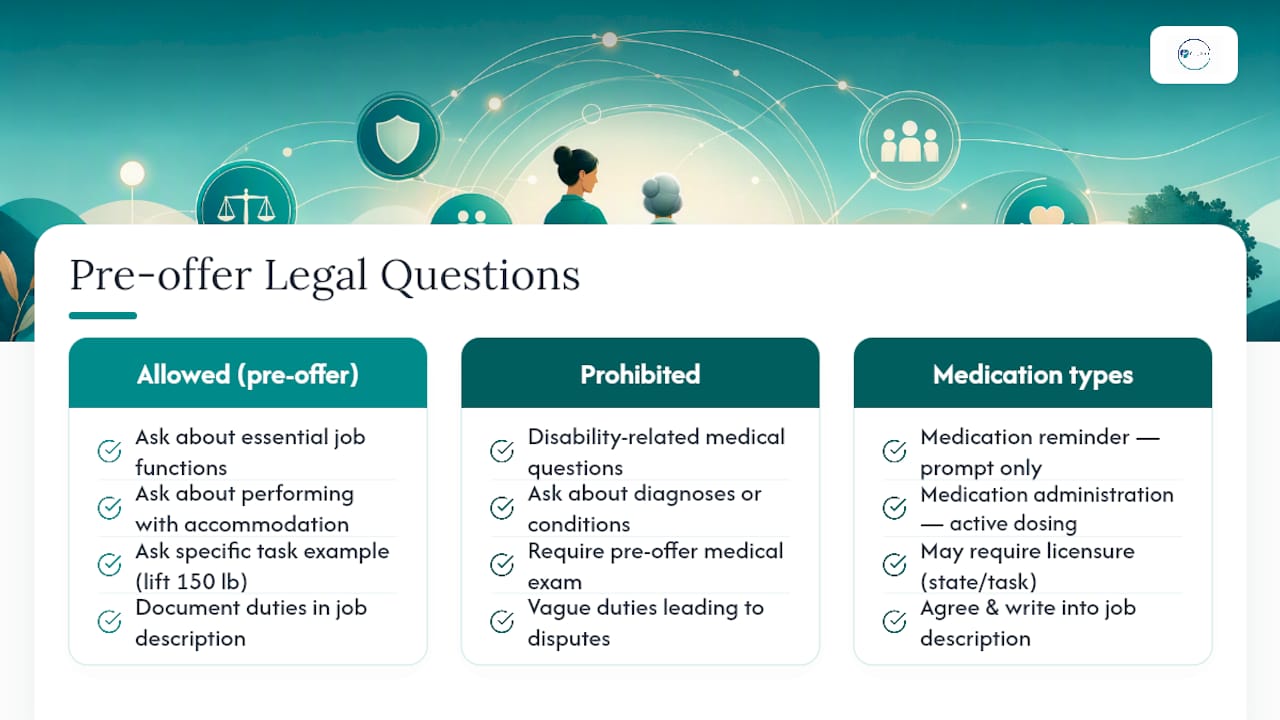
Language around medication matters legally, not just practically. A "medication reminder" (prompting someone to take a pill they've already been prescribed) is different from "administering medication," which often requires licensure depending on the state and task. Both employer and candidate should agree on which one the job actually involves and get it written into the job description, not just discussed verbally. Vague scope now becomes a dispute later.
Reference Checks: Questions That Actually Reveal Something
A reference who says "she was wonderful" tells you almost nothing. Better questions get specific:
- What tasks did this caregiver handle without needing supervision?
- Was there ever a situation that required correction or extra guidance?
- How did they handle an unexpected problem, like a fall or a missed appointment?
- Would you hire this person again, and why or why not?
Watch for inconsistency between what the candidate described in the interview and what the reference actually says happened. Vague answers about availability, or hesitation when asked to describe an emergency step by step, deserve a second look. Where certifications matter, ask to see them directly rather than taking a candidate's word, and consider a short paid trial shift before committing to a longer schedule.
Quick Checklist Before You Wrap Up
For interviewers: have the job description finalized, your essential-functions list ready, your chosen questions in hand, and a plan for references and background checks before the conversation starts.
For candidates: bring your resume, reference contacts, any certifications, your real availability, and one or two specific examples you can speak to without notes.
Once you've both agreed to move forward:
- Schedule a paid trial shift if possible.
- Put the agreed care plan and scope in writing.
- Confirm documentation expectations before day one.
Why I Think Most Caregiver Interviews Miss the Point
I've read enough of these interview guides to notice they all treat hiring like a background check with extra steps. It isn't. You're trying to find someone who fits into your daily life, or your parent's, in a way that feels steady rather than intrusive.
Ask about backup coverage early. Ask what happens on a bad day, not just a good one. And if you're the candidate, don't be afraid to ask what boundaries the family already has. Fit isn't a soft factor here. It's the whole thing.
— Mike
Get Personalized Help Hiring or Preparing for the Role
A question bank gets you far, but it can't account for your specific situation: a parent with early dementia, a caregiver search with no family nearby to help vet candidates, or a job description that still feels fuzzy after three drafts. That's the gap the Solo Aging Clarity Session is built for.
It's a paid, one-on-one 45-minute Zoom session where you work through your specific hiring situation, not a generic template. That might mean scoping out exactly which tasks belong in the job description, prepping the interview questions that matter for your circumstances, or drafting a care plan that spells out boundaries before anyone starts work. Current session pricing details are available on the organization's website. If you're navigating this without a built-in support system to lean on, having someone walk through it with you once can save weeks of second-guessing. Book a session and get a plan that actually fits your situation instead of a checklist that fits everyone's.
Sources
For deeper detail, the EEOC's guidance on pre-offer disability questions lays out exactly what's legal to ask. The BLS occupational profile for home health and personal care aides covers typical duties and training expectations. For sample question wording, see Gusto's caregiver interview questions and Monster's caregiver interview guide. Families hiring for a child with medical complexity may also find pediatric home care interview questions useful for continuity planning.
- BLS factsheet: Personal care aides
- EEOC: Enforcement guidance on disability-related inquiries and medical examinations
- Rewarding Work: 12 questions to ask when hiring a caregiver
FAQ
What Questions Are Typically Asked in a Caregiver Interview?
Expect questions about your experience with specific tasks like bathing, mobility help, and medication reminders, plus behavioral questions asking for real examples and situational scenarios testing judgment. Employers also usually ask about motivation, availability, and pay expectations, and candidates should ask about scope, backup coverage, and documentation in return.
What Are the Top Strengths to Highlight as a Caregiver?
Calm communication under pressure, respect for a client's own choices, and clear, consistent documentation stand out most to employers, according to Monster's caregiver hiring guidance. Reliability and a clear sense of when to escalate a problem rather than handle it alone also matter heavily.
What Are Common General Interview Questions That Still Apply to Caregivers?
Standard questions like "Tell me about yourself," "Why do you want this job," and "What's your greatest strength" still show up, but caregiver interviews add specifics: types of care provided, how you handle refusal of care, and how you've managed an emergency. The goal is always the same: replace a general claim with a specific example.
Do I Need Formal Certification to Get Hired as a Caregiver?
Not always. BLS data show most personal care aide jobs rely on on-the-job training rather than requiring prior paid experience, so unpaid caregiving or volunteer work can carry real weight in an interview.
How Do I Know If a Caregiving Job Is a Good Fit Before Accepting?
Ask about exact duties, replacement policy if you're sick, minimum hours, and who you call in an emergency before saying yes. If those answers feel vague or shift when you press for detail, that's worth pausing on before committing to a schedule.