

When you don't have a spouse or adult children nearby, care doesn't disappear. It gets distributed. The most common caregiving roles inside chosen families are the medical advocate, medication manager, transportation and errands lead, daily living support person, financial and administrative helper, legal decision-maker, emotional support anchor, respite provider, and care coordinator. Most chosen families split these roles across two or more people, not one designated "caregiver."
Here's what each one actually looks like:
- Medical advocate: Attends appointments, asks the questions you're too tired to ask, and pushes back on unclear discharge instructions.
- Medication manager: Tracks prescriptions, refill timing, and dosage changes so nothing gets missed between doctors.
- Transportation and errands lead: Handles rides to appointments, grocery runs, and pharmacy pickups.
- Daily living support: Helps with meals, bathing, mobility, or housekeeping when energy is low.
- Financial and administrative support: Manages bills, insurance paperwork, and benefit forms.
- Legal decision-maker: Holds power of attorney or health care proxy status to act when you can't.
- Emotional support anchor: Provides steady, non-clinical companionship and reassurance.
- Respite provider: Steps in temporarily so the primary caregiver can rest.
- Care coordinator: Keeps the whole circle organized so no task falls through.
LGBTQ+ adults are 3.5 times more likely to provide care for friends and chosen family than their non-LGBTQ+ peers, according to the Center for Health Care Strategies. Research from MDPI frames these roles as medical navigator, advocate, and coordinator work, not informal favors. Agingsolo builds its planning guidance around exactly this reality: care that's organized, not accidental.
Key Takeaways
Chosen-family caregiving works best when roles are named explicitly, documented legally, and rotated deliberately to prevent burnout.
| Point | Details |
|---|---|
| Nine core roles exist | Medical advocate, medication manager, transportation, daily living support, financial help, legal decision-maker, emotional support, respite, and coordination. |
| LGBTQ+ adults lead this pattern | LGBTQ+ people are 3.5 times more likely to care for chosen family than non-LGBTQ+ peers. |
| Documentation prevents gatekeeping | A health care proxy, HIPAA form, and power of attorney should be ready before a crisis hits. |
| Roles need explicit conversations | Ask specific questions ("could you be my first call?") rather than vague ones to get reliable answers. |
| Agingsolo builds the paperwork trail | Agingsolo's planning tools and clarity sessions help solo agers formalize chosen-family roles into recognized legal documents. |
Table of Contents
- What Chosen Family Means and Why This Caregiving Matters
- Examples of Chosen Family Caregiving Roles in Practice
- How Chosen Families Share Care: Circle Models That Work
- Getting Institutions to Recognize Your Chosen Family Caregivers
- Barriers Chosen Family Caregivers Face and How to Push Through Them
- Protecting Your Own Limits While Caregiving
- What the Research Says About Chosen-Family Caregiving
- Starting the Conversation About Who Does What
- Putting Informal Caregiving Agreements in Writing
- When Different Generations Share the Caregiving Load
- Culturally Specific Caregiving Roles in Chosen Families
- An Editorial Take on Chosen-Family Caregiving
- How Agingsolo Helps You Formalize These Roles
- Sources
- FAQ
What Chosen Family Means and Why This Caregiving Matters
A chosen family is the network of people you've chosen, rather than been born into, who function as family in practical and emotional terms. For solo agers and LGBTQ+ adults especially, this isn't a backup plan. It's often the primary plan.
That distinction shows up in the numbers. LGBTQ+ people are 1.2 times more likely to be primary caregivers overall, and research on gay and bisexual midlife adults found that relatives provide only 11 to 14 percent of elder care in some LGBT samples, compared with a much larger share in general population studies. Non-relatives are picking up the rest.
The Numbers: LGBTQ+ individuals are 3.5 times more likely to care for friends and chosen family, and blood relatives provide as little as 11 to 14 percent of elder care in some LGBT communities.
This matters because chosen-family care tends to run on a different logic than traditional caregiving. Healthline describes it as a mutual "ethic of care," where members expect to give and receive support in rotation rather than assign one permanent caregiver. That reciprocity is a strength, but it only works if roles are named out loud instead of assumed.
Examples of Chosen Family Caregiving Roles in Practice
Here's what each role looks like day to day, and who typically fills it.
1. Medical advocate. This person attends appointments, takes notes, asks follow-up questions, and challenges vague instructions from providers. Typical tasks: scheduling specialist visits, requesting test results, flagging medication interactions, and speaking up during hospital rounds. In chosen families, this is often the friend who's naturally organized or has some health care background. A real scenario: a friend accompanies someone to a cancer follow-up and catches that a new prescription conflicts with an existing one.
2. Medication manager. Tracks what's being taken, when, and whether refills are due. Tasks include organizing pill boxes, watching for side effects, and coordinating with pharmacies. This role often falls to whoever lives closest or visits most regularly.
3. Transportation and errands lead. Handles rides to appointments, pharmacy runs, and grocery trips. A rotating cast of two or three people usually shares this, since it's time-intensive but low-skill.
4. Daily living support. Covers meals, light housekeeping, bathing assistance, or mobility help. In chosen families, this is frequently split among several people rather than centered on one.

5. Financial and administrative support. Manages bill pay, insurance claims, and benefits paperwork. This role calls for someone detail-oriented and trusted with sensitive information, often a longtime friend rather than a rotating helper.
6. Legal and designated decision-maker. Holds documented authority such as a health care proxy or power of attorney. This is typically the person with the steadiest relationship and the clearest head under pressure, and it should always be formalized in writing.
7. Emotional support anchor. Provides steady companionship, especially during hard stretches like a new diagnosis. Often several people share this informally, checking in on different days.

8. Respite provider. Steps in so the main caregiver can rest, travel, or simply breathe. Even one afternoon a week from a respite provider meaningfully reduces burnout.
9. Care coordinator. Keeps the whole circle synced through a shared calendar or group chat, tracking who's doing what and when.
Pro Tip: Split roles by strength, not by proximity. The person who lives closest often gets stuck doing everything, while a friend two states away could easily own the financial paperwork or coordinate appointments by phone.
How Chosen Families Share Care: Circle Models That Work
Three models cover most situations. The rotating-shift model assigns specific days to specific people, which works well for daily living support or overnight coverage. The hub-and-spoke model puts one care coordinator at the center, delegating tasks out to the rest of the circle, useful when the person needing care has complex medical needs. The mutual-aid cluster has no fixed leader; instead, whoever has capacity that week picks up tasks from a shared list, which suits smaller circles with lighter needs.
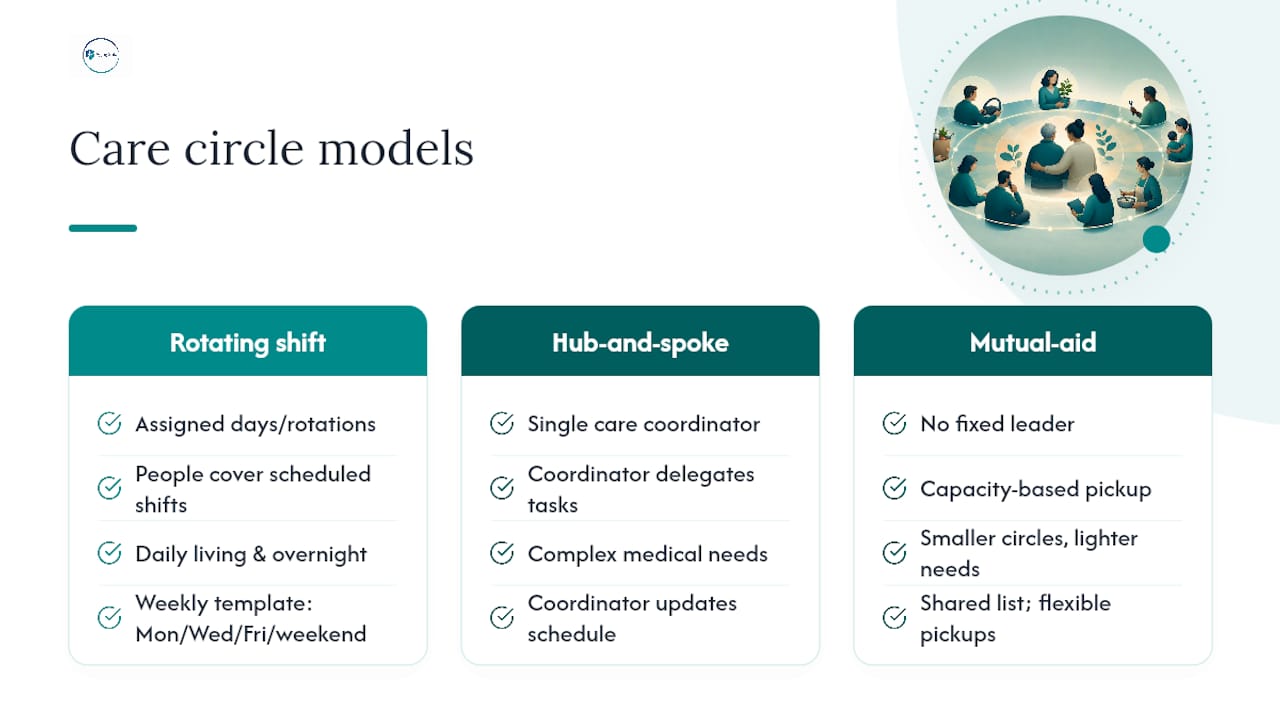
A simple weekly template might look like: Monday transport, Wednesday meal drop-off, Friday medical check-in call, weekend overnight coverage rotated monthly. Qualitative research on queer and transgender young adults found chosen families frequently build group messages and planned schedules around known events like surgery, rather than scrambling after the fact.
Pro Tip: A shared calendar app and a single group chat cut coordination friction more than any formal meeting. Assign one person to update the calendar weekly so it never goes stale.
Getting Institutions to Recognize Your Chosen Family Caregivers
Hospitals and agencies default to blood and legal ties unless you hand them paperwork that says otherwise. This is general information, not legal advice, so involve an attorney or patient advocate for your specific documents.
Build this folder before you need it:
- Health care proxy or advance directive naming your chosen decision-maker.
- HIPAA authorization so your medical advocate can access records and speak with providers.
- Power of attorney for financial and legal matters, if applicable.
- Emergency contact forms filed with your doctor's office, not just in your phone.
Bring printed copies to hospital intake, and keep digital copies on your phone as backup. CHCS research notes that caregivers sometimes feel pressured to misrepresent their relationship as "family" just to get through the door. Documentation removes that pressure entirely. Agingsolo's health and emergency planning guide walks through exactly which documents to prepare first.
Barriers Chosen Family Caregivers Face and How to Push Through Them
Expect a few recurring obstacles. Intake forms often only have fields for "spouse" or "next of kin." Staff may quietly assume a friend has no real authority. Some caregivers feel pressured to "come out" as a couple or a chosen-family unit just to get past the front desk. Insurance and workplace leave policies frequently exclude non-relative caregivers entirely.
Practical responses: ask for a "patient advocate" or "designated support person" by name, since most hospitals have that category even if front-desk staff don't mention it. If you're turned away, ask to speak with a hospital ombudsman. Keep your HIPAA form and proxy documents on hand every single time, not just for the first visit. Agingsolo's Circle of Care guide covers how to phrase these requests so they land clearly with staff who may not be familiar with chosen-family arrangements.
Protecting Your Own Limits While Caregiving
Reciprocity is what keeps chosen-family care sustainable, so protect it deliberately:
- Schedule your own medical checkups even during someone else's health crisis.
- Rotate respite coverage so no single person carries the load for months straight.
- Say the boundary out loud early: "I can do Tuesdays and phone calls, but I can't do overnights right now."
- Lean on your wider circle instead of absorbing every task solo.
Pro Tip: Try opening with: "I want to keep showing up for you long term, so I need to be honest about what I can't take on right now." It's direct without sounding like a rejection.
What the Research Says About Chosen-Family Caregiving
The pattern holds up across multiple studies, not just one survey. CHCS found LGBTQ+ adults are 3.5 times more likely to care for chosen family, and peer-reviewed work on queer and transgender young adults documents emotional labor, meal prep, transport, and advocacy as standard, expected parts of chosen-family life, not exceptions to it.
Starting the Conversation About Who Does What
Most chosen families never explicitly agree on roles until a crisis forces the question, which is exactly backward. Start the conversation while everyone's healthy and thinking clearly.
Open with a specific ask rather than a vague one. Instead of "can you help me if something happens," try "if I ended up in the hospital, could you be the person doctors call first?" That gives the other person something concrete to say yes or no to. Vague requests get vague, unreliable answers.
Bring it up during a normal moment, not a crisis. A dinner conversation works better than a phone call made from a hospital waiting room. Ask each person what they're actually good at and what they have capacity for, rather than assigning roles based on who happens to be available that week. The friend who's a nurse might be a natural medical advocate. The friend with a flexible schedule might be better suited to transportation.
Write down what you agree on, even informally. A shared document or even a group text summary ("okay, so Jamie's got medical stuff, Priya's doing Wednesdays") turns a vague understanding into something people can actually reference later. Revisit it once a year or after any major health change, since capacity and circumstances shift. Someone who could commit to weekly visits in their thirties may need to step back after having kids or changing jobs, and that's normal, not a betrayal.
Putting Informal Caregiving Agreements in Writing
A caregiving agreement doesn't need a lawyer to have value, though formalizing legal authority still does. Think of it as a shared reference document, not a contract.
Cover four things: who does what, how often, what happens if someone can't cover their part, and how decisions get made if there's disagreement. Keep it specific. "Alex handles Tuesday and Thursday check-ins" beats "Alex helps out sometimes."
Build in a review clause. Circumstances change, jobs relocate, health needs shift, and an agreement that never gets revisited becomes outdated within a year. Set a standing date, maybe every six months, to reread it together.
Address money early and directly. If someone's covering gas, medication costs, or lost work hours, write down how that gets handled before resentment builds. Ambiguity around money quietly damages more chosen-family caregiving arrangements than almost anything else.
Keep the tone collaborative rather than legalistic. The goal is clarity, not a document that feels like a workplace contract between friends. Agingsolo's friendship-based care network guide offers a practical starting template for exactly this kind of conversation.
When Different Generations Share the Caregiving Load
Chosen families frequently span decades in age, and that mix changes how caregiving actually plays out. A younger member might handle physical tasks like transportation and errands, while an older member offers financial guidance or steadier emotional support built on more life experience.
This dynamic runs both directions, though. It's common for an older solo ager to have been the one who supported a younger chosen-family member through a rough patch years earlier, and caregiving later becomes reciprocal rather than one-directional. That history matters. It's part of why chosen-family care tends to feel more durable than transactional help.
Age gaps can also create friction. A younger caregiver might not fully grasp the pace of an older adult's medical needs, while an older care recipient might hesitate to ask a younger friend for help out of concern about burdening them. Naming that concern directly, rather than letting it go unspoken, keeps the relationship healthier long-term.
Culturally Specific Caregiving Roles in Chosen Families
Chosen families don't build caregiving roles from scratch. They frequently borrow and adapt roles from their culture of origin, even when biological family isn't in the picture.
Someone raised in a tradition with strong elder-care expectations might bring that same instinct into their chosen family, effectively becoming the person who checks in daily without being asked. A person from a culture where communal meals carry weight might take point on food, treating meal delivery as both practical support and emotional connection. Faith communities sometimes lend structure too. Some LGBTQ+ chosen families incorporate rituals borrowed from religious upbringing, like a rotating prayer or check-in circle, even after leaving the original faith community itself.
The throughline is intentional adaptation. Chosen families keep what worked from their own backgrounds and drop what excluded them, building something functional out of the pieces that still fit.
An Editorial Take on Chosen-Family Caregiving
The biggest gap isn't willingness. Chosen families show up. The gap is documentation, and it's fixable in an afternoon with the right forms.
How Agingsolo Helps You Formalize These Roles
Naming roles out loud is the hard part. Turning that conversation into documents a hospital or bank will actually honor is where most chosen families get stuck, and it's the piece Agingsolo focuses on.
Agingsolo's free planning tools walk you through exactly which forms to prepare, in what order, so your chosen-family caregivers aren't scrambling during a crisis. Start with the planning tools and checklists to map out your own circle, then explore the life care plans guide for a deeper walkthrough of proxies, HIPAA forms, and coordination strategies. If you want personalized guidance instead of working through it alone, book a 45-minute Solo Aging Clarity Session and leave with a concrete plan matched to your specific circle and situation.
Sources
- LGBTQ Caregivers: Challenges, Policy Needs, and Opportunities
- We Just Take Care of Each Other: Navigating ‘Chosen Family’ in the Context of Health, Illness, and the Mutual Provision of Care amongst Queer and Transgender Young Adults
- PMC article on caregiving and chosen family
- ‘That’s what friends do’: Informal caregiving for chronically ill midlife and older gay and bisexual adults
FAQ
What Are the Three Main Roles of a Caregiver?
Most caregiving breaks into three broad categories: hands-on physical support (meals, mobility, medication), administrative and medical coordination (appointments, paperwork, insurance), and emotional support. Chosen families typically split these three categories across multiple people rather than one person.
What Is Caregiver Anger?
Caregiver anger refers to the frustration, resentment, or irritability that builds when caregiving demands outpace a person's capacity to rest and recover. It's a common signal of burnout, and rotating respite coverage among chosen-family members is one of the most direct ways to reduce it.
Can You Give an Example of a Caregiver Archetype?
The "medical advocate" is a common archetype: the person who attends appointments, asks pointed questions, and pushes back on unclear discharge instructions. In chosen families, this role often goes to whoever is naturally organized or has some health care background.
What Are the Duties of a Family Caregiver?
Duties typically include medication management, transportation, meal preparation, financial and insurance paperwork, emotional support, and acting as a medical advocate during appointments. In chosen families, these duties get distributed across a circle instead of falling to one designated person, which Agingsolo's planning resources are built to help formalize.