
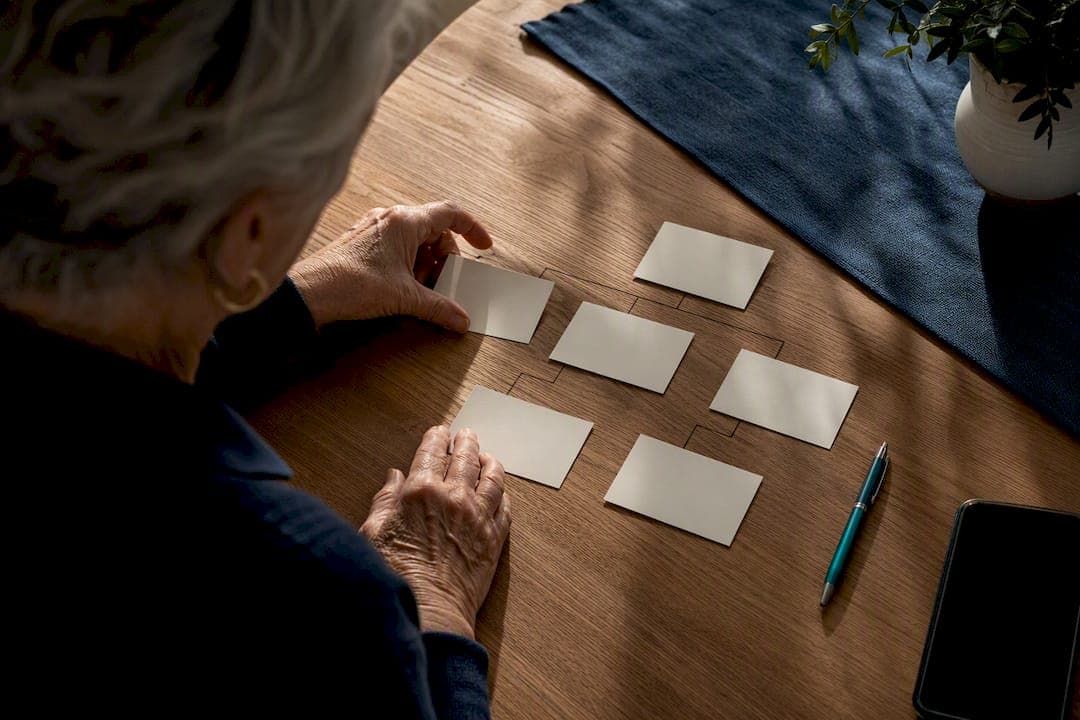
A phone tree for emergencies is a small, active network of named people with assigned roles, not just a list of numbers by the phone. It works because everyone on it already knows exactly what to do. Start today by naming one primary check-in person and printing a one-page emergency sheet. That single sheet, kept somewhere obvious, does more for your safety than any app you could download.
TL;DR:
- Your phone tree should include four to six reliable contacts based on their availability, proximity, and trustworthiness, not just familiarity or obligation.
- Assign clear roles such as primary check-in, proximity responder, and medical advocate, with specific scripts and an automatic escalation timeline to prevent hesitation during emergencies.
- Keep printed and digital copies of your emergency information, including medical, insurance, access codes, and pet-care instructions, in easily accessible, secure locations.
- Use technology to complement—not replace—your phone tree, ensuring devices are charged and covered indoors; always call 911 directly for life-threatening situations.
- Regularly test, review, and update your plan at least annually, and practice the escalation process twice a year to ensure readiness and identify weak points.
Table of Contents
- What Is a Phone Tree for Emergencies and Why Does It Matter?
- Who Belongs on Your List and What Should They Do?
- How Do You Actually Build the Phone Tree?
- What Information and Access Do Your Contacts Actually Need?
- Does Technology Actually Help, or Just Add Noise?
- How Often Should You Test and Update the Plan?
- An Author's Take: Planning as an Act of Independence
- Finish Your Plan With a Solo Aging Clarity Session
- Sources
- FAQ
What Is a Phone Tree for Emergencies and Why Does It Matter?
Most emergency contact lists are passive. They sit in a drawer or a phone app, full of names nobody has actually agreed to call in what order. A real phone tree for emergencies is a protocol. Each person has a job, and each job has a trigger.
That distinction changes outcomes. When contacts know their role ahead of time, they act in seconds instead of scrambling to figure out who should do what. Confusion is what costs time in a crisis, not distance or logistics. PSS Life U frames this kind of network design as an act of independence rather than a concession to risk. Solo agers who live alone often face longer emergency response times simply because nobody nearby notices trouble right away. A structured system with defined roles closes part of that gap, and it does it without requiring anyone to move in with you or check on you daily.
Who Belongs on Your List and What Should They Do?
You need four to six people, not twenty. A tree that's too big collapses under its own weight because nobody is sure who's actually supposed to call first.
Choose people based on three things: how reliably they answer their phone, how close they live or how quickly they could reach you, and whether you trust them to follow through without hovering. A sibling three states away who never misses a call is often more useful than a neighbor who means well but forgets.
Here's a role structure that works for most solo agers:
- Primary check-in — the first call in any scenario, usually someone who talks to you often enough to notice if something's off.
- Proximity responder — lives or works close enough to physically get to you, and holds a key or access code.
- Medical advocate — comfortable speaking with doctors or paramedics on your behalf and knows your health history.
- Communicator — updates the wider circle (extended family, close friends) so the primary contacts aren't fielding a dozen calls mid-crisis.
- Out-of-area backup — someone farther away who can coordinate by phone if local contacts are unreachable.
Assign roles by capability, not by who feels obligated. A distant cousin who's a retired nurse may be a better medical advocate than the neighbor down the hall.
How Do You Actually Build the Phone Tree?
This is where most plans fall apart. People write down names, but never script what happens when someone doesn't answer.
Start with a one-page template. Print it, and also save a digital copy your contacts can access, following the same digital-and-physical approach Aging Solo's emergency contact plan recommends. Your template should include:
- Your name, address, and the location of your nearest cross street or landmark.
- Each contact's name, role, phone number, and a backup number.
- A short script for each contact to use, so nobody is improvising.
- The escalation timeline (below), written out in plain steps.
Scripts remove hesitation. Give your primary contact three short lines to use depending on the situation:
- No response after a scheduled check-in: "Hi, it's [name]. I haven't heard from you today, just calling to check in. Call me back when you can."
- Minor help needed: "I'm okay, but I need a hand with something. Can you come by or send someone?"
- Medical emergency: "This is urgent. I need you to call 911 and then come to my address right away."
Escalation has to be automatic, not improvised under stress. A workable timeline looks like this: attempt the primary contact immediately, try again ten minutes later if there's no answer, call the proximity responder at the thirty-minute mark, and call 911 if nobody has made contact within roughly an hour. Writing the timeline down means nobody has to decide, in the moment, whether waiting "a little longer" is reasonable.
Pro Tip: Tape a laminated copy of your escalation timeline to the inside of a kitchen cabinet door. It stays out of sight but is always exactly where you'd look for it.
What Information and Access Do Your Contacts Actually Need?
A phone tree only works if the person who shows up can act the moment they arrive. That means giving your contacts more than a phone number.
Your Grab-and-Go sheet should include your full name, date of birth, current medications and allergies, your primary doctor and pharmacy, insurance information, and pet-care instructions if you have animals. Ready recommends exactly this kind of printed sheet, posted where it's easy to find, along with copies of insurance and medication lists.
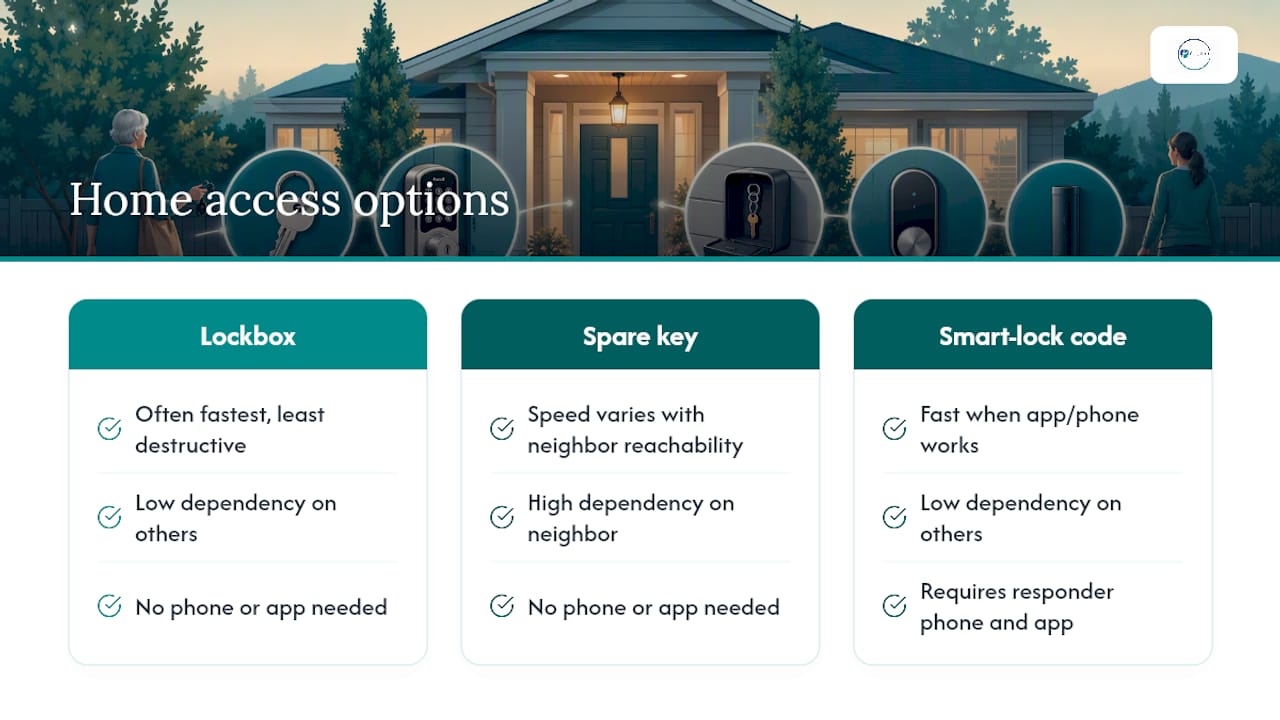
Home access matters just as much as information. A lockbox with a code shared with your proximity responder is often the fastest, least destructive way to get someone inside. A spare key with a trusted neighbor works too, though it depends on that neighbor being reliably reachable. Smart-lock temporary codes offer flexibility but require your responder to have a working phone and app access at the moment it matters, which isn't guaranteed.
Keep physical copies on the refrigerator, by the front door, and in a lockbox. Contacts should have their own digital copy stored somewhere they'd actually check, not buried in an old email thread. Aging Solo's guide on living alone emergency planning walks through the full Grab-and-Go checklist if you want a version to adapt.
Does Technology Actually Help, or Just Add Noise?
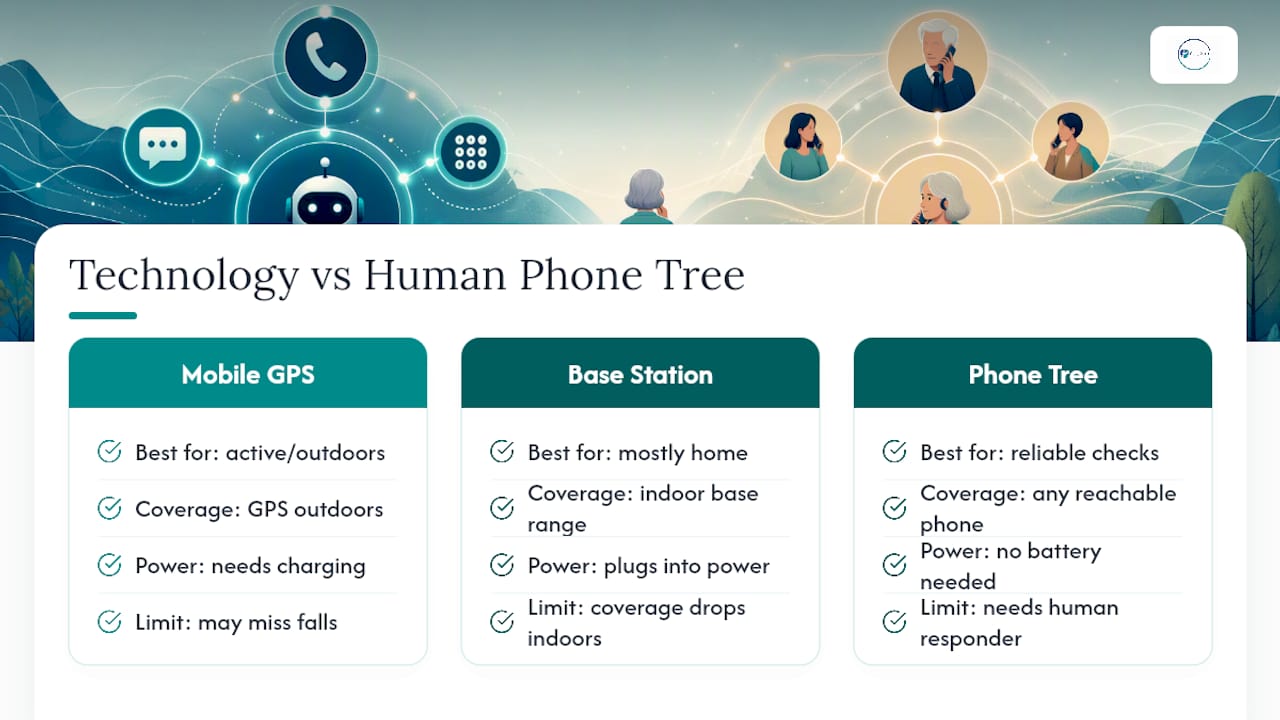
Medical alert devices, fall-detection wearables, and check-in apps can complement your phone tree, but none of them replace it — for practical fall-prevention steps and caregiver tips, see the Caregiver First STEADI Plan for Seniors. A device only helps if you're wearing it, charged, and in range when something happens.
Match the technology to your habits. Someone who's active and out running errands benefits more from a mobile GPS device, while someone mostly home does fine with a base-station medical alert system. VisitingHub's guide to practical emergency planning breaks down these trade-offs in coverage, battery life, and monthly cost.
Every device has limits. Batteries die, fall sensors misfire, coverage drops indoors. None of that replaces a human being who knows to call you at 9 a.m. and knows what it means if you don't pick up. And know the line: call 911 directly for anything life-threatening. Don't wait on a monitoring service to relay the call if you can make it yourself.
How Often Should You Test and Update the Plan?
A phone tree that hasn't been tested is a guess, not a plan. Set a rhythm and stick to it.
- Do a quick check-in with your primary contact monthly, just to confirm numbers and routines still work.
- Review the full plan once a year, or sooner if you move, change doctors, or your health status shifts.
- Run a 10-minute drill twice a year: have your primary contact call you, time how long it takes you to answer, and note anything that felt confusing.
The American Red Cross recommends practicing contact methods regularly so weak points, like a disconnected number or a contact who's moved, surface before an actual emergency does. Keep one master copy yourself and give a backup to your communicator, so the plan doesn't live only in your head. Aging Solo's piece on why seniors should update contacts annually covers the update triggers worth watching for.
An Author's Take: Planning as an Act of Independence
I think about a woman I heard about once who kept her emergency sheet folded inside her recipe box, right next to the card for her mother's pot roast. Nobody would think to look there unless she told them, which was exactly her point: it was hers, done her way, and it worked.
You can do two things in the next fifteen minutes. Fill in one line on your template, maybe your primary doctor's name. Then text someone and ask if they'll be your primary check-in. That's it. A phone tree isn't about bracing for the worst. It's what lets you keep living exactly the way you want to, alone and unafraid.
— Mike
Finish Your Plan With a Solo Aging Clarity Session
A template gets you most of the way there, but some decisions are easier to work through out loud, like who actually fits each role, or how to phrase the hard conversation with a contact you're not sure will follow through. That's where Aging Solo's Solo Aging Clarity Session comes in: a $97 one-off, 45-minute Zoom conversation built specifically for solo agers finishing exactly this kind of plan.
In the session, you'll review your phone tree template together, sort out who should hold which role, and talk through home access and documentation so nothing gets left vague. It's not a replacement for the work you've already started. It's a second set of eyes on a plan that only works if it's actually finished. If you'd rather build out the fuller picture first, Aging Solo's elder planning guide is a solid next stop. When you're ready to talk it through, book your session directly.
Sources
- Ready
- Building your support network — American Red Cross
- Planning for solo aging — PSS Life U
- How to build a practical emergency plan for older adults living alone in 2026 — VisitingHub
FAQ
How Many People Should Be on My Phone Tree?
Four to six people is enough for most solo agers. More than that makes the escalation order confusing under stress.
What if Two Contacts Disagree on What to Do?
Assign one person, usually your medical advocate, as the final decision-maker for health-related calls so disagreements don't stall a response.
How Do I Keep My Information Private but Still Accessible?
Share your Grab-and-Go sheet only with named contacts, keep the lockbox code separate from the printed sheet, and store digital copies in a password-protected file rather than open email.
What About Pets During an Emergency?
Include pet-care instructions on your emergency sheet and name a backup person specifically for pet pickup. Aging Solo's emergency pet care plan covers this in detail.
Can Aging Solo Help Me Set This Up if I Get Stuck?
Yes. The Solo Aging Clarity Session is built to help you finalize roles, access, and documentation with someone walking through it alongside you.