
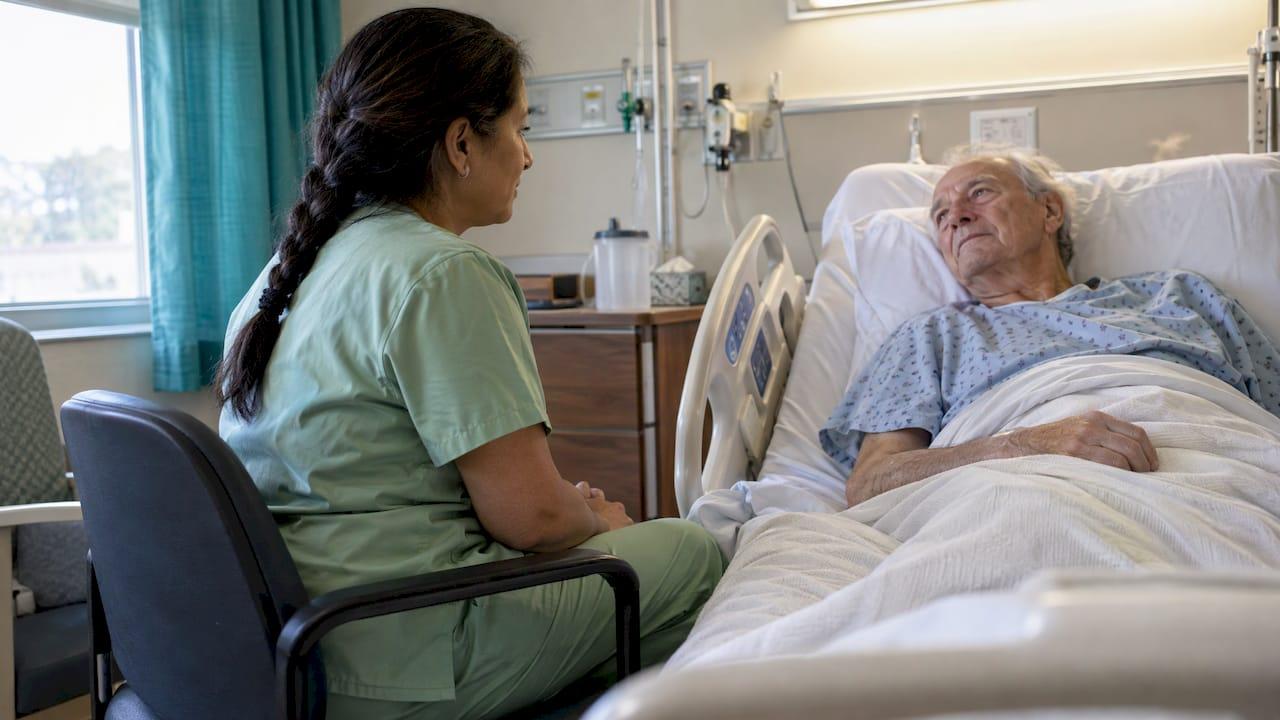
It's 2 a.m. on a hospital ward. The monitors hum and the hallway lights are low. You've had surgery, the pain medication has made your thoughts a little soft, and you reach for a glass of water that isn't there. Nobody is in the chair by the window. For many people who live on their own, that empty chair is the part of a hospital stay they think about most.
A hospital sitter is one answer to it. A sitter is a person assigned to stay with a patient and keep watch. Some hospitals provide sitters when a patient's safety calls for it. Families and friends can also hire private companions to sit with someone in a hospital room. If you're aging solo, knowing both options ahead of time means you can walk into a hospital stay with more calm and less worry.
TL;DR
- A hospital sitter is a staff member or volunteer who stays near a patient to observe and keep them safe, often because of fall risk, confusion, or agitation.
- Hospital-assigned sitters are a safety measure ordered for specific reasons. Private companions are a separate, paid choice you or someone you trust arranges.
- Sitters work alongside nurses and report to them. They don't replace nursing care.
- If you live alone, think about who can speak up for you during admission, and who can help once you're home.
- Ask about 24-hour contacts and how any private caregiver is screened before you agree to anything.
Table of Contents
- What a hospital sitter actually is
- How a sitter differs from a nurse
- Why this matters more when you live alone
- Two kinds of sitter help
- What it costs, and who pays
- Questions worth asking before you say yes
- Finding help without rushing
- A small idea: choose your person, and tell them
- Our perspective
- Talk it through with us
- The part that matters most
- FAQ
- Sources
What a hospital sitter actually is
The job goes by several names: patient safety assistant, patient companion, one-to-one observer, constant observer. The Pennsylvania Patient Safety Authority describes a sitter as a staff member or volunteer assigned to directly observe patients who are at risk of falls, self-harm, harming others, substance-related behavior problems, delirium, confusion, or agitation.
That last group matters for older adults. Hospital stays can be disorienting. Strange rooms, interrupted sleep, new medications and illness can leave a person foggy for a while. A sitter's presence gives the care team a steady set of eyes in the room when the nurse can't be there every minute.
It helps to know what a sitter is not. A sitter isn't there to be a friend for the afternoon, although a kind one is certainly company. In a hospital-ordered setting, the job is observation and safety.
How a sitter differs from a nurse
A nurse assesses you, gives medications, manages treatments and makes clinical decisions, and usually looks after several patients at once. A sitter's attention is on one person. That is the whole point of the role.
The Pennsylvania guidance describes sitters who observe, stay within arm's reach when appropriate, keep the environment safe, stay with the patient in the bathroom, document what they see, and communicate with the assigned nurse. Notice the last item. The sitter reports to the nurse. If you start pulling at an IV line, trying to climb out of bed, or seem more confused than an hour ago, the sitter tells the nurse. The nurse decides what to do.
So think of the two roles as partners. One person provides the clinical care. The other provides constant, close attention. Rules for each hospital differ, so the hospital itself is the place to ask exactly what its sitters do.

Why this matters more when you live alone
If you share a home with a spouse or grown children, someone naturally ends up in that chair. They notice you're muddled. They ask the nurse about your pain. They run home for your reading glasses.
When you're solo, those small jobs don't disappear. They just need a different owner. That isn't something to dread. It's a practical detail, the same way you'd plan who feeds the cat while you're away.
A story reported by KFF Health News shows how it can go. An older man was alone in the hospital and needed a care manager as an on-the-ground advocate. Afterward he needed companion care to help him get up, walk to the bathroom and get water. Nothing dramatic about those tasks. They were just the ones nobody was there to do.
Two separate stretches of time are worth thinking about:
- The stay itself. Someone to be your voice, notice changes, and sit with you.
- The first days home. Someone to help with the ordinary things while you get your strength back.
The Caregiver Action Network also supports early planning, noting that a solo older adult may need an advocate during admission and a separate companion or home-care plan after discharge. Our own guide to post-hospital discharge planning goes deeper on that second stretch.
Two kinds of sitter help
Sitters the hospital provides
A hospital-assigned sitter is usually part of a safety plan, ordered because the care team sees a specific risk. You generally can't just request one the way you'd request an extra pillow, though you can always tell your nurse what worries you. If you're often unsteady at night, easily confused when ill, or have had delirium before, say so. Those are exactly the details a care team uses.
A good, plain question at admission is: "What do you do here when a patient needs someone close by?" You'll learn whether the hospital uses staff sitters, volunteers, or technology, and what it takes for them to be assigned.
Private companions you arrange
Private companions, sometimes called private-duty caregivers or hospital sitters through an agency, are paid help you or a trusted person books. They may sit with you during the day, overnight, or both. They offer company, help with comfort needs, and a second pair of eyes. They don't provide medical treatment, and the hospital team keeps clinical control.
Before a stay, you can decide whether this is something you'd want. Many people find it's one of those "just enough" supports: not every night, not for weeks, but for the first night after a big surgery when you're most groggy.
What it costs, and who pays
Cost is the question most people have and the one with the least tidy answer. Here's what we can say responsibly.
The Pennsylvania Patient Safety Authority notes that sitter programs can be costly and that third-party payers did not reimburse the associated costs. It cites one hospital's 2007 program that cost $515,480 in overtime and agency-hired nursing assistants. That's a hospital's staffing bill, not a patient's, but it explains why hospitals use sitters carefully.
For you, the practical takeaway is simple. Don't assume that insurance covers a private companion. Ask the agency for its hourly rate and minimum shift length in writing, ask whether overnight shifts cost differently, and ask your insurer or the hospital's patient financial office what, if anything, applies to your plan. Rates vary by city and agency, so a figure from someone else's town won't help you much.
Questions worth asking before you say yes
This is the part where a little calm curiosity goes a long way. You're welcoming a stranger into a vulnerable moment, so you're allowed to ask thoughtful questions. Think of it as getting to know someone, not interrogating them.
How are caregivers screened? Screening rules differ by state. New Mexico, for example, requires covered caregivers and hospital caregivers to go through registry and exclusion-list searches followed by fingerprint-based state and federal checks. Agencies elsewhere may do different things. Screening can include criminal history, employment and education verification, license checks, drug screening, and driving records, and the federal Fair Credit Reporting Act requires notice and written authorization before a consumer background check. Ask an agency what its process includes.
Who do I call at 3 a.m.? The Caregiver Action Network suggests confirming whom to contact for help 24 hours a day, including weekends. If a companion doesn't show, you or your friend need a human being to call.
What exactly will they do? Sitting with you, fetching water, helping you to the bathroom with the nurse's approval, calling for the nurse. Be clear about what's expected so everyone is comfortable.
Does the hospital allow it? Policies on private companions vary. Check with the unit before the shift is booked.
If you'd like to go further on vetting someone you'll be spending time with, our guide to hiring a private caregiver safely walks through it, and our caregiver interview questions can help you get a sense of who someone is, not just what's on their résumé.
Finding help without rushing
Hospitals have people whose job is exactly this. Discharge planners, case managers and social workers often know the community supports near you. The Caregiver Action Network says discharge planners may know community supports, and that senior centers or private case managers can also help locate services. It also warns that choosing in-home help shouldn't be rushed even when discharge is near.
That's why a planned surgery is a gift of a kind. You have time. You can have a quiet conversation with the surgical team or social worker weeks ahead, and you can ask a trusted friend to be your point person. The KFF Health News story mentions that an organization serving older adults gave one family 21 agency choices and that they arranged round-the-clock care for several days after discharge, with the option of continuing. Twenty-one choices is a lot to sort through from a hospital bed. It's much easier on a Tuesday afternoon with a cup of tea.
A small idea: choose your person, and tell them
Here's one doable thing, and it isn't homework. Think of the one or two people who'd show up if you called. A neighbor. A friend from your walking group. A cousin two states away who's great on the phone. Ask one of them, casually, if they'd be willing to be your voice if you ever land in the hospital.
That conversation is often warmer than people expect. Most people are touched to be asked. And that one person can sit with you, make calls, or simply be the name the nurses write down.
If you'd like a gentle way to put your wishes in front of the care team, our Advocacy Card is designed to carry key medical and legal information in one place.
Our perspective
We started Aging Solo Today because a solo life can be a full one, and a full life includes the chair by the window. We've seen how much calmer people feel when they know who'd be in it.
Our view is simple. Aging on your own doesn't mean doing every hard hour on your own. It means choosing, on your terms, who walks beside you and when. A sitter, a friend, a neighbor, a paid companion for one long night: these are all good answers, and you get to pick the mix.
We believe the best time to think about this is when nothing is wrong. The conversation is easier, the options are wider, and you can make decisions from a place of curiosity instead of urgency. That's the heart of how we work with people. We listen to what your life looks like, and together we figure out what "just enough" support looks like for you.
It's also why our guidance stays calm, realistic and non-medical. We don't tell you what treatment to choose. We help you build the people and plans around you so you can walk into a hospital, or a holiday, or a new hobby, feeling steady.
Mike Crawford
Talk it through with us
Sometimes it helps to say it out loud to someone who gets it. Our Solo Aging Clarity Session is a 45-minute Zoom conversation for $97, built around your situation: who's in your circle, where the gaps are, and what a hospital stay or recovery might look like for you. We founded Aging Solo Today as solo agers ourselves, so you won't have to explain why you're doing this your way.

You can book a Solo Aging Clarity Session when you're ready, or browse our free checklists and resources first. There's no pressure either way.
The part that matters most
It would be easy to read all this and feel a little heavier. Try not to. Thinking about a hospital stay now isn't about expecting the worst. It's about making sure the good things in your life, your independence, your friends, your sense of humor, come along with you if you ever have to spend a few nights in a bed that isn't yours.
People who live alone are often wonderful at taking care of themselves. Asking for company during a vulnerable moment is just another form of that skill. And on the other side of recovery is your own kitchen, your own coffee, your own mornings, and the people who were glad to be asked.
If you want to keep exploring a connected, independent life, our guide on building social connection is a good next stop. Those friendships are the ones that show up in the waiting room and also the ones you laugh with at brunch.
FAQ
What is a hospital sitter?
A hospital sitter is a staff member or volunteer who stays close to a patient to observe and help keep them safe. The role is often used for patients at risk of falls, confusion, or agitation. Private companions can also be hired to sit with a patient, though they work under the hospital's rules.
Can I request a sitter for myself?
You can always tell your nurse why you're worried, such as a history of confusion in hospitals or unsteadiness at night. Whether the hospital assigns a sitter is the care team's decision. If you'd like company beyond that, ask the unit whether private companions are allowed and arrange one through a screened agency.
Does insurance pay for a hospital sitter?
Don't assume it does. Pennsylvania's patient safety agency reports that third-party payers did not reimburse sitter program costs in the cases it reviewed. Call your insurer and the hospital's financial office to ask about your own plan, and get any private agency's rates in writing.
Does a sitter replace a nurse?
No. A sitter observes and reports to the assigned nurse, who handles medical care and decisions. Think of the sitter as an extra pair of eyes and a steady presence, working alongside the nursing team.
What should I plan for after I leave the hospital?
Many people need help with simple things at first, like getting up, walking to the bathroom, and getting water. Talk with the discharge planner early, and avoid rushing the choice of in-home help. Our guide to post-hospital discharge planning can help you think it through.
Sources
- The Use of Patient Sitters to Reduce Falls: Best Practices, Pennsylvania Patient Safety Authority
- We Put Off Planning, Until My Father-in-Law's Medical Crisis Took Us by Surprise, KFF Health News
- Hospital Discharge Planning: A Guide for Families and Caregivers, Caregiver Action Network
- Background Checks, New Mexico Health Care Authority
- Caregiver Background Checks: Requirements and Disqualifiers, GoodHire