
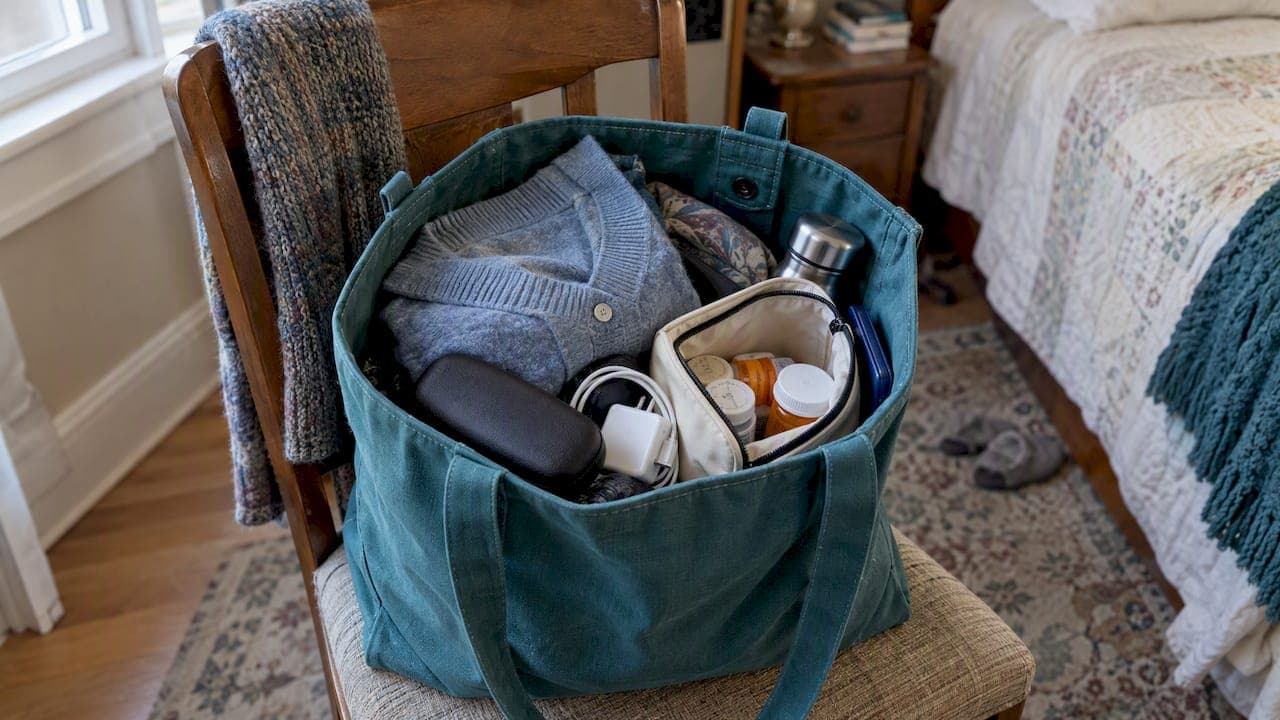
Picture a Tuesday evening. You're in your good chair, tea going cold, halfway through a chapter you're enjoying. Then something feels wrong, and an hour later you're in an emergency room with nothing but your phone and the clothes you're wearing. The part that stings isn't the waiting. It's realizing nobody is on the way with your glasses.
If you live on your own, that scene is worth a few quiet minutes of thought. Not because it's likely tonight, but because one small bag by the door can turn it into an inconvenience instead of a scramble. A hospital go bag for seniors is simply a few things, gathered once, so that a surprise stay doesn't take your dignity, your routine, or your sense of being yourself.
TL;DR
- A hospital go bag is a small, ready bag of comforts and information. Most of its power comes from a current medication list, your ID and insurance cards, and your advance directive.
- It matters: nearly a quarter of older adults who go to the emergency department end up admitted, so "just in case" is a real situation.
- When you live alone, the bag works best with one person who knows where it is and can get in to grab it.
- Keep it light, label what you can't afford to lose, and check it twice a year. Then go back to living.
Table of Contents
- Why a solo ager's bag looks a little different
- What actually goes in the bag
- The key question: who can get to it?
- A bag that fits the life you actually have
- What about the long stay?
- How we think about it
- If you'd like a second pair of eyes
- Keep it fresh, then forget it
- Frequently asked questions
- Sources
Why a solo ager's bag looks a little different
Most go bag articles quietly assume a spouse or a grown child will show up with a tote bag and a worried face. Maybe you have a sister two states away, a neighbor you wave to, or a friend who would drop everything. Maybe you have none of those yet. Either way, your bag has to do some of the work another person would have done.
That means two things. First, it should speak for you. A stranger in scrubs doesn't know that you take your coffee black, that you hate being called "dear," or that you take a thyroid pill every morning without fail. Second, it should be easy for someone else to reach. A beautifully packed bag locked in a closet nobody can open is just a nice closet.
We go into this more in our piece on packing light and naming a keyholder. Here, let's keep it human and keep it short.
What actually goes in the bag
There's a long internet list for this, and you can ignore most of it. Think in three small groups: the things that tell your story, the things that keep you comfortable, and the things that keep you connected.
The things that tell your story
This is the part that matters most, and it's lighter than you think.
A medication list. Write down every prescription, over-the-counter product, vitamin, supplement and herbal remedy you take, with doses and how often. The Hartford HealthCare guidance on preparing for a hospital stay stresses bringing a complete list like this. If you take many medications, consider also keeping the actual bottles in a sealed bag. The AHRQ's patient safety network notes that intake teams can verify doses and formulations more accurately with the real containers than from a list alone, which is a good reason to ask the admitting team which they prefer.
One caution from the same safety literature: home medications brought to the hospital need care in storage and return, so ask a nurse where yours are kept and make sure they come home with you. If you want a durable format for the list itself, we compare options in our medication list card guide, and there's more on everyday routines in managing medications safely when living alone after 50.
Copies of the basics. The Vermont Department of Health's medical go bag checklist lists copies of your photo ID, your health insurance card, and your advance directive or power of attorney, plus a medical history page. Copies are fine. Keep the originals safe at home.
A short note about you. This is the piece most lists skip, and it's the one that makes you feel like a person on a hospital bed instead of a chart. Write four or five lines: what you like to be called, how you sleep, what helps when you're anxious, who to call. The National Institute on Aging suggests, in the context of caring for someone with dementia, leaving a personal information sheet with staff covering routine, preferred name and signs of discomfort. You don't need a diagnosis to borrow the idea. Anyone is easier to care for when staff know who they're caring for.

The things that keep you comfortable
Hospitals are bright, cool and loud. A little comfort goes a long way.
- Loose, soft clothing, including a robe or cardigan, and a few pairs of socks and underwear
- Non-slip slippers or comfortable shoes
- A small toiletry kit: toothbrush, toothpaste, lip balm, the face cream you actually like
- Glasses, hearing aids, dentures and their cases
- Something that's yours: a paperback, a photo, a small blanket
That last one isn't frivolous. Elder.org's hospital stay tips point to comfort items like a favorite book or photo, and advise leaving jewelry and large amounts of cash at home. Wards are tight on space, so smaller is better.
One more small thing: label your glasses case, hearing aid case and cane with your name and phone number. Items move between rooms, and hospital storage for personal belongings isn't standardized. A strip of tape and a marker is enough.

The things that keep you connected
A phone charger with a long cord. A short list of numbers written on paper, because phones die and memories get fuzzy under stress. Maybe earbuds, a puzzle book, a crossword you've been saving. This is the part of the bag that lets the hours pass pleasantly, and it deserves as much thought as the pills.
The key question: who can get to it?
Here's where living alone changes things. A bag only helps if it gets to you.
So decide on one person, a friend, neighbor, cousin, or someone from your book club, who knows where the bag is and can reach it. Give them a key, a lockbox code, or an arrangement with a building manager. Tell them in plain words: "If I'm ever in the hospital, this is what I'd love you to bring." Most people are touched to be asked. It's a small, specific way of saying you trust them.
If you don't have that person yet, the bag is still worth packing. Keep it by the door, and let the question of who be one more reason to widen your circle. We write about that in building your support circle and in Independence Is Not Isolation.
Two companions to the bag are worth a few minutes each:
- Your phone's emergency information. Responders and ER staff can look there when you can't speak. Here's how to set up the iPhone Medical ID.
- Your fridge. First responders often look there. The 911Ready emergency medical data form is a free template, and it suggests keeping your advance directive copy in the same spot so it can be produced quickly. Our guide to digital, wallet and fridge contact plans walks through the layers.
A bag that fits the life you actually have
One pharmacist in Vermont built a go bag for his 93-year-old father, with his diagnoses, medications and contacts inside, and the same information laminated on the back on a clip that staff can lift off. NPR told the story, and it's a lovely reminder that a go bag doesn't have to look like a survival kit. It can look like care.
Yours might be a canvas tote you already love. A small rolling carry-on if lifting is hard. A backpack that leaves your hands free. Pick something you can carry with one arm, and that doesn't scream "emergency" every time you open the closet. If you've ever wondered where to buy a special bag, you probably don't need to: a bag you already own, one that's easy to lift, will do.
And if you live somewhere with hurricanes, wildfires or winter storms, a hospital bag is a different thing from an evacuation kit. We separate the two in two kits, one clear trigger.
What about the long stay?
A go bag is for the first day or two. If the stay stretches on, your keyholder can bring more: another set of clothes, your own pillowcase, a few more books. The Medicare discharge planning checklist is also worth reading before you ever need it, because it shows you're allowed to be an active member of your own discharge planning, and to bring along a caregiver or trusted friend to those conversations.
It's also worth thinking quietly about life at home while you're away: who waters the plants, who brings in the mail, how the bills get paid. We cover that last one in a 48-hour bill pay plan. Handle it once, and the stay stays about resting.
How we think about it
We built Aging Solo Today around a belief: a solo life can be a full one. Friends, travel, dinners out, romance, ordinary Saturday joy. A go bag belongs in that picture, but only in a small corner of it.
The founder is a solo ager himself, and the way he talks about this is the way we all do. You pack the bag so it can stop being a worry. You do it on a slow afternoon with music on, maybe with a friend who is doing theirs too. Then you put it by the door, and you go out to lunch.
People sometimes arrive at planning through fear. We'd rather you arrive through confidence. Alone isn't the same as lonely, and ready isn't the same as anxious. A steady, light bit of readiness frees you to say yes to more of life, because you know the "what if" has a small, calm answer waiting by the door.
— Mike Crawford
If you'd like a second pair of eyes
Sometimes it helps to talk it through with someone who has been there: who your keyholder should be, what to say to them, how the bag fits with everything else. That's what our 45-minute Zoom Solo Aging Clarity Session is for. It's $97, one time, and it's built around your situation, not a generic list. Many readers never book it and simply use our free guides, and that's welcome too.
Keep it fresh, then forget it
Twice a year, when the clocks change is an easy cue, open the bag and check three things: Did your medications change? Do the phone numbers still work? Do the clothes still fit and suit the season? Our note on why emergency contacts need a yearly refresh explains why this small ritual matters more than the packing itself.
That's it. Ten minutes, twice a year.
Frequently asked questions
What are the must-haves for a long hospital stay?
Bring your medication list, ID and insurance copies, and your advance directive copy first. Then add soft clothing, non-slip slippers, glasses and hearing aids, a long charger cord, and a book or two. Your keyholder can swap in more as the days go on.
Should I bring my actual pills or just a list?
A written list is the minimum. Some teams prefer to see the real bottles in a sealed bag, because it helps them check doses, so ask when you call ahead or on arrival. Either way, make sure any bottles come home with you.
Can I use a regular tote or overnight bag?
Yes. Choose one you can lift comfortably, label it with your name and phone number, and keep it where your keyholder can reach it. A special product isn't required.
What if I have nobody to bring the bag?
Keep it by the door with your information on top, and set up your phone's Medical ID and a fridge sheet so responders can find the essentials. Then make finding a keyholder a gentle, ongoing project, perhaps a neighbor or a friend from a class or club.
Sources
- NPR: Older adults should have a go bag for medical emergencies
- Hartford HealthCare: Preparing for Your Hospital Stay
- AHRQ PSNet: Medication Reconciliation Pitfalls
- AHRQ PSNet: Home Medications and Error on Discharge
- Vermont Department of Health: Medical Go Bag checklist
- National Institute on Aging: Taking a Person With Alzheimer's Disease to the Hospital
- Elder.org: Hospital Stay Tips and Go Bag Checklist
- 911Ready: Emergency Medical Data Long Form
- Medicare: Your Discharge Planning Checklist