
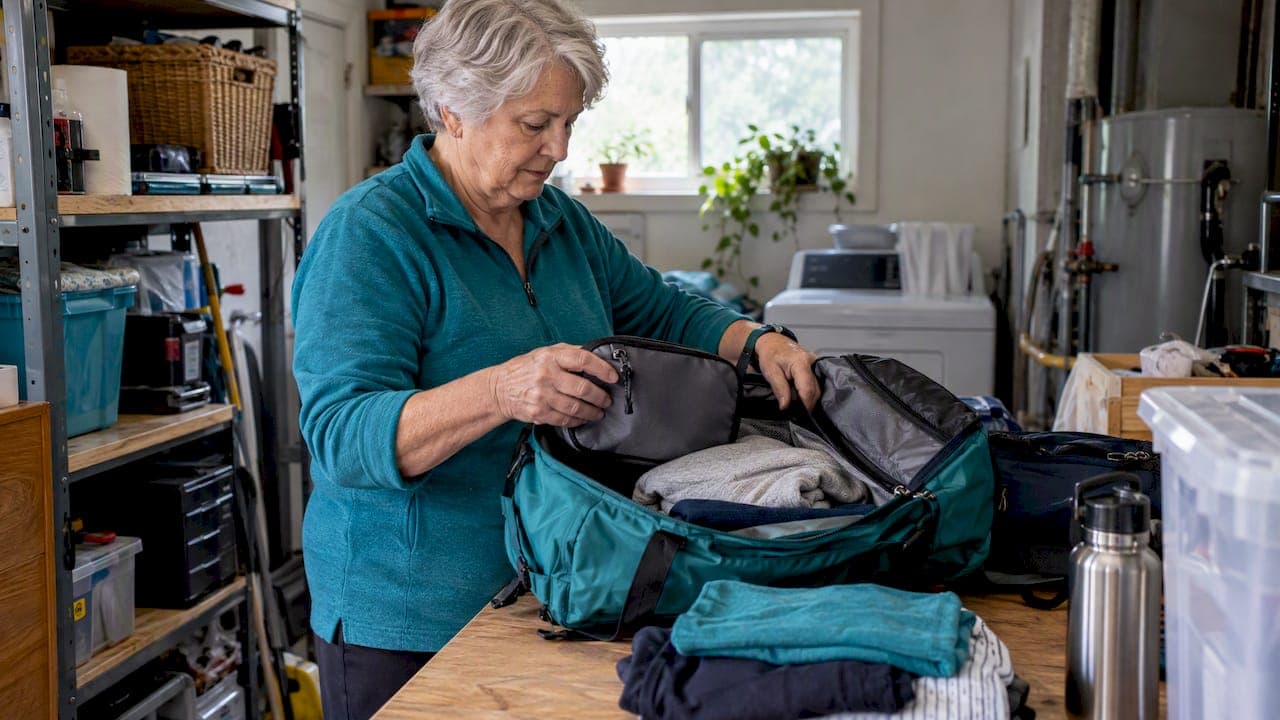
A senior go bag is a portable evacuation kit built for an older adult living independently, and the two things that matter more than anything else inside it are a workable medication supply and one named support person who holds a spare key. If you do nothing else today, write a short medication list, tuck a spare key where a neighbor can find it, and tell that neighbor what you're planning.
TL;DR:
- Pack one gallon of water per person daily, plus several days of food that needs no cooking or refrigeration, and keep it accessible.
- Ask your pharmacist whether critical prescriptions can be supplied for one to two weeks; baseline emergency guidance recommends at least a few days.
- If powered medical equipment is essential, plan backup power for delays of up to 72 hours and confirm whether nearby shelters can run it.
- Map two routes, arrange a ride beyond your car, and tell local officials or shelters about mobility or medical needs before an emergency.
- Check medication and food expiration dates and test batteries twice yearly, confirm the bag’s location quarterly, and rehearse carrying it and your route annually.
Table of Contents
- Compact prioritized packing checklist for your evacuation go bag
- Medications and medical needs: supply, documentation, and backup power
- Critical documents and how to store them for evacuation
- Mobility, assistive devices, and accessible evacuation planning
- Building and activating your support network
- Practical packing: weight, labeling, and testing your bag
- Maintenance schedule and rehearsal: keeping the bag current
- Comfort items and mental health support in your bag
- Customizing your go bag for the emergencies most likely where you live
- Technology tools that add a layer of safety for solo seniors
- The quiet confidence of a bag that's ready
- Want help turning this into your own plan?
- FAQ
- Sources
Compact prioritized packing checklist for your evacuation go bag
A go bag works best when you pack in order of what keeps you alive, then what keeps you comfortable. Start with water and food: the Ready recommends one gallon of water per person per day, plus a supply of food that lasts several days without cooking or refrigeration.
After that, layer in the gear that lets you see, hear, and stay connected in the dark or without power.
- Water (one gallon per person per day) and a multi-day supply of nonperishable food.
- A flashlight, a battery-powered or hand-crank radio, and a backup phone charger with extra batteries.
- Basic first-aid supplies, a small sanitation kit, and a dust mask.
- A change of clothes, sturdy walking shoes, and personal hygiene items.
- Pet food, a leash, and vaccination records if you share your home with an animal.
Pets deserve their own plan inside your plan. Our emergency pet care guide walks through what to pack and which shelters will take you both in.
Medications and medical needs: supply, documentation, and backup power
Medication is the piece most people underpack, and it's the piece you can least afford to run short on. The National Institute on Aging suggests a supply of essentials to last a few days as a baseline, with some guidance pointing toward a longer supply for critical prescriptions. Ask your doctor or pharmacist now whether an emergency supply makes sense for what you take.
Alongside the pills themselves, carry the paperwork that lets any helper, paramedic, or pharmacist act fast.
- A written list of medications, dosages, and the condition each one treats.
- Your prescribing doctor's name and your pharmacy's phone number.
- Copies of prescriptions, kept in a waterproof pouch inside the bag.
If you rely on a CPAP, oxygen concentrator, or another powered medical device, ASPR's guidance for people with access and functional needs notes that emergency responders may take up to 72 hours to reach everyone, so a backup power plan is not optional. Call your utility company ahead of time to ask about priority reconnection for life-sustaining equipment.
Pro Tip: Keep a small, separate power kit, extra batteries and a compact inverter, just for your medical device, and check with any shelter you might use about whether they can run powered equipment.

Critical documents and how to store them for evacuation
Pack the paperwork that proves who you are and what you need. That means photo ID, Medicare or Medicaid and insurance cards, advance directives, power of attorney, your medication list, and the phone numbers of anyone who helps care for you.
- Keep originals in a small waterproof container inside the bag.
- Back up digital copies to a USB drive or encrypted cloud folder, with login credentials stored separately.
- Give your support contact a copy and tell them exactly where the originals live.
The Ready.gov older adults guide specifically recommends waterproof storage paired with a digital backup, so your records survive even if the bag doesn't stay dry. Our one page emergency binder gives you a single sheet that organizes all of this in one place.
Mobility, assistive devices, and accessible evacuation planning
Before anything else, be honest with yourself about whether you can evacuate on your own or whether you'll need shelter-in-place arrangements instead. Mobility and medical needs should drive that decision, not pride.
- List every assistive device you use daily, a cane, walker, wheelchair, or hearing aids, and pack spare batteries or chargers for each.
- Identify two possible evacuation routes from your home, and line up at least one transportation option beyond your own car, a friend, a paratransit service, or a community volunteer program.
- Contact your local emergency management office or a nearby shelter in advance to let them know about mobility or medical access needs, so arrangements are already on file when you arrive.
ASPR's guidance on personal preparedness for people with access and functional needs notes that registering ahead with local services, rather than scrambling during an emergency, makes a real difference in how quickly help reaches you. Our transportation options guide walks through community programs worth lining up now.
Building and activating your support network
A go bag only works if someone besides you knows it exists. The National Council on Aging points to a personal support network as a core piece of older-adult preparedness, not an afterthought. That network should know where your bag is kept, hold a spare house key, and have a copy of your medication list and emergency contacts.
Rehearsal matters as much as the list itself. Walk a neighbor or friend through what you'd need from them calmly, during an ordinary afternoon, not during an actual emergency.
- Choose one or two people who live close enough to reach you quickly.
- Give them a spare key and show them where the go bag sits.
- Share your medication list and ask them to check in during any local alert.
Pro Tip: Practice the handoff once a year, hand your neighbor the spare key, show them the bag, and ask them to repeat back where everything is.
Our guides on building your support circle, running calm emergency drills, and pairing a main kit with a grab bag go deeper on turning this into a rehearsed habit rather than a one-time conversation.
Practical packing: weight, labeling, and testing your bag
A bag stuffed with everything you might need is useless if you can't lift it. Pack a main bag for a longer evacuation and a smaller grab bag with just the essentials, medications, ID, phone charger, for a quick exit.
- Use clear, labeled waterproof pouches for medications and medical devices, so a helper can find them instantly.
- Lift the packed bag and carry it across a room before you call it finished.
- Mark each pouch with large print or a simple icon, meds, documents, device power, so identification doesn't depend on reading fine text under stress.
Pro Tip: If you can't comfortably carry the main bag for a few minutes, it's too heavy. Move the overflow into a bag you keep in the car instead.
For a template that separates the two kits by purpose and trigger, see our guide on building a two-kit evacuation plan.
Maintenance schedule and rehearsal: keeping the bag current
A go bag that sat untouched for two years is a liability, not a safety net. Set a rhythm you'll actually keep.
- Twice a year, check expiration dates on medications and food, test flashlight and radio batteries, and swap in seasonal clothing.
- Once a quarter, send your support contact a quick message confirming the bag's location hasn't changed.
- Once a year, do a full rehearsal: lift the bag, walk your evacuation route, and ask your clinician whether any emergency refill plans need updating.
Note the date of each check on a card inside the bag, and keep an updated copy of your medication list with your support contact every time it changes.
Comfort items and mental health support in your bag
Supplies keep you alive; a few personal touches keep you steady. Pack something small that genuinely comforts you, a favorite photo, a paperback, a deck of cards, or a sachet that smells like home. Evacuation shelters are loud and unfamiliar, and a familiar object gives your mind something to hold onto besides the stress of the moment.
Include a short list of phone numbers for people you'd want to talk to, not just logistics contacts, but the friend who makes you laugh or the neighbor you trust with how you're actually feeling. A phone charger matters for calling for help, but it also matters for calling someone just to hear a familiar voice.
If you manage anxiety, sleep trouble, or grief with specific routines or items, bring what supports that routine: a sleep mask, earplugs, a journal, or a small amount of any supplement you rely on. None of this is extra. Feeling grounded is part of being prepared, and a bag that only addresses your body while ignoring your mind will leave you more rattled than you need to be when it matters most.
Customizing your go bag for the emergencies most likely where you live
A go bag built for a wildfire looks different from one built for a flood, and yours should reflect what's actually likely to happen near you. If you live somewhere prone to flooding, prioritize waterproof document storage, a whistle, and a plan for upper floors or nearby high ground rather than assuming you'll drive away. If storms and extended power outages are the bigger risk, lean harder on backup power for medical devices and a longer food supply, since you may need to shelter in place rather than evacuate immediately.

Coastal and hurricane-prone areas call for an earlier evacuation trigger, since storm timing is usually predictable days in advance. Areas prone to sudden events like earthquakes or wildfires need a bag that's ready to grab in minutes, with sturdy shoes and a dust mask near the top rather than buried at the bottom.
Check with your local emergency management office about which hazards are considered most likely in your area, and adjust your supply list accordingly rather than packing a generic kit and hoping it fits whatever comes. The NCOA preparedness guide points to local emergency management and community resources as a reliable way to learn what your specific area tends to face.
Technology tools that add a layer of safety for solo seniors
A phone with a charged battery is the single most useful piece of technology in your bag, but a few other tools are worth setting up before you ever need them. Set your phone's Medical ID feature so emergency responders can see your conditions and medications from the lock screen without needing a passcode; a family emergency contact list guide from Kin Watchdog walks through exactly how to set this up alongside a printed contact sheet.
A GPS tracker or location-sharing app gives a support contact a way to find you if phone service is spotty or you can't call. Local alert systems, often run through your county or state emergency management office, send text or call alerts for evacuation orders in your specific area, and they're usually free to sign up for in a few minutes online.
None of these tools replace a human support contact, but they make it easier for that person to reach you, or find you, when it counts. Set them up on a calm afternoon, not while you're also trying to pack.
The quiet confidence of a bag that's ready
Marjorie packs her go bag every October, radio on, cat curled on the dry food bin. Her neighbor Dale stops by, checks the spare key still hangs on his hook, and asks where she keeps her medication list this year. She tells him, same spot, taped inside the front pouch, and hands him a duplicate for his own kitchen drawer.
It takes fifteen minutes. Then she makes tea, and Dale stays for a while, and the rest of the afternoon belongs to neither of them worrying.
Preparedness isn't the point. It's what clears the space for everything else, the tea, the conversation, the ordinary Tuesday you get to keep living fully because the hard part is already handled.
— Mike Crawford
Want help turning this into your own plan?
If reading through all of this leaves you wanting someone to sit with your specific situation, a Solo Aging Clarity Session gives you that.
In a 45-minute Zoom call, we help you turn this guide into a plan that fits your actual home, your actual medications, and your actual support circle.
- Build a personalized checklist based on your mobility, medications, and local risks.
- Identify transportation and local resources specific to where you live.
- Walk through device power needs and shelter access questions before you need the answers.
A Solo Aging Clarity Session costs $97 one-off, and you can book one through our Solo Aging Clarity Session page.
FAQ
How long should go bag supplies last for an older adult?
Government guidance generally points to a 3 to 7 day supply of essentials like water, food, and basic supplies, according to the National Institute on Aging. For critical prescription medications specifically, some guidance recommends planning for up to a one to two week supply, so it's worth asking your pharmacist what's realistic for your prescriptions.
What should go in a senior emergency kit besides medications?
Beyond medications, pack water at one gallon per person per day, several days of nonperishable food, a flashlight, a battery-powered or hand-crank radio, basic first-aid supplies, and copies of important documents, as outlined in the Ready.gov guide for older adults. Add any assistive devices you use daily along with spare batteries or chargers for them.
How do I decide whether to evacuate or shelter in place?
The right choice depends heavily on your mobility, medical needs, and the type of emergency approaching, including whether you rely on powered medical equipment. ASPR's guidance for people with access and functional needs notes that emergency responders may take up to 72 hours to reach everyone, which makes having both a shelter-in-place plan and an evacuation plan worthwhile rather than assuming help will arrive quickly.
Who should know about my go bag and emergency plan?
At least one or two trusted people close to you, a neighbor, friend, or paid caregiver, should know where your bag is kept, hold a spare key, and have a copy of your medication list. The National Council on Aging points to a personal support network as a central part of emergency readiness for older adults living independently.
How often should I update my senior go bag?
A twice-yearly check covers expiring medications, dead batteries, and seasonal clothing, with a full rehearsal once a year to confirm you can still carry and use everything inside it. Pair those checks with a quick quarterly message to your support contact confirming nothing about the bag's location or contents has changed.
Sources
- Ready
- Disaster preparedness and recovery for older adults | National Institute on Aging
- Personal preparedness for individuals with disabilities | ASPR
- Emergency preparedness 101: What to do before, during, and after disaster | NCOA