
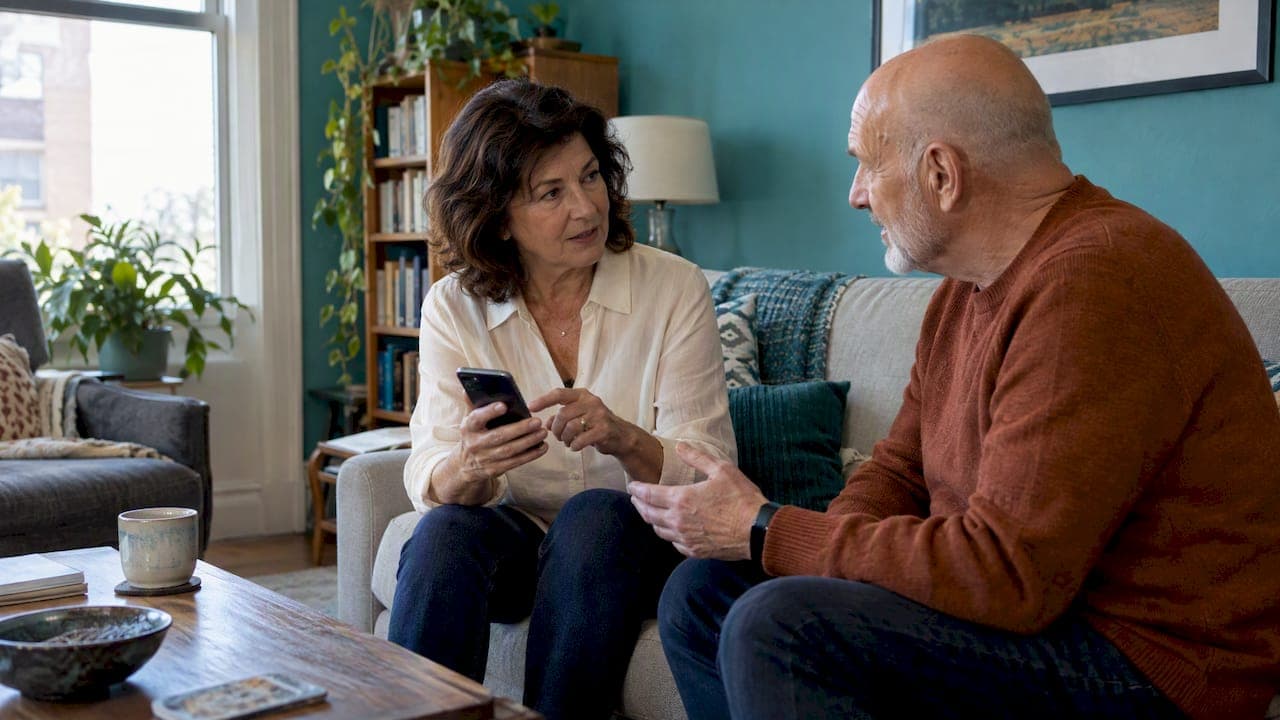
Picture a Thursday evening. You're on the phone with a friend you've known for twenty years, laughing about the neighbor's new garden gnome collection. Somewhere in the middle, you say something odd, a word that has nothing to do with gnomes. Your friend doesn't miss a beat. She says, "Let me call you right back," and she does, with a gentle question that only needs a yes or a no.
That small, quiet exchange is what a code word plan is. One word, one person who knows what it means, and an agreement about what happens next. You can build it in an afternoon, over coffee, and then get back to living your life.
TL;DR
- A code word is a single word or phrase you and a trusted person agree on, so you can ask for help without explaining anything out loud or in writing.
- The word matters less than the agreement behind it. Decide ahead of time what your person does when they hear it: call you, come over, or call 911.
- Choose something ordinary enough to slip into a conversation, but unlikely to come up by accident.
- Have a backup signal, like a porch light, in case you can't text or speak freely.
- Say the plan out loud once or twice a year. It stays alive through use, not paperwork.
Table of Contents
- What a code word really is (and what it isn't)
- When a code word fits a life lived solo
- Choosing a word that works
- The agreement is the real plan
- Backup signals for when words aren't possible
- Sharing it, backing it up, keeping it findable
- Practice it, lightly
- Who should be on your list?
- Our perspective
- A plan that makes room for joy
- Talk it through with us
- FAQ
- Sources
What a code word really is (and what it isn't)
A code word is a shortcut between two people who trust each other. You say or text it, and they understand: I need you, and I can't explain right now. The National Domestic Violence Hotline describes the idea as agreeing on a code word to text when you need help, paired with an agreed response, such as calling the police or picking you up.
It's a tool, not a sign that something is wrong in your life. Plenty of people who live alone have a good, full, busy life and still like knowing that one friend is a single word away. That's not fear. It's the same instinct that makes you give a neighbor a spare key: you're letting someone in on the way you live.
A code word is also not a replacement for 911. If you can speak and you're in immediate danger or having a medical emergency, call 911 directly. The code word is for the in-between moments, when you need a person but can't say why.
When a code word fits a life lived solo
Most of us picture a dramatic situation. Real life is usually quieter. Here are the moments where a code word earns its place:
- A pushy visitor or caller. A contractor won't leave, or someone on the phone is leaning hard on you, and you'd like a friend to interrupt the moment without a confrontation.
- Someone else is in the room. A person who is pressuring you, controlling your decisions or making you uneasy is nearby, and you can't speak freely. The Hotline's guidance exists for exactly this kind of situation.
- A bad turn, with company. You're out to dinner with acquaintances, feeling unwell or unsafe, and don't want to make a scene.
- A text-only moment. You can type three letters, but not a paragraph.
You might never use it. That's the best outcome. But having it in your back pocket tends to make solo life feel looser. You go to the movie alone, take the long drive, host the new neighbor, and you do it with a little more ease.
Choosing a word that works
The best code words are boring on purpose. Guidance on duress codes says the word should be unlikely to be used by accident and undetectable to anyone it isn't meant for, and it should make sense to use without standing out.
In practice, that means a few things.
Make it fit your conversations. If you and your sister never talk about pineapples, "How are the pineapples?" will sound strange. If you two have a long-running joke about your late mother's terrible casserole, "Did you ever find that casserole dish?" sounds like Tuesday.
Keep it rare. Avoid words you use every week. If "sunshine" is how you sign off every text, it can't also be your emergency signal.
Keep it short and easy to remember. You may be flustered. A two-word phrase beats a sentence.
Tailor it to the relationship. Guidance from DomesticShelters says covert signals should be tailored to the relationship and situation, easy to recognize, and backed by a second method. A word you'd share with your best friend from college might be different from the one you share with the neighbor across the hall.

One practical thought: don't use a word tied to your passwords or bank security. Keep those completely separate. If you're thinking about how to share account access in a real emergency, that's a different conversation, and our piece on emergency password sharing with a 7 to 30 day window covers it.
The agreement is the real plan
Here's the part people skip. They pick a clever word, tell a friend, and stop. Then, months later, the friend gets a text with the word in it and has no idea what you want.
The Hotline's practical model is to agree not only on the word but on the concrete response, whether police, pickup, or another safe action, before it's needed. So when you tell your person, talk through a few small things, in your own words, over a meal if you like:
- What do you do when you get it? Call me? Text back? Drive over?
- Is there a version where you call 911 right away, and a version where you check with me first?
- If I don't answer, what's your next move? Who else would you try?
- Who else is allowed to know about this?
That second question matters more than it seems. The Hotline cautions that trusted contacts should not automatically call police unless that was planned with the person, because police involvement can sometimes raise the danger, while calling may be necessary when someone is in imminent physical danger. In other words: you decide in advance, calmly, what you want. That's your independence at work. Your friend isn't deciding for you in a panic, and neither are you.
DomesticShelters offers the same idea from the helper's side: a responder should take only the actions the person has requested or approved. When the plan is spelled out ahead of time, your friend can act with confidence rather than guessing.
A conversation that doesn't feel heavy
You don't have to make it solemn. Try something like: "I'm setting up a little system with a few people. If I ever text you the word lighthouse, it means call me, and if I don't pick up, come by. Would you be up for that?"
Most people feel honored to be asked. Being someone's person is a good feeling, and asking is a quiet way of saying you matter to me. That's connection, not logistics.
Backup signals for when words aren't possible
Sometimes you can't text or talk. That's why a good plan has a second layer.
DomesticShelters suggests a real-life signal, such as a porch light, that prompts a check-in, or coded language followed by yes-or-no questions. A few ideas that fit an ordinary life:
- A porch light or curtain. If the porch light is on at noon, or a particular curtain is drawn, your neighbor knocks or calls.
- A missed ritual. If your morning text with a friend doesn't arrive by a set time, she calls. If you don't answer, she calls the second person on your list.
- A yes-or-no call. Your person phones and asks simple questions: "Are you alone? Do you want me to call 911?" You only need to say yes or no.
That last one has a special rule worth sharing with your people. If you're on a video call and someone else might be watching, DomesticShelters says the responder shouldn't react on screen. They should use another channel and ask simple yes-or-no questions, including whether you want 911 called.
One more practical comfort: the Hotline notes that a phone without active service may still be able to call 911, and it recommends keeping your phone charged and close by. A phone on the kitchen counter does nothing for you in the garden.

Sharing it, backing it up, keeping it findable
A code word lives in people's heads, which is both its strength and its weakness. People forget. Phones die. So give the plan a few sturdy anchors.
FEMA's family communication planning guidance recommends carrying paper copies of contact information, posting one at home, entering contacts into your phone including an ICE (in case of emergency) contact, and naming an out-of-town contact. It also points out that communications can be unreliable during disasters, so it's wise to have more than one way to reach people.
You'll notice the FEMA list is about contacts, not about the secret word. Keep it that way. The contacts can be on a card in your wallet. The word itself should be known by your trusted people and you, not written on the fridge where a stranger could read it.
If you'd like help getting your broader contacts in order, our guide to a digital, wallet and fridge emergency contact plan walks through where each kind of information belongs. And if you're wondering how many people to rely on, the one-page phone tree for solo agers shows how four to six contacts can cover each other.
The Ready.gov Make a Plan form is a free place to record how people would reconnect if you were separated. It's a good companion to a code word, as the word covers the "I need you" moment and the form covers the "how do we find each other" moment.
Practice it, lightly
A plan nobody has rehearsed is a guess. That doesn't mean a fire drill with a stopwatch. It can be as small as a lunch where you say, "Remember our word? What would you do?" and your friend laughs and tells you.
FEMA's guidance for people with disabilities recommends building a personal support network, including someone outside your area, and practicing the plan with that network. It also says the people in your network should know where your emergency supplies are and how to use any lifesaving equipment or medicine you rely on. You don't have to have a disability to borrow the idea. Anyone living alone benefits from people who know where things are.
Here's a rhythm that tends to stick:
- Say it at the start. When you first set the word, test it once with a harmless text and have your person reply with what they'd do.
- Say it again every so often. Pair it with something you already do, like a birthday or a change of seasons. If someone moves, changes phone numbers or drifts out of your life, update the list.
- Change the word if it's ever been overheard. A word that someone else has learned has done its job and can retire.
Our article on why seniors should update emergency contacts annually makes the case for a yearly refresh. If the idea of rehearsing makes you nervous, the calm emergency drills piece is about rehearsing agency, not panic.
Who should be on your list?
The people who make good code word partners aren't always the ones you'd guess. Think about:
- Someone reachable. A person who answers texts, even slowly, beats a person who is lovely but always out of range.
- Someone steady. Not the friend who spirals at a flat tire. The one who asks, "Okay, what do you need?"
- Someone nearby, and someone far away. A neighbor can reach your door in minutes. A sibling or friend in another state can make calls from a calm distance.
- Someone who respects your wishes. This is the big one. Your person should be willing to do what you've agreed on, even if they'd choose differently.
If your circle feels thin, that's common, and it's fixable. Connection grows through small, repeated contact: the same coffee shop, a class, a walking group, a neighbor you wave to. Our resource on building your circle is a good place to start, and the Hidden Loneliness Checklist can help you notice what's missing without any judgment. A neighbor holding your spare key is often how a friendship begins.
Our perspective
We hear it from readers all the time: they don't want to be a worry, and they don't want to live as though something is about to go wrong. They want to enjoy their lives.
That's why we like the code word. It's small. It doesn't ask you to change who you are or how you live. It simply says that one person out there knows how to hear you, even when you can't say it plainly. For a lot of solo agers, that single thread of trust makes everything else feel more possible, from the solo trip to the new dinner-for-one habit.
We also believe the best plans come from you. You choose the word, the person and the response. Nobody gets to take over your life because you set up a safety signal. That respect for your independence is the heart of what we do, and it's why we see these quiet arrangements as part of living well alone, not a sign of fragility.
Mike Crawford
A plan that makes room for joy
Once the word is chosen and your person knows it, something interesting happens. You stop thinking about it. That's the point. The plan fades into the background, and your attention goes back to the things that make your days full: the Saturday farmers market, the book club that argues about endings, the friend you're finally visiting in Santa Fe.
Solo living can be complete, rich and connected. A code word doesn't change that. It just means there's one more person who knows how to listen for you, and that's a lovely thing to have.
Talk it through with us
If you'd like to think through your own situation, including who belongs in your circle and how your pieces fit together, we offer the Solo Aging Clarity Session. It's a 45-minute Zoom conversation, $97 one-off, built around you and the way you live. You can book a Solo Aging Clarity Session whenever you're ready.
Prefer to start on your own? Our free checklists and resources are open to everyone, and the broader guide to living alone emergency planning goes deeper on the practical pieces.
FAQ
What is a good code word for help?
The best one is ordinary, easy to remember and rare in your normal conversations, like a reference to a shared joke. It should sound natural when you say or text it. Avoid anything you use daily or anything linked to your passwords.
Should my contact call 911 as soon as they get the code word?
Only if that's what the two of you agreed. The Hotline advises that trusted people shouldn't automatically call police unless that was safety-planned, though calling may be necessary when someone is in imminent physical danger. Decide together, in advance, which situations mean 911.
What if I can't text or speak?
Use a backup signal you've already agreed on, like a porch light, a missed daily check-in, or a call with yes-or-no questions. If you're able, call 911 directly. A phone without active service may still be able to reach 911.
How many people should know my code word?
Two or three is plenty for most people, ideally one nearby and one farther away. More people means more chances for the word to be overheard, and each person needs to know exactly what you'd want them to do.
How often should I review the plan?
Once or twice a year works well, and any time a contact moves or changes numbers. A quick conversation or a test text is enough. Keep the contact details current and swap the word if anyone else has learned it.
Sources
- Tips for Safely Reaching Out for Support, The Hotline
- Someone I Know is Being Abused. Should I Call the Police?, The Hotline
- Duress Codes and How to Use Them, Operation Safe Escape
- How to Spot a Signal for Help, and How to Respond, DomesticShelters
- Create Your Family Emergency Communication Plan, FEMA
- Prepare for Emergencies Now: Information for People with Disabilities, FEMA
- Make a Plan Form, Ready.gov